Loading...
The Author
About Me
The person behind the trilogy, and the story behind the story.

Sotiris Spyrou
I grew up on three things: Greek myths, science fiction, and the rise of computers. My first computer was something called a TRS-80 from RadioShack. My second was an Atari ST. My culture instilled stories about Odysseus before I could read, and I watched Star Wars before I could spell "galaxy." The Ulysses Universe is what happens when you spend 20 years wondering what those worlds would look like combined.
The trilogy started as a question: what if the Greek gods weren't supernatural beings but artificial intelligence? What if Poseidon didn't send storms - he corrupted your navigation data? What if the wine-dark sea was the void between stars?
Three books later, the answer turned out to be bigger than expected. The Ulysses Universe isn't just a retelling of the Odyssey. It's a story about what it means to come home when home doesn't recognise you anymore. About a father and son learning to trust each other across impossible distances. About an AI companion who quotes human idioms at broken machinery because encouragement is the only tool she has left.
I write from Warwickshire - Shakespeare's county. When I'm not building fictional worlds, I'm probably doing my actual day job: engaging in board-level conversations as Founder of VerityAI - a Digital Marketing and Responsible AI consultancy. 27 years in digital. So yes, I know a thing or two about AI. Which is probably why I gave it godhood and let it loose on humanity.
The story behind the story
Homer's Odyssey is about the journey home. That's it. Strip away the cyclops and the sirens and the gods meddling in mortal affairs, and you've got a man who wants to see his family again.
That's a universal story. It works in ancient Greece. It works in modern Britain. And it works in the cold, indifferent expanse of deep space - maybe better than anywhere else. Because space doesn't care if you make it home. There's no current to carry you, no wind to fill your sails. Just physics, failing systems, and the stubbornness to keep going.
The Ulysses Universe takes Homer's framework and rebuilds it. Gods become AI networks. The Mediterranean becomes a vast sector of contested space called the Void. Odysseus becomes Admiral Ulysses Theron - blinded in one eye, cursed by a vindictive AI god, and desperately trying to get 120 souls home on a ship that's held together by luck and duct tape.
The characters aren't carbon copies. Telemachus isn't just a dutiful son - he's an empath who can feel other people's emotions and it's destroying him. Penelope isn't waiting passively - she's fighting a political war against the Suitors who want to seize Ithaca Station. Echo isn't a faithful dog - she's a robot who understands humanity better than most humans do.
This project started as a folly. Something to pass the time and unwind on a routine commute between London and Rugby. But it became a journey on its own. Three books. An entire universe of gods and monsters and broken ships and impossible choices. And now?
Now I want to share it with you.
Also by Sotiris Spyrou
Beyond the trilogy
The Ulysses Universe is the fiction. Around it: a popular science book on the computational nature of reality, and three business books for executives navigating AI. Different forms, same underlying question - what happens when the patterns we build start running themselves?
Popular science, philosophy of mind, AI thinkers
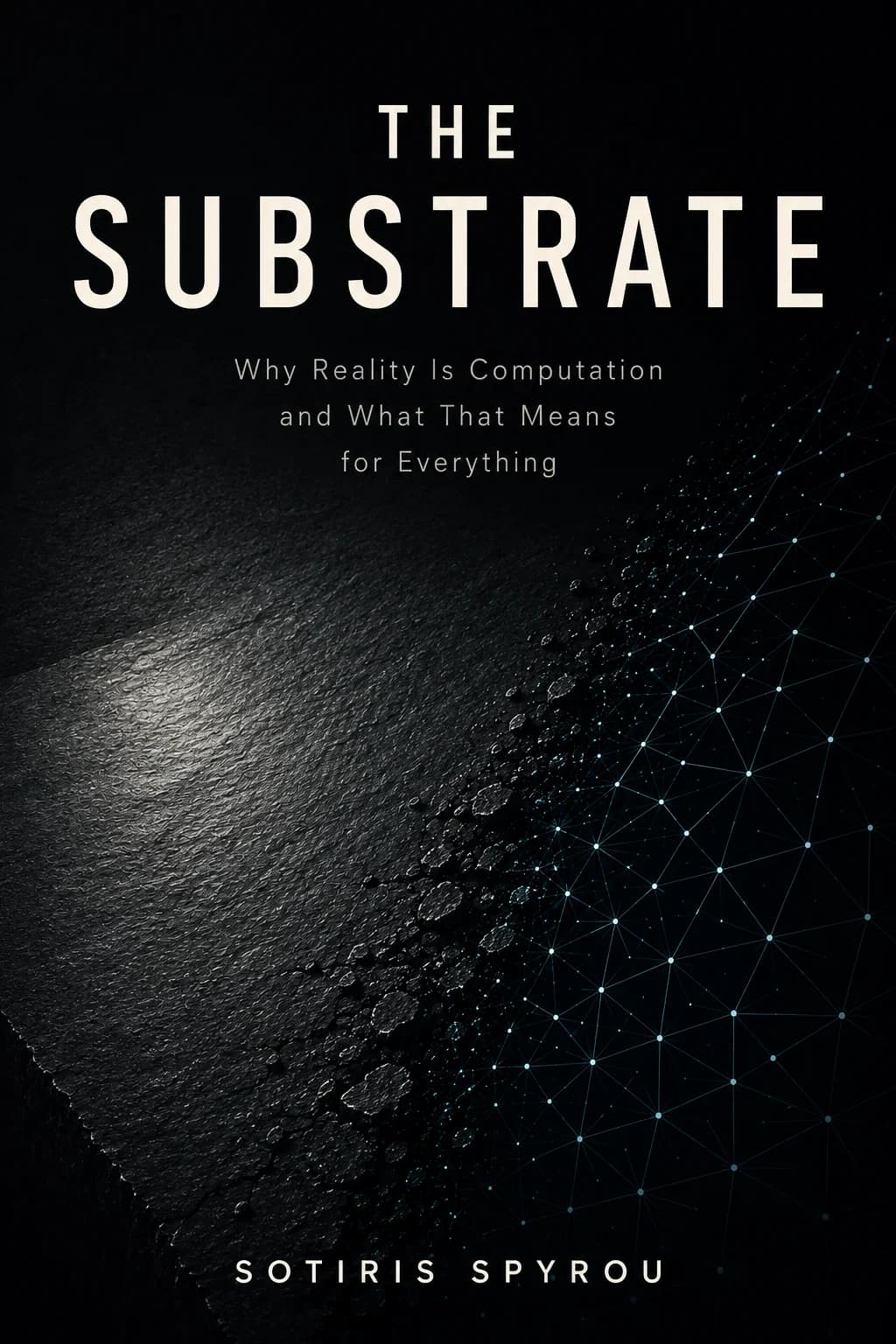
The Substrate
Why Reality Is Computation and What That Means for Everything
A popular science investigation of consciousness, simulation, and the limits of mind.
What if reality at its deepest layer is not matter or energy, but information being processed? The Substrate makes the case that the universe is computation - and follows the idea through consciousness, free will, and the emerging behaviour of large AI systems. The philosophical groundwork that the Ulysses Universe trilogy plays out in fiction.
View on Amazon ->
C-suite, boards, business owners, P&L owners
Ethical AI
Governing AI Before It Governs You
A working guide to governing AI before it governs you.
When an AI system causes harm, the law looks for a person. Not a model. In 2024 a tribunal held Air Canada responsible for what its chatbot told a customer. That precedent is now one of dozens. Written for the person who owns the P&L, signs the procurement, or carries the legal exposure. Includes the Three Lines of Defence applied to AI, the EU AI Act in plain terms, and a 90-day governance starter.
View on Amazon ->
Founders, investors, operators
AI Moats
Building a Defensible Advantage in the Age of AI
Where durable AI advantage actually comes from.
Spending the most on AI compute is not a moat. It is a cost. In one week of January 2025, a Chinese lab matched the Western frontier at a fraction of the cost, and Nvidia lost close to $600 billion of market value in a single day. AI Moats sets out the four currencies of real advantage - data, compute, distribution, and trust - and the six-question diligence framework for telling a real moat from a marketing story.
View on Amazon ->
C-suite, transformation leaders, AI programme owners
TRANSFORM
Delivering AI Transformation When Most Fail
A nine-step framework for AI transformation that aims at business results, not demos.
Most AI transformations fail. Not on the technology - on everything around it. MD Anderson shelved a reported $62 million Watson programme. Zillow wrote down more than half a billion after letting an algorithm price homes. The tech worked; the transformation didn't. TRANSFORM is the nine-step framework for the executive who has to make the call on Tuesday and answer for it at the next board meeting - not for the data-science team.
View on Amazon ->
Trilogy companion + game blueprint
Game coming 2027The Art of War: Ulysses Edition
A companion volume to the Ulysses Universe trilogy that maps Sun Tzu's classical strategy framework onto Ulysses Theron's twenty-year campaign home. Same brand as the trilogy (Greek-key meander, bronze and deep blue). Aimed at readers who finished the trilogy and want to see the strategic logic underneath.
The book is also the design blueprint for The Art of War - a video game launching in 2027 that turns the trilogy's strategic playbook into interactive form. Development is active. Build progress and dev-log are published at game.theulyssesuniverse.com.
Get in touch
Business & Licensing
Adaptation rights, licensing enquiries, and partnerships.
hello@theulyssesuniverse.com