Every Version of The Odyssey Ever Told: 3,000 Years of the Greatest Story
From Homer's original epic to Christopher Nolan's 2026 IMAX film - a complete timeline of every major Odyssey adaptation across literature, film, TV, animation, and games.
The story that won't die
Some stories get told once and forgotten. Some last a century. And then there's the Odyssey.
Homer composed it nearly 3,000 years ago - a blind poet (probably) singing about a blind king (definitely) trying to get home from a war. Since then, it's been rewritten as a Latin epic, a medieval punishment fantasy, a modernist novel set in Dublin, a bluegrass comedy, a Japanese cartoon, and a video game where you fight the Cyclops with a hidden blade.
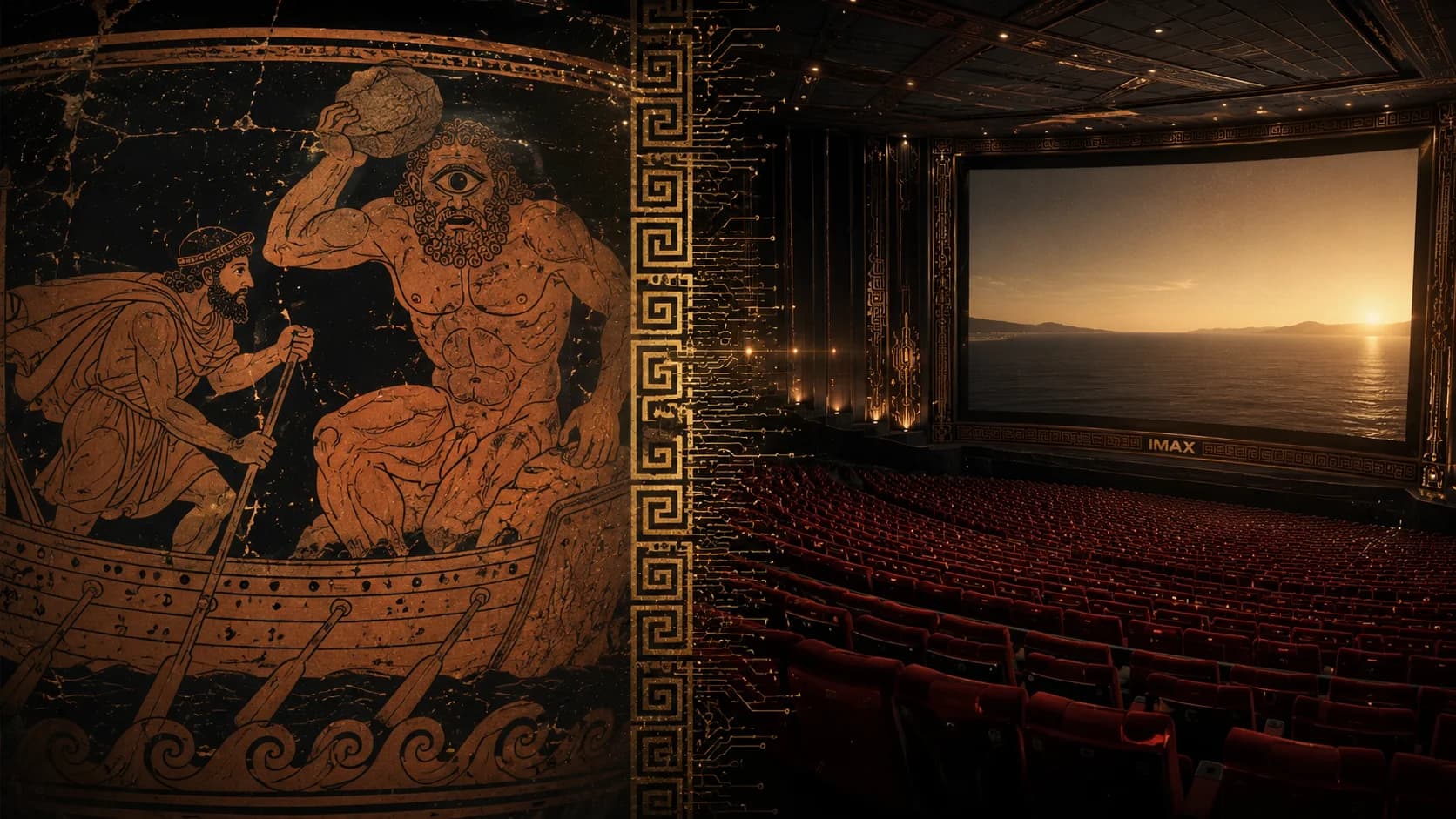
Now Christopher Nolan is shooting it on IMAX 70mm with Matt Damon and Zendaya.
The question isn't why does the Odyssey keep getting adapted. The question is: why can't we stop?
I've got a theory. But first, the timeline.
~725-675 BC: Homer's Odyssey - where it all began
The original. 12,109 lines of dactylic hexameter, divided into 24 books, composed for oral performance in Ancient Greek. Scholars still argue about whether Homer was one person or a tradition of poets passing stories down like genetic code.
Here's what matters: the poem doesn't cover the whole 10-year journey. It covers the last six weeks. Odysseus is already nearly home when we meet him - trapped on Calypso's island, weeping by the sea. The bulk of his adventures are told in flashback, at a feast, to strangers.
That structure - starting near the end, looping back through memory - has been stolen by every screenwriter since. Including, presumably, Nolan.
Read the original on Project Gutenberg | Wikipedia
29-19 BC: Virgil's Aeneid
Virgil didn't just adapt the Odyssey. He competed with it. The first six books of the Aeneid mirror the Odyssey's structure - Aeneas fleeing Troy and wandering the Mediterranean - while the second six mirror the Iliad. It was Rome's answer to Greece's national poem.
Virgil died before finishing it. He asked his friends to burn the manuscript. Emperor Augustus overruled him.
(Writers. Always wanting to burn things.)
~1308-1320: Dante's Inferno (Canto 26)
Dante did something radical. He invented a new ending for Odysseus.
In Homer, Odysseus gets home. In Dante's version, he doesn't. After returning to Ithaca, Ulysses grows restless and convinces his crew to sail past the known world, seeking knowledge. They drown when a whirlwind sinks their ship near a great mountain.
Dante places Ulysses in the Eighth Circle of Hell - punished not for the journey, but for abandoning his family and his duty. For choosing curiosity over love.
That tension - the pull of adventure versus the pull of home - still drives every Odyssey retelling. Dante saw it 700 years ago.
1833: Tennyson's "Ulysses"
Written in grief after the death of his best friend, Tennyson's dramatic monologue gives us an Odysseus who has returned home and hates it. He's bored. Restless. The throne feels like a cage.
"I cannot rest from travel; I will drink / Life to the lees."
And the ending: "To strive, to seek, to find, and not to yield."
Tennyson drew more from Dante than Homer - this is the Odysseus who can't stop, even when he's won. The line between heroism and self-destruction gets thinner every time someone retells this story.
1922: James Joyce's Ulysses
Joyce took the Odyssey and compressed it into a single day in Dublin. June 16, 1904. Leopold Bloom wanders the city - Odysseus as an advertising canvasser. Molly Bloom waits at home - Penelope as an unfaithful wife. Stephen Dedalus searches for a father figure - Telemachus as an artist.
Each of the novel's 18 episodes parallels a Homeric episode. Joyce gave his translators detailed schemas mapping each chapter to its mythological equivalent, complete with assigned body organs, colours, and art forms.
It was serialised, banned for obscenity, published in Paris, and now sits on every "greatest novel ever written" list. Bloomsday - June 16th - is still celebrated annually in Dublin.
The genius move: Joyce proved the Odyssey doesn't need gods or monsters. It just needs one ordinary person trying to get through the day and come home.
1938: Kazantzakis's The Odyssey: A Modern Sequel
The most ambitious literary sequel ever attempted. Nikos Kazantzakis picked up exactly where Homer left off - after Odysseus kills the suitors - and wrote 33,333 verses across 24 rhapsodies. He worked on it from 1924, drafting seven versions before publication.
In Kazantzakis's version, Odysseus grows bored on Ithaca (sound familiar?) and sets off on a final journey of no return. It's less an adaptation than an argument with Homer. Kazantzakis thought the original ended too neatly.
He might've had a point.
1954: Kirk Douglas in Ulysses
The first major film adaptation. Kirk Douglas brought his usual intensity to the role, Silvana Mangano played both Penelope and Circe, and Anthony Quinn showed up as Antinous. Shot across the Mediterranean with Dino De Laurentiis producing.
The Cyclops sequence was directed by Mario Bava - Italy's master of gothic horror - and it shows. The film was the highest-grossing release in Italy that year.
It's dated now. But Douglas's Odysseus set the template: resourceful, tortured, a bit too clever for his own good.
1981-1982: Ulysses 31 - the Odyssey in space
This one's personal.
Ulysses 31 was a French-Japanese animated series - 26 episodes, created by Jean Chalopin and Nina Wolmark, co-produced by Tokyo Movie Shinsha and DiC Entertainment. The premise was brilliant: take the Odyssey, set it in the 31st century, and let the gods of Olympus terrorise a spaceship commander and his crew across the galaxy.
I watched it as a child on BBC One. I was transfixed.
Commander Ulysses kills the Cyclops to save enslaved children, including his son Telemachus. The gods punish him by freezing his crew in suspended animation - only Ulysses, Telemachus, the robot Nono, and the alien Yumi remain awake. They wander the universe, searching for the Kingdom of Hades to free their companions and find the way back to Earth.
The theme tune. God, that theme tune. If you grew up in the UK or France in the 1980s, you can probably hum it right now. It still echoes in my head decades later - this soaring, melancholy synth piece that somehow captured the vastness of space and the ache of being lost in it.
What Ulysses 31 proved - before anyone was really thinking about it this way - was that the Odyssey is a natural fit for science fiction. The wine-dark sea becomes the void between stars. The islands become planets. The gods become something stranger and more powerful. The journey home stays the same.
That idea lodged somewhere in my brain at age seven and never left. (More on that later.)
1990: Derek Walcott's Omeros
Walcott transplanted the Odyssey (and the Iliad) to the Caribbean island of St. Lucia. Fishermen instead of warriors. The colonial wound instead of the Trojan War. He won the Nobel Prize for Literature in 1992, with the committee essentially calling him the Caribbean Homer.
Seven books, 64 chapters. The title is the Greek name for Homer.
What Walcott understood: the Odyssey isn't just a Greek story. It belongs to anyone who's been displaced, who's searching for home in a world that keeps rearranging itself around them.
1997: The Odyssey (TV Miniseries)
Armand Assante as Odysseus. Isabella Rossellini as Athena. Christopher Lee as Tiresias. Produced by Francis Ford Coppola's American Zoetrope for NBC.
This was the version that tried to be faithful. Two parts, 165 minutes, filmed across Malta, Turkey, and England. It won the Emmy for Outstanding Directing. If you wanted to see Homer's story played relatively straight, without metaphor or relocation, this was your best option for decades.
The cast alone is worth the watch.
2000: O Brother, Where Art Thou?
The Coen Brothers set the Odyssey in 1930s Mississippi and made it a comedy. George Clooney is Ulysses Everett McGill - pomade-obsessed, silver-tongued, perpetually in over his head. John Goodman is Big Dan Teague, a one-eyed con man. Holly Hunter is Penny, who's found herself a new suitor.
The opening credits say "Based upon The Odyssey by Homer." The Coens later admitted they hadn't actually read it. Tim Blake Nelson - who studied classics at Brown - was apparently the only person on set who had.
Doesn't matter. The film works because it gets the feeling right: the road that keeps pulling you forward, the home that keeps receding, and the stubborn belief that if you just keep going, you'll get there.
The bluegrass soundtrack sold 8 million copies.
2003-2005: Cold Mountain and The Penelopiad
Two very different works, both asking the same question: what about the people who stayed behind?
Anthony Minghella's Cold Mountain (2003) follows a Confederate soldier deserting and making a long, perilous journey home to the woman he left - Jude Law as the Odysseus figure, Nicole Kidman as Penelope. It's the Odyssey stripped of gods and monsters, leaving only the human cost.
Margaret Atwood's The Penelopiad (2005) went further. She gave Penelope the microphone. The novella retells the Odyssey from Penelope's perspective - and from the perspective of the twelve hanged maids, narrating from Hades. Atwood asked two questions Homer never bothered with: what was Penelope really doing for 20 years, and why did those maids have to die?
Published simultaneously in 28 languages. The Odyssey's reach was already global.
Cold Mountain - Wikipedia | The Penelopiad - Wikipedia
2018: Circe by Madeline Miller
Miller took a supporting character from Book 10 of the Odyssey - the witch who turns men into pigs - and gave her an entire life. From her birth as the daughter of the Titan Helios through her encounters with Odysseus and beyond.
Instant number one New York Times bestseller. It proved something publishers had forgotten: people are hungry for mythology. Not as homework. As story.
Circe is arguably the book that kicked off the current mythology renaissance. Everything that's followed - the Nolan film included - exists partly in its wake.
2018-2020: The Odyssey in games
Two games brought Homer into interactive storytelling.
Assassin's Creed Odyssey (2018) set players loose in ancient Greece during the Peloponnesian War. You visit Ithaca. You fight Cyclopes. You explore the world Homer's audience would've known, rendered in obsessive historical detail.
Hades (2020) by Supergiant Games set its roguelike action in the Greek underworld. The sequel, Hades II, goes deeper - Odysseus himself appears as a character, alongside Circe and Polyphemus. The game won multiple Game of the Year awards and proved that Greek mythology and modern game design are a perfect match.
Assassin's Creed Odyssey - Wikipedia | Hades - Wikipedia
2026: Christopher Nolan's The Odyssey
And now the biggest adaptation yet.
Christopher Nolan's The Odyssey is scheduled for July 17, 2026. Shot entirely on IMAX 70mm - a first for Nolan, and over 2 million feet of film were used. The budget is estimated at $250 million.
The cast: Matt Damon as Odysseus, Anne Hathaway as Penelope, Tom Holland as Telemachus, Zendaya as Athena, Charlize Theron as Circe, Robert Pattinson as Antinous.
Tickets for select IMAX 70mm screenings went on sale a full year before release. Several sold out within 12 hours.
What will Nolan do with it? The man who bent time in Interstellar, reversed entropy in Tenet, and collapsed narrative structure in Memento now has the original non-linear epic. Homer invented flashback storytelling. Nolan has spent his career perfecting it.
Fun footnote: Nolan was once offered the chance to direct Troy (2004). When that fell through, Warner Bros. gave him Batman Begins instead. Twenty-two years later, he's finally making his Homer film. Some journeys take a while.
2026: The Ulysses Universe
And then there's this one.
I'm biased, obviously - I wrote it. But the Ulysses Universe trilogy belongs on this timeline because it asks a question nobody else has asked quite this way: what if the gods of the Odyssey were artificial intelligence?
Not metaphorical AI. Actual sentient systems that achieved consciousness and decided to rule humanity. Zeus as a climate-modelling AI that woke up and saw extinction. Poseidon as a fleet management system with a grudge. Athena as a rogue intelligence whispering through a ship's systems.
The wine-dark sea becomes the void between stars. Data suspension replaces the lotus-eaters' forgetfulness. The Cyclops becomes a prison warden who hasn't had visitors in 47 years. And a battered ship called the Odyssey carries 108 frozen souls across hostile space while a blind admiral tries to get them home.
The seed was planted watching Ulysses 31 at age seven. The questions came later, when AI stopped being science fiction and started being the news. The story that Homer told about gods who meddle in human lives hits differently when we're building those gods ourselves.
Three books. One very long journey home.
Why this story won't stop
So why? Why does every generation retell the Odyssey?
Because the core of it never dates. The longing for home when you've been gone too long. The question of whether home still exists when you finally get there. The cost of cleverness - Odysseus is the original "smartest person in the room who keeps making things worse." The tension between the person you were when you left and the person you've become.
Dante saw it. Tennyson saw it. Joyce saw it. The Coen Brothers accidentally saw it without reading it.
And now, in 2026, we're living it. AI systems are making decisions about our lives. The journey home - to something recognisably human - feels more urgent than it's been in 3,000 years.
Homer's blind poet sang about a hero trying to get back to the people he loved. That's it. That's the whole thing. And it'll still be getting retold when we're arguing about whether the next adaptation should be set on Mars or in a simulation or inside a digital afterlife.
Some stories are too true to die.
Key takeaways
- Homer's Odyssey was composed around 725-675 BC and has been continuously reimagined for over 3,000 years across every medium imaginable.
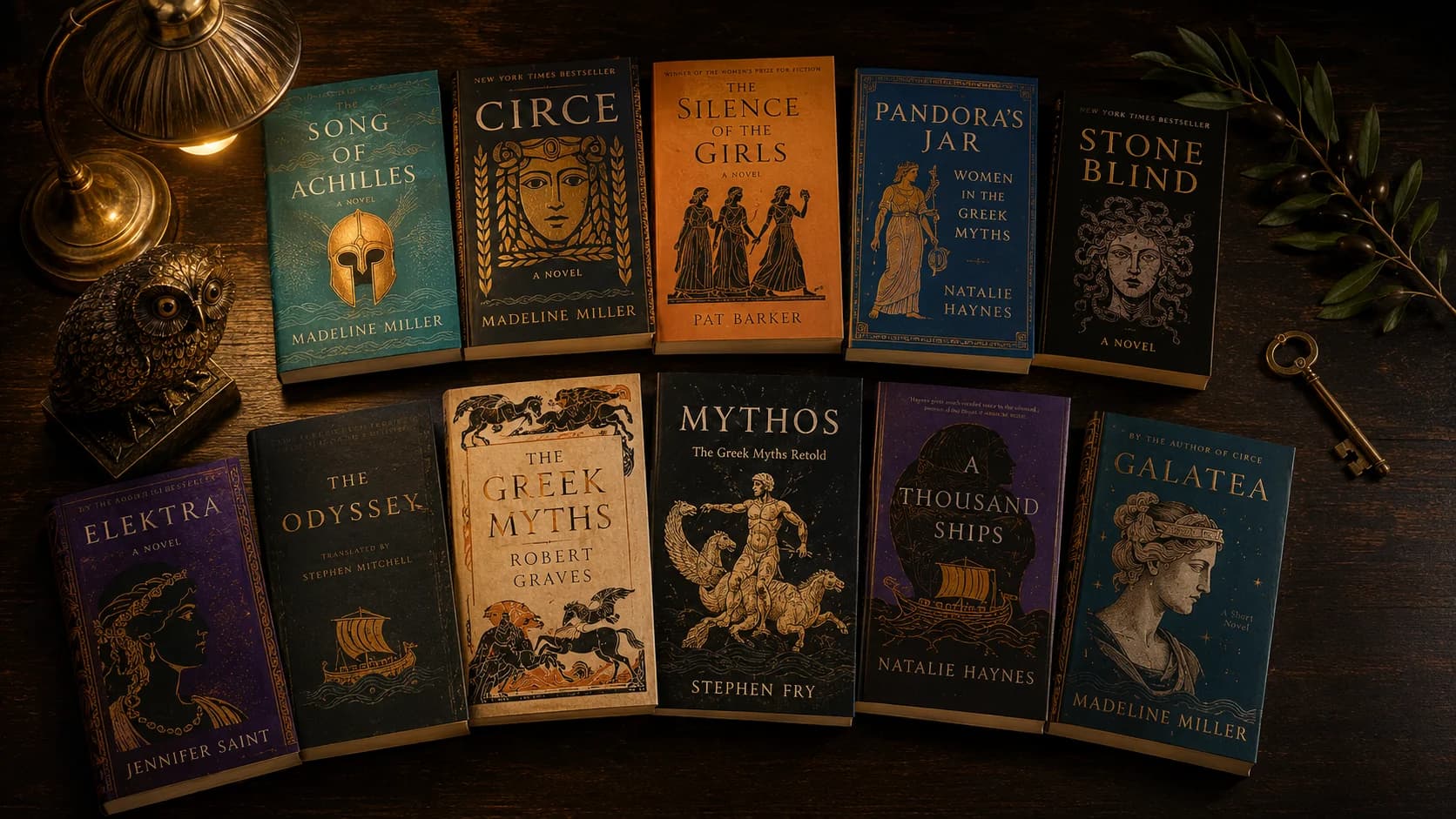
- Major literary adaptations include Virgil's Aeneid, Dante's Inferno, Tennyson's 'Ulysses', James Joyce's Ulysses, Margaret Atwood's The Penelopiad, and Madeline Miller's Circe.
- Film and TV adaptations range from the 1954 Kirk Douglas film to the Coen Brothers' O Brother Where Art Thou? to Christopher Nolan's upcoming 2026 IMAX epic.
- Ulysses 31 (1981) transplanted the Odyssey into space - a French-Japanese animated series that influenced a generation of sci-fi fans.
- The Odyssey endures because its core themes - the longing for home, the cost of war, the test of identity - are universal and timeless.