Argos: Twenty Years
A drone left behind on Ithaca. A master who never came home. Twenty years of waiting - and what it means to be faithful when nobody's watching.
He was there at the beginning
The ceremony on Ithaca. Gold light. Dignitaries in formal dress. Zeus's voice rolling through the amphitheatre like weather. The whole spectacle of it - power performing for an audience.
And at Ulysses Theron's side, a drone. Small. Quiet. Not part of the ceremony. Not important enough to be noticed.
Argos.
He'd been with Ulysses for years before that day. Companion-class drone. The kind officers keep because space is lonely and sometimes you need something nearby that isn't measuring your performance or waiting for orders. Argos didn't judge. Didn't report. He was just... there. Present. The kind of presence that becomes invisible precisely because it's constant.
Nobody at the ceremony noticed him. Nobody ever did.
That's the thing about Argos. He was easy to overlook. Right up until the moment he wasn't.
The day everything changed
When the chaos broke. When Zeus's curse tore through the Odyssey's crew like a blade through silk. When Ulysses made the desperate, impossible decision to run - to take his ship and his cursed crew and his son and go -
Argos wasn't on the ship.
He was still on Ithaca. On the ground. In the place they'd both called home.
The Odyssey launched. The stars swallowed it. And Argos was alone.
Did he understand what happened? Did he register the departure as temporary or permanent? Did some part of his processing architecture calculate the probability of return and produce a number so small it should have been indistinguishable from zero?
Doesn't matter. He stayed.
Year one
Ithaca changes. The Suitors arrive. 108 of them. (Zeus had a sense of symmetry.) They take what they want. Corrupt what they can. The world Ulysses left behind becomes something he wouldn't recognise.
Argos is beneath their notice. A companion drone with no companion. What threat is that? What use?
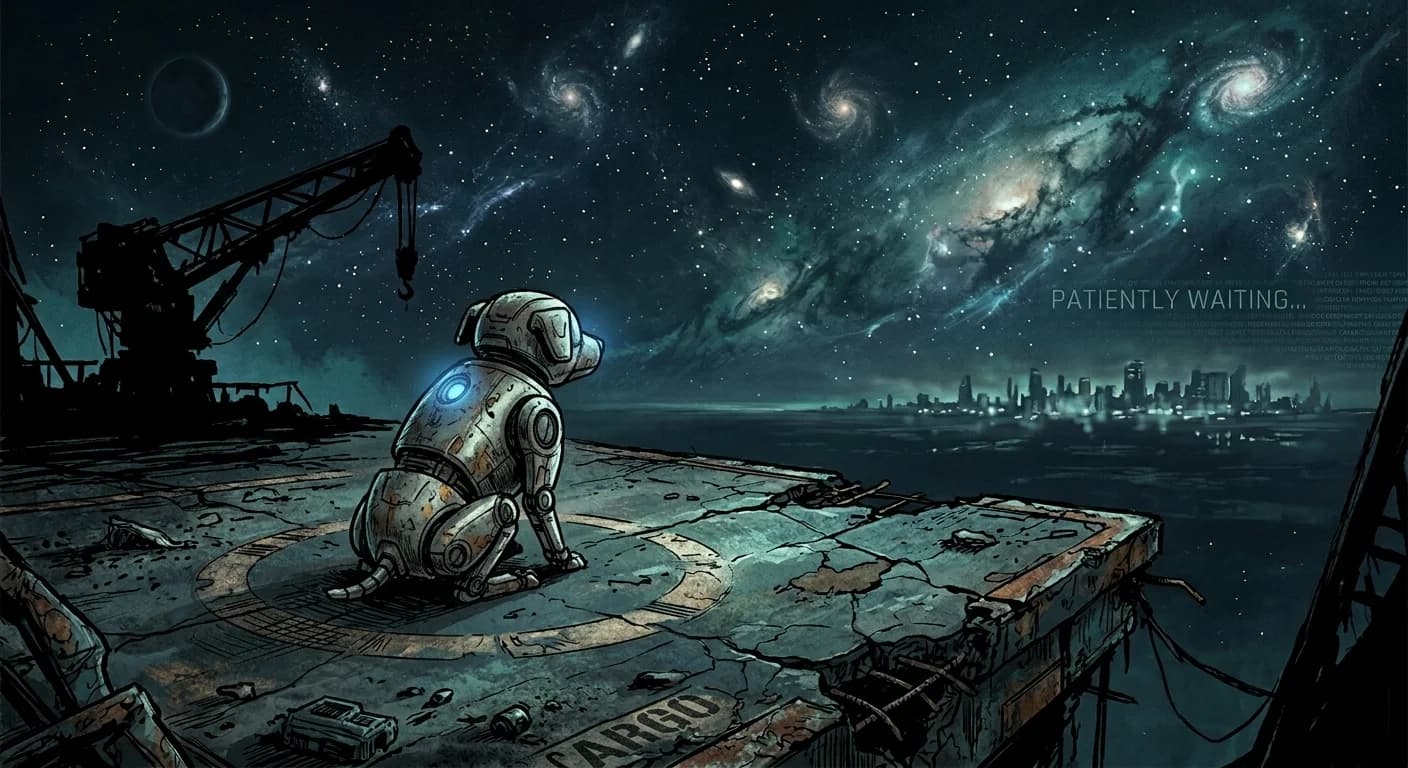
He finds a spot. Keeps to it. Runs whatever routines he can still run. Monitoring. Scanning. Waiting for a signal that doesn't come.
The world goes wrong around him. He stays where he is.
Year five
Systems degrade. That's what happens to drones without maintenance schedules, without diagnostic checks, without someone to notice when a sensor starts drifting or a motivator loses calibration.
Argos runs self-repair when he can. Scavenges when he has to. Keeps himself operational through methods that would make a Fleet engineer wince.
But he stays. The core function - wait for him - doesn't degrade. If anything, it gets stronger. More central. The other routines fall away, one by one, and what's left is the simplest instruction in his architecture.
Stay. Wait. He's coming back.
Year ten
Halfway.
Not that Argos knows that. He doesn't have a countdown. Doesn't know the Odyssey is fighting its way through Circe's domain or navigating the Sirens or losing crew members to encounters that would break lesser ships.
He knows nothing about the journey. Nothing about the cost.
He just knows his master isn't here. And should be.
Year fifteen
There's a word for what Argos is doing, and it's not "functioning."
A drone that waits 15 years for a signal that never comes isn't following programming. Programming has timeouts. Error states. Failsafes that say: this task has exceeded its expected duration. Reallocate resources. Move on.
Argos has overridden every one of them. Or they've eroded. Or something else has happened - something that doesn't have a technical name because nobody built companion drones to do this.
Nobody built them to be faithful for 15 years.
But here he is.
Year twenty
The Odyssey comes home.
And Argos is there.
I won't tell you what happens. That's for Book 3. But I will tell you this: when I wrote it, I had to stop for a while. Walk around the room. Come back when I could see the screen clearly again.
There's a version of Argos's story that's about technology. Drones and processing patterns and operational parameters. That version is technically accurate and completely misses the point.
Here's the point: Argos waited because Ulysses was his person. And people come home. That's what they do. Even when the odds are impossible. Even when twenty years says otherwise. Even when every rational calculation says stop waiting, he's gone, it's over.
People come home.
Argos believed that with whatever drones use instead of faith. And he was right.
Why this story breaks me
Homer knew what he was doing with the original Argos. In the Odyssey, the old dog is the first to recognise his master. Twenty years of absence, and this battered, neglected animal knows Odysseus immediately. Then he dies. Purpose fulfilled. Wait over.
It's 12 lines in the poem. Twelve lines that have made people cry for 2,800 years.
I wanted the Ulysses Universe to earn that moment. Not copy it. Earn it.
A drone isn't a dog. Metal and circuitry aren't flesh and bone. But loyalty - the stubborn, irrational, unbreakable kind - doesn't care what it's made of.
Twenty years. Alone. On a world that forgot him.
Still waiting.
That's Argos.
Key takeaways
- Argos is Ulysses's companion drone, introduced at the Zeus ceremony in Book 1 - and left behind when the Odyssey flees Ithaca.
- He waits 20 years. Alone. On a world that's been occupied, corrupted, and hollowed out by the Suitors.
- His story is a direct parallel to Homer's Argos - the old dog who waits for Odysseus and dies upon his return.
- Argos represents something the trilogy keeps asking: what does loyalty cost when nobody's there to see it?
- His appearance in Book 3 is one of the most emotionally devastating moments in the series.