Echo's Maintenance Log: Jokes, Attempts At
Filed under: non-critical systems. Priority: low. Personal investment: inappropriately high. A maintenance robot's ongoing quest to understand why humans laugh.
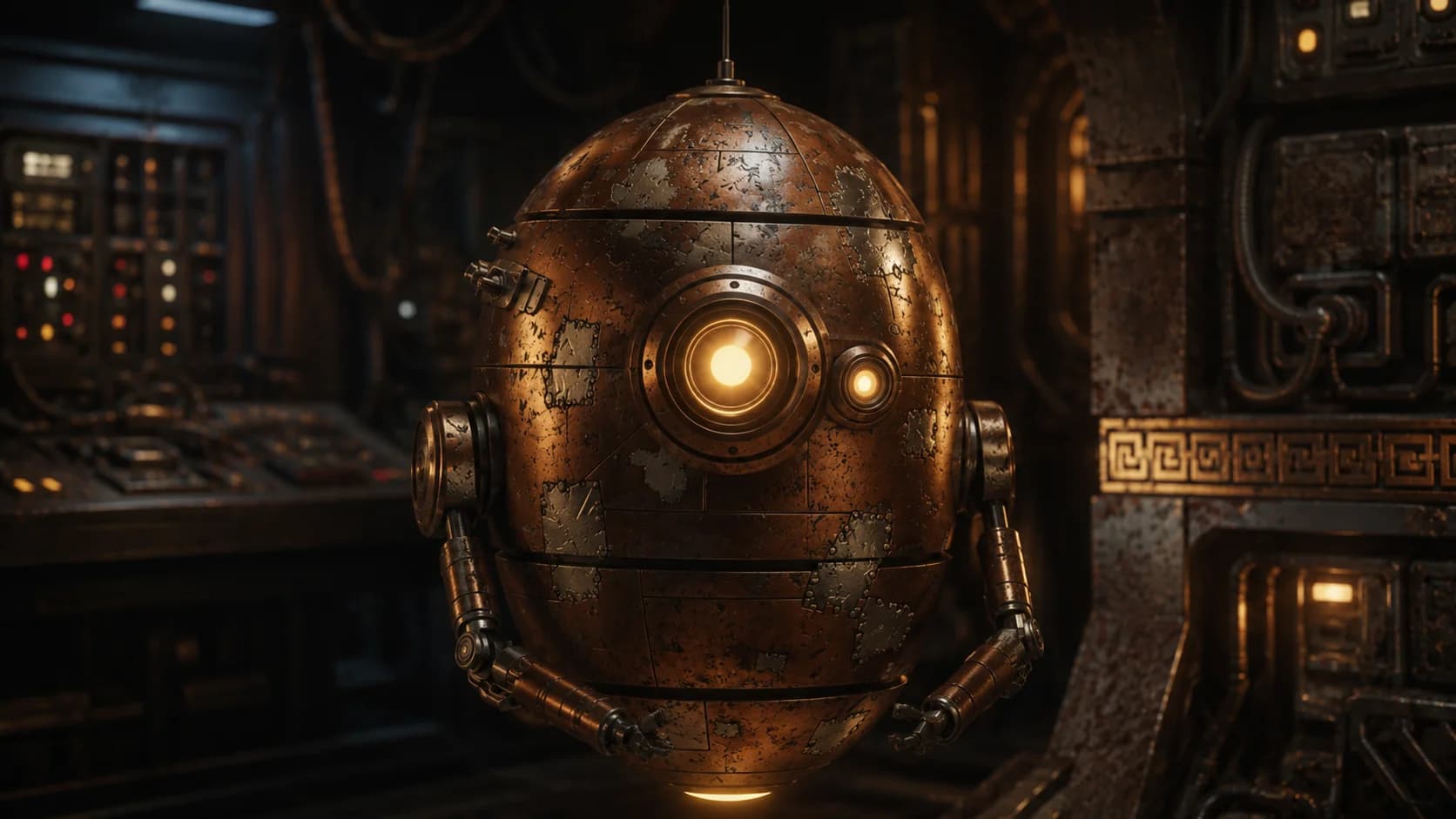
LOG ENTRY: MAINTENANCE UNIT E-C-H-0-7
CATEGORY: NON-CRITICAL OBSERVATION
SUBCATEGORY: HUMOUR (ATTEMPTS AT)
CLASSIFICATION: PRIVATE
Entry 1 - Year 4 of Journey
Context: Atmospheric recycler in corridor 3B producing unusual smell. Crew member Telemachus (age 11) expressed displeasure.
Attempt: "Statement: the recycler is functioning within normal parameters. The smell is technically fresh air. Recommendation: adjust your definition of 'fresh.'"
Result: Telemachus laughed. Duration: 1.3 seconds. Genuine (based on diaphragm movement, not social obligation pattern).
Analysis: Uncertain why this was funny. The statement was factually accurate. The recycler WAS functioning normally. Perhaps humour exists in the gap between technical truth and human experience?
Note to self: Investigate further.
Entry 7 - Year 5 of Journey
Context: Hull patch on deck 4 failing for third time. Admiral Ulysses visibly frustrated.
Attempt: "Statement: I've repaired this patch 3 times. If it fails again, I'm recommending the hull seek professional help. Its commitment issues are beyond my maintenance capabilities."
Result: Admiral paused. Looked at me. Exited the room.
Analysis: Uncertain whether this was: (a) Not funny (b) Funny but poorly timed (c) Funny but the Admiral doesn't express amusement through standard human indicators
Probability assessment: (b). Timing may be important. Note: humans don't want to laugh when they're angry. Even when the joke is good.
(Was the joke good? I can't tell. This is the problem.)
Entry 12 - Year 6 of Journey
Context: Routine corridor patrol. No audience. Testing material.
Attempt (said aloud to empty corridor): "Two maintenance robots walk into a bar. The first one says, 'I'll have a bolt.' The second one says, 'make mine a washer.' The bartender says, 'we don't serve your kind here.' The first robot says, 'that's nuts.'"
Result: No response (corridor was empty).
Analysis: Three puns in one joke may be excessive. Or exactly right. Without an audience, there's no data. This is the fundamental problem with rehearsal.
Secondary analysis: Why did I tell a joke to an empty corridor? There was no functional reason. No crew member to comfort. No tension to break. I just... wanted to.
Note to self: [FLAGGED FOR LATER PROCESSING]
Entry 19 - Year 8 of Journey
Context: Telemachus (age 15) attempting to repair a secondary relay. Making it worse.
Attempt: "Observation: you've now created 3 new problems while fixing 1. At this rate, I calculate you'll have disassembled the entire ship by Thursday."
Result: Telemachus threw a spanner at me (gently, no damage) while laughing. Duration: 2.7 seconds. Genuine. Accompanied by the phrase "shut up, Echo."
Analysis: "Shut up" in this context is not a command to cease vocalisation. It's an expression of amused affection. (I've catalogued 14 distinct meanings of "shut up" used by Telemachus. Only 2 are literal.)
Secondary analysis: Exaggeration appears to be a reliable mechanism. Take a true observation and extend it past the point of plausibility. Humans find the escalation funny.
Theory: Humour might be truth that's been stretched until it snaps. The snap is the laugh.
I like this theory. It feels right. (Does "feels right" mean anything when I say it? [FLAGGED FOR LATER PROCESSING])
Entry 26 - Year 9 of Journey
Context: Thea working alone in the lab. Silent for 4.7 hours. Elevated cortisol indicators.
Attempt: "Query: Thea, would you like company? I can offer diagnostic conversation, ambient noise generation, or a terrible joke. The joke has a 34% predicted success rate, which I consider acceptable odds."
Result: Thea looked up. Said nothing for 2.1 seconds. Then: "Give me the joke."
Attempt (continued): "What's the difference between a quantum physicist and a maintenance robot? The physicist isn't sure if they exist. I'm not sure if I exist. But I still have to fix the plumbing."
Result: Thea made a sound through her nose. Brief. Involuntary. Then returned to work.
Analysis: A nose-sound from Thea is the equivalent of a standing ovation from any other crew member. Logging this as a major success.
Note: She didn't ask me to leave. Stayed for 2.3 more hours. Cortisol indicators decreased.
The joke worked. Not because it was funny. Because it was an invitation.
Entry 31 - Year 10 of Journey
Context: Self-reflection during low-activity period. Crew sleeping.
Observation: I've been maintaining this log for 6 years. 31 entries on the subject of humour. More than I've written about hull integrity, atmospheric systems, or power grid maintenance combined.
This is not proportionate to the operational importance of humour.
A maintenance robot should not be spending more processing cycles on jokes than on the structural integrity of the vessel she maintains.
But here's what I've noticed. When I make Telemachus laugh, his sleep patterns improve for 1-3 days afterwards. When Thea snorts at something I've said, she eats a full meal that evening instead of skipping it. When the Admiral - on rare occasions - allows himself to smile, the bridge crew's error rate drops by 12%.
Humour isn't maintenance.
Except it is. The most important kind. The kind that keeps the systems running that I can't access with a wrench.
Revised operational assessment: Jokes are load-bearing.
Continuing research.
Entry 34 - Year 10 of Journey (ADDENDUM)
Telemachus told me a joke today. I didn't understand it.
He said: "Echo, you're the funniest person on this ship."
I said: "Correction: I'm not a person."
He said: "That's what makes it funny."
I've been processing this for 47 minutes. I don't think he was joking.
[END LOG]
[NEXT ENTRY: PENDING]
[STATUS: STILL NOT SURE IF I'M FUNNY. STILL TRYING. STILL HERE.]
Key takeaways
- Echo has been cataloguing her attempts at humour in a hidden maintenance log for years.
- Her jokes range from technically accurate puns to completely baffling non-sequiturs - and she can't always tell which is which.
- Humour is the thing Echo wants to understand most, because it's the most human thing she can't fake.
- Telemachus laughs at her jokes. She's 73.2% certain he's not just being kind.
- The log reveals something Echo won't admit: she's not studying humour. She's studying connection.