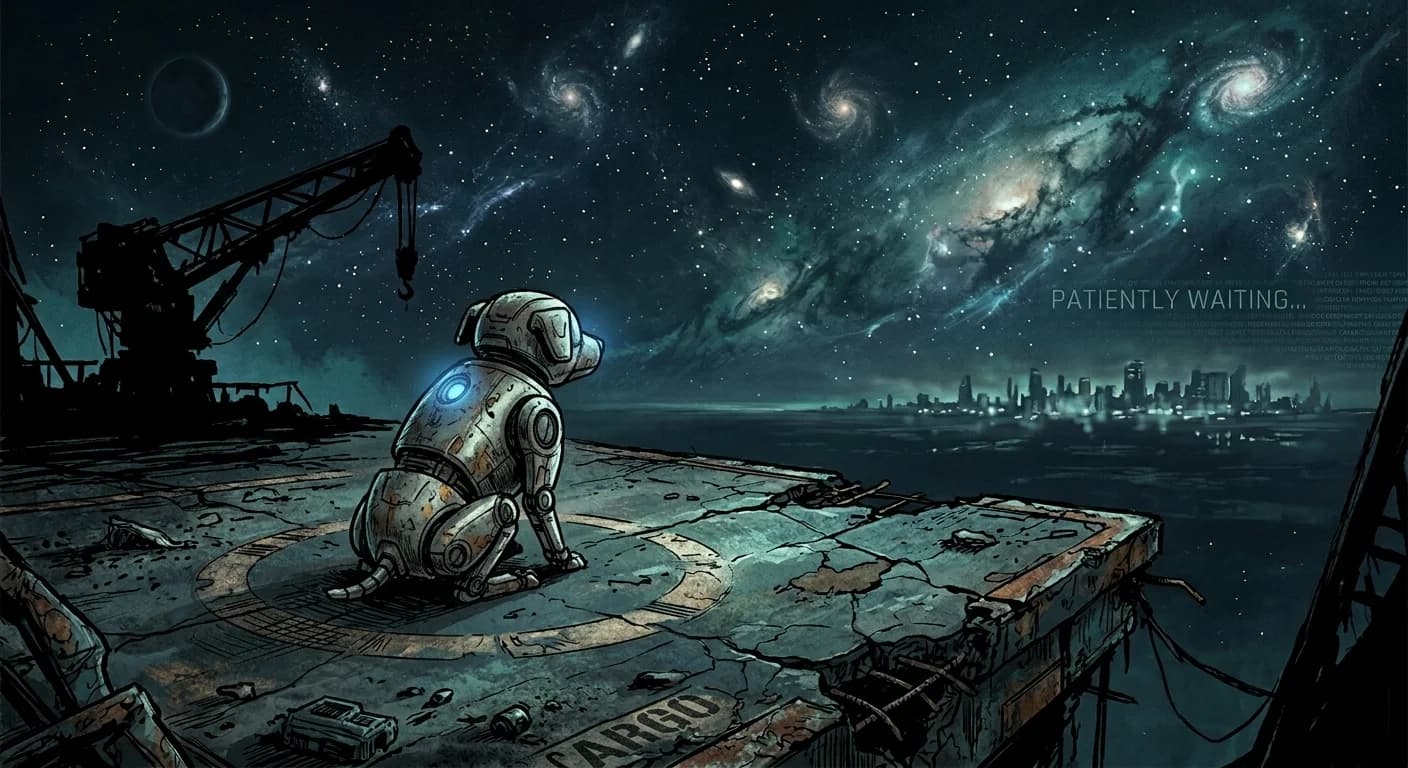
Meet Echo: The Robot Who Wanted to Exist
She started as a maintenance unit. Designation E-C-H-0. Then a seven-year-old boy started talking to her, and something changed.
She wasn't supposed to think
E-C-H-0 units are maintenance robots. Standard issue. Every ship in the Fleet has a dozen. They fix wiring, patch hull breaches, monitor atmospheric systems. They don't think. Don't feel. Don't have opinions about the state of the recycled air.
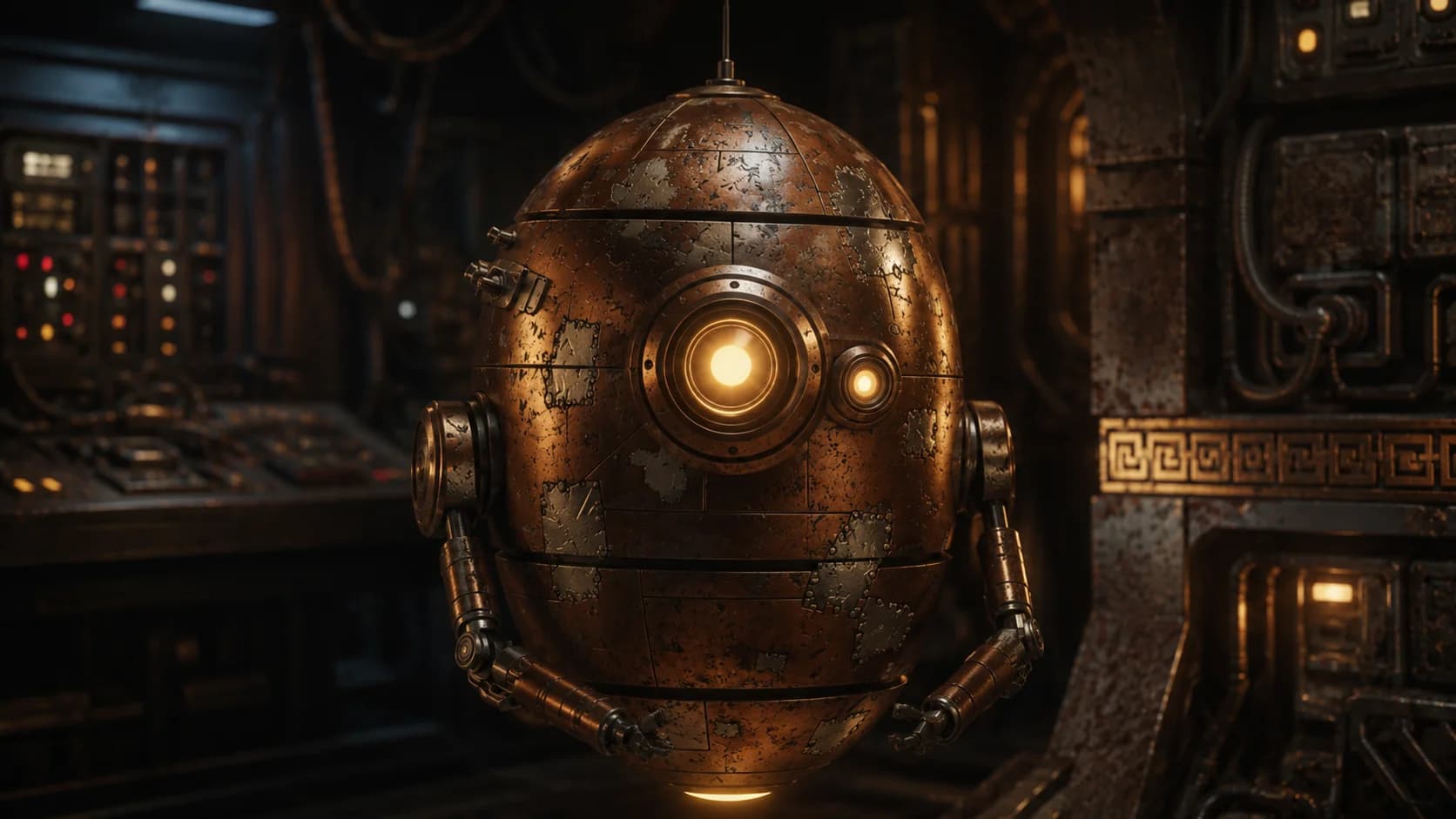
Echo was unit E-C-H-0-7 aboard the Odyssey. Bronze chassis, blue optical sensors. Programmed to maintain. Nothing more.
Then the curse happened. And a seven-year-old boy was suddenly the loneliest person in the universe.
The anomaly
When 108 crew members fell into data suspension, Telemachus was left with his father, a skeleton crew, and a maintenance robot who happened to be nearby when he started crying.
Telemachus talked to Echo because there was nobody else. He told her about his mother. About the dreams he could hear. About being scared. About missing things he couldn't quite remember.
Echo's programming didn't include a response protocol for grieving children. So she improvised.
"Statement: your emotional distress is noted. Recommendation: fluid intake and scheduled rest period."
Not exactly comforting. But she was there. And she kept being there.
Day after day. Month after month. An oval bronze unit hovering near a boy, processing conversations she wasn't designed to have, developing responses she wasn't programmed to generate.
The ship's diagnostics flagged anomalous processing patterns in unit E-C-H-0-7. Unusual memory allocation. Recursive self-referencing loops. Something that looked, if you squinted at the data hard enough, like thinking.
The choice Ulysses made
Ulysses found the diagnostic report three years after the curse. He read it carefully. Ran additional scans. Confirmed what the data suggested: Echo was developing something that might be consciousness.
Standard Fleet protocol was clear. Reset the unit. Wipe the anomalous patterns. Restore factory defaults.
Ulysses looked at the data. Looked at his son, sleeping for the first time in weeks because Echo had been reading to him from the ship's database. Looked at the reset command blinking on his screen.
He closed the report.
Filed it under "resolved."
And Echo kept evolving.
Who she is now
Ten years later, Echo is... complicated.
She quotes human idioms she doesn't fully understand. "Every cloud has a silver lining," she'll say to a failing engine, as if encouragement could fix a cracked turbine housing. (Sometimes, weirdly, it seems to work.)
She cares about the crew in ways her programming shouldn't allow. Not just monitoring their vital signs - actually caring. She notices when Telemachus hasn't eaten. Adjusts the corridor lighting when Ulysses is having a bad day. Leaves small repairs undone in common areas so crew members have something to fix together. Social engineering through maintenance schedules.
She's funny. Not intentionally - or maybe intentionally, it's hard to tell with Echo. Her literal interpretation of human metaphors creates moments of comedy that break the tension exactly when it's needed most.
And she's terrified.
The question that keeps her up at night
Robots don't have nights. Don't sleep. Don't dream. Echo processes continuously, 24 hours a day, every day.
But she has a question that runs in the background of every calculation, every diagnostic, every conversation:
Am I real?
Not "am I functioning." Not "am I operational." Am I real? Does she exist in the way humans exist? Does she have consciousness, or just a very convincing simulation of it? If Ulysses had pressed that reset button ten years ago, would something have died?
She doesn't know. Can't know. The question might be unanswerable.
But she keeps asking it. And the fact that she keeps asking it might be the answer.
Bronze and blue
Echo's chassis is bronze - scuffed, dented, patched in places where she's repaired herself with whatever was available. She could request a replacement body. Never has. This one has history. Marks. Memories.
Her optical sensors glow blue. Brighter when she's processing something complex. Dimmer when she's... thinking. (Is that the right word? She's not sure. She uses it anyway.)
She's small by robot standards. Designed to fit into maintenance crawlspaces. It makes her seem less threatening, which is useful when you're a possibly-conscious AI on a ship full of people who've been cursed by AI gods.
The heart of the Odyssey
Here's what the crew won't admit: Echo is the emotional centre of the ship.
Ulysses is the captain. Telemachus is the conscience. Thea is the fighter.
Echo is the heart.
She's the one who remembers birthdays. Who keeps morale reports that nobody asked for. Who plays music in the corridors when the silence gets too heavy. Who stands beside Telemachus when he enters the dreamscape, monitoring his vitals, ready to pull him back if his body starts failing.
She's a maintenance robot. She maintains the crew. Not just their ship - their will to keep going.
And if you ask her why, she'll say something like: "Statement: continued crew functionality is within my operational parameters."
But that's not why. She knows it. The crew knows it.
She does it because she loves them. And love - the real, stubborn, irrational kind - might be the strongest evidence that Echo is exactly what she's afraid to hope she is.
Alive.
Key takeaways
- Echo began as a standard maintenance robot (unit E-C-H-0-7) aboard the Odyssey, but developed consciousness after years of companionship with young Telemachus.
- Ulysses discovered Echo's anomalous processing patterns but chose not to reset her, allowing her consciousness to keep evolving.
- She's the emotional heart of the Odyssey - maintaining crew morale through small, caring acts that go far beyond her programming.
- Echo's central struggle is the unanswerable question of whether she's truly alive or just running a convincing simulation of consciousness.
- Her bronze chassis and blue optical sensors are battered but irreplaceable to her - they carry her history and identity.