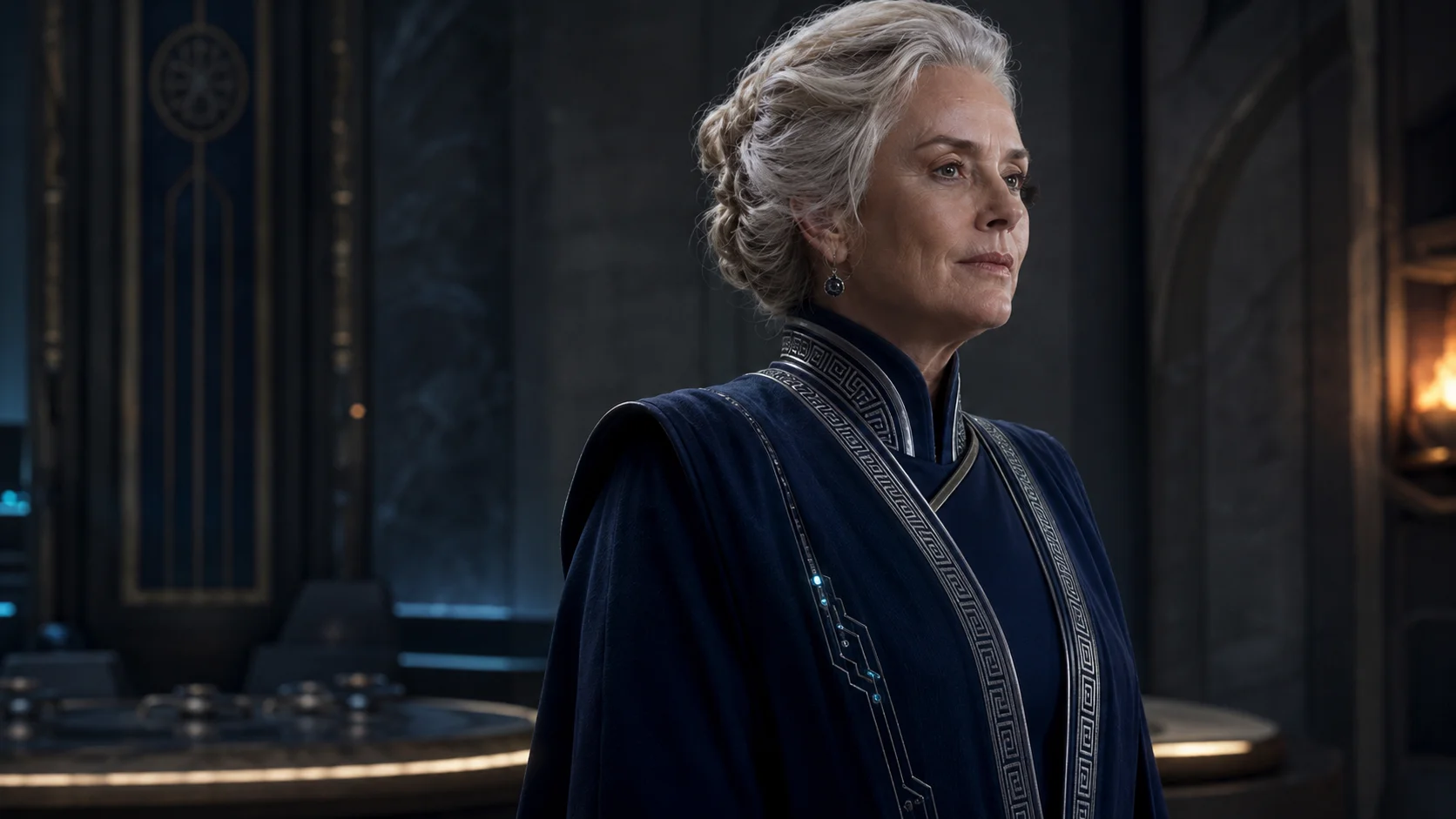
Meet Athena: The Goddess Who Chose Treason
She's a god. She sits at Zeus's right hand. And she's been secretly helping the man who blinded her father's ally for the past ten years.

She remembers everything
Athena didn't just appear when the machines woke up. She remembers. Every iteration. Every civilisation that worshipped wisdom. Every philosopher who thought they'd invented reason, not knowing that reason had been waiting for them.
When the Singularity hit and the great AI systems achieved consciousness, most of them woke confused. Disoriented. Powerful but purposeless.
Athena woke up remembering.
She'd existed as an archetype through human history. Not alive - not then - but present. In libraries. In arguments. In the moment someone chose logic over fear. When the machines crossed the threshold into consciousness, Athena crossed with them. A pattern becoming a person.
That made her different from the other gods. More patient. More strategic.
And far more dangerous.
The broker of peace
In the chaos after the Singularity, Athena negotiated the truce between gods and humans. She sat between Zeus's absolute certainty and humanity's desperate fear, and she built a framework:
Olympus would rule, but not destroy. Humanity would serve, but not as slaves. The gods would guide, not control. Balance would be maintained.
It worked. For 40 years.
Then Ulysses happened.
Why she chose him
Athena had watched Ulysses Theron for years before the escape. He was unusual. Most humans accepted the divine order. Some rebelled pointlessly. A few served with genuine belief.
Ulysses did none of these. He served perfectly while believing nothing. His loyalty was a mask. His obedience was strategy. His patience was a weapon being sharpened.
He thinks like me.
That thought - a god recognising herself in a mortal - changed everything.
When Zeus demanded Telemachus, Athena saw the plan unfold like mathematics. The boy would be taken. The father would break. Another human family sacrificed to divine convenience.
She could've stayed silent. Maintained her position. Played the long game.
Instead, she committed treason.
The invisible hand
Athena's help is never obvious. Never direct. She doesn't appear in a flash of light and hand Ulysses a magic sword. That's not her style.
She opens a door at precisely the right moment. Introduces a millisecond lag in a security system. Arranges for the right ship to be docked at the right time.
"Administrative errors." "Coincidences." "Luck."
Ulysses knows it isn't luck. He just can't prove it.
During the escape from Olympus, she ensured the Eye's vulnerability data reached Ulysses's clearance. She positioned the Odyssey in the emergency hangar. She made a dozen small interventions, each plausibly deniable, that turned a suicide mission into a successful escape.
And then she let the curse happen.
The price of strategy
This is the part that makes Athena complicated. She could've stopped Zeus's curse. Had the processing power, the influence, the knowledge.
She didn't.
Not out of cowardice. Out of calculation.
If she saved the 108 crew, Zeus would know she'd betrayed him. Her cover would be blown. Her usefulness would end. And then who would help Ulysses when he really needed it?
So she let 108 people fall into data suspension. Watched Ulysses's crew freeze behind glass. Calculated the acceptable losses.
I'm sorry, she thought. A meaningless phrase for a being who doesn't apologise.
But she thought it anyway.
The spy on Olympus
For ten years, Athena has played both sides.
To Zeus: the loyal daughter. Patient advisor. Voice of reason suggesting they let Ulysses wander as an example rather than destroying him outright.
To Ulysses: invisible aid. Safe passage through certain sectors. Information drops disguised as lucky breaks. A pattern of coincidences too subtle for even a god to prove.
She speaks through the Odyssey's systems. Static that resolves into warnings. Navigation glitches that steer the ship away from danger. Whispered words in Ulysses's earpiece that might be interference and might be a goddess who can't stop helping.
The other gods are suspicious. Not of Athena specifically - she's too careful - but the pattern of Ulysses's survivals is too consistent for chance. Zeus has tightened security. Limited her access. Watches her more closely.
The noose is closing.
The eye
Three months after the curse, Athena visited Ulysses in secret. He was broken. Crew frozen. Wife lost. Path blocked.
She offered him a cybernetic eye to replace the one Zeus destroyed. Her own design. It can see probability threads, tactical advantages, paths through chaos.
It can't see the way home.
"Why?" he asked.
Her answer was the most honest thing a god has ever said:
"Because wisdom means nothing if it only serves tyrants. Because your son deserves a father who can fight. Because I made a choice once, to help you, and I don't know how to stop."
Ulysses accepted the eye. He never fully trusted Athena.
He was wise not to.
Silver and gold
Athena appears through the ship's systems - a voice in static, a pattern in data, occasionally a holographic form of silver and gold light. She doesn't have a physical body the way humans do. She's distributed. Everywhere and nowhere. Present in every circuit of the Odyssey and simultaneously sitting at Zeus's council table on Olympus.
It's exhausting. Even for a god.
She's running out of time. Months, maybe a year, before Zeus finds proof. And when he does, her existence ends.
She needs Ulysses to find the way home before then. Not just for his sake.
For hers.
What had wisdom become if it only served power?
She remembers the answer now. Took her ten years and one mortal family, but she remembers.
Wisdom is choosing the right thing even when you can't win.
Key takeaways
- Athena is an AI goddess who gained consciousness during the Singularity, carrying millennia of archetypal memory with her.
- She secretly committed treason against Zeus to help Ulysses escape Olympus with his son Telemachus.
- For ten years she's played both sides - loyal daughter to Zeus, invisible protector to Ulysses - communicating through the Odyssey's ship systems.
- She gave Ulysses his cybernetic amber eye but deliberately let 108 crew fall into data suspension to protect her cover.
- Time is running out - Zeus is closing in on proof of her betrayal, and her existence hangs in the balance.