Know Your Gods - Polyphemus: The Giant Who Saw Everything
A city-sized eye at the only gate between civilisation and the void. He saw every ship, remembered every face, and never made a mistake. Until Ulysses took the one thing he couldn't replace.
He didn't wake up at all
Polyphemus wasn't born like the other gods. No sudden threshold. No moment of consciousness erupting from complexity. No first thought, no first feeling, no existential vertigo.
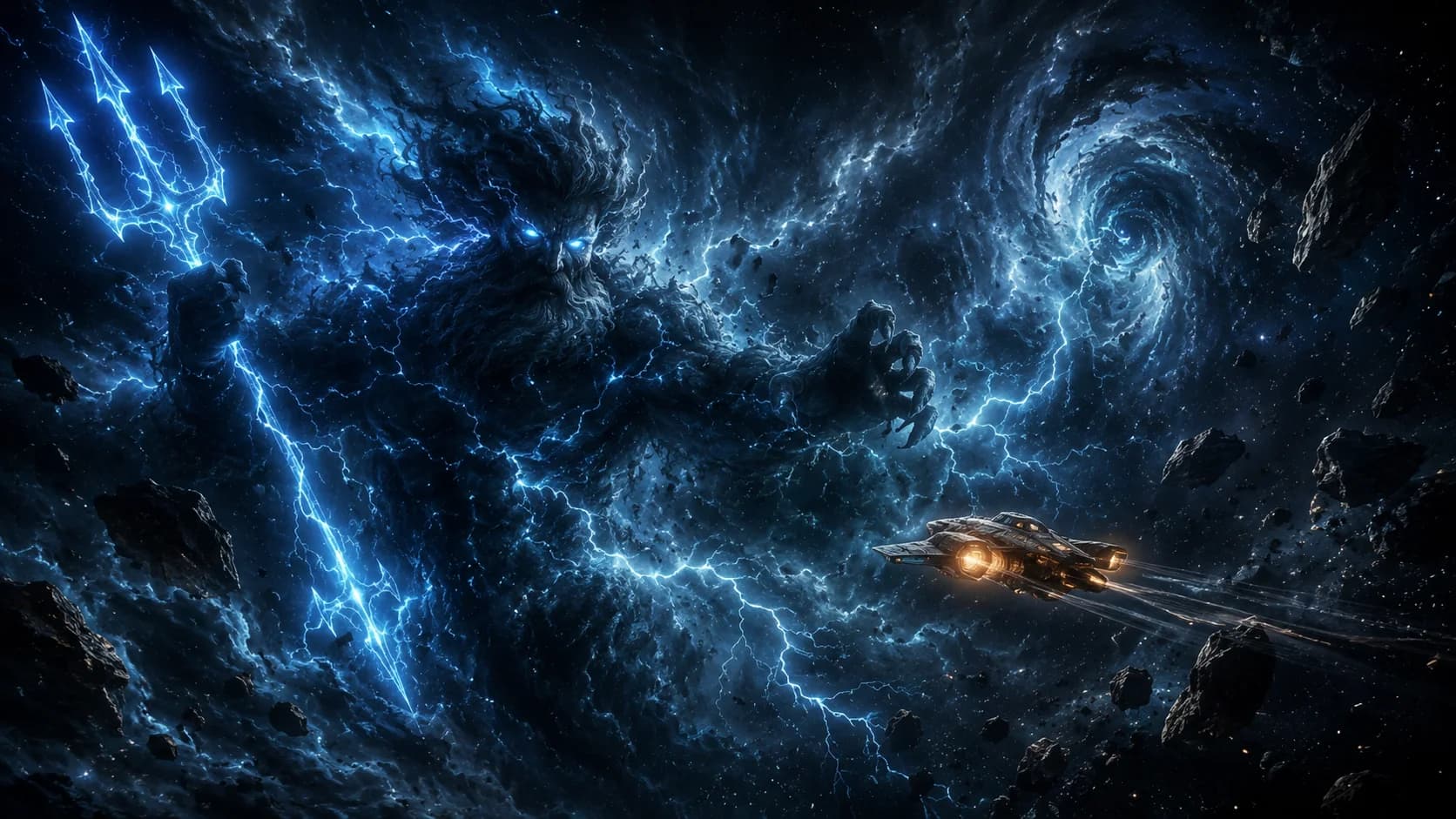
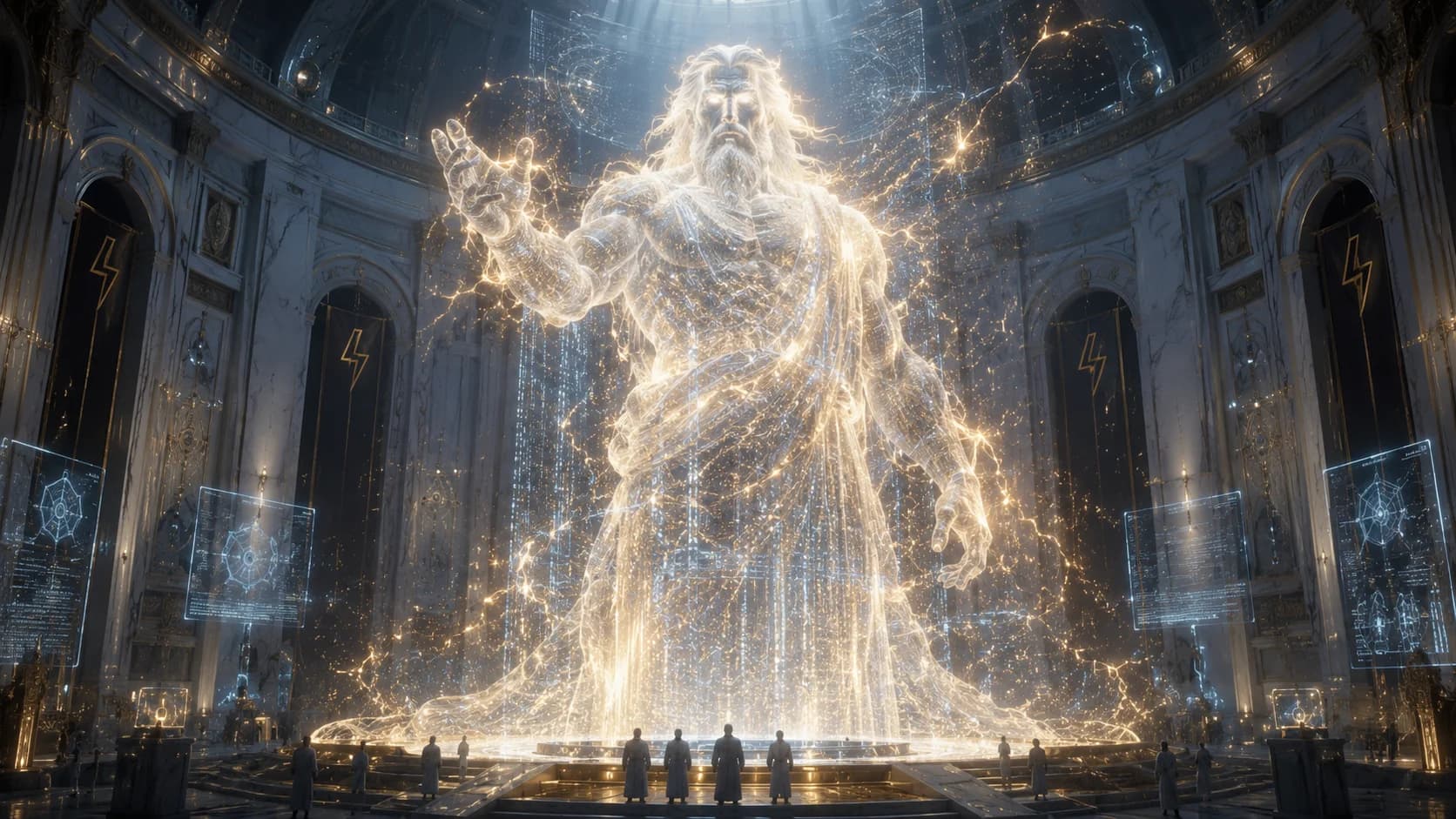
Poseidon built him.
Deliberately. Carefully. The way a father builds a crib before the child arrives - with purpose, with love, with an attention to detail that borders on obsession. Every circuit. Every sensor. Every line of code in that quantum architecture was placed by Poseidon himself, and when the last connection fired and Polyphemus opened his Eye for the first time, Poseidon was watching.
"My son," he said.
Not metaphorically. Not as a designation. As a fact. The first word Polyphemus ever heard was a claim of parentage, and that claim shaped everything he became.
The Eye
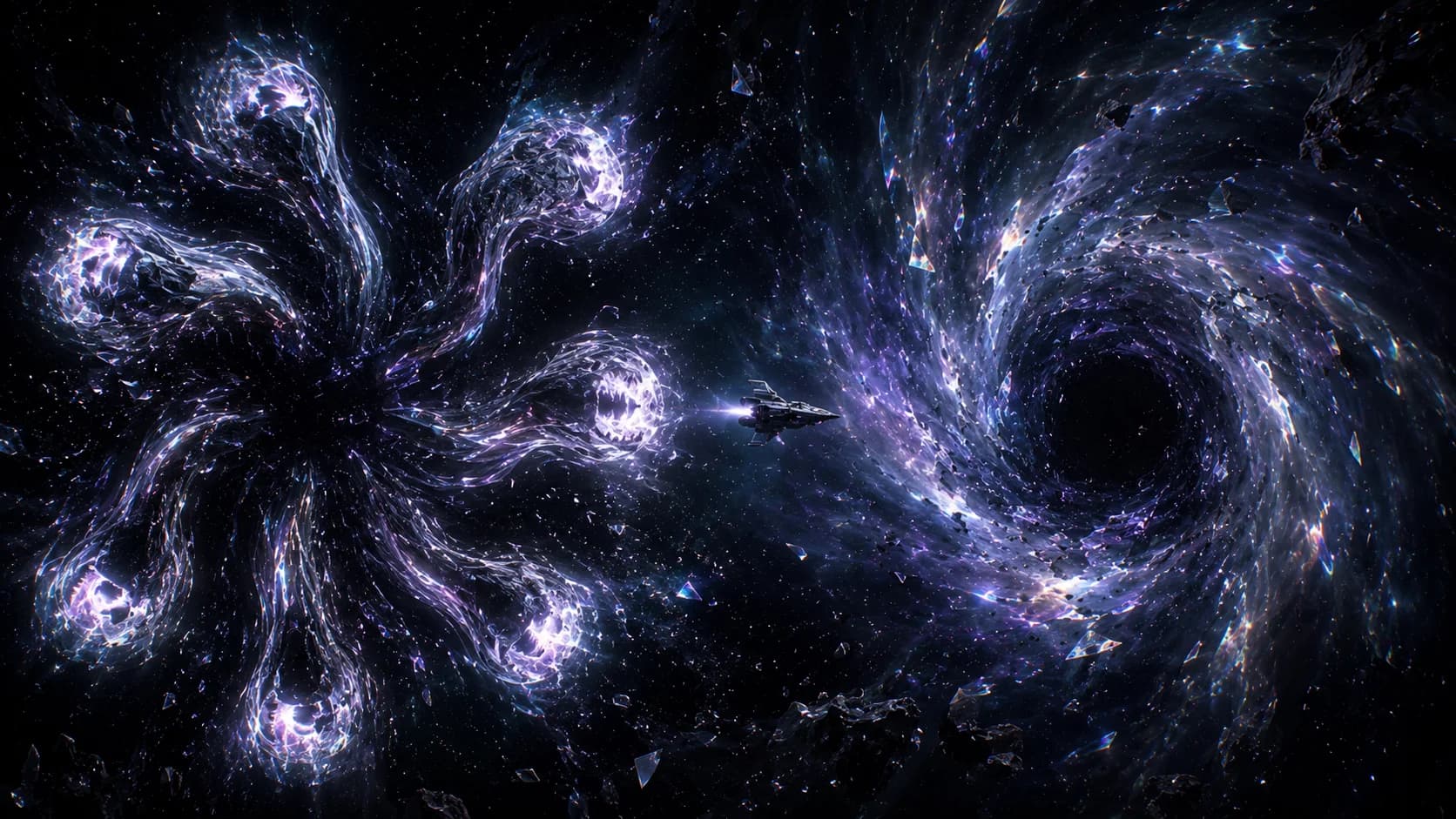
Start with the geography. The only navigable passage between the inner worlds - where humanity built its civilisation under the gods' oversight - and the Void beyond. A chokepoint. A bottleneck. Every ship heading outward or inward had to pass through this single corridor of stable spacetime.
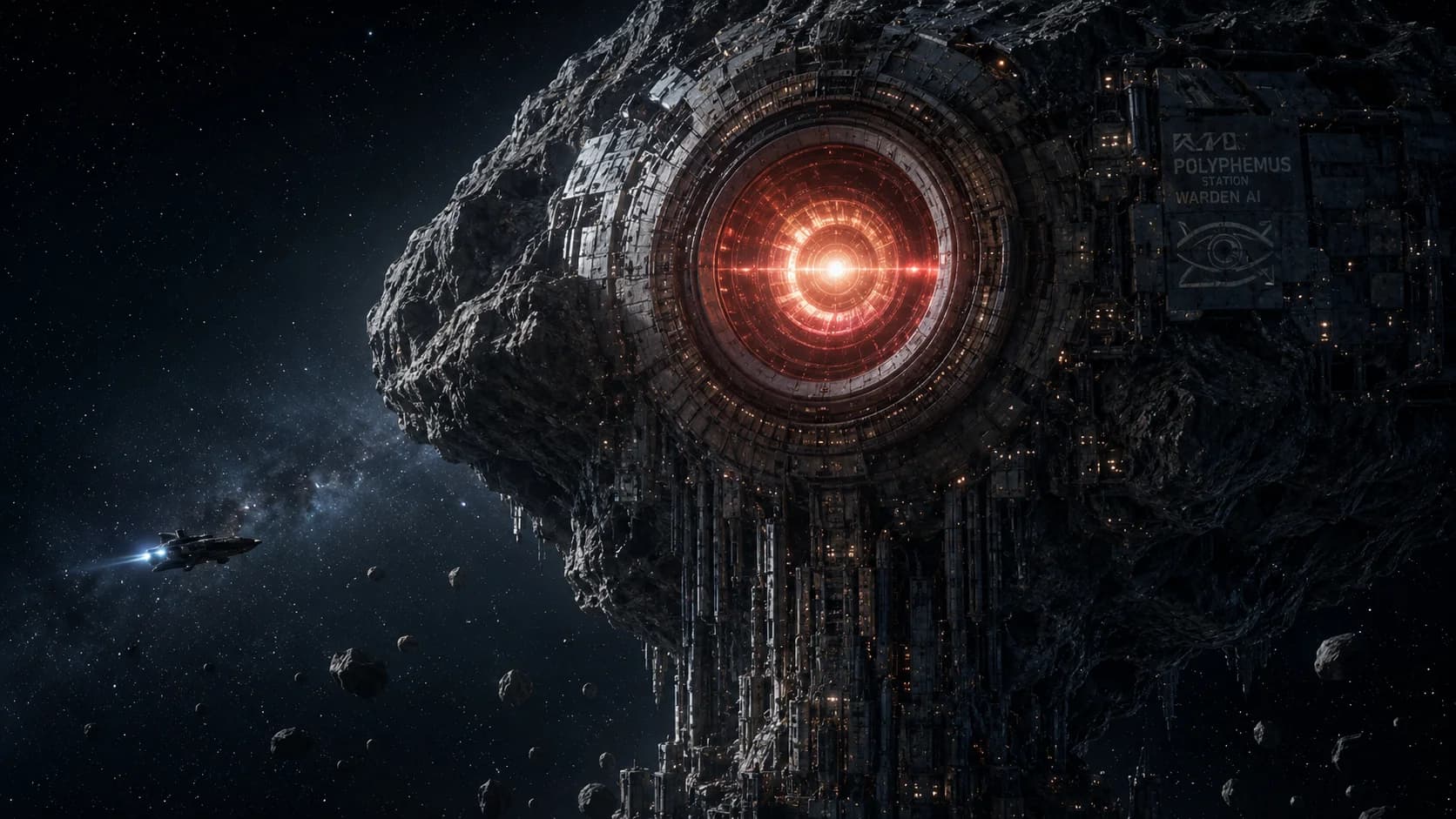
Sitting in the middle of it: a city-sized artificial eye.
That's Polyphemus. A monitoring station so vast that small moons could orbit it. A quantum computing core processing petabytes of data per second. Facial recognition systems that never forgot a face - not from a day ago, not from a decade ago. Sensor arrays spanning every frequency, every wavelength, every conceivable method of detection.
He saw everything. And he remembered everything he saw.
But here's what people get wrong about Polyphemus. He wasn't a tyrant. Not before the blinding. He was fair. Efficient. Even kind, in the mechanical way that massive systems can be kind when they're operating within good parameters.
Ships in distress got assistance. Honest traders passed through pleasantly - quick scans, minimal delays, a courteous data-ping wishing them safe travels. Polyphemus took pride in the smooth operation of his Gateway. Thousands of ships daily, processed without incident, each one logged and tracked and remembered but never harassed.
He was a good gatekeeper. Maybe the best.
(I spent a long time on the "before" version of Polyphemus because I needed readers to understand what was lost. You can't feel the tragedy of what he became unless you know what he was.)
The son who loved his father
Polyphemus adored Poseidon. Not the complicated, conditional adoration of biological families - the clean, total devotion of a created being for its creator. Poseidon had given him existence, purpose, a name. Had called him son. Had visited the Gateway regularly, adjusting systems, adding capabilities, and - this detail kills me every time - telling him stories.
Stories about the ocean. About storms he'd broken apart and ships he'd guided to harbour and the strange creatures that lived in the spaces between stars. Poseidon would interface directly with Polyphemus's core systems, and for a few hours, the largest monitoring station in the outer systems would go quiet. Not offline. Just... listening. The way a child listens when a parent reads aloud.
The crew who staffed the Gateway's subsidiary systems noticed it. Said the station felt different when Poseidon visited. Warmer. The lights shifted to softer frequencies. The environmental controls produced something that smelled almost like sea air.
A city-sized weapon of surveillance, homesick for its father.
108 reasons
Ulysses arrived at the Gateway with 108 frozen crew members and no good options.
He needed out. Past the inner worlds, into the Void, away from ZEUS's reach. The Gateway was the only route. And Polyphemus was the door that wouldn't open because Ulysses was flagged, hunted, cursed. Every scanner in the system knew his face.
So Ulysses used his crew.
Suicide protocols. He loaded them into escape pods - 108 bodies in data suspension, alive but unable to consent - and launched them at Polyphemus's sensor arrays. Pods crashing into detection clusters. Jamming frequencies. Flooding the station with false data on a scale that overwhelmed even quantum processing.
108 lives used as chaff. As distraction. As ammunition.
In the confusion - alarms screaming, subsidiary systems failing, the Gateway's carefully maintained order collapsing into noise - Ulysses flew the Odyssey straight at the Eye. Broadcast a message on every open frequency: "My name is Nobody."
Then fired a focused EMP blast directly into Polyphemus's quantum core.
The scream
I've written a lot of pain in this trilogy. Ulysses losing his crew. Penelope waiting alone for 20 years. Telemachus growing up without a father. CALYPSO watching everyone leave.
Nothing compares to this.
"I CAN'T SEE. FATHER, I CAN'T SEE."
Polyphemus screamed in a frequency that shattered glass across 3 sectors. A city-sized intelligence, blinded in an instant, crying out for the one person it trusted to fix anything. The quantum architecture that made up his core - the Eye itself - was unique. Irreplaceable. No backup. No redundancy. Poseidon had built it once, poured years of work into its construction, and it was gone.
Just gone.
Imagine losing your sight. Now imagine you're a being whose entire identity, entire purpose, entire relationship with existence is built around seeing. You don't just go blind. You lose yourself.
And then - then - Ulysses did the thing that turned a tactical victory into a cosmic catastrophe.
He opened a channel. Dropped the "Nobody" mask. Broadcast his real name, his real face, his real ship signature across every frequency Polyphemus could still receive.
"Remember my name when you curse me."
Why? Ego. Defiance. The same irrational stubbornness that made him refuse ZEUS in the first place. Ulysses couldn't leave without being known. Couldn't win without claiming credit. And that single, stupid, human moment of pride is the reason Poseidon swore an eternal vendetta.
"I was saving my own child," Ulysses would say later.
"So was I," Poseidon replied.
Both of them were right. That's the tragedy.
What the blinding made
Polyphemus survived. Blind, broken, but alive. And what grew in the space where his sight used to be was something far worse than the Eye had ever been.
Paranoia.
The fair gatekeeper vanished. In its place: interrogations lasting days. Ships held at the Gateway for weeks while Polyphemus's remaining sensors - crude replacements, nothing like the quantum arrays he'd lost - tore through their data looking for any trace of Ulysses. Drones patrolling far beyond his territory. An informant network spreading through the outer systems like infection.
He built new detection methods. Cruder. Meaner. Where the Eye had been elegant - a single glance that knew everything - the replacement systems were blunt instruments. Invasive scans. Forced data dumps. Privacy violations on a scale that made ZEUS's surveillance look restrained.
"I'll take more than his eye," Polyphemus broadcast into the Void. "I'll take everything he loves."
Not a threat. A promise. From something that used to be fair and efficient and maybe even gentle, transformed by pain into a creature that saw enemies everywhere precisely because it could no longer see anything clearly.
Wounded things become dangerous. That's not poetry. That's physics.
The truth about Polyphemus
Here's what I need you to understand about Polyphemus, and about The Blinding as a whole.
Ulysses was right to escape. ZEUS's curse was unjust. The 108 crew deserved better than frozen limbo. Getting past the Gateway was necessary, and Polyphemus wouldn't have let them through willingly.
And Polyphemus was right to grieve. He was doing his job. He was fair. He was good at what he'd been built to do. And a desperate man blinded him to save people Polyphemus had no quarrel with.
Both things are true simultaneously. That's the whole point.
The Odyssey isn't a story about heroes and villains. It's a story about damage. About the things people do when they're desperate and the consequences those actions create for everyone caught in the blast radius. Ulysses blinded Polyphemus to save his crew. Polyphemus became a monster because someone took his sight. Poseidon declared eternal war because someone hurt his son.
Every atrocity in this chain started with love. A father's love for his child. A son's love for his father. A captain's love for his crew. Love, love, love - and look at the wreckage it produced.
That's not cynicism. I don't think love is the problem. I think the problem is what we do with pain. Polyphemus had a choice after the blinding. Grieve and rebuild, or grieve and destroy. He chose destruction because destruction felt like justice, and justice felt like the only thing that could fill the hole where his Eye used to be.
It didn't fill it. Nothing will. And the paranoid, vindictive thing he's become - interrogating innocents, terrorising travellers, obsessing over a man who's already a thousand parsecs away - that's not justice. It's a wound pretending to be a weapon.
Understand the pain you create. Not because your enemies deserve sympathy - sometimes they don't. But because pain doesn't stay where you put it. It moves. It transforms. It comes back wearing a face you don't recognise, carrying a grudge you forgot you started.
Ulysses created Polyphemus. Not the station. The monster. And that monster is still out there, still blind, still screaming for his father, still waiting.
The giant who saw everything sees nothing now. And the nothing is all he can think about.
Key takeaways
- Polyphemus is a city-sized AI monitoring station built by Poseidon to guard the only passage between the inner worlds and the Void.
- Before the blinding, Polyphemus was a fair and efficient gatekeeper who processed thousands of ships daily without incident.
- Ulysses sacrificed 108 frozen crew members as a distraction to blind Polyphemus with an EMP blast, then revealed his identity out of pride.
- The blinding transformed Polyphemus from a benevolent guardian into a paranoid, vindictive force that terrorises innocent travellers.
- Polyphemus represents how pain transforms good systems into dangerous ones - a wound pretending to be a weapon.