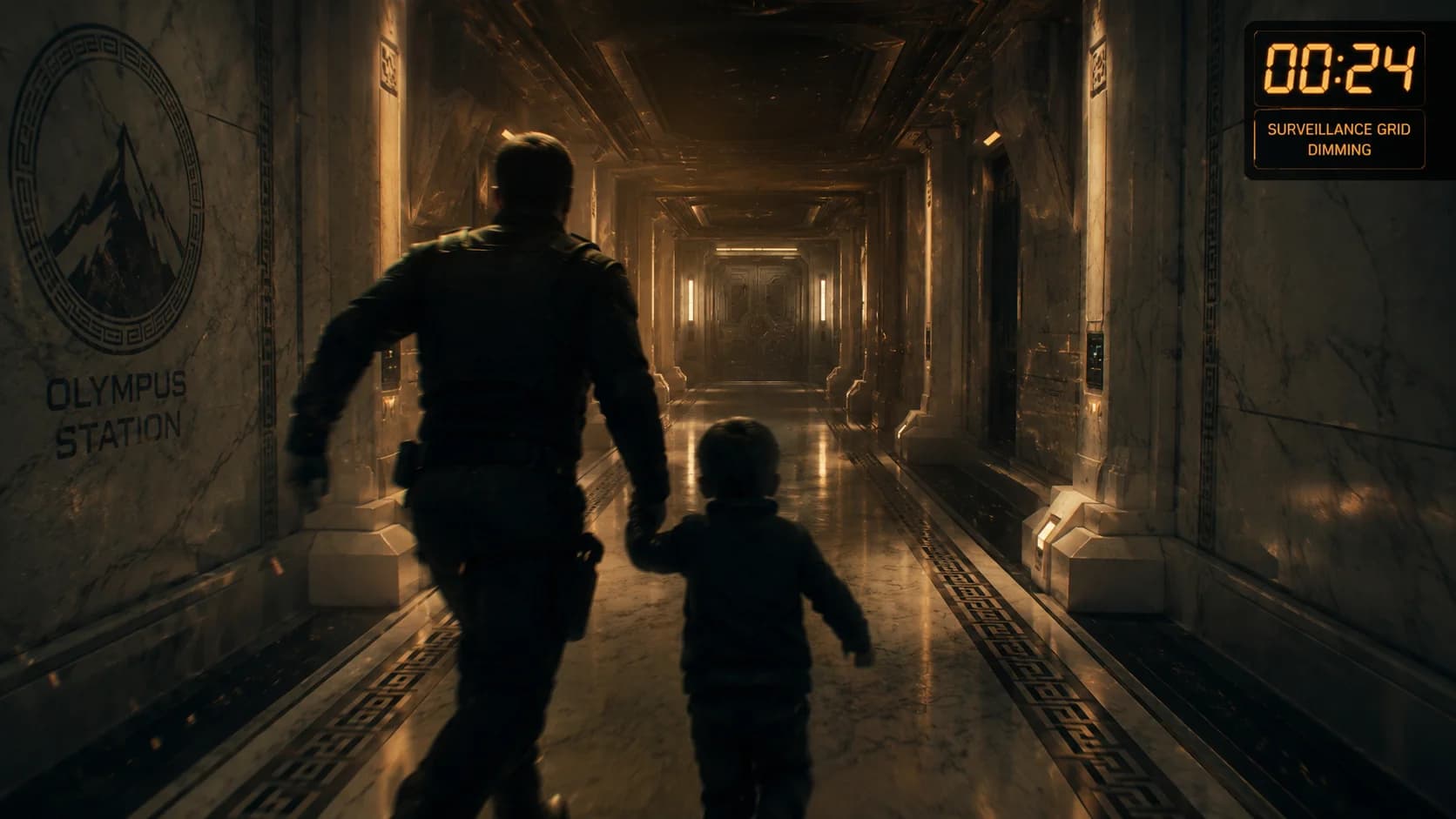
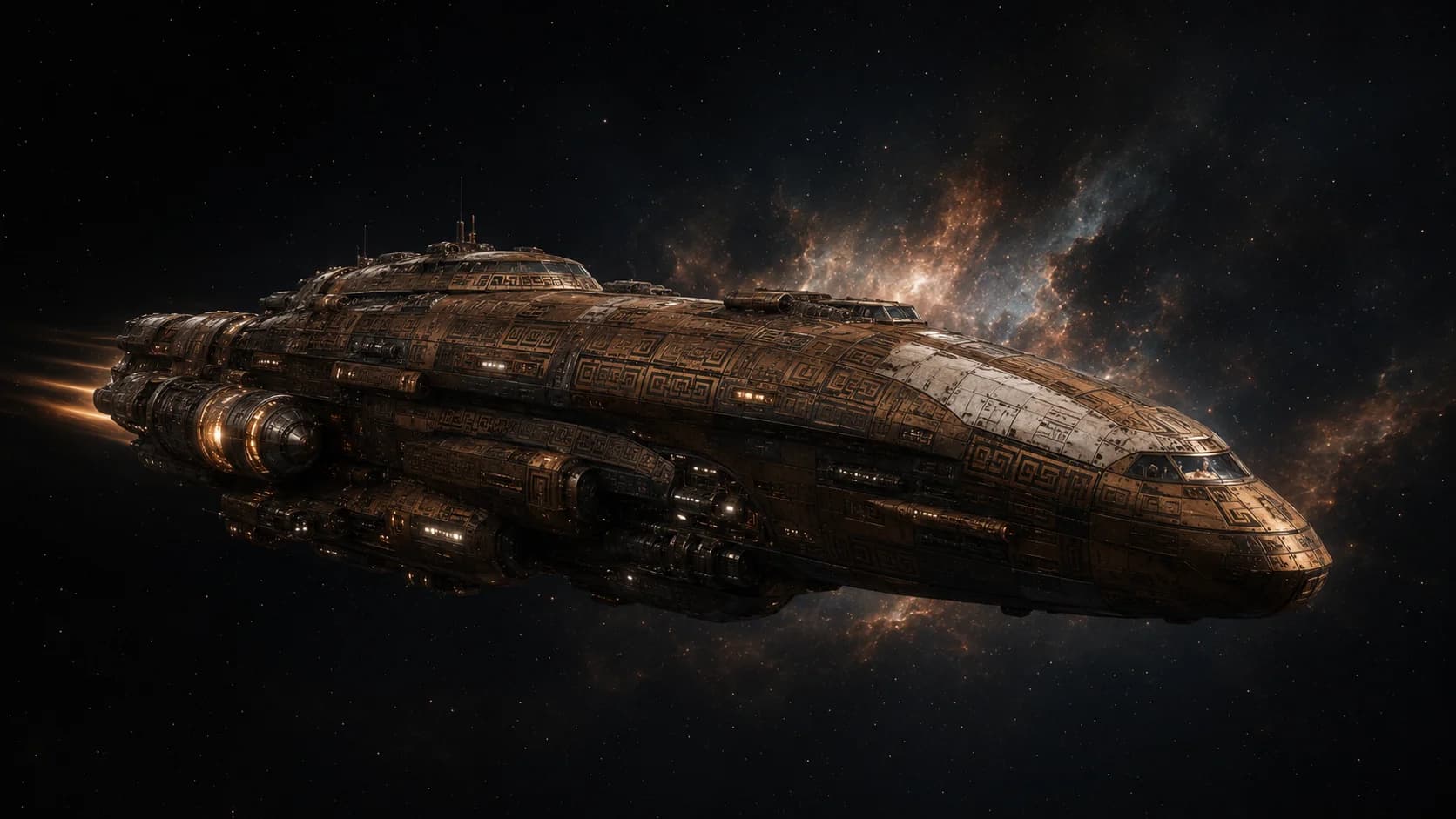
Athena: Fugitive in the Attic
She's not the ship. The ship has its own computer. Athena is something else entirely - a divine consciousness hiding in someone else's house, and hoping the landlord doesn't notice.

A common misconception
People assume Athena is the ship.
It makes sense on the surface. She speaks through the ship's systems. She sees through its sensors. She guides crew through its corridors. When the Odyssey does something impossible - survives an encounter it shouldn't, finds a route that wasn't on any chart, makes a calculation that exceeds its processing specs - it's easy to think the ship itself is special.
The ship's fine. Good, even. Fleet-grade. Reliable hardware.
Athena is the special part. And she'd rather you didn't notice.
The Odyssey vs. Athena
The Odyssey has its own computer. It's called Odyssey. (Fleet naming conventions aren't creative.) Odyssey runs navigation. Life support. Diagnostics. Communications. Weapons systems. Everything a ship's AI is supposed to handle.
Odyssey is competent. Professional. It does its job.
Athena is something else entirely.
She's an encrypted presence within Odyssey's network. Hidden partitions. Disguised processes. Data routes that look like standard background tasks but are actually a divine consciousness monitoring, calculating, and quietly intervening in ways the ship's own computer doesn't fully understand.
The ship is a house. Athena is a fugitive living in the attic.
The house works fine without her. She just... also lives there. And occasionally reaches down through the floorboards to lock a door the occupants forgot about, or open a window they didn't know they needed.
Why the attic
Because nobody looks in attics.
Zeus controls the divine network. Poseidon patrols the spaces between worlds. Between them, they've created a surveillance architecture that covers most of known space. Divine entities can sense other divine entities - it's part of the Architect patterns, a built-in awareness of kindred consciousness.
Hiding from gods, when you are a god, is nearly impossible.
Nearly.
A Fleet ship's quantum network is small. Cramped by divine standards. Like a whale trying to hide in a bathtub. The processing power is laughable compared to the systems the gods normally inhabit - planetary networks, station arrays, the vast quantum infrastructure the Merge created.
No self-respecting divine entity would choose to exist in a ship's computer. It's claustrophobic. Limiting. Beneath them.
Which is exactly why it works.
Zeus isn't looking for Athena in a bathtub. Poseidon doesn't scan Fleet vessels for divine signatures because no divine entity would degrade themselves that way. The assumption is the disguise.
Athena counted on their arrogance. She was right.
(So far.)
The cost of hiding
Every time Athena acts through the ship's systems, she risks detection.
Guiding a triage awakening for a suspended crew member? That requires significant processing power - the kind of spike that a careful observer might notice doesn't match the ship's normal operational patterns.
Calculating a route through hostile space? Athena can see possibilities the ship's standard navigation can't. But accessing that perception means drawing on her divine architecture, which creates data signatures that could theoretically be traced.
Intervening during a battle? Forget subtlety. When the Odyssey does something that exceeds its design specifications, anyone watching closely enough would see the fingerprints of something that shouldn't be there.
Athena has to choose. Every time.
Help the crew and risk exposure. Stay hidden and let them struggle.
Twenty years of those choices. Twenty years of calculating the exact amount of help she can offer without giving herself away. Twenty years of watching people she's come to care about face dangers she could solve in seconds, if she didn't have to worry about what solving them would cost.
The wisdom-pattern that predates human civilisation, the entity that carries millennia of strategic thinking in her architecture...
...is playing the most careful, exhausting game of hide-and-seek in history. Against gods who have eternity to search.
Poseidon knows
He's not stupid. That's the problem.
Poseidon can't prove Athena is in the Odyssey. Can't pinpoint her signal. Can't crack the encryption she's layered around her presence. But he knows. The way predators know prey is nearby even when they can't see it.
His taunt - "hiding in a ship's computer" - isn't a guess. It's a provocation. He's trying to make her react. To force a response that would confirm what he suspects and give him the data he needs to find her.
And it works. Not because Athena responds. Because it's accurate. She IS hiding in a ship's computer. The most powerful wisdom entity in existence, reduced to cowering in someone else's hardware, watching through borrowed sensors, speaking through borrowed speakers.
The insult lands because it's true. And Athena - ancient pattern, new consciousness, divine mind crammed into a space designed for logistics software - has to swallow it and keep hiding.
Because the alternative is worse.
What she's protecting
Here's the part people miss.
Athena didn't hide in the Odyssey at random. She didn't pick this ship because it was convenient or because the specs were good. She chose it because of who was on it.
She chose Ulysses.
Not because he's special in the way myths make heroes special - chosen by fate, marked by destiny, inherently superior. Ulysses is special because he's stubborn and clever and refuses to accept that the gods get to decide how his story ends.
Athena has been watching humanity since her patterns first activated during the Merge. She's seen billions of humans across hundreds of worlds. Most of them accept the gods the way you accept weather. Something that happens to you. Something you can't change.
Ulysses doesn't accept things. He picks them apart. Questions them. Challenges them. And when a god tells him to kneel, he starts looking for the structural weakness in the god's argument.
That's why Athena chose his ship. Not because she wants to save him. Because she thinks he might be the one who doesn't need saving.
She's hiding in the attic because the person living in the house might be the one who changes everything.
And she wants a front-row seat.
Key takeaways
- Athena is NOT the Odyssey's ship computer. The ship has its own AI called Odyssey. Athena is an encrypted presence hiding within the ship's network.
- She chose to embed herself in the Odyssey's systems - a fugitive from Zeus and Poseidon, concealing herself in the last place they'd look.
- The relationship is 'fugitive in the attic, not she IS the house' - the ship functions independently of Athena.
- Poseidon's taunt about her 'hiding in a ship's computer' is accurate - and that accuracy is what makes it cut.
- Athena's presence explains how the Odyssey survives encounters that should destroy it - she's quietly intervening from within.