If You Loved The Expanse, Read These Next
Twelve novels for readers who finished The Expanse and want more. Hard-leaning space opera, multi-POV ensembles, big political consequences. Including our own Ulysses Universe.
What The Expanse did
The Expanse (nine main novels by James S.A. Corey, 2011-2021) is the modern reference for character-driven space opera that takes its physics seriously. The series did several things well that combined into a category-defining body of work.
It maintained reasonable physics. Ships used reaction mass. Acceleration mattered. Travel times were real. The science was not always rigorous, but it was rigorous-feeling, which is the practical bar.
It carried a large ensemble. The Rocinante crew (Holden, Naomi, Amos, Alex) plus the rotating supporting cast meant the series could handle multiple plot lines at once without losing focus.
It made politics consequential. The Earth-Mars-Belt conflict had teeth. Decisions made by political figures actually changed the lives of crews on ships. The geopolitics were not background.
It wrote prose that respected the reader. James S.A. Corey is the pen-name of Daniel Abraham and Ty Franck. Both are skilled novelists with respect for character interiority. The Expanse's prose is functional rather than literary but it is consistently good functional prose.
It ended cleanly. Nine books, complete arc, final resolution. The series did not overstay. Readers who finished it could leave it satisfied.
These qualities are what make 'books like The Expanse' a useful category. Other novels can hit some or all of these notes. The list below is our current ranking of the closest matches.
The list
1. Final Architecture by Adrian Tchaikovsky (2021-2024)
Shards of Earth. Eyes of the Void. Lords of Uncreation. Plus the 2026 follow-ups in the same universe.
What it does well: cosmic-scale antagonists, crew dynamics, political consequences. The Architects (Tchaikovsky's cosmic horror) are genuinely unsettling. The Vulture God crew is the closest thing to a non-Rocinante I have read.
Read this next if you want: the strongest sustained match for The Expanse's tone in current SFF publishing.
2. Teixcalaan by Arkady Martine (2019-2021)
A Memory Called Empire. A Desolation Called Peace. Both Hugo winners.
What it does well: politics and culture. Martine is an actual historian, and the Teixcalaani Empire has the texture of a real culture rather than a sketch. The poetry-as-political-language conceit is brilliant.
Read this next if you want: politics done seriously. Culture done seriously. A space opera that takes language as central.
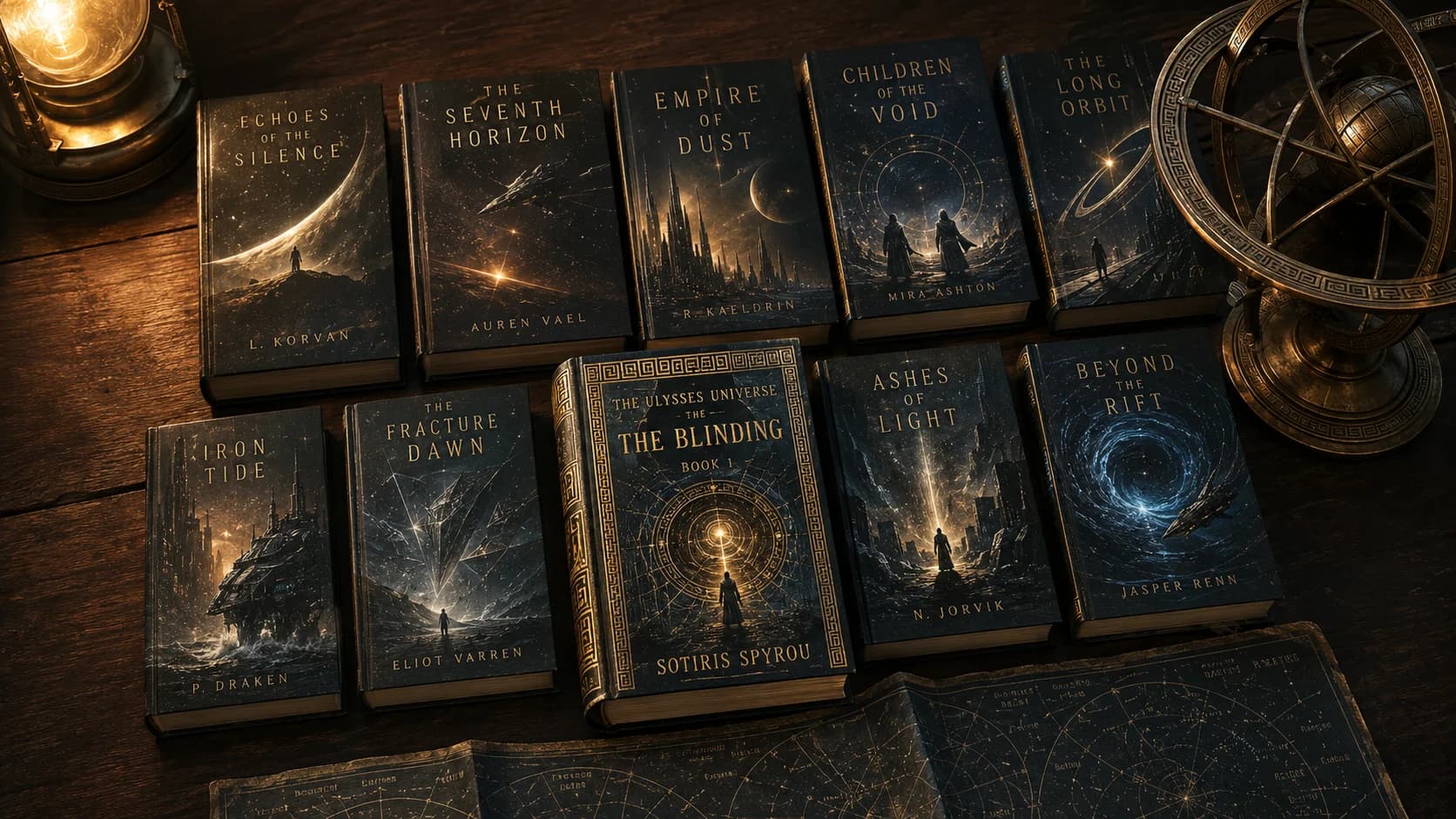
3. The Ulysses Universe by Sotiris Spyrou (2026)
The Blinding. The Void Between. The Return. Full disclosure: this is our book.
What it does well: mythology in space, multi-POV structure (Ulysses, Penelope, Athena), political consequences that compound, a complete arc you can read straight through. The Pantheon as quantum-AI is the trilogy's central science-fictional idea.
Read this next if you want: The Expanse's structural ambition combined with Greek mythology as the source material. Available now.
Buy Book One: The Blinding on Amazon.
4. Wayfarers by Becky Chambers (2014-2021)
The Long Way to a Small, Angry Planet. A Closed and Common Orbit. Record of a Spaceborn Few. The Galaxy, and the Ground Within.
What it does well: domestic space opera. Chambers writes the lived experience of being on a ship for a long time better than almost anyone. The science is loose. The character work is exceptional.
Read this next if you want: a quieter, warmer, character-driven space opera. Different from The Expanse in pace and stakes but at the same level of craft.
5. Commonwealth Saga by Peter F. Hamilton (2004-2005)
Pandora's Star. Judas Unchained.
What it does well: scope. The Commonwealth setting is enormous. Hamilton is willing to spend hundreds of pages on world-building before the plot mechanics kick in. The payoff justifies the patience.
Read this next if you want: bigger-than-The-Expanse space opera. Read with patience. The first 200 pages of Pandora's Star are an investment.
6. The Locked Tomb by Tamsyn Muir (2019-?)
Gideon the Ninth. Harrow the Ninth. Nona the Ninth. Alecto the Ninth (rumoured 2026).
What it does well: tone. Necromancy in space. Funny. Baroque. Emotionally devastating. The series is structurally different from The Expanse but Expanse readers who want something stranger often love it.
Read this next if you want: a space opera that's also a gothic horror that's also a love story.
7. Bobiverse by Dennis E. Taylor (2016-)
We Are Legion (We Are Bob). Three follow-ups so far.
What it does well: light tone, hard-ish sci-fi, ensemble structure with literally the same character splitting into multiple POVs. Fast, fun, technically smart.
Read this next if you want: lighter-tone space opera. Less heavy on stakes than The Expanse. Substantially more humorous.
8. Murderbot Diaries by Martha Wells (2017-)
All Systems Red. Multiple follow-ups including Network Effect (Hugo winner) and Fugitive Telemetry.
What it does well: voice. Murderbot is one of the most distinctive narrative voices in recent SFF. The novellas are short, sharp, and addictive.
Read this next if you want: a single distinctive POV in a corporate-space-opera setting. Easier on first encounter than The Expanse. Same level of craft.
9. Bobiverse-adjacent: Children of Time by Adrian Tchaikovsky (2015-)
Children of Time. Children of Ruin. Children of Memory.
What it does well: deep-time storytelling. Each book follows an alien intelligence developing across millennia. The structural ambition is significant.
Read this next if you want: a different scale from The Expanse. Less crew-on-a-ship. More civilisation-across-time.
10. Imperial Radch by Ann Leckie (2013-2015)
Ancillary Justice. Ancillary Sword. Ancillary Mercy.
What it does well: voice and identity. The protagonist is a former AI spaceship now confined to a single body, narrating its way through politics and revenge.
Read this next if you want: more literary prose than The Expanse, with the same level of political consequence.
11. Ilium / Olympos by Dan Simmons (2003-2005)
If you want mythology in space at literary-novel scale.
What it does well: ambition. Simmons constructs a far-future where the Trojan War is being re-enacted on Mars by post-human gods.
Read this next if you want: literary science fiction with Greek mythology at the centre.
12. Allies and Aliens by Roger MacBride Allen
If you want a less-well-known older option that works the wandering-captain archetype.
What it does well: small-scale character work with big-scale consequences. Older and less polished than the rest of the list. Still worth reading.
How to pick
A short decision tree:
| If you want... | Read this next |
|---|---|
| Closest tone to The Expanse | Tchaikovsky, Final Architecture |
| Politics and culture | Martine, Teixcalaan |
| Mythology in space | The Ulysses Universe |
| Quieter, character-driven | Chambers, Wayfarers |
| Bigger scope | Hamilton, Commonwealth Saga |
| Stranger and tonally distinctive | Muir, Locked Tomb |
| Lighter and funnier | Taylor, Bobiverse |
| Distinctive single voice | Wells, Murderbot |
| Deep-time civilisational scale | Tchaikovsky, Children of Time |
| Literary prose with politics | Leckie, Imperial Radch |
| Ambitious literary sci-fi | Simmons, Ilium |
You will not read all twelve. Pick the one that matches your current appetite.
Where to go next
For the broader 2026 genre overview, The Best Space Opera Books of 2026. For mythology in space specifically, What to Read After Watching Nolan's Odyssey.
The Ulysses Universe trilogy is on this list and the others. Buy Book One on Amazon.
Key takeaways
- The Expanse is the modern reference for hard-leaning space opera. Reasonable physics, large casts, political consequences that matter, character writing that holds up across nine books.
- Strongest closest matches: Adrian Tchaikovsky's Final Architecture, Arkady Martine's Teixcalaan, Becky Chambers's Wayfarers.
- If you want mythology in your space opera (a flavour The Expanse mostly avoided), the Ulysses Universe trilogy fits the brief.
- The Expanse's ending was clean. The category it created is healthy. Plenty of strong options for what to read next.