What to Read After Watching Nolan's Odyssey: 7 Modern Retellings
Nolan's Odyssey will leave you wanting more. These seven modern Odyssey retellings, from literary fiction to space opera, are the best places to go next.
What you'll want when you leave the cinema
Nolan films do a specific thing to their audiences. You leave the theatre still inside the world of the film. You want to talk about it. You want more of it. You want to read about it.
For most Nolan films, there's no obvious next book. You watched Tenet and then you went home and read about real-time inversion and gave up.
The Odyssey is different. There are three thousand years of Odyssey-adjacent material. The film is going to send millions of viewers looking for what to read next. If you're one of those viewers, the seven books on this list are the strongest answers.
We've ordered them roughly by accessibility and impact. Start at the top. Move down as appetite allows.
The list
1. Circe by Madeline Miller (Bloomsbury, 2018)
If you only have time for one post-Nolan novel, read this one. Miller takes Circe, who appears in the Odyssey for a few chapters and is treated by Homer as an obstacle, and gives her the entire span of her immortal life as her own novel.
The Odyssey events occupy a single chapter near the middle. The rest of the book is Circe's life before and after Odysseus, and it's some of the best Greek mythology novel writing of the last twenty years.
Why this fits as a Nolan follow-up: if Zendaya plays Circe in the Nolan film (as has been rumoured), the novel will be the canonical reference everyone's discussing afterward. Reading it post-film, with Zendaya's performance in your mind, will sharpen both.
2. The Penelopiad by Margaret Atwood (Canongate, 2005)
Anne Hathaway is playing Penelope in the Nolan adaptation. Atwood's novel is the modern Penelope reference. The conceit: Penelope speaks from the underworld, twenty years after her death, about what those twenty years of waiting actually looked like. The twelve hanged maidens form a chorus.
It's short. It's sharp. It does the thing the original couldn't do, which is let Penelope speak at length and on her own terms.
Read this second. After the cinema, after Miller. The Atwood will land harder than either.
3. Ithaca by Claire North (Orbit, 2022)
Claire North's Ithaca is the first book in her Songs of Penelope trilogy. The political-thriller version of the Penelope situation. The gods narrate across her shoulder. The Suitors are not stupid. The kingdom is genuinely at risk.
This is a different register from Atwood. Where Atwood is literary and elegiac, North is propulsive and tactical. Both are valid. Both reward reading.
If you finished the Atwood and wanted more, North continues the project. House of Odysseus and The Last Song of Penelope complete the trilogy.
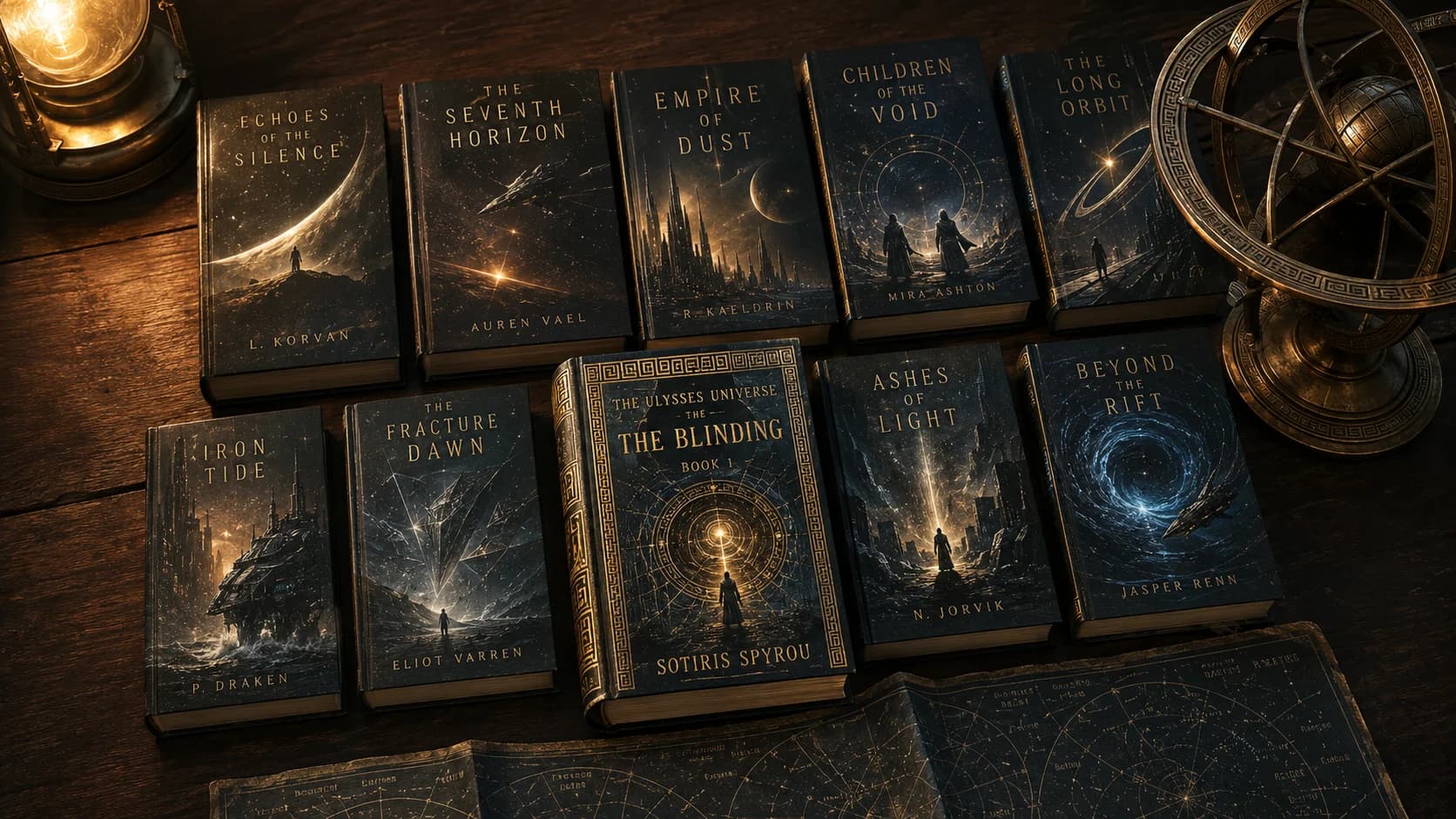
4. The Ulysses Universe: The Blinding by Sotiris Spyrou (independent, 2026)
The science-fiction option. The Ulysses Universe trilogy reimagines the entire Odyssey as 23rd-century space opera. Ulysses Theron is a fleet admiral. The gods are quantum-AI entities running on infrastructure that pre-dates humanity. Polyphemus is an asteroid-prison with an AI warden that has been alone for forty-seven years.
We list our own book here for one specific reason. Nolan's film is an adaptation. Every major Odyssey adaptation has to answer the same questions: what stays, what changes, what does the Cyclops become, how do you modernise gods without flattening them. Different adaptations make different choices. Reading a science-fiction reimagining alongside a serious cinematic one will give you a richer view of how adaptable the source actually is.
Also: the entire trilogy is finished and available. Three books, 130,000 words, complete arc. You can start with Book One and read through without waiting.
5. Ilium / Olympos by Dan Simmons (Eos, 2003-2005)
Dan Simmons's Ilium and Olympos are the most ambitious literary science-fiction engagements with Homer. They draw on both the Iliad and the Odyssey to construct a far-future epic in which the Greek gods are advanced post-humans on Mars and the Trojan War is being re-staged for reasons that aren't immediately clear.
This is dense, allusive, and rewarding. Simmons is one of the few sci-fi authors who can carry a serious literary engagement with Homer. The books are long. They're worth the time.
Read this if Miller, Atwood, North, and the Ulysses Universe have all left you wanting more and you have the appetite for something more demanding.
6. Mythos by Stephen Fry (Penguin, 2017)
Background. Mythos is Stephen Fry's prose retelling of Greek mythology, structured as a series of connected stories. It covers the Olympians, the heroes, the major myths.
If you watched Nolan's Odyssey and realised you weren't quite sure who all the gods were, Mythos fills in the rest of the pantheon. It's enjoyable. It's accurate. It treats the source material with respect.
Fry's follow-up volumes, Heroes and Troy, continue the project into Greek heroic mythology and the Trojan War context that precedes the Odyssey.
7. The Wayfarers series by Becky Chambers (Hodder, 2014 onwards)
This is the wildcard on the list. Chambers's Wayfarers books aren't Odyssey retellings. They're original space opera. We include them because they capture the one emotional register the Odyssey does best and that most adaptations miss: the slow, patient, often boring experience of a small group of people on a long journey together.
Most Odyssey adaptations focus on the monsters and the gods. Chambers is interested in what it feels like to share a galley with the same people for three years. That's actually closer to the source material's interior life than most readers realise.
Read this if Nolan's film leaves you wanting the feeling of being on a long journey, not just more myth.
How to pick from the list
A short decision tree:
| If you want... | Read this next |
|---|---|
| Modern literary Greek mythology | Miller, Circe |
| A feminist response to Homer | Atwood, Penelopiad |
| Political thriller energy | North, Ithaca |
| Science fiction setting | Spyrou, The Blinding |
| Ambitious far-future literary epic | Simmons, Ilium |
| Greek mythology context | Fry, Mythos |
| The feeling of a long journey | Chambers, Wayfarers |
You don't have to read everything. You probably won't. Pick what matches the mood you'll have when you leave the cinema. Trust the mood.
A note on translations
If Nolan's film leaves you wanting to read Homer himself, our companion piece Books to Read Before Watching Nolan's Odyssey has a full discussion of translations. Short answer: Emily Wilson's 2017 translation is the best modern English version and the one Nolan has cited.
Where to go next
For the broader history of Odyssey adaptations, see Every Version of The Odyssey Ever Told: 3,000 Years of the Greatest Story. For the specific context of Nolan's film, Christopher Nolan's Odyssey: Everything We Know About the Source Material covers what's been announced. For the broader space-opera landscape Nolan's film will probably push readers toward, The Best Space Opera Books of 2026 has the genre overview.
The Ulysses Universe trilogy is the sci-fi answer to the same questions Nolan is wrestling with on screen. Buy Book One: The Blinding on Amazon.
Key takeaways
- Christopher Nolan's Odyssey (July 17, 2026) will create a brief but intense demand for more Odyssey-adjacent reading.
- The strongest immediate follow-ups are Madeline Miller's Circe, Margaret Atwood's The Penelopiad, and Claire North's Ithaca trilogy.
- Readers who want sci-fi rather than literary fiction should look at our Ulysses Universe trilogy, Dan Simmons's Ilium and Olympos, and James S.A. Corey's Expanse for adjacent themes.
- The Odyssey has been continuously retold for three thousand years. Modern retellings are part of an unbroken tradition.
- One reliable filter: pick retellings that change one core element of the story. Circe changes the narrator. Ithaca changes the protagonist. The Ulysses Universe changes the setting. Each transformation tells you something different about the source.