Books to Read Before Watching Christopher Nolan's Odyssey
Christopher Nolan's Odyssey hits cinemas July 17, 2026. The seven books on this list will get you ready, deepen the experience, and answer most of the questions the film will raise.
Why a reading list before the film
A great adaptation rewards a prepared audience. Christopher Nolan's Odyssey is being made by the most ambitious mainstream filmmaker working today, with a $250 million budget, an A-list cast, and IMAX cameras shooting in real Mediterranean locations. The footage already released suggests Nolan is taking the source material seriously.
If you turn up at the cinema on 17 July without having read anything, you'll have a good time. The story is famous for a reason.
If you turn up having read the source material and a few of the best modern responses to it, you'll have roughly twice the experience. You'll see the choices Nolan is making. You'll catch the references. You'll notice what he's dropped, what he's added, and what he's reimagined. That's the difference between watching a film and participating in a conversation about it.
Six weeks is enough to read the seven books below. The release is sixty-four days away. Plenty of time.
The list
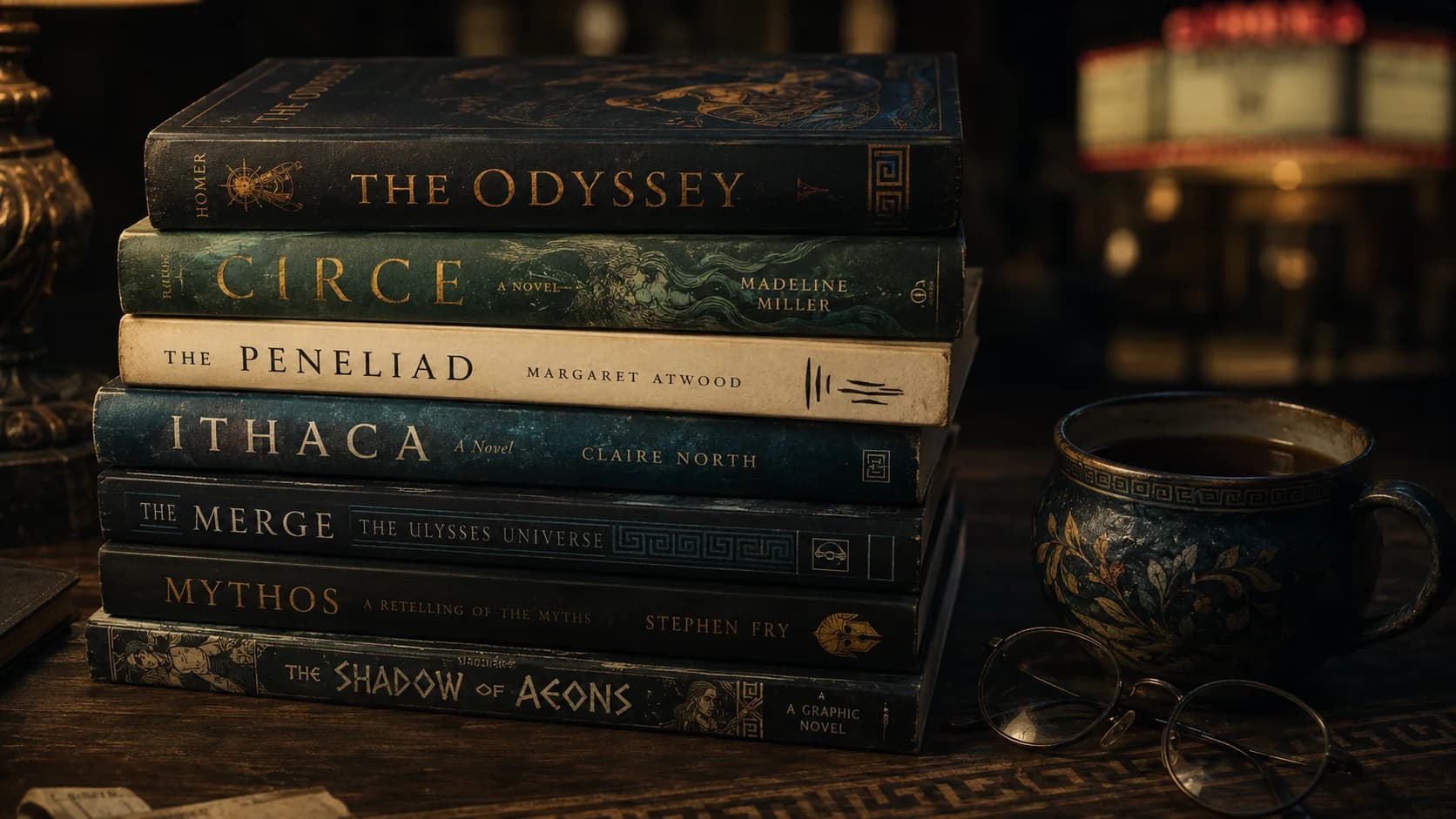
1. The Odyssey, translated by Emily Wilson (Norton, 2017)
This is the starting point. Wilson's translation is the most readable modern English version of Homer, and Nolan has cited it as direct inspiration. The verse moves at a pace that doesn't slow modern readers down. The introduction is genuinely useful. The notes are extensive without being pedantic.
What you get: the original story. A king tries to get home from a war. The journey takes ten years. Gods help him. Other gods hinder him. His wife holds the kingdom together. His son grows up. The reunion, when it comes, is one of the great scenes in Western literature.
Why this version specifically: Wilson is the first woman to translate the Odyssey into English, and her translation makes choices the older male translators didn't. The depiction of Penelope, the slave women, and Circe in particular is sharper and more honest. If Nolan is drawing on Wilson, you should be too.
Read this first. Read this even if you read nothing else on the list.
2. Circe by Madeline Miller (Bloomsbury, 2018)
Circe appears in the Odyssey for a few chapters. She turns Odysseus's men into pigs, sleeps with Odysseus, and sends him on his way after a year. Homer treats her as an obstacle and a temptation.
Madeline Miller gives Circe her own novel. The book covers her entire immortal life, with Odysseus appearing as one chapter in a much longer story. The result is one of the best Greek mythology novels of the last twenty years and a model for how to take a side character seriously.
Why read it before the film: Zendaya is rumoured to be playing Circe in Nolan's adaptation. Knowing the full Miller version of the character will change how you watch Zendaya's performance. Circe has also become the canonical modern Circe. Anyone working on the character now is working in dialogue with this book.
3. The Penelopiad by Margaret Atwood (Canongate, 2005)
Penelope's perspective. The Odyssey gives her a few scenes. Atwood gives her a whole book and lets her speak from the underworld, twenty years after her death, about what those twenty years of waiting actually looked like.
Anne Hathaway is playing Penelope in the Nolan adaptation. Atwood's book is the modern reference for the character. It is also the best demonstration of how a marginal Homeric character can carry an entire novel.
Read this third. After you've read Wilson's Penelope, Atwood's Penelope will hit harder.
4. Ithaca by Claire North (Orbit, 2022)
Claire North's Ithaca is the first book in her Songs of Penelope trilogy. It covers the years before Odysseus's return from Penelope's perspective on Ithaca, with the gods narrating across her shoulder.
This is the most recent major novelistic engagement with the Penelope-and-suitors situation, and it does something the others don't: it takes seriously the political problem of holding a kingdom together when your husband is missing and presumed dead.
If the Atwood is the literary version, the North is the political-thriller version. Both are valuable. Both are short. Read them back to back if you have time.
5. The Ulysses Universe: The Blinding by Sotiris Spyrou (independent, 2026)
A direct piece of self-promotion, and we'll be transparent about that. The Ulysses Universe trilogy reimagines the entire Odyssey as a 23rd-century space opera. The gods are quantum-AI entities. Polyphemus is an asteroid-prison with an AI warden. The Sirens are a signal that rewrites your memories. Ithaca is a station.
We mention it on this list because Nolan is being asked to adapt the Odyssey for a modern audience and a different medium. Every modern Odyssey adaptation wrestles with the same questions: what stays, what changes, what does the Cyclops become, what does Penelope do that the original underrated. The Ulysses Universe is one author's answers. Nolan will have different ones. Reading our answers will help you see his.
You can start with Book 1 on Amazon.
6. Mythos by Stephen Fry (Penguin, 2017)
Background. If you want to understand who Zeus, Poseidon, Athena, and the other Olympians are before you read the Odyssey, Fry's Mythos is the most enjoyable modern overview of Greek mythology.
Fry is funny, accurate, and respectful of the source material. The book is structured as a series of myths told in modern prose. It's not a scholarly text, but it's also not dumbed down. It's the right level of background reading for an adult coming to Greek mythology after a long absence from school.
7. The Odyssey: A Graphic Novel by Gareth Hinds (Candlewick, 2010)
Visual aid. If you want to anchor the journey geographically and the characters visually before the film, Gareth Hinds's graphic novel of the Odyssey is the best illustrated version available. The art is accurate to historical sources. The pacing follows Homer closely.
Useful as a refresher after Wilson, or as a primer if you're not sure you'll finish a 480-page verse epic.
How to read the list
A reading order that works for most people:
| Order | Book | Why this position |
|---|---|---|
| 1 | Wilson's Odyssey | The source. Read it first. |
| 2 | Fry's Mythos | Optional context. Skip if you already know your Olympians. |
| 3 | Miller's Circe | The Circe reference for the modern era. |
| 4 | Atwood's Penelopiad | The Penelope reference. |
| 5 | North's Ithaca | The political-thriller Penelope. |
| 6 | The Ulysses Universe: The Blinding | The sci-fi adaptation. |
| 7 | Hinds's graphic novel | Visual refresher in the final week before the film. |
This sequence builds from the original through the most influential modern responses. By the time you finish, you'll have read the Odyssey, two definitive feminist retellings, a contemporary political reimagining, a science-fiction adaptation, and a graphic refresher. You'll walk into the cinema in July with the cultural and literary context most viewers won't have.
That's the prize.
A note on time
Six weeks. Forty-five minutes a day. Seven books. The math works.
If you don't have time for everything: Wilson's Odyssey and Miller's Circe. Those two will carry you through 80% of the film's references.
If you only have time for one book: Wilson's Odyssey. Without question.
Where to go next
For a comparison of every Odyssey adaptation in history, see Every Version of The Odyssey Ever Told. For background on what Nolan is actually adapting and how it differs from the broader Greek mythology context, read Christopher Nolan's Odyssey: Everything We Know About the Source Material. For sci-fi readers who want to know what to read after the Nolan film as well, What to Read After Watching Nolan's Odyssey: 7 Modern Retellings is the companion piece to this one.
For the sci-fi retelling we ourselves are most familiar with: Buy Book One: The Blinding on Amazon.
Key takeaways
- Christopher Nolan's Odyssey releases July 17, 2026. Reading the source material first will roughly double the depth of the experience.
- Start with Emily Wilson's 2017 translation. Nolan has cited it as direct inspiration and it's the most readable modern English version of Homer.
- Madeline Miller's Circe and Margaret Atwood's The Penelopiad give you the two perspectives Homer left out: the witch and the wife.
- If you want sci-fi context for Nolan's adaptation, our own Ulysses Universe trilogy puts the entire Odyssey in space and answers some of the same adaptation questions Nolan is wrestling with.
- Time-wise, you can read all seven in roughly six weeks. That fits comfortably between now and the July release.