Argos the Dog: The Most Heartbreaking Scene in the Odyssey
Twenty years. One old dog. A wagging tail. Three lines of Homer that have made readers weep for three thousand years. The Argos scene explained.
The scene
Book 17. Odysseus has returned to Ithaca after twenty years. He is disguised as a beggar by Athena. The disguise is necessary: if the suitors recognise him before he is ready to act, they will kill him. He must move through his own home unrecognised by the people who knew him before.
He arrives at the palace with Eumaeus the swineherd, who has been told nothing but treats the beggar with proper xenia. They approach the palace gates.
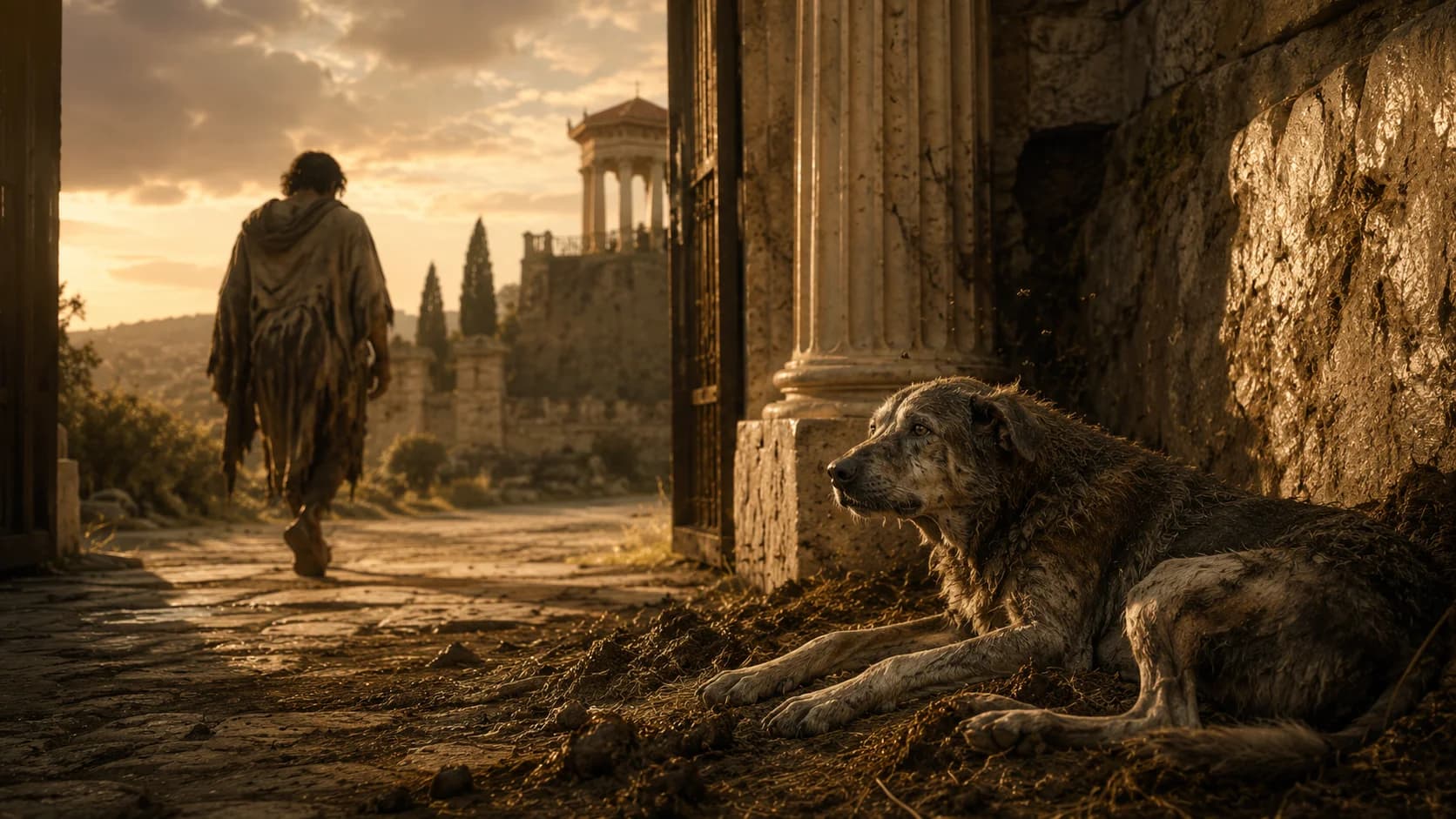
There is a dog lying on a dung heap by the gate.
The dog is old. He is covered in flies. His coat is matted. He has not been brushed or cared for in years. He cannot lift his head. He cannot rise.
Eumaeus tells the beggar that the dog is Argos. Odysseus's hunting dog, from before he left for Troy. The best hunting dog in Ithaca in his day. Reduced now to this because nobody has cared for him.
The beggar looks at the dog. The dog looks back.
The dog recognises him.
Argos cannot rise. He cannot bark. He cannot do anything except what twenty years of failing body still allows: he wags his tail. His ears, drooping, lift very slightly. His eyes, which had been closing, open one more time.
Odysseus, in the beggar's disguise, cannot acknowledge him. The disguise depends on no one recognising him. If the beggar suddenly shows recognition of the king's old dog, the cover breaks.
He turns his head. The text is explicit: he wipes away a tear. He cannot let Eumaeus see. He hides his face.
Then he walks past.
Argos, having seen his master one last time, dies.
The economy of Homer's prose
Homer writes this in 37 lines. Roughly half a page in modern translation. He does not extend the scene. He does not pause for elaboration. He does not have characters comment on the emotional weight. He simply presents the events.
The economy is the point. A longer treatment would become sentimental. The short, hard description is more devastating than any extended treatment could be. Homer trusts the reader to feel the weight without being told what to feel.
This trust is one of the Odyssey's structural strengths. Homer's emotional set pieces are short. The Argos scene. The recognition with Penelope. The marriage-bed test. Each lands in a small number of lines and then moves on. The reader does the work.
Modern writers can learn from this. The temptation in writing emotional scenes is to extend them, to add description, to underscore the weight. Homer does the opposite. The compression is what makes the scene survive three thousand years of translation and adaptation.
What the scene argues
The Argos scene is not just emotional pathos. It is structural argument. The dog's recognition is the first recognition Odysseus receives on Ithaca. It comes from a non-human. It is silent. It costs the dog his life. It costs Odysseus the chance to acknowledge it.
The argument: recognition by those who knew you before requires their continued attention across the time you have been away. Argos has paid attention for twenty years. He has waited. The waiting has cost him: he is old, neglected, lying on a dung heap. The recognition is real. The price of being able to recognise is the price of waiting.
The humans on Ithaca have mostly stopped waiting. Penelope still waits, but she has had to wait politically rather than emotionally. The suitors have stopped any pretence of waiting. The other servants have largely accommodated themselves to the new order. Only Argos has waited without compromise.
The dog gets the first recognition because the dog has done the work the humans have stopped doing.
Why dogs and not humans
Several ancient and modern traditions treat dogs as the canonical example of loyal recognition across time and distance. The Odyssey's Argos scene is one of the founding texts of this tradition.
The reason is partly biological. Dogs recognise their humans through scent, gait, and voice rather than primarily through visual appearance. These senses are less affected by aging or by the kind of disguise Athena gives Odysseus. A dog's recognition holds against the changes that fool human recognition.
The reason is partly literary. A dog's loyalty is not contingent on the dog's understanding of the social situation. Argos does not know about the suitors, about the political pressure on Penelope, about Odysseus's twenty-year journey. He simply knows his master. The simplicity of the loyalty is what makes it readable as pure.
A human servant who recognised Odysseus immediately would have political complications. They would have to decide whether to acknowledge him, whether to keep the secret, whether to help. The dog has no such complications. The dog only has the recognition.
How readers have responded
Three thousand years of readers have wept at the Argos scene. The scene is one of the most-cited examples of pathos in ancient literature. It appears in countless anthologies, commentaries, and citations. It has shaped the broader Western tradition of dog-and-master narratives.
In modern adaptation, the scene is almost always preserved. Most film and television versions of the Odyssey include it. The 1997 Konchalovsky miniseries includes a brief version. The Coen brothers' O Brother, Where Art Thou? includes a structural echo. The Ulysses Universe trilogy includes our own version.
The scene survives every adaptation because the basic emotional architecture is portable. Loyal animal. Long absence. Recognition that comes too late. The architecture is older than language. Homer formalised it. The form has not aged.
The Ulysses Universe version
Our Argos is a drone, not a biological dog. The structural function is preserved. He was left behind on Ithaca Station when Ulysses fled. He has been operating at minimal power for twenty years, waiting. When Ulysses returns, Argos is the first being on the station to recognise him.
The recognition is mechanical rather than biological. The wagging tail is a servo function that the drone's degraded electronics still permits. The death is the final failure of those electronics. The visual register is canine throughout.
We made this choice because biological pets in a 23rd-century space-station setting would have read as costume. A drone with canine architecture, operating on loyalty programming that has lasted twenty years past its expected service life, is the closest we could come to preserving the Homeric scene's weight in the trilogy's setting.
For our version, see Argos: Twenty Years, the existing blog post on the trilogy's Argos.
Where to go next
For the Odyssey's structural overview, The Odyssey Summary: Book by Book Breakdown. For the broader homecoming sequence, How Does the Odyssey End?. For the trilogy's Argos scene, Argos: Twenty Years.
The Ulysses Universe trilogy contains its version of the Argos scene in Book 3. Buy Book One on Amazon to start at the beginning.
Key takeaways
- Argos is the old hunting dog of Odysseus. When Odysseus returns to Ithaca disguised as a beggar after twenty years, Argos is the first being on the island to recognise him.
- The dog has been neglected for twenty years. He is lying on a dung heap, covered in flies, barely alive.
- He recognises Odysseus. He wags his tail. He cannot rise. He dies.
- Odysseus, in disguise, cannot acknowledge him without giving himself away. He turns his head to hide the tear and walks past.
- The scene is one of the most-quoted moments of pathos in Western literature. Three thousand years of readers have wept at it.