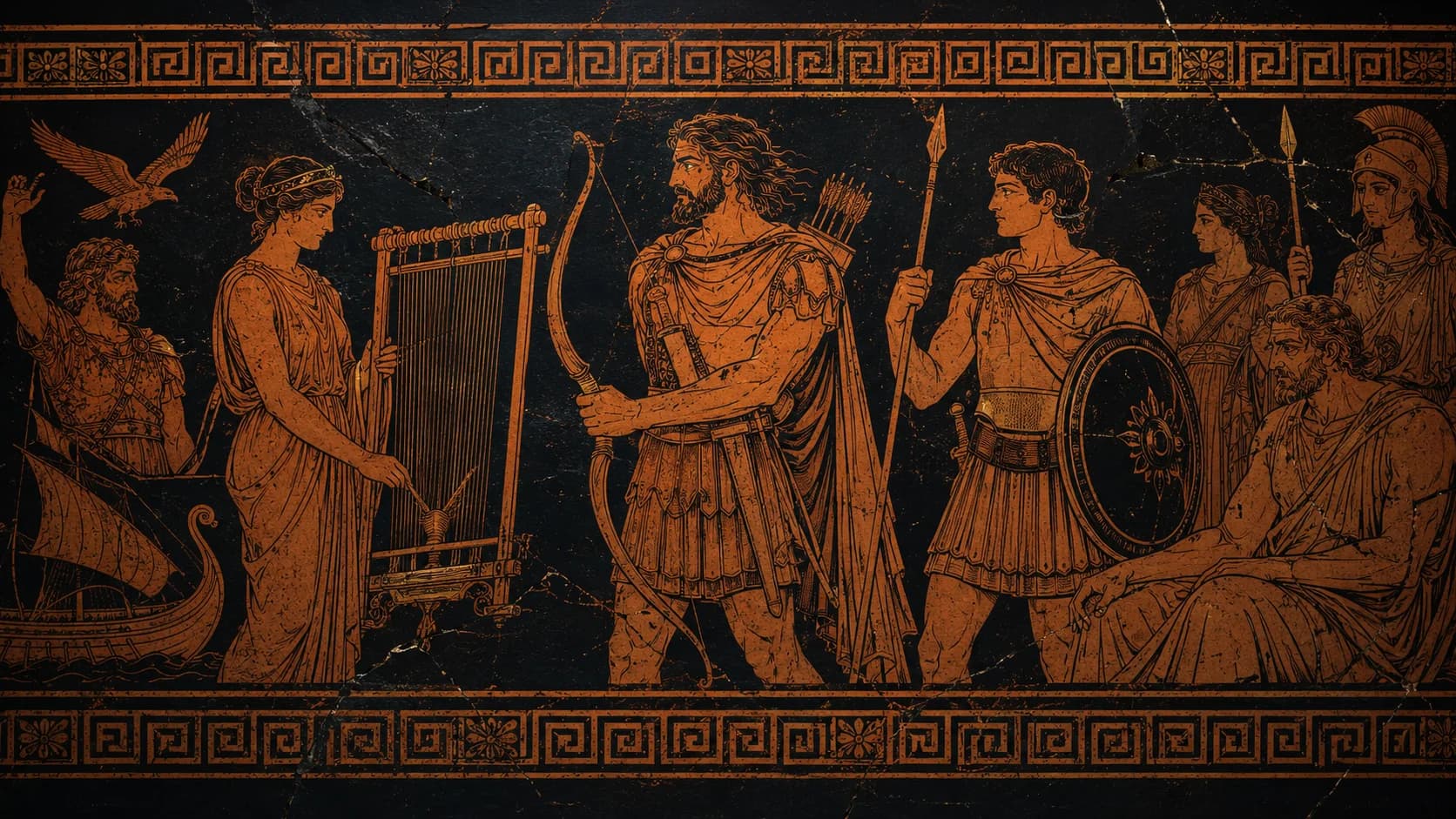
The Odyssey Summary: Book by Book Breakdown
All 24 books of Homer's Odyssey summarised, with the major events, key characters, and themes of each. A complete chapter-by-chapter guide for readers and students.
The structure
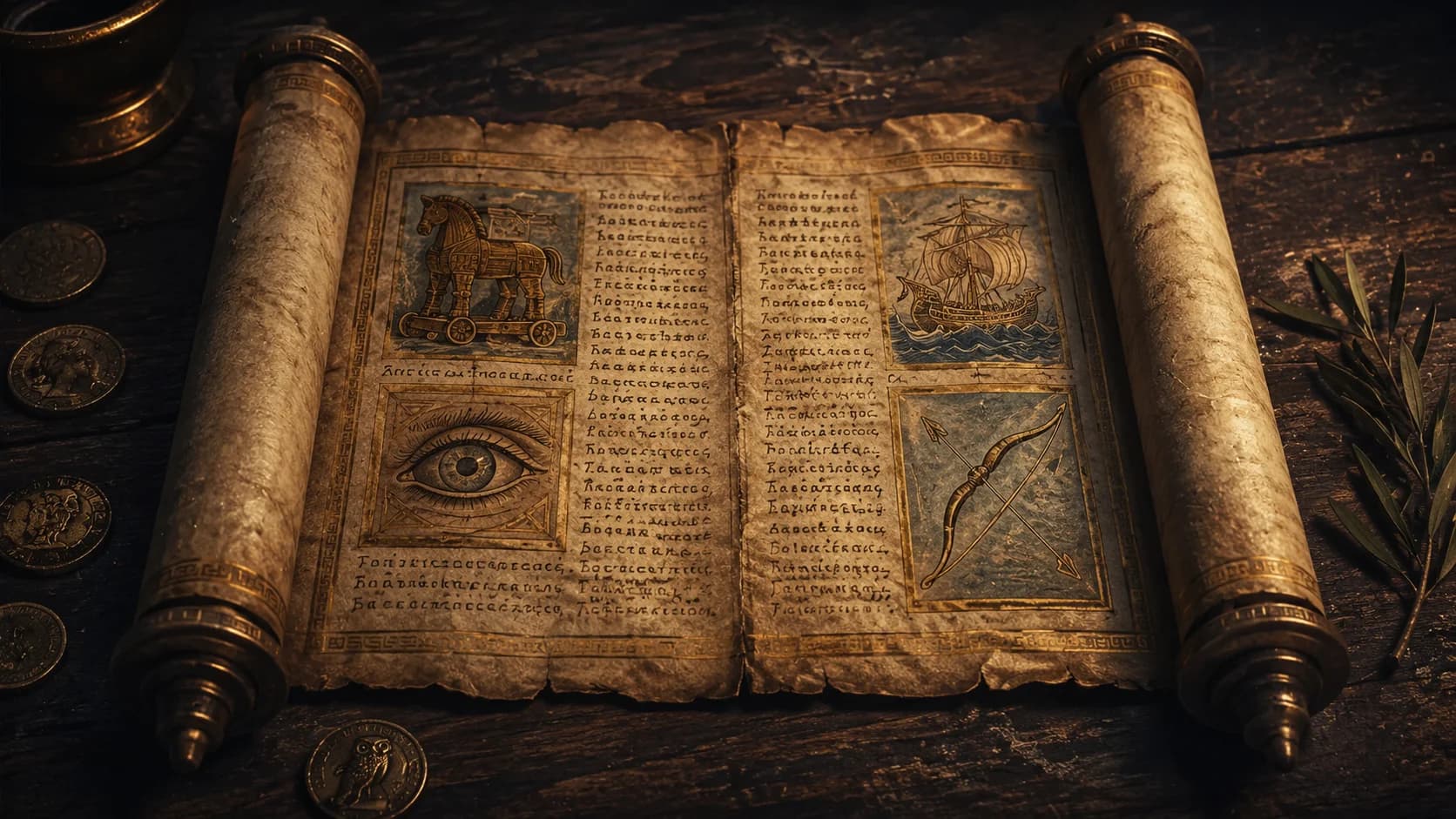
The Odyssey divides naturally into three parts. The Telemachy (Books 1-4) focuses on Telemachus. The adventures (Books 5-12) cover Odysseus's journey home, mostly recounted in flashback. The homecoming (Books 13-24) covers his return to Ithaca and the events that follow.
The structure is non-linear. The poem opens in the middle of the story, jumps backward and forward in time, and uses extensive flashback to fill in events between Troy and the present. This was unusual for ancient epic and is one reason the Odyssey reads as more modern in feel than the Iliad.
The Telemachy (Books 1-4)
Book 1. The gods discuss Odysseus's plight in council. Poseidon, who is hunting Odysseus, is briefly absent. Athena seizes the opportunity to petition Zeus for Odysseus's release from Calypso. Zeus agrees. Athena goes to Ithaca, where she visits Telemachus in disguise as Mentes, an old family friend. She urges him to look for news of his father. The book introduces the suitors who have moved into the palace.
Book 2. Telemachus convenes the assembly of Ithaca and denounces the suitors. The suitors deflect. Athena, now in the disguise of Mentor, helps Telemachus organise a ship and crew for his journey.
Book 3. Telemachus arrives at Pylos and meets Nestor, a Greek elder and survivor of the Trojan War. Nestor offers what news he has and sends Telemachus on to Sparta. The chapter establishes the Greek heroes who fought at Troy and what has become of them.
Book 4. Telemachus arrives in Sparta and meets Menelaus and Helen. Menelaus tells him the most recent news of Odysseus: that he is trapped on Calypso's island. Telemachus learns of plots against his life by the suitors and prepares to return home.
The adventures (Books 5-12)
Book 5. Hermes arrives at Calypso's island Ogygia with Zeus's order to release Odysseus. Calypso protests but complies. Odysseus builds a raft and leaves. Poseidon, returning from his absence, sees Odysseus at sea and sends a storm. Odysseus washes up on the shore of the Phaeacians.
Book 6. Nausicaa, the Phaeacian princess, finds Odysseus on the shore. She brings him to her father's palace.
Book 7. Odysseus meets King Alcinous and Queen Arete of the Phaeacians. He is welcomed without yet revealing his identity.
Book 8. The Phaeacians hold a feast with athletic contests and a recital by the blind bard Demodocus, who sings of the Trojan Horse. Odysseus weeps. Alcinous asks who he is.
Books 9-12. Odysseus tells the Phaeacians his story. This is the longest single sustained narrative in the poem.
- Book 9. The Cicones (a raid that goes wrong, with crew losses). The Lotus Eaters (men who lose their will to return home). The Cyclops Polyphemus (whose blinding triggers Poseidon's grudge).
- Book 10. The Laestrygonians (cannibal giants who destroy most of Odysseus's fleet). Aeolus (who gives the bag of winds, which the crew open prematurely). Circe (who turns men into pigs, then becomes ally and lover).
- Book 11. The descent to the underworld. Odysseus consults Tiresias and speaks with the dead.
- Book 12. The Sirens. Scylla and Charybdis. The cattle of the sun god Helios (which the crew eat, causing their final destruction). Odysseus survives alone, reaching Calypso's island.
The homecoming (Books 13-24)
Book 13. The Phaeacians transport Odysseus to Ithaca in their magical ships. They deposit him sleeping on the shore. Athena meets him, disguises him as an old beggar, and tells him the political situation.
Book 14. Odysseus visits Eumaeus the swineherd, who does not recognise him but extends genuine hospitality. They talk through the night.
Book 15. Telemachus returns from Sparta. The suitors plan an ambush. Telemachus arrives safely.
Book 16. Father and son are reunited at Eumaeus's hut. They plan the slaughter together.
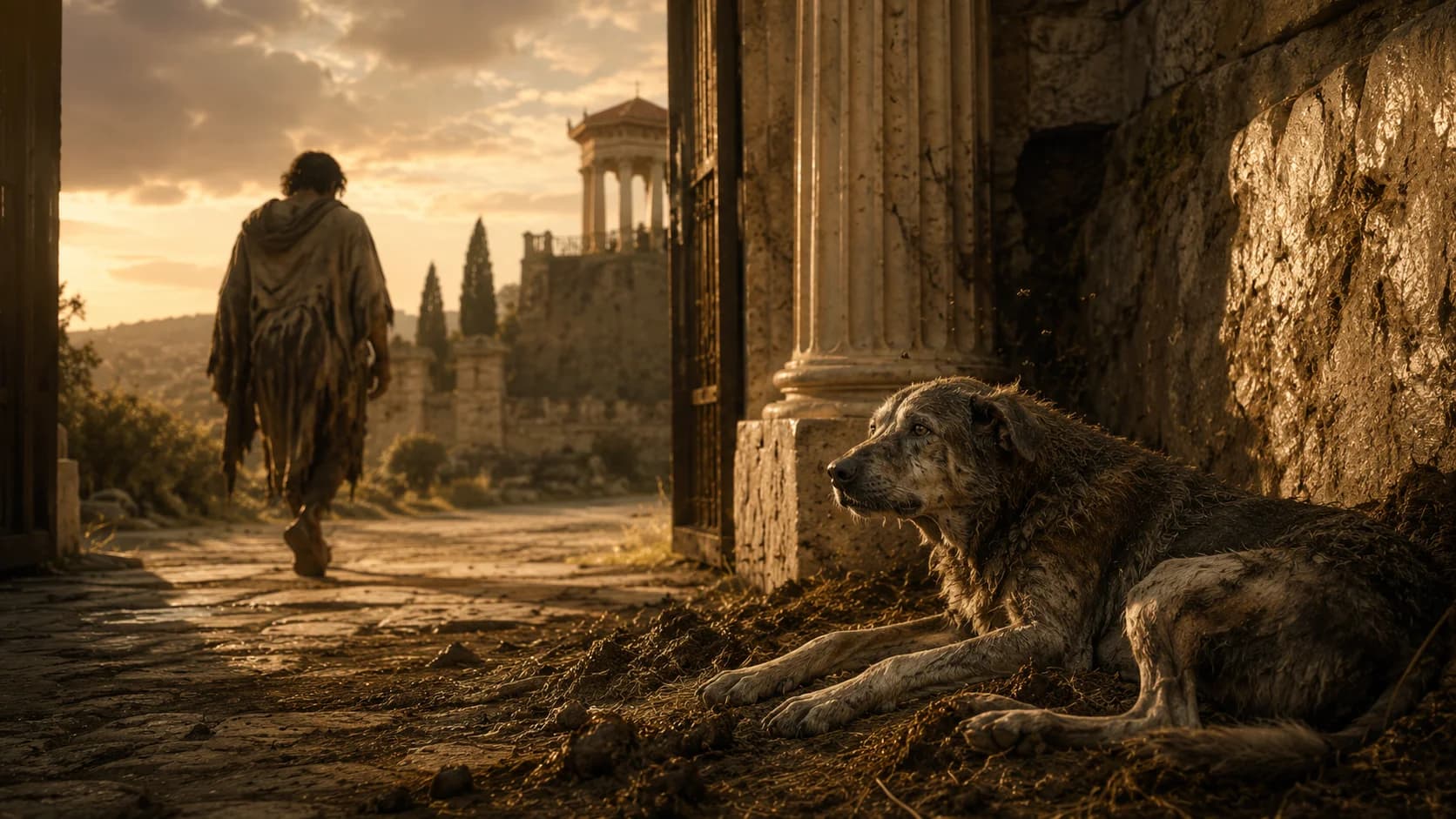
Book 17. Odysseus, still disguised, enters his own palace. The old dog Argos recognises him, wags his tail, and dies. The suitors abuse the beggar.
Book 18. A wrestling match between Odysseus and another beggar named Irus. Odysseus wins. Penelope appears briefly.
Book 19. Penelope interviews the beggar. She does not consciously recognise him, but suspicions stir. The old nurse Eurycleia recognises him by the scar on his thigh. He swears her to silence.
Book 20. The night before the slaughter. Tense preparation. Athena appears to Odysseus.
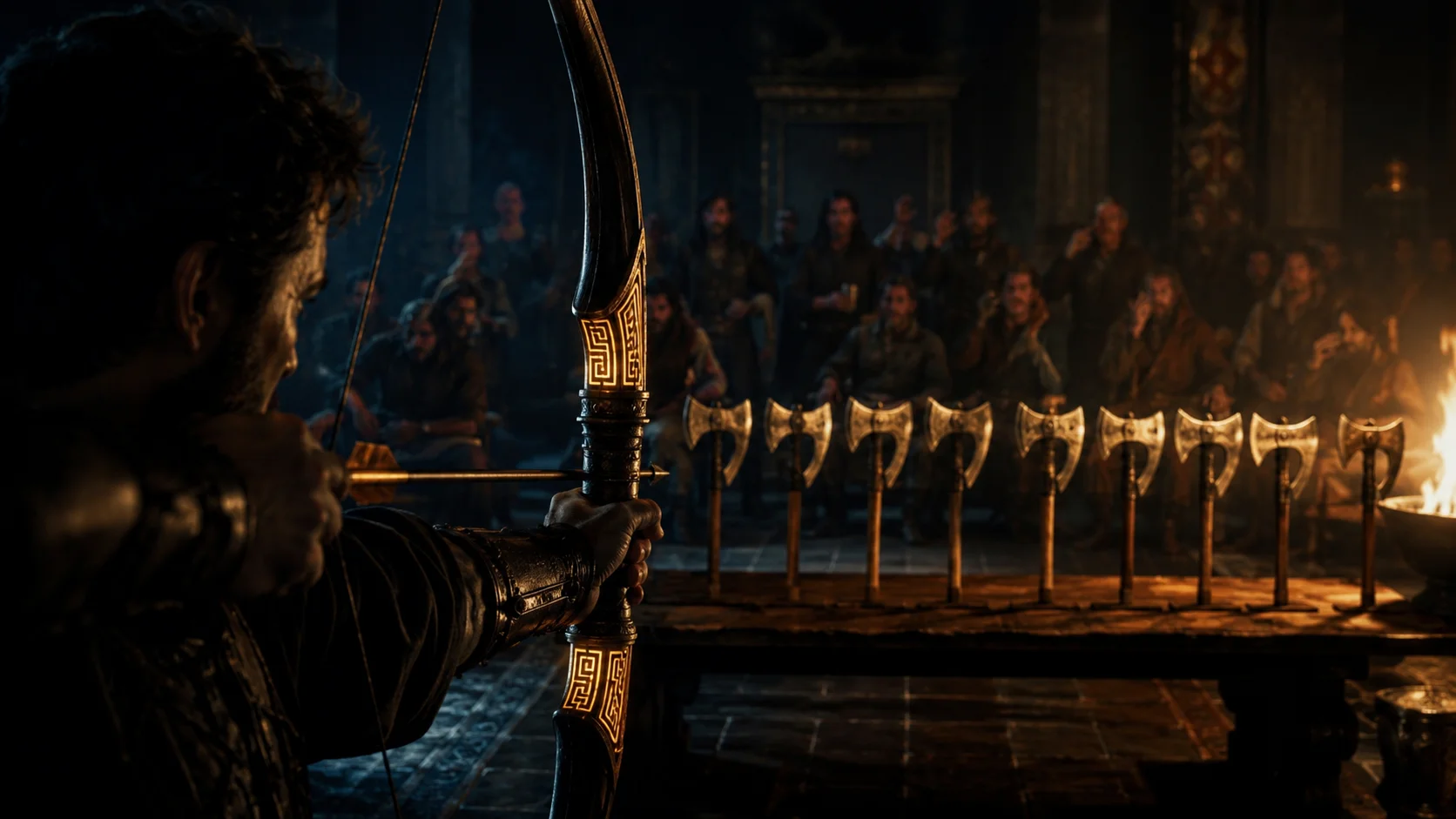
Book 21. Penelope announces the bow contest. The suitors fail. The disguised Odysseus succeeds, stringing the bow in one motion.
Book 22. The slaughter of the suitors. 108 men die. The treacherous handmaidens are hanged.
Book 23. The marriage-bed test. Penelope orders the bed moved. Odysseus reveals the impossibility (the bed is built into a living olive tree). Penelope accepts him.
Book 24. Hermes leads the souls of the dead suitors to the underworld. The suitors' families gather for revenge. Athena intervenes and imposes peace. The poem ends.
What the structure does
The Odyssey opens with Telemachus, not Odysseus, deliberately. The opening establishes the political situation on Ithaca before introducing the hero. By the time Odysseus appears, the reader knows what is at stake. The reader knows the suitors. The reader knows Penelope is in danger. The reader knows Telemachus is growing up without his father.
When Odysseus then appears on Calypso's island in Book 5, the reader's emotional investment in his return is already substantial. The structural choice is one of the Odyssey's most-studied formal innovations.
The flashback structure of Books 9-12 (where Odysseus tells the Phaeacians his own story) lets the poem cover ten years of adventures without exhausting the narrative pace. The action set pieces (the Cyclops, the Sirens, Circe) are concentrated. The interstitial travel time is skipped. The pacing benefits.
The Ulysses Universe trilogy version
The Ulysses Universe trilogy preserves the structural elements of the Odyssey while updating the setting to a 23rd-century space opera. The Telemachy is partially preserved (Telemachus's coming-of-age across the trilogy). The flashback structure is preserved (Book 1 opens with the Olympus escape in flashback). The major waypoints map to specific science-fictional locations.
For the trilogy's canonical timeline, see Twenty Years on the Odyssey: The Master Timeline. For specific waypoints in our version, the Behind the Scenes category contains location features.
Where to go next
For Christopher Nolan's film adaptation, Christopher Nolan's Odyssey: Everything We Know About the Source Material. For the canonical translation choice, Books to Read Before Watching Nolan's Odyssey. For the Iliad comparison, The Odyssey vs The Iliad.
The Ulysses Universe trilogy is the contemporary science-fiction reimagining. Buy Book One on Amazon.
Key takeaways
- Homer's Odyssey is 24 books long. The first four (the Telemachy) focus on Telemachus. Books 5-12 cover Odysseus's journey, mostly in flashback. Books 13-24 cover the homecoming.
- The structure is non-linear. The poem opens in the middle (Telemachus on Ithaca), jumps to Calypso's island, flashes back to Troy onward, and finally reaches Ithaca for the homecoming.
- Key events: the encounter with the Cyclops (Book 9), the descent to the underworld (Book 11), Scylla and Charybdis (Book 12), the bow contest (Book 21), the slaughter of the suitors (Book 22), the marriage-bed test (Book 23).
- Total length in modern translation: approximately 480 pages. Total reading time: 12-15 hours.