The Odyssey vs The Iliad: What Connects Homer's Two Epics
Two poems. One war. One journey home. The same author. Why the Iliad and the Odyssey are the foundational texts of Western literature, and how they differ in structure, theme, and ambition.
What each poem covers
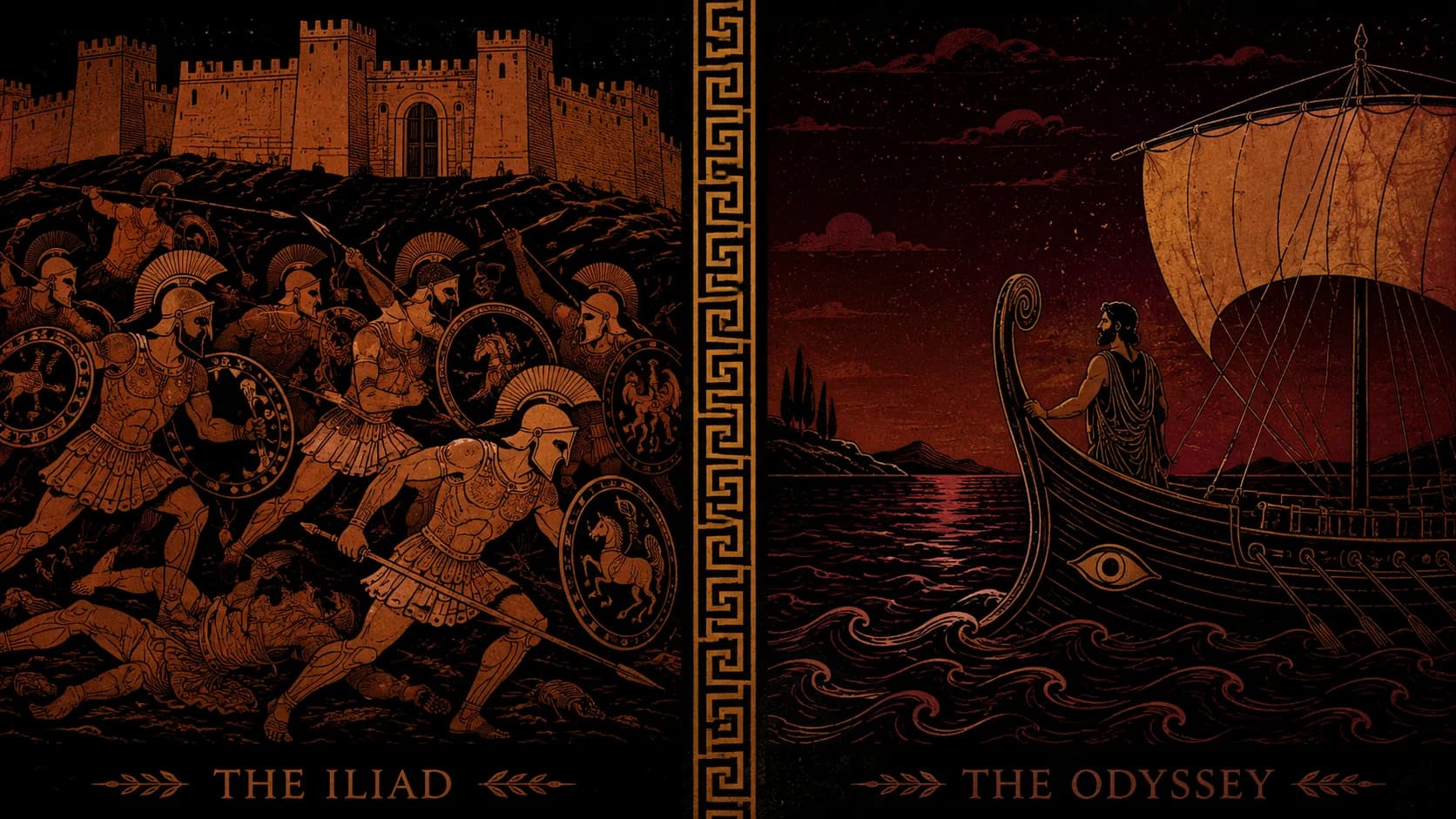
The Iliad is set in the tenth year of the Trojan War. It covers approximately fifty-one days of the war's final phase. The narrative focuses on the quarrel between Achilles, the greatest Greek warrior, and Agamemnon, the supreme commander of the Greek expeditionary force. Achilles withdraws from battle after being insulted by Agamemnon. The Greeks suffer near-catastrophic defeat without him. Patroclus, Achilles's closest companion, takes Achilles's armour into battle and is killed by Hector, the leading Trojan warrior. Achilles returns to combat to avenge Patroclus. He kills Hector and abuses his body. The poem ends with the funerals of Patroclus and Hector and a brief, unstable peace.
The Odyssey is set after the war has ended. It covers approximately ten years of the journey home of Odysseus, the Greek strategist whose plans were central to the war's resolution (he proposed the wooden horse). The narrative structure is non-linear, starting in the middle, jumping to flashbacks, returning to the present. Odysseus reaches home in the final third. The closing books cover the bow contest, the slaughter of the suitors, and the recognition with his wife Penelope.
The Iliad is one war story. The Odyssey is one journey story.
What each poem is about
The Iliad's central concern is honour. Specifically the kind of honour that comes from public recognition by one's peers. Achilles withdraws because Agamemnon has dishonoured him publicly. Hector fights because his honour requires it. The deaths are organised around honour. The funeral rites at the end are about restoring honour to the dead.
The Iliad is also about anger. Its opening word in the Greek is menis: the rage of Achilles. The poem is, in some readings, the longest single sustained meditation on what anger does to a man and a city.
The Odyssey's central concern is home. Specifically the specific particularity of one's own home, with one's own wife, on one's own land. Odysseus refuses Calypso's offer of immortality because immortality is not home. He endures the Cyclops, the Sirens, Circe, the underworld, and Calypso, all because he wants to return to Ithaca and Penelope.
The Odyssey is also about identity. Who you are, when you have been away too long. Who you are, when you cannot prove you are who you claim. The recognition scenes are the Odyssey's deepest single set of concerns.
How they differ structurally
The Iliad has a tight, formally rigorous structure. The action proceeds chronologically. The set pieces are organised around the major battles. The pace is consistent. The poem has the discipline of a play.
The Odyssey is structurally looser. The narrative starts in the middle (Telemachus on Ithaca, looking for news of his father). It jumps to Odysseus on Calypso's island. It flashes back to the events between Troy and Calypso. It returns to the present for the journey home. It splits between Odysseus's perspective and Penelope's perspective.
This structural complexity makes the Odyssey easier for modern readers. Modern readers are used to non-linear narrative, multiple perspectives, and structural complexity. The Iliad's discipline can feel, to a modern reader, more demanding.
How they differ tonally
The Iliad is bleaker. The Trojan War is depicted with almost no moments of relief. The violence is sustained, graphic, and morally complicated. The gods are present but their interventions tend to make things worse rather than better. The funerals at the end are the poem's most peaceful sustained passage.
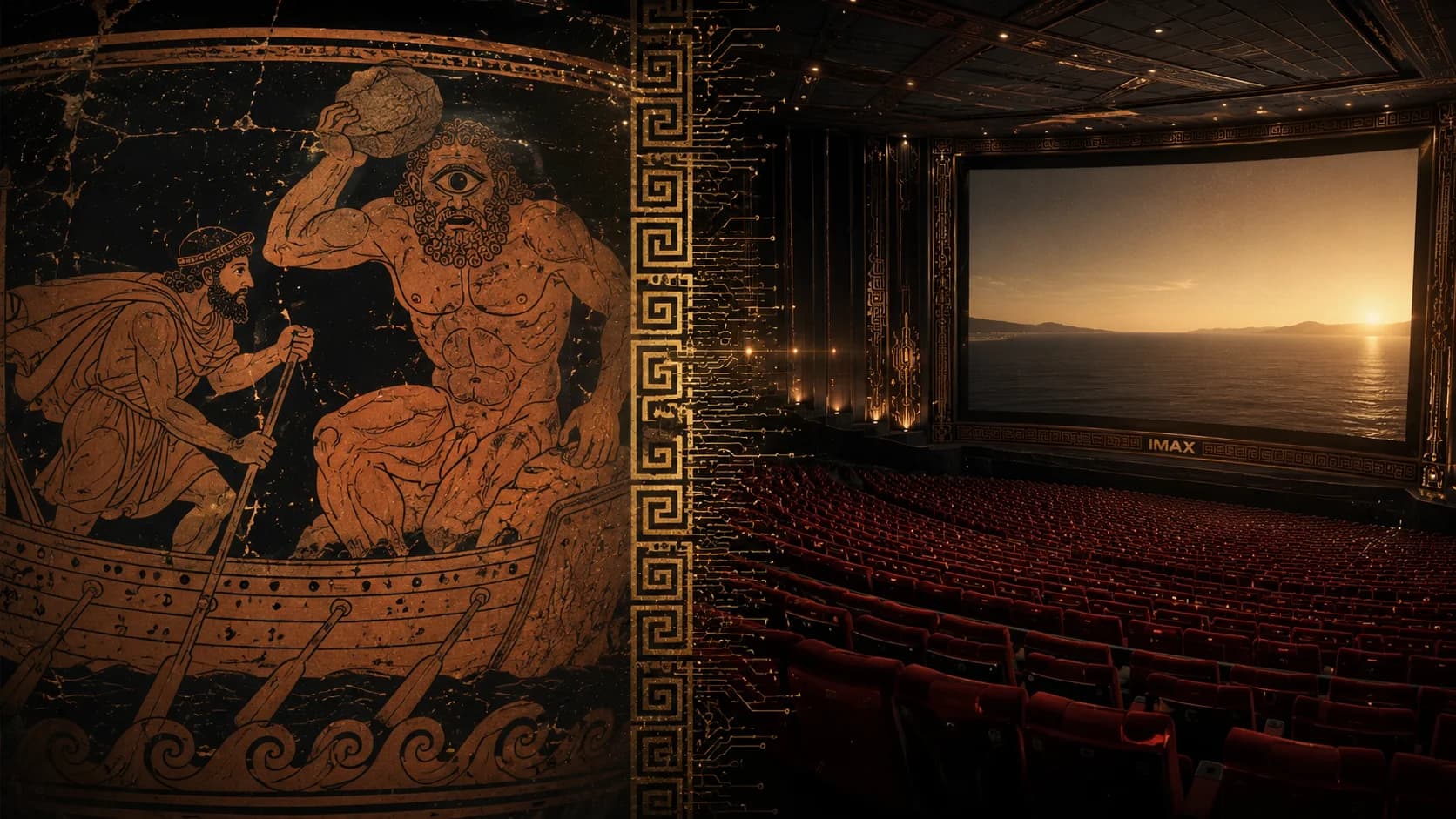
The Odyssey allows more tonal variation. There are domestic scenes (Eumaeus's hut, the recognition with Penelope). There are humorous moments (Polyphemus's confusion about 'Nobody'). There are passages of genuine wonder (the Phaeacian palace, Circe's hospitality once the conflict resolves). The Odyssey's emotional palette is broader.
Some readers prefer the Iliad's tonal consistency. Some prefer the Odyssey's variation. The preference is not arguable. Both works do what they intend.
The shared material
The two poems share a great deal. The same gods. The same heroes (Odysseus appears in both). The same overall mythology. The same conventions of formal epic verse.
The Odyssey also explicitly references the Iliad. Odysseus, in the underworld descent, speaks with the shade of Achilles, who has died (in the events between the two poems). He speaks with Agamemnon, who was murdered by his wife on his return home. He hears about Ajax's suicide. The Iliad's heroes are present, in death, in the Odyssey.
The reverse is not true. The Iliad does not assume the Odyssey. It cannot, because in the Iliad's chronology the Odyssey has not happened yet. Odysseus is present in the Iliad as a Greek strategist. His later journey is not foreshadowed in any specific detail.
This is part of why most readers find the Iliad easier to read first. It does not assume anything that comes later. The Odyssey assumes the Iliad as backstory.
The combined ambition
Together, the Iliad and the Odyssey form what is conventionally called the Homeric corpus. They are the foundation of Western literature. Almost every major Western literary work that came after has, in some way, been in dialogue with them.
Greek tragedy emerged partly from the Homeric tradition. Latin epic (especially Virgil's Aeneid) is explicitly modelled on Homer. Dante, Milton, Joyce, Walcott, and dozens of others have written in direct conversation with Homer.
The two poems together establish the conventions of epic poetry: in medias res opening, divine intervention, formal set pieces (the catalogue of ships, the descent to the underworld, the recognition scene), and the broader structural patterns that epic continues to use to this day.
You can argue that the Iliad and the Odyssey are the most influential single body of work in Western literature. The argument is hard to refute.
The Ulysses Universe relationship
Our trilogy is an Odyssey adaptation. We do not directly adapt the Iliad. The Trojan War events appear in our trilogy as backstory, the way they appear in Homer's Odyssey. Ulysses Theron's cybernetic left eye is given to him 'at Troy' (which in our universe means a different conflict with similar function). The wooden horse equivalent is referenced but not depicted.
Future projects in the Ulysses Universe may engage with the Iliad more directly. The trilogy itself does not.
Where to go next
For the Odyssey's central characters, Meet Ulysses Theron and Penelope in the Odyssey cover the protagonist and his wife. For the ending, How Does the Odyssey End?. For the broader cultural reception, Every Version of The Odyssey Ever Told.
For the question of who Homer was, Who Was Homer? The Poet Behind the Odyssey.
The Ulysses Universe trilogy adapts the Odyssey specifically. Buy Book One on Amazon.
Key takeaways
- The Iliad covers a few weeks of the Trojan War. The Odyssey covers ten years of Odysseus's journey home from that war. Both poems are attributed to Homer.
- The Iliad is about war and honour. The Odyssey is about home and identity. The two poems are companion pieces in the way that tragedy and comedy can be.
- The Iliad is structurally tighter, formally more rigorous, and emotionally bleaker. The Odyssey is structurally looser, formally more inventive, and emotionally more variable.
- You can read the Odyssey without the Iliad. The reverse is harder. The Odyssey assumes the Iliad as backstory. The Iliad assumes itself.