Who Was Homer? The Poet Behind the Odyssey
The ancient Greek poet credited with the Iliad and the Odyssey. Whether he existed. Whether he wrote both. What we know, what we don't, and why it still matters.
The conventional answer
Homer was an ancient Greek poet, traditionally credited with composing the Iliad and the Odyssey, the two foundational epic poems of Western literature. He is conventionally placed in the 8th or 9th century BCE, somewhere on the western coast of what is now Turkey or in the eastern Greek islands.
The Iliad is approximately 15,700 lines. The Odyssey is approximately 12,100 lines. Together they constitute the oldest surviving extended works of Western literature.
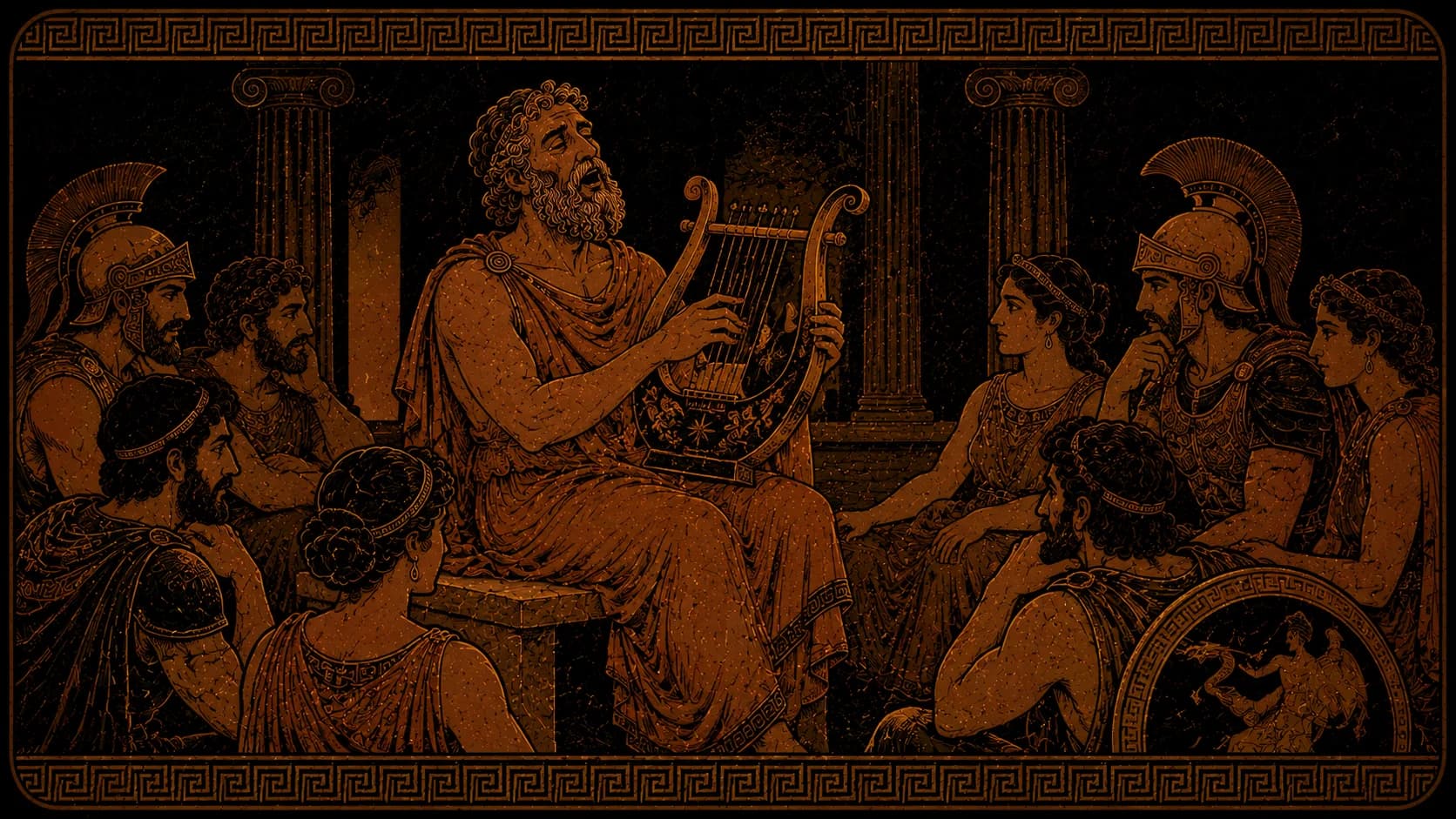
The tradition says Homer was blind. The tradition says he was poor. The tradition says he travelled extensively and composed his poems orally, performing them at the courts of various rulers. The tradition gives us seven different cities that claim to have been his birthplace.
The tradition is, in most particulars, unverifiable.
The Homeric Question
The Homeric Question is the long-running scholarly debate about the authorship of the Iliad and the Odyssey. The debate has been active for at least two thousand years. The main positions are:
Single author. One historical poet named Homer composed both poems. This is the traditional ancient Greek view. It is also the simplest hypothesis and the one most modern lay readers default to.
Two different authors. The Iliad and the Odyssey were composed by different poets, both of whom were later conflated under the name Homer. The two poems have stylistic and structural differences that some scholars find sufficient to argue for separate authorship.
Multiple authors, accumulated. The poems are compilations of older oral material, assembled and edited by various poets over centuries, with the final fixation in writing perhaps as late as the 6th century BCE. This is the position associated with Friedrich August Wolf's 1795 Prolegomena ad Homerum and modern oral-tradition scholars like Milman Parry and Albert Lord.
A bardic tradition. The poems represent the work of a long-standing tradition of Greek bards, with no single 'author' in the modern sense. Each performance was partially improvised within fixed structural conventions. The texts we have are the eventual written versions of performances that had been refined over centuries.
The current scholarly consensus is closer to the bardic-tradition position than the single-author position, though without consensus on the specifics. The Iliad and the Odyssey almost certainly emerged from an oral tradition. Whether there was a single 'Homer' who gave the tradition its definitive form is harder to determine.
What we can determine from the texts
The texts themselves offer some clues, even if they cannot resolve the authorship question definitively.
Both poems use a poetic dialect that does not correspond to any specific spoken Greek dialect of the historical period. The dialect is, instead, a mixture of features from several regional dialects, suggesting that the poems were composed across a wide geographical area or by a tradition that had absorbed influences from multiple regions.
Both poems use formulaic phrases, repeated descriptors ('rosy-fingered Dawn,' 'swift-footed Achilles,' 'wine-dark sea'), and standard scene structures (the catalogue, the visitor-host meeting, the assembly of warriors). These features are characteristic of oral tradition. They allow a bard to compose-in-performance by drawing on a stock of pre-made phrases and structures.
Both poems show extensive knowledge of Bronze Age Greek culture (the period of the Trojan War events, roughly 12th century BCE) that the composition period (8th century BCE) would not have direct access to. This knowledge appears to be inherited from the oral tradition, preserved across centuries.
These features are most consistent with the oral-tradition hypothesis. The texts we have are the eventual written form of a tradition that had been operating for several centuries before the texts were fixed.
What the tradition tells us
The ancient Greek tradition treated Homer as a real person. There are seven cities that claimed to be his birthplace (Smyrna, Chios, Colophon, Salamis, Rhodos, Argos, and Athens). Each city's claim is partial and contradicted by the others. None can be independently verified.
The most-frequently named candidates are Smyrna (modern Izmir, Turkey) and Chios (a Greek island off the Turkish coast). Both were major Ionian Greek population centres. Both have ancient associations with bardic tradition.
The legendary biography of Homer includes:
- His birth, the date varies by tradition but is generally placed in the 9th or 10th century BCE
- Various claims about his parentage (a river god is sometimes named as his father)
- His blindness, possibly arising late in life
- His travels among the Greek-speaking cities, performing his poems
- His death, in some traditions on the small island of Ios
None of this is verifiable. All of it is the kind of biographical material that accumulates around figures whose actual lives are unknown. The tradition is closer to legend than to history.
Why the question still matters
Whether Homer was a single historical person or not, the poems exist. They have been read continuously for almost three thousand years. They have shaped Western literature directly and indirectly. The biographical question is, in many ways, less important than the textual question.
But the biographical question is also persistent because the poems feel authorial. They have a consistent voice, a recognisable artistic intelligence, a sustained literary vision. Even readers who accept the oral-tradition hypothesis often find themselves imagining a single mind behind the work.
This is the kind of feeling that may not have a verifiable referent. The poems are constructed in a way that produces the impression of a unified author. Whether the impression corresponds to a real person is a separate question.
Most modern scholars work with both possibilities held in mind. The poems have an authorial voice. The authorial voice may not correspond to a single historical individual. Both can be true.
How the Ulysses Universe handles Homer
Our trilogy is an adaptation of the Odyssey. The trilogy does not, in any explicit way, depict Homer as a character. The trilogy treats the Odyssey as inherited material that exists in our world, the way Homer treated the Trojan War material as inherited from oral tradition.
We mention Homer occasionally in author notes and blog posts. We treat him as a useful name for the literary tradition that produced the Odyssey, without committing to the question of his historical individuality.
This is roughly the modern scholarly default. It is also probably the most honest available position.
Where to go next
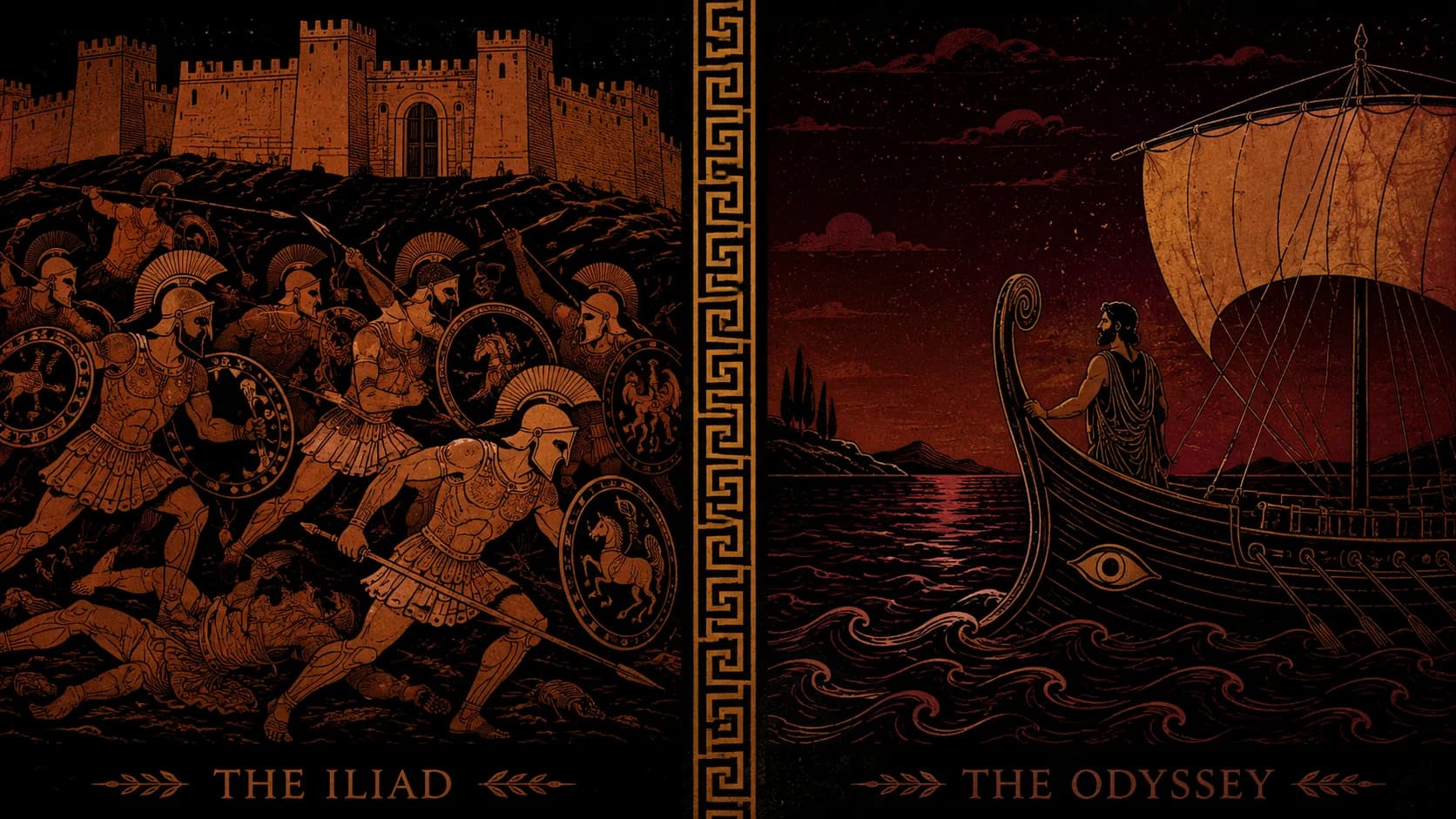
For the two poems Homer (or the Homeric tradition) produced, The Odyssey vs The Iliad. For the Odyssey itself, the Books to Read Before Watching Nolan's Odyssey covers the best modern translations. For the broader cultural reception of the Odyssey across three thousand years, Every Version of The Odyssey Ever Told.
The Ulysses Universe trilogy is one specific modern engagement with Homer's tradition. Buy Book One on Amazon.
Key takeaways
- Homer is the name traditionally given to the author of the Iliad and the Odyssey. Whether he was a single historical person is debated and has been for at least two thousand years.
- The most likely composition date for both poems is the 8th century BCE. The poems emerged from a much older oral tradition that pre-dated their fixation in writing.
- The 'Homeric Question' is the centuries-old debate about whether one author, multiple authors, or an oral tradition produced the surviving texts.
- Whether Homer existed or not, the poems exist. They have shaped Western literature for nearly three thousand years.