Every Film and TV Adaptation of the Odyssey Ranked
From 1954 to Nolan 2026. Every major screen version of Homer's Odyssey ranked by ambition, faithfulness, and whether it's worth your time. Includes O Brother and Ulysses 31.
Why adaptations are hard
The Odyssey is one of the hardest texts in Western literature to adapt successfully. Three reasons.
First, the structure is non-linear. The poem opens with Telemachus, jumps to Calypso, flashes back to Odysseus's adventures, then returns to the present for the homecoming. Most film adaptations flatten this into chronological order, which loses something specific to the original.
Second, the supernatural elements are difficult to depict without either underplaying them (which loses the source material's mythological weight) or overplaying them (which makes the film feel like a fantasy adventure rather than a literary epic). The right balance is hard.
Third, the Ithaca-side narrative is essential structurally but provides less visual material than the journey. Penelope's twenty years are political and emotional rather than visual. Adaptations that cut the Ithaca arc lose half the story. Adaptations that keep it have to find ways to make the political scenes work cinematically.
The adaptations that have succeeded have generally found one specific solution to these problems. Different adaptations solve the problems differently.
The ranking
Ordered by what we consider their success, with brief notes on each.
1. O Brother, Where Art Thou? (Coen Brothers, 2000)
Indirect adaptation. The Odyssey transplanted to Depression-era Mississippi. The Cyclops becomes a one-eyed Bible salesman (John Goodman). The Sirens are three women bathing in a river. The journey home is the protagonists' escape from a chain gang.
What works: the transplant. The Coens understand that the Odyssey's themes (home, identity, cunning) survive the change of setting. The Bronze Age Mediterranean is not strictly necessary. The film proves it.
What doesn't: nothing significant. The film is widely considered one of the strongest Odyssey adaptations precisely because it does not try to be a direct adaptation.
2. The Odyssey (Konchalovsky miniseries, 1997)
Direct adaptation. Three-plus hours of Armand Assante as Odysseus, with Greta Scacchi as Penelope. Aired on NBC.
What works: the scope. The miniseries covers the major events at the right scale. The supernatural elements are treated with appropriate weight. Polyphemus is rendered as a genuine giant. The Sirens are unsettling. The bow contest lands.
What doesn't: some performances are uneven. The CGI of 1997 was weaker than what's available now. The Odyssey deserves to be remade at the current scale, which is what Nolan is doing.
3. Christopher Nolan's Odyssey (2026)
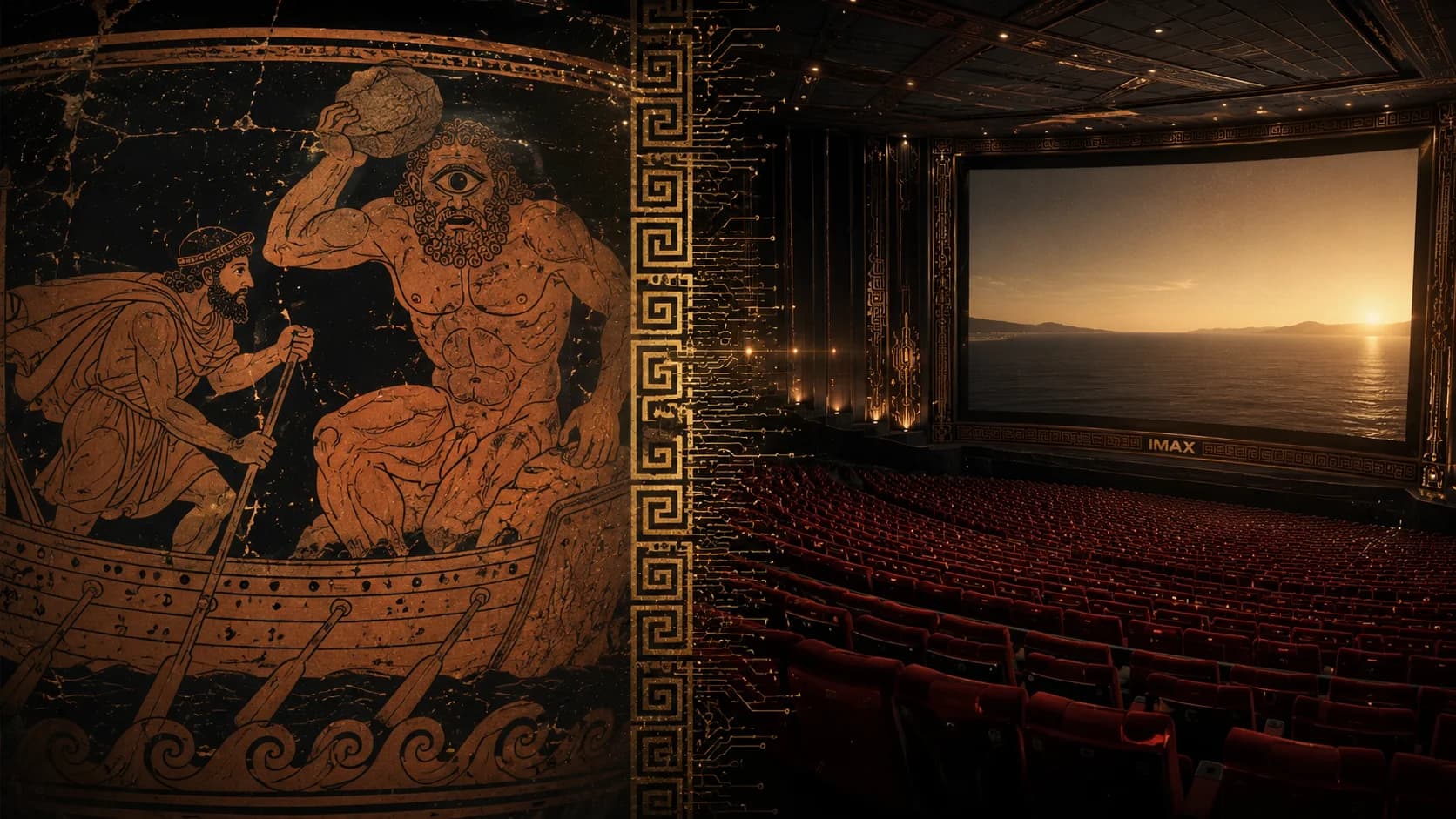
Not yet released as of writing. Opens 17 July 2026. The most-anticipated upcoming literary adaptation of the decade. Matt Damon as Odysseus. Anne Hathaway as Penelope. Tom Holland as Telemachus. Zendaya as (rumoured) Circe.
Production budget reportedly $250 million. Shooting in IMAX in Mediterranean locations. Cinematographer Hoyte van Hoytema. Composer Ludwig Göransson.
What we expect: the most faithful and most cinematically ambitious Odyssey film ever produced. Nolan has cited Emily Wilson's translation as direct inspiration. The cast is loaded. The runtime is rumoured to be substantial.
We will know on 17 July. We will write more then.
4. Ulysses 31 (1981 animated series)
French-Japanese animated production. The Odyssey reimagined as space opera. Ulysses travels with his son Telemachus and an alien companion in a spaceship called the Odyssey. The Greek gods are antagonists.
What works: the premise. Translating the Odyssey to space opera was a useful experiment. The series developed a cult following and proved that the structural elements survive the science-fiction setting. The Ulysses Universe trilogy is, in some sense, the novelistic descendant of Ulysses 31.
What doesn't: the animation is dated, the storytelling is episodic in the way 1980s animation tended to be, and the series ran for only one season.
5. Ulysses (Mario Camerini, 1954)
Italian production starring Kirk Douglas. The first major Odyssey film. Anthony Quinn and Silvana Mangano in supporting roles.
What works: it exists. Kirk Douglas brings the right physical presence. Some of the set pieces (Polyphemus, the Sirens) hold up better than the rest of the film.
What doesn't: it is a 1954 film and looks like one. The special effects are limited. The treatment of Penelope is conservative. Useful as historical document. Not the version to watch first.
6. Helen of Troy / The Trojan Women / various peripheral adaptations
Various films and TV productions have adapted aspects of the Odyssey or the Trojan War without taking the full text as their subject. Troy (2004, Wolfgang Petersen) covers the Trojan War proper. The Trojan Women (1971, Michael Cacoyannis) covers the aftermath. These are valuable but not strictly Odyssey adaptations.
7. Various forgotten productions
The Odyssey has been adapted to film, television, and stage so many times that any complete list is difficult to assemble. Italian, French, German, British, American, and Greek productions have each contributed. Most are forgotten. The pattern of forgetting is itself useful: the Odyssey is so adaptable that many adaptations have failed to leave lasting marks.
What makes a good Odyssey adaptation
Common factors among the successful adaptations:
They commit to a perspective. The Coens commit to Depression-era Mississippi. Konchalovsky commits to bronze-age Mediterranean. Ulysses 31 commits to space opera. Adaptations that try to be all things simultaneously tend to fail.
They preserve the structural elements. The journey, the cunning protagonist, the long absence from home, the political situation on Ithaca, the recognition at the end. These are non-negotiable.
They handle the supernatural with appropriate weight. Too cartoonish and the source material loses its mythological gravity. Too literal and the audience checks out. The middle ground is narrow.
They make Penelope visible. The Ithaca-side narrative is essential. Adaptations that cut Penelope or background her lose the Odyssey's actual structural depth.
The Nolan adaptation, by these criteria, has the elements in place. Whether they cohere is the open question.
The Ulysses Universe as adaptation
Our trilogy is a novelistic Odyssey adaptation. It commits to space-opera setting (like Ulysses 31). It preserves the structural elements. It handles the divine politics through the Pantheon AI framework. It foregrounds Penelope's parallel arc.
We are not in competition with the Nolan film. We are running on a parallel track. Both projects are adaptations of the same source material into different media for different audiences. Both can be worth your time.
If you want to compare specific choices, What Christopher Nolan Gets Right About the Odyssey covers what we expect from his version. Why Set the Odyssey in Space? covers our version's foundational choice.
Where to go next
For Nolan-specific preparation, Books to Read Before Watching Nolan's Odyssey. For modern Odyssey novels, What to Read After Watching Nolan's Odyssey. For the broader contemporary Greek mythology landscape, The Best Greek Mythology Books for Adults in 2026.
The Ulysses Universe trilogy is our entry in the long history of Odyssey adaptations. Buy Book One on Amazon.
Key takeaways
- The Odyssey has been adapted to film and television for nearly a century. Each adaptation makes different choices about what to keep and what to change.
- The strongest recent screen versions: O Brother, Where Art Thou? (2000) for indirect adaptation, Konchalovsky's miniseries (1997) for faithfulness.
- Christopher Nolan's 2026 version is poised to be the most-watched adaptation in history. Production budget reportedly $250 million, IMAX release, A-list cast.
- Indirect adaptations (O Brother, Ulysses 31, the Ulysses Universe) often work better than direct ones. The Odyssey's themes transplant. The Bronze-Age-Mediterranean setting does not always.