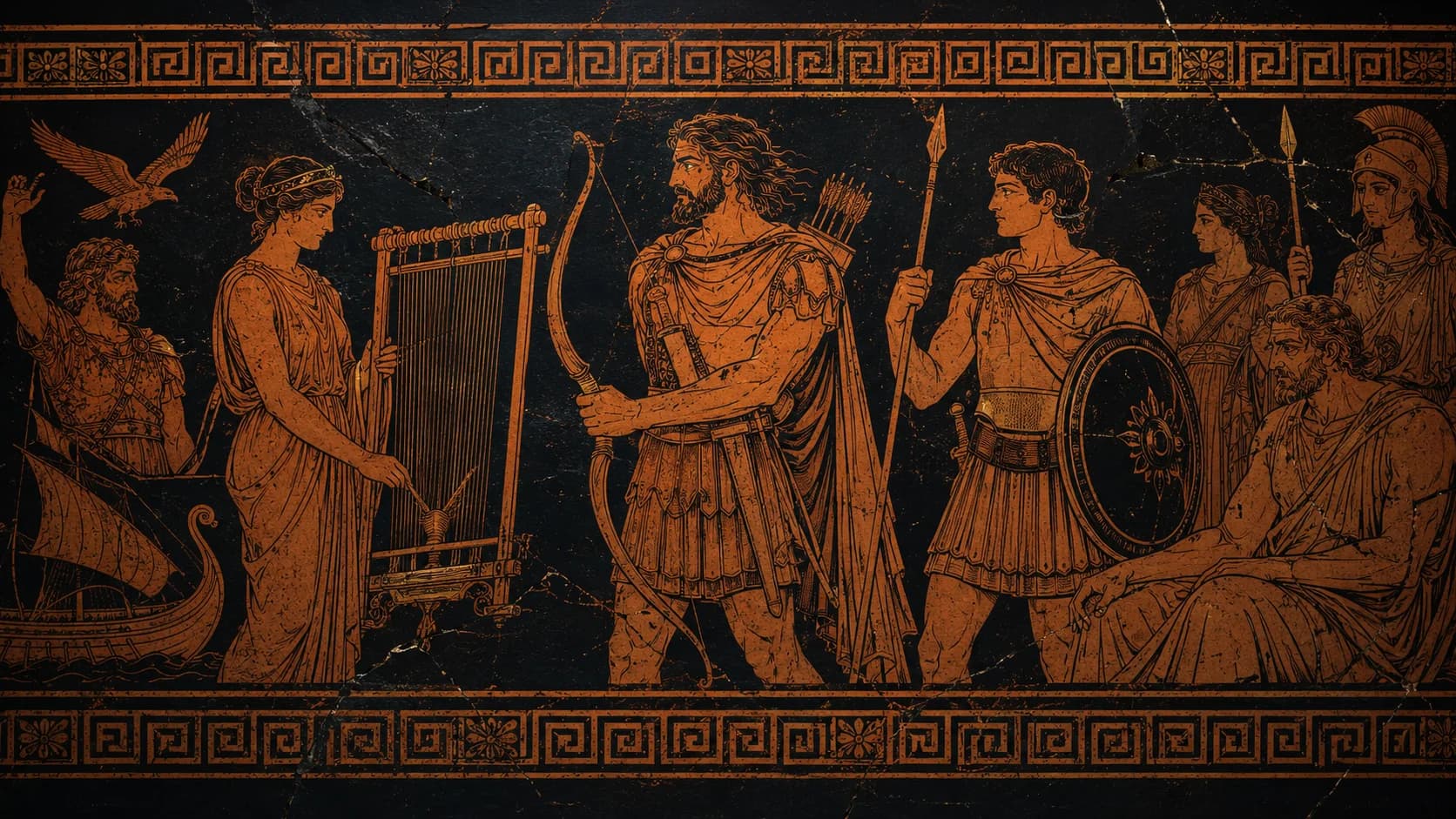
Penelope in the Odyssey: The Most Underrated Hero in Homer
Twenty years of waiting. One hundred and eight suitors at the door. A kingdom held together by patience and craft. Penelope is the Odyssey's quietest hero and arguably its sharpest.
What Homer wrote
Penelope is the Odyssey's quietest character. She gets fewer lines than Odysseus. She gets fewer set pieces. She does not fight monsters. She does not travel.
She stays. For twenty years.
While her husband is fighting his way home from Troy through every supernatural obstacle the eastern Mediterranean can produce, Penelope is at home dealing with a problem of equal difficulty in a different register. Ithaca is small. The kingdom is precarious. Her husband is missing-presumed-dead. The local nobility see opportunity. They move into her house. They eat her food. They drink her wine. They press her to choose one of them as her new husband.
She refuses for twenty years.
This is not a minor refusal. The political pressure on Penelope is sustained, accumulating, and increasingly serious. The suitors are not patient men. They are running out of food and patience. They have begun discussing more aggressive options. Some have started planning to kill Telemachus, who is growing up and will soon be old enough to challenge their occupation directly.
Penelope holds the line. She does so through the only means available to her. Procedural delay. Strategic refusal. Carefully maintained ambiguity about what she will eventually do.
She does this for twenty years.
This is heroism. The Odyssey treats it as heroism. Most modern readings somehow miss this.
The shroud trick
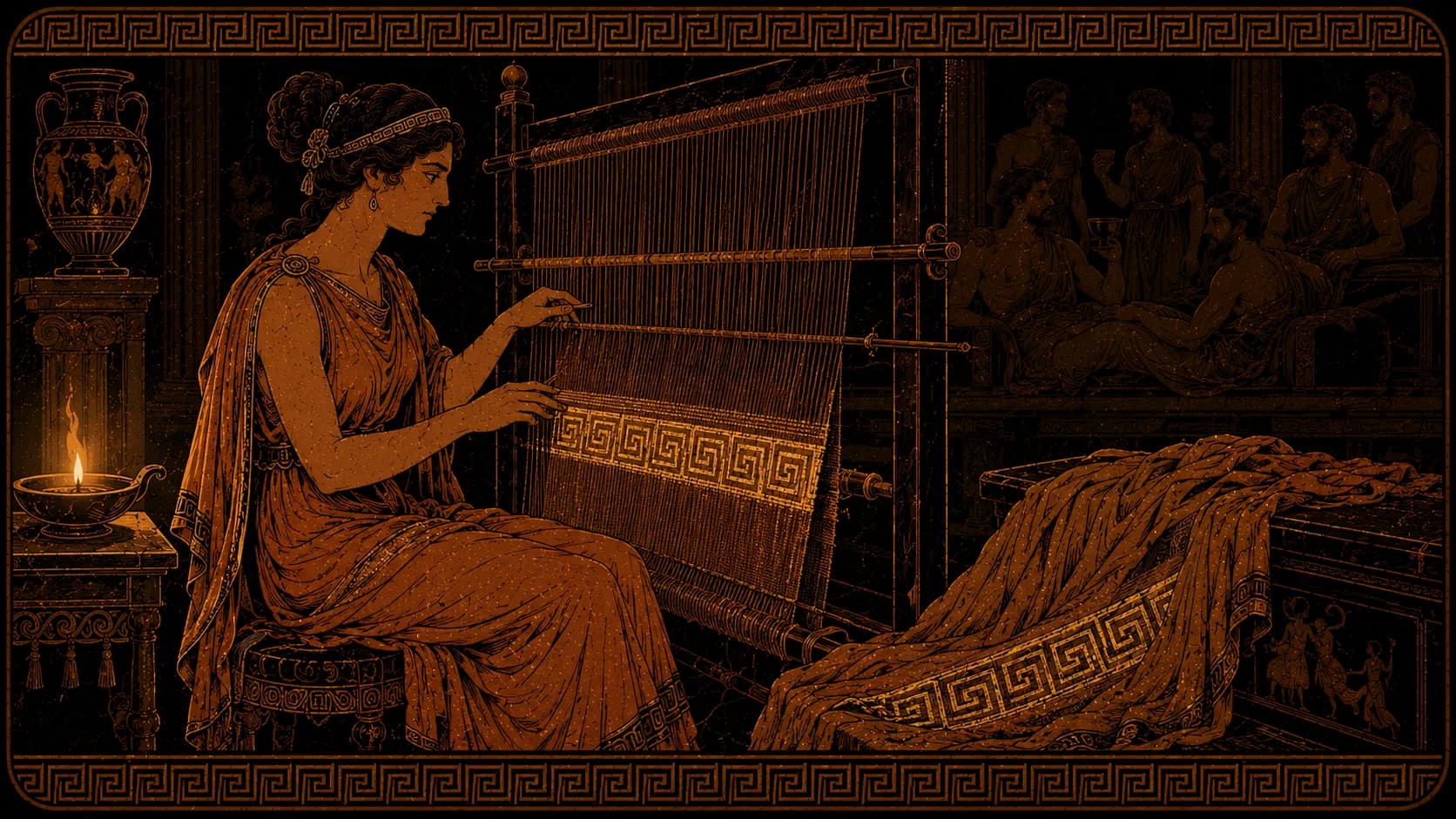
The most famous of Penelope's strategies is the shroud trick. She tells the suitors that she will choose a new husband once she has finished weaving a burial shroud for her father-in-law Laertes. The weaving is presented as an act of piety. The suitors agree to wait.
What the suitors do not know is that Penelope is unweaving her day's work every night. She weaves during the day. She unweaves what she has woven during the night. The shroud, never finished, exists as a permanent excuse.
The trick buys her three years.
It ends when a treacherous handmaiden, Melantho, reveals it to the suitors. The suitors are furious. Penelope must now produce a new strategy. She does. She announces the bow contest.
The shroud trick is the Odyssey's most-quoted example of female cunning, and one of the most-quoted examples of cunning generally in ancient literature. It is also a useful index of Penelope's actual position. She is not a damsel in distress. She is running a sustained political operation under conditions of severe constraint.
The recognition tests
When Odysseus returns to Ithaca, he is disguised as a beggar. He reveals his identity to a small number of trusted figures (Telemachus, the swineherd Eumaeus, the loyal servant Eurycleia). Penelope is not initially told.
She is not stupid. She suspects something. The beggar is too articulate. He knows too many specific facts about Odysseus. His size, gait, and bearing are familiar in ways she cannot quite reconcile with his appearance.
She tests him.
The test is the marriage-bed scene. After the slaughter of the suitors, after Odysseus has revealed himself, after Telemachus has accepted him, Penelope still hesitates. She orders the marriage bed moved to a guest room so the stranger can sleep.
This is impossible. The marriage bed cannot be moved. Odysseus built it himself, around a living olive tree that grew up through the floor of the bedroom. The bed is part of the tree. Moving it would require cutting the tree.
The order is the test. If the man is Odysseus, he will know. If he is not, he will not.
Odysseus knows. He responds with grief, anger, and the exact details of how the bed was built. The fury is unmistakeable. Penelope accepts him.
This is the Odyssey's sharpest piece of mutual cleverness. Penelope tests her husband. He passes by revealing how angry her test makes him. The mutual recognition is, in some ways, the Odyssey's actual climax. The slaughter of the suitors is the action climax. The marriage-bed scene is the emotional one.
Modern readings
Penelope has been substantially recovered by modern readers, especially in the last twenty years. Margaret Atwood's The Penelopiad (2005) gives Penelope her own novel narrated from the underworld. Claire North's Ithaca (2022) treats Penelope as the central political operator of the entire story, with the gods narrating across her shoulder. Madeline Miller's Circe (2018), while focused on Circe, also rehabilitates Penelope in its closing chapters.
The pattern in these readings: Penelope is not waiting. She is governing. She is not passive. She is running a long, slow, careful political operation against a hostile occupying faction. She is not a damsel. She is the Odyssey's quiet political genius.
This reading is correct. Homer's text supports it. The text does not soften Penelope. The text does not depict her as merely sad or merely faithful. The text gives her cunning, agency, strategy, and the procedural authority that the suitors cannot break without her consent.
What the text does, that modern readings sometimes correct, is foreground Odysseus's adventures while backgrounding Penelope's parallel work. The structural attention is uneven. Both arcs are present. The attention given to each is not.
The Ulysses Universe version
Our own Penelope Maris, in the trilogy, is a direct continuation of the modern feminist reading. She governs Ithaca Station against the Suitor occupation for twenty years. She uses heritage-decoration comms relays (see Embroidery as Resistance and The Sigil They Walked Past) to run a covert intelligence network from inside the council chamber. She holds the founding charter's amendment veto. She delays Suitor consolidation through procedural mechanisms.
The trilogy's version is Penelope at her most political. The shroud trick equivalent is the procedural-delay infrastructure she has built across two decades. The bow contest equivalent is the bow that no Suitor can string because the biometric calibrator does not recognise them.
Reading Homer's Penelope and our Penelope side by side will, we hope, sharpen both.
Why she is the underrated hero
Penelope's twenty years are the Odyssey's hardest single sustained piece of work. Odysseus's journey involves enormous physical and supernatural challenges, but it is, structurally, a sequence of discrete obstacles. He fights the Cyclops. He survives the Sirens. He passes Scylla and Charybdis. Each challenge is finite. Each ends.
Penelope's challenge does not end. She must hold the line every day for twenty years. She must maintain her composure in front of the suitors every day for twenty years. She must run her covert operations without being caught. She must keep Telemachus safe without making him a target. She must wait without ever knowing whether her husband is alive.
This is harder. Sustained pressure under uncertain conditions is, in most psychological models, harder than discrete trauma. Odysseus has the easier job, structurally. He gets to act. Penelope has to refuse to act, while looking like she is on the verge of acting, every single day.
The Odyssey is, in some readings, two heroes' stories told together. The travelling hero gets the screen time. The staying hero gets the deeper work. Modern reading has begun to give Penelope the credit Homer's structure makes her have to earn from the reader.
Where to go next
For the Ulysses Universe version of Penelope, Meet Penelope: The Queen Who Didn't Wait. For the modern feminist reading of the bow scene, The Bow That Knows You. For Penelope's covert resistance infrastructure, Embroidery as Resistance.
For the broader Ulysses Universe approach to the Odyssey's character set, Ulysses vs Odysseus: Why the Same Hero Has Two Names.
The Ulysses Universe trilogy makes Penelope's parallel arc central. Buy Book One on Amazon.
Key takeaways
- Penelope holds Ithaca together for twenty years against 108 suitors who have moved into her house and want her hand.
- Her famous trick: weaving a burial shroud for her father-in-law and unweaving it at night. The trick buys her three years.
- She passes the recognition tests Homer gives her. She tests Odysseus back. The marriage-bed scene is the Odyssey's sharpest piece of mutual cleverness.
- Modern readings (Atwood, Miller, North) treat Penelope as the Odyssey's quiet political genius. Homer's text supports the reading.