Ulysses vs Odysseus: Why the Same Hero Has Two Names
Odysseus is the Greek name. Ulysses is the Roman one. Same character, two names, three thousand years of history. Here's the full story of how one of literature's most famous heroes got two identities.
The short answer
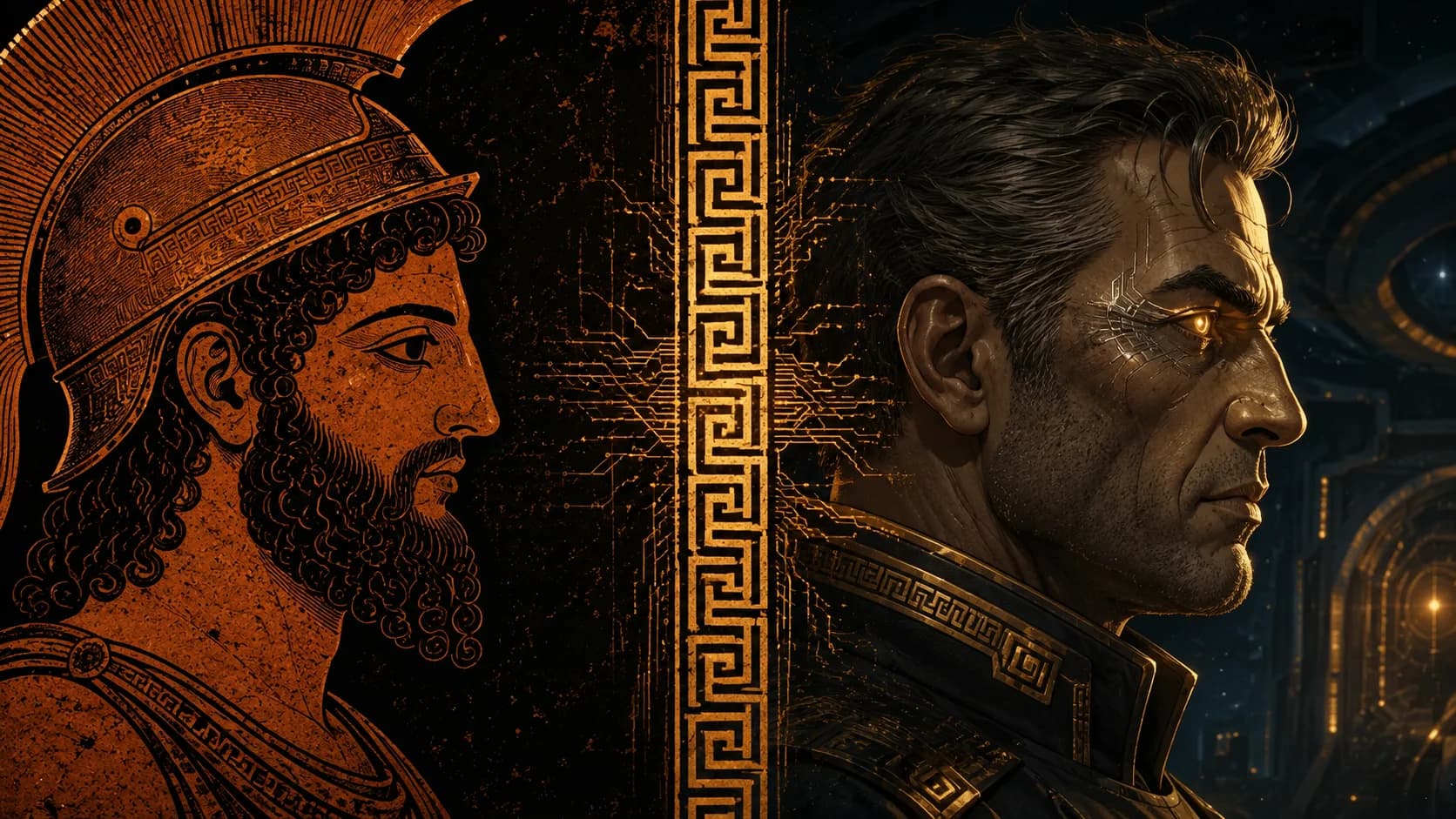
Odysseus is Greek. Ulysses is Roman Latin. Same character. Different languages. Two thousand years of cultural reception in between, which has given each name slightly different associations.
If you only have time for one sentence: he's called Odysseus in Homer and most modern translations, and Ulysses in everything from Virgil to James Joyce.
The longer story is more interesting.
Where the names come from
The original Greek name is Ὀδυσσεύς (Odysseús). It appears throughout Homer's Iliad and Odyssey, composed around the 8th century BCE. The etymology is debated. Some scholars derive it from the Greek verb odyssesthai, 'to be wroth against' or 'to hate.' Homer himself plays with this in the Odyssey, when Odysseus's grandfather names him 'because I am wroth with many.'
The Latin form is Ulixes. This is the version that appears in Livius Andronicus's Latin translation of the Odyssey, written around 240 BCE. Ulixes is closer to the original Greek than Ulysses, but the spelling evolved over centuries. By the time Virgil writes the Aeneid in the first century BCE, the standard Latin form is Ulysses or Ulisses.
Why the change? Standard linguistic drift. Latin treats Greek words differently than Greek does. Sounds shift. Spellings adapt. The Romans had centuries to file down Odysseus into Ulixes into Ulysses. Same character. Different mouth.
How the names spread
The Roman form is the one that travelled. When the Roman Empire spread across Europe, it carried Latin literacy with it. Greek literacy stayed largely confined to the Eastern Mediterranean. By the time the Western Roman Empire fell in 476 CE, most of Western Europe could read some Latin, but almost nobody could read Greek.
This had consequences for how the Odyssey was received. Medieval Western European writers worked from Latin sources, not Greek ones. Dante wrote about Ulysse, not Odysseus. Chaucer mentions Ulysses, not Odysseus. The Italian, French, and Spanish literary traditions inherited the Roman name and stuck with it.
Greek learning returned to Western Europe in the Renaissance, when Byzantine scholars fleeing the fall of Constantinople brought Greek manuscripts and Greek literacy with them. From the 15th century onward, Western European scholars could read Homer in the original. The Greek name became available again.
But by then the Latin form had two thousand years of literary use behind it. It didn't go away. It coexisted.
The English-language compromise
English-language tradition has been unusually flexible about which name to use:
| Period | Typical usage | Notable examples |
|---|---|---|
| Medieval | Ulysses (via Latin) | Chaucer references |
| Renaissance | Ulysses | Shakespeare's Troilus and Cressida uses 'Ulysses' |
| 18th century | Ulysses | Alexander Pope's translation uses 'Ulysses' |
| 19th century | Ulysses (Romantic) / Odysseus (scholarly) | Tennyson's 'Ulysses' (1842); academic scholarship moves to 'Odysseus' |
| 20th century | Mixed | Joyce's Ulysses (1922); modern translations split |
| 21st century | Odysseus (translation) / Ulysses (literary tradition) | Wilson, Fagles, Lattimore use Odysseus; popular reference and adaptation often use Ulysses |
The pattern: when English speakers want the scholarly, Homer-faithful version, they use Odysseus. When they want the older, accumulated, Western-tradition version, they use Ulysses. Both names work. They carry slightly different connotations.
What the names mean culturally
After three thousand years, the names have picked up different associations.
Odysseus is the Greek name. It's closer to the source. It's what scholars use. It carries associations of authenticity, the original text, the Bronze Age Mediterranean. If you want to signal that you've read Homer and are thinking about what Homer actually wrote, you say Odysseus.
Ulysses is the Roman name, but more importantly it's the name English literary tradition has built around for two thousand years. Tennyson's 'Ulysses' is one of the most famous poems in the English language. The aged hero refusing rest, deciding to sail one more time. 'To strive, to seek, to find, and not to yield.' That poem is part of the cultural weight 'Ulysses' carries.
James Joyce's Ulysses (1922) reinforces the association. Leopold Bloom wandering Dublin on a single day, mapped against the structure of the Odyssey. The modernist masterpiece that defined twentieth-century literary ambition. It uses the Latin form deliberately. It would not have worked as Odysseus.
The Latin form, in English, has become the name of a literary tradition. The Greek form is the name of a specific Homeric text. Both are alive.
Why the Ulysses Universe trilogy uses 'Ulysses'
A direct authorial answer. We chose Ulysses Theron as the protagonist's name for three reasons.
First, the Latin form carries the right associations for space opera. Empire. Scale. The wandering hero across vast distances. A name that has been part of Western imagination for two thousand years feels appropriate for a 23rd-century fleet admiral.
Second, the Latin form lets us nod to Tennyson and Joyce without forcing it. Readers who catch the reference get something. Readers who don't catch the reference don't lose anything. The name does its work either way.
Third, in straight prose terms, Ulysses simply reads better than Odysseus for this kind of story. Three syllables. Familiar. The reader's eye doesn't trip over it. Odysseus would have required a permanent low-level effort from the reader. Ulysses doesn't.
We also use the Greek names for the rest of the cast where the Greek form has accumulated cultural weight. Telemachus, not Telemachus's Latin form Telemachus (they're the same in this case, lucky for us). Penelope, not the Latin Penelope (also identical). The Greek forms have remained recognisable in English. Only Odysseus/Ulysses splits.
How to choose for your own writing
A short decision guide:
| If you're writing about... | Use this name |
|---|---|
| Homer's text directly, academic context | Odysseus |
| Modern Greek translation studies | Odysseus |
| English literary tradition (Tennyson, Joyce) | Ulysses |
| Renaissance, medieval European reception | Ulysses |
| Roman literature (Virgil, Ovid) | Ulysses |
| Generic adaptation, signalling tradition | Ulysses |
| The Ulysses Universe trilogy specifically | Ulysses Theron |
You can use both names in the same piece if you're explicit about which usage you're invoking when. 'Homer's Odysseus' and 'Tennyson's Ulysses' both make sense, refer to the same character, and signal different things.
Where to go next
For the broader context of how the Odyssey has been adapted across three thousand years, see Every Version of The Odyssey Ever Told. For Christopher Nolan's upcoming film and which form he's expected to use, Christopher Nolan's Odyssey: Everything We Know About the Source Material covers what's been announced. For our specific protagonist, Meet Ulysses Theron: The Admiral Who Blinded a God is the character primer.
For the ceremonial bow that proves Ulysses's identity in both versions of the story, ours and Homer's, read The Bow That Knows You.
Buy Book One: The Blinding on Amazon.
Key takeaways
- Odysseus is the original Greek name, used by Homer in the Iliad and the Odyssey. Ulysses is the Latin form, used by Roman authors like Virgil and later adopted across Western Europe.
- Both names refer to the same character: the king of Ithaca, hero of the Trojan War, husband of Penelope, father of Telemachus.
- English-language tradition has used both names historically. James Joyce's 1922 novel Ulysses is the most famous modern use of the Latin form. Most modern translations of Homer (Wilson, Fagles, Lattimore) use Odysseus.
- The Ulysses Universe trilogy uses 'Ulysses Theron' for the protagonist because the Roman form carries the right associations: empire, scale, a name that has survived two thousand years of Western retelling.
- If you're choosing between the names for your own purposes: Greek context, scholarship, modern translation, use Odysseus. Roman context, Renaissance reception, English literary tradition, use Ulysses.