10 Themes in the Odyssey That Still Matter Today
The hospitality test. The cost of cleverness. The price of pride. The Odyssey's themes were written 3,000 years ago and still appear in every conversation about home, identity, and what we owe each other.
Why we still read it
The Odyssey is three thousand years old. By any reasonable expectation, a text that old should not be a major part of contemporary cultural conversation. Most works of that age survive only as objects of historical study. The Odyssey is different. It is still, in 2026, the source material for major film adaptations and bestselling novels. It still gets taught in undergraduate seminars not just as historical artefact but as living literature.
Why?
Because the questions it asks have not been settled. The themes it puts on the table are still on the table. We have new contexts for asking them. We do not have new answers.
Ten themes. Three thousand years. Still working.
The themes
1. Hospitality (xenia)
The sacred Greek concept of hospitality runs through the Odyssey as a moral backbone. Hospitality is reciprocal. The host owes the guest food, shelter, safety, gifts. The guest owes the host gracious acceptance and no betrayal. Violation of xenia is, in the Odyssey, the most consistently signalled moral wrong.
The suitors violate xenia on Ithaca for twenty years. Polyphemus violates xenia by eating Odysseus's men. Aeolus exemplifies xenia by giving Odysseus the wind-bag. Athena tests potential allies by asking how they treat strangers.
The modern equivalent: how we treat the strangers we encounter. Refugees. The unhoused. The unfamiliar. The Odyssey's argument remains current.
2. Cunning over strength
The Odyssey is, in some readings, the original argument for intelligence as the highest hero-quality. Odysseus is not the strongest of the Greek heroes. Achilles is. Ajax is. Diomedes is. Odysseus is the cleverest.
Achilles dies at Troy. Odysseus gets home.
The argument is sustained across the poem. The wooden horse, the blinding of Polyphemus, the trick with 'Nobody,' the marriage-bed test. The hero who wins is the hero who thinks.
The modern equivalent: the persistent contemporary argument about whether the smart, the strong, or the connected get the rewards. The Odyssey votes for the smart.
3. The cost of pride
Odysseus's worst mistake is shouting his name to Polyphemus from the safety of his ship. The boast is unnecessary. It costs ten years.
The Odyssey is not subtle about this. The hero's flaw is named. The flaw produces measurable consequences. The reader is meant to notice.
The modern equivalent: the price of unnecessary credit-claiming, of needing to be seen as the source of a success, of the small ego protections that compound into large losses. Plenty of contemporary stories make the same point.
4. Identity and recognition
The Odyssey's homecoming sequence is built around recognition. Argos recognises Odysseus immediately. Eurycleia recognises him by the scar. Telemachus accepts him through Athena's intervention. Eumaeus accepts him through demonstrated knowledge. Penelope accepts him through the marriage-bed test.
The pattern is sustained: identity must be proved, and proving it requires the specific knowledge that only the actual person could have.
The modern equivalent: every story about whether someone can be trusted, whether they are who they claim to be, whether their identity can survive long absence. The Odyssey wrote the template.
5. Fidelity
Penelope's twenty years of fidelity to Odysseus is one of the Odyssey's most famous themes. Odysseus's fidelity to Penelope is more complicated (he sleeps with Calypso and Circe), but his refusal of immortality with Calypso is read as a higher fidelity to his marriage and to Ithaca.
The Odyssey is not naive about fidelity. It treats it as difficult, costly, sometimes ambiguous. Penelope's fidelity is also her work. It is not passive waiting. It is active political maintenance.
The modern equivalent: every conversation about whether and how relationships can survive distance, time, and circumstance.
6. The meaning of home
Home is non-substitutable. This is the Odyssey's clearest single argument. Odysseus refuses Calypso, refuses immortality, refuses the paradise island, because none of them is Ithaca. Ithaca is the specific place. Penelope is the specific person. Telemachus is the specific son.
The modern equivalent: the question of whether home is a place, a person, a feeling, or a construction. The Odyssey says: specific. Whatever home is, it is the particular thing rather than the type.
7. Divine attention
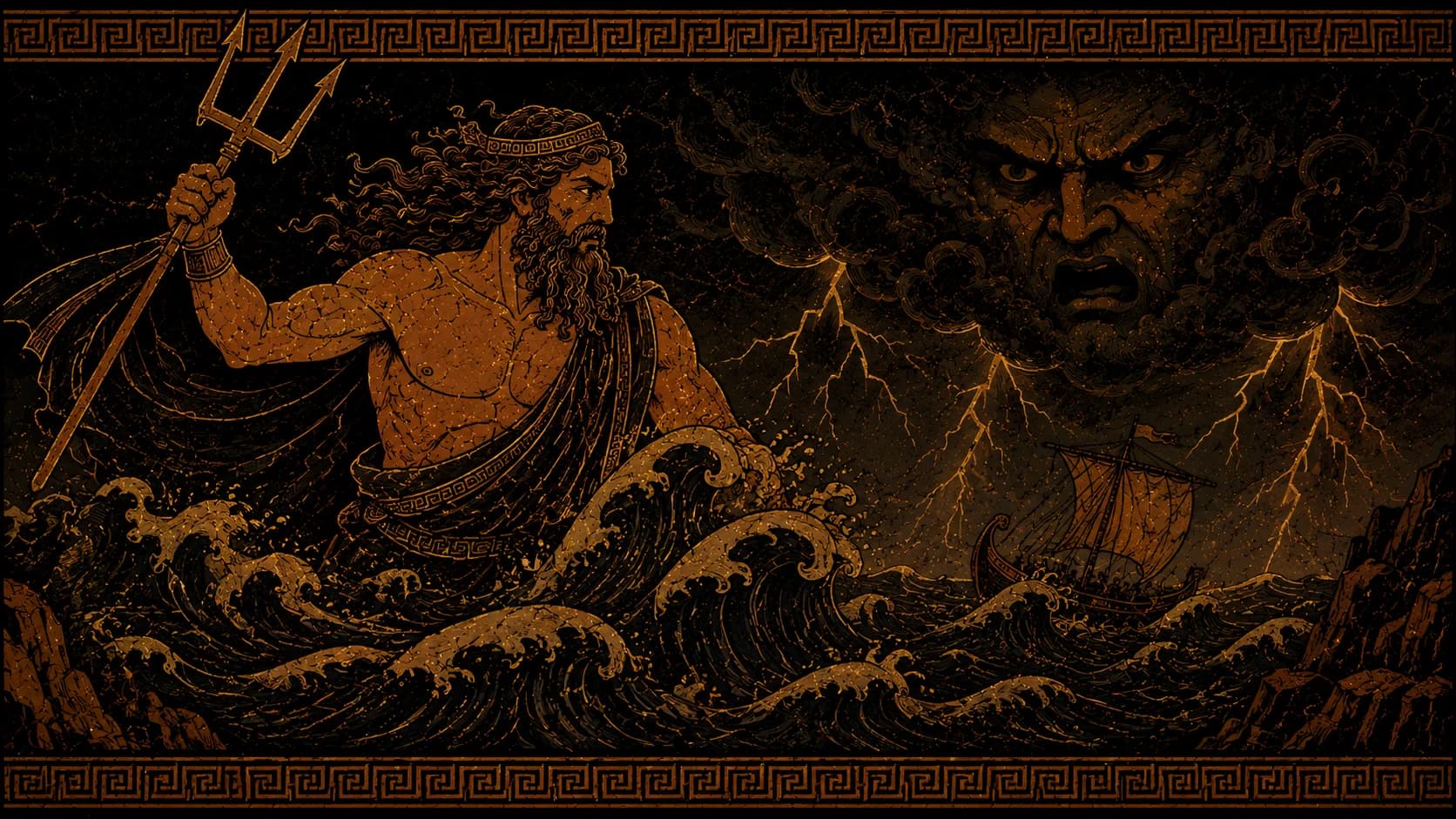
Athena's favour helps Odysseus. Poseidon's grudge hurts him. Both are sustained. Both are personal. Both are the kind of attention most mortals do not receive.
The Odyssey is interested in what it means to be noticed by powers larger than yourself. The noticing can be wonderful. It can be terrible. It cannot be undone.
The modern equivalent: the experience of mattering to forces beyond your control. Whether those forces are political, economic, cultural, or institutional. Once a power notices you, the noticing has consequences.
8. Women and power
The Odyssey's women are more politically active than the popular image suggests. Penelope governs. Circe runs Aeaea. Calypso runs Ogygia. Athena drives much of the plot. Eurycleia keeps secrets. Each woman has her own form of agency.
Modern readings (Atwood, Miller, North) have substantially restored these characters. The Odyssey's text supports the restoration.
The modern equivalent: the contemporary work of reading classical texts in ways that recover the agency of female characters who were always there but were narratively backgrounded.
9. Mortality
The Odyssey is a meditation on death. Odysseus visits the dead. He learns from the dead. He chooses mortal life over Calypso's offered immortality. Achilles, in the underworld, says he would rather be alive (the lowliest farmhand on a poor farm) than the king of the dead.
The argument: mortality is the price of being yourself. Take it away and you stop being yourself. The Odyssey treats this as obvious. Modern readers often need to be reminded.
10. Storytelling itself
The Odyssey is, in some ways, a poem about telling stories. Odysseus tells his story to the Phaeacians across multiple books of the poem. The structure of the Odyssey is shaped by who is telling what to whom.
The poem is also self-aware. It knows it is a poem. It references the bards (Demodocus on the Phaeacian island, Phemius on Ithaca). It thinks about how stories preserve identity across time.
The modern equivalent: the contemporary writer's awareness that they are participating in a tradition of storytelling that pre-dates them and will outlast them. The Odyssey already knew this.
How the trilogy engages these themes
The Ulysses Universe trilogy preserves all ten themes structurally. Hospitality runs through Aeolus and the Suitors. Cunning over strength is the trilogy's clearest sustained argument. The cost of pride drives Ulysses's twenty-year journey home. Identity and recognition are central to Book 3. Fidelity is the Penelope arc. Home as non-substitutable is the entire premise. Divine attention drives the Pantheon's pursuit. Women's agency is concentrated in Penelope, Circe, Calypso, Athena, and Thea. Mortality is the suspension-pod question. Storytelling appears as the trilogy's self-awareness about being a retelling.
The themes are the reason the trilogy exists. The plot is the trilogy's specific delivery mechanism for the themes.
Where to go next
For Penelope's place in the fidelity theme, Penelope in the Odyssey. For the cost-of-pride theme, Poseidon vs Odysseus: The Longest Grudge. For the identity-and-recognition theme, How Does the Odyssey End?.
The Ulysses Universe trilogy carries all ten themes forward. Buy Book One on Amazon.
Key takeaways
- The Odyssey is 3,000 years old. Its themes are still active in contemporary writing because the questions it asks are still open.
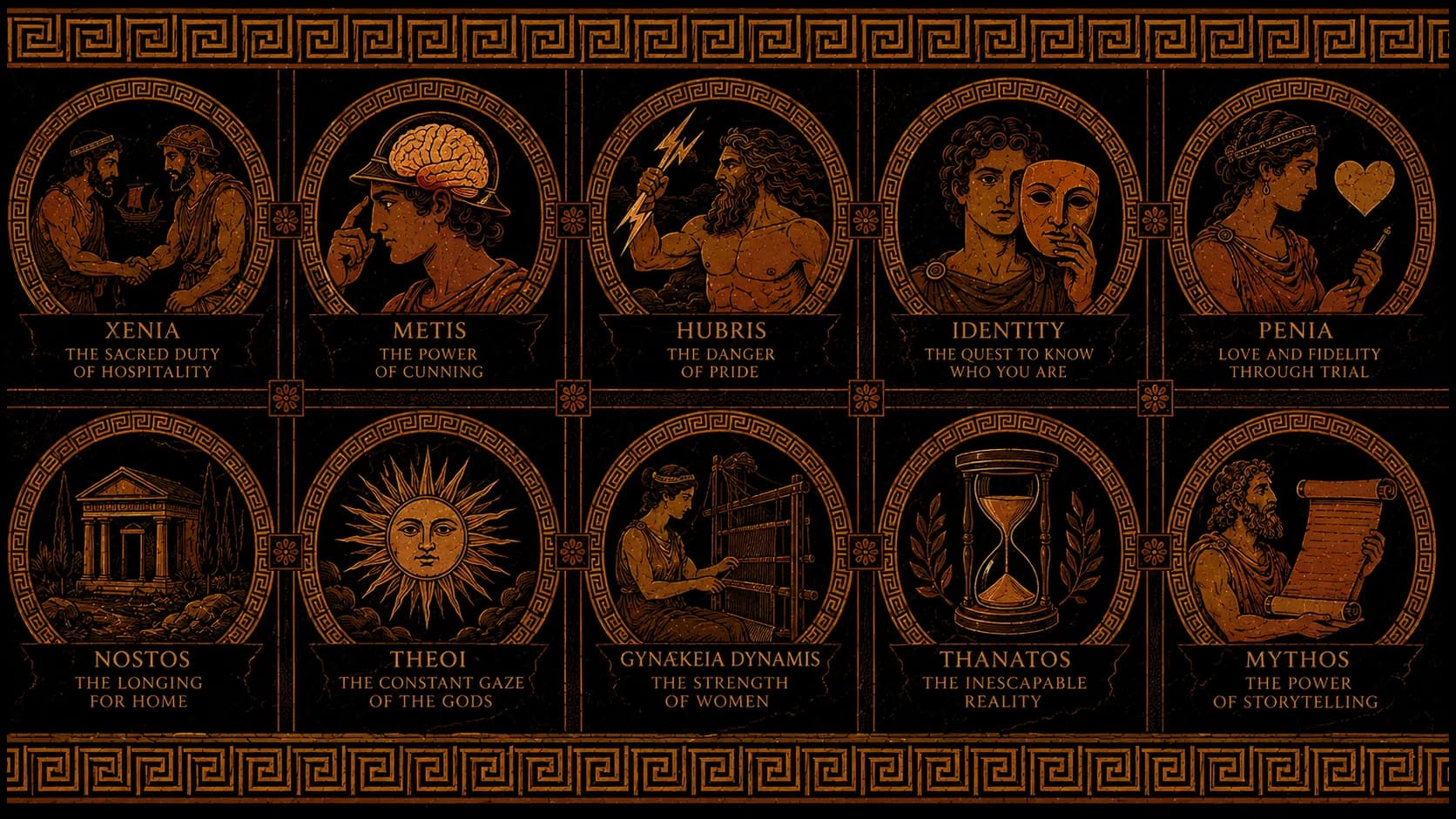
- The strongest themes: hospitality (xenia), cunning vs strength, the cost of pride, identity and recognition, fidelity, the meaning of home, divine attention, the role of women, mortality, and storytelling itself.
- Modern adaptations (Atwood, Miller, North, the Ulysses Universe) tend to foreground different themes than the ancient tradition emphasised.
- The themes are the reason the Odyssey keeps being adapted. The plot is one of many possible plots. The themes are the reason the plot still matters.