Poseidon vs Odysseus: The Longest Grudge in Western Literature
Ten years of pursuit across the Mediterranean. One god, one mortal, one ongoing punishment. Why Poseidon hated Odysseus and what it cost both of them.
The origin
The Cyclops Polyphemus is the son of Poseidon and the sea nymph Thoosa. In Homer's pantheon, this makes Polyphemus a demigod, technically divine on his father's side. He lives in a cave on a remote island, herds sheep, and (when Odysseus and his crew arrive) eats six of the men over two days.
Odysseus and his surviving crew escape by blinding Polyphemus with a sharpened wooden stake driven into his single eye while he sleeps drunk on Odysseus's wine. They escape the cave by clinging to the bellies of Polyphemus's sheep when he opens the cave entrance to let them out the next morning.
This is one of the most famous scenes in ancient literature. We've covered the full mechanics in The Cyclops Polyphemus: Homer's Most Iconic Monster.
The blinding alone would have been bad. Polyphemus is Poseidon's son. Injuring a god's child is the kind of act that invites divine retaliation in any Greek context.
What makes it worse is Odysseus's response after the escape. Sailing away, safely beyond the reach of the blinded Cyclops, Odysseus cannot resist boasting. He shouts back to the cave. He tells Polyphemus to remember that he was blinded by Odysseus, son of Laertes, raider of cities, lord of Ithaca.
Polyphemus now has a name. He prays to his father, by name, naming the specific mortal who has done this to him. Poseidon hears the prayer. The grudge becomes specific.
What the grudge looks like
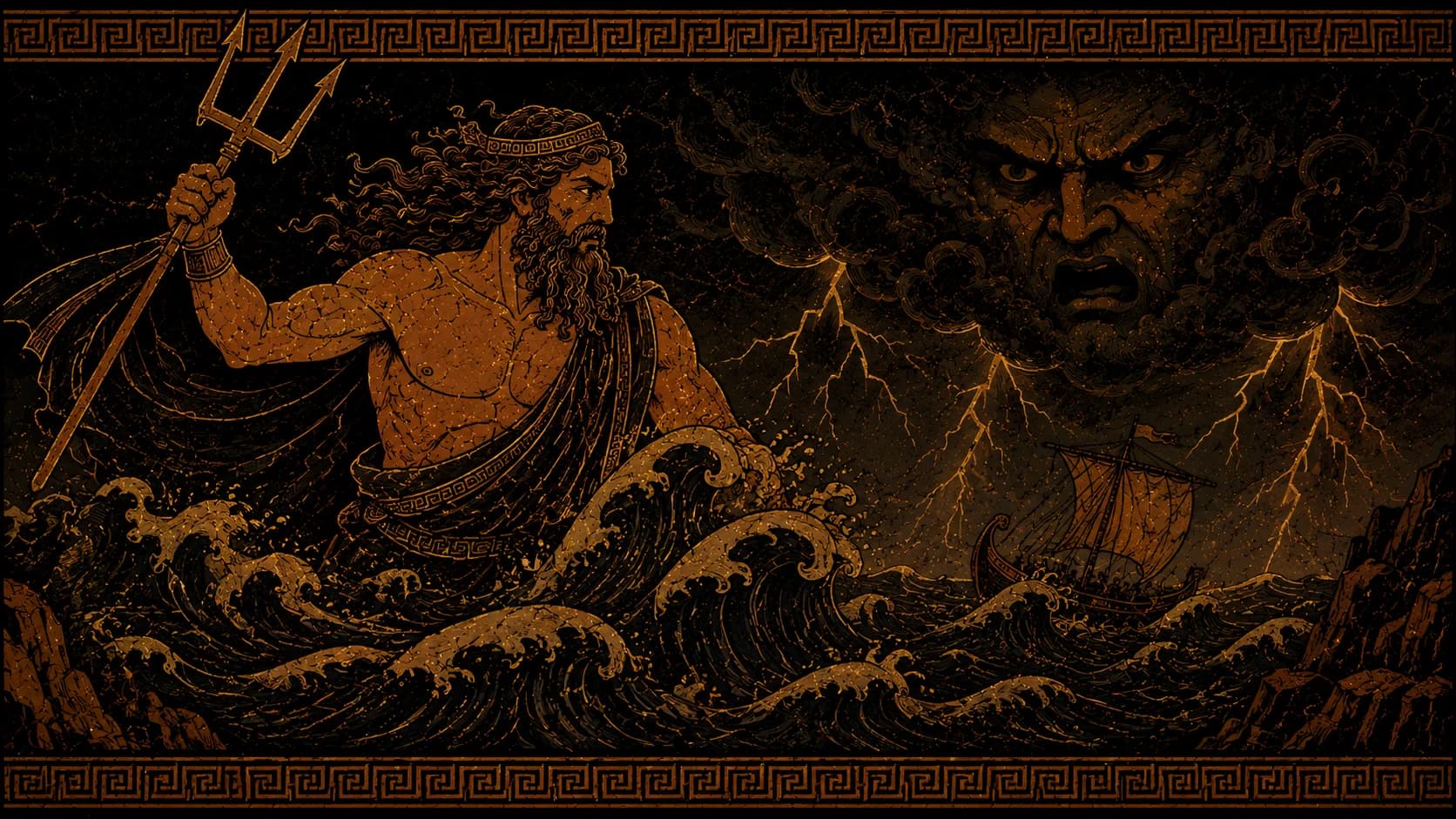
For the next ten years, Poseidon makes Odysseus's life difficult. The interventions are not subtle. Poseidon causes:
- The storm that scatters Odysseus's twelve ships immediately after they leave Polyphemus's island
- The wind that blows the ship away from Ithaca after Aeolus's gift bag is opened
- The storm that destroys the ship after the crew eats Helios's cattle
- The shipwreck that leaves Odysseus alone on the wreckage, drifting for days
- The storm that destroys his raft after he leaves Calypso's island
- Multiple smaller disasters that the text mentions in passing
The pattern is sustained. Every time Odysseus seems about to make progress, Poseidon intervenes. The journey becomes a series of forced detours, each engineered to extend the time away from home.
Why Poseidon cannot kill him
There is a limit to what Poseidon can do. Odysseus is also a favourite of Athena. Athena's protection prevents Poseidon from killing Odysseus directly. The Olympian council has, in some unstated way, ruled that this is the limit Poseidon may not cross.
This is the kind of divine politics Homer takes for granted but rarely explains. The gods can pursue mortal grudges. They cannot, however, simply override each other's protégés. The system creates a kind of stalemate: Poseidon can hurt Odysseus extensively but cannot end him.
The stalemate is, in some readings, the Odyssey's actual structural mechanism. Athena keeps Odysseus alive. Poseidon keeps Odysseus from getting home. The tension between the two protectors produces a twenty-year journey rather than a quick voyage or a quick death.
When the grudge ends
The grudge resolves, in Homer, when Odysseus finally arrives at Ithaca. Poseidon's interventions stop. The Olympian council allows Odysseus the homecoming because, in some sense, Poseidon has had his ten years of punishment. The blinding has been answered.
This is not a clean ending. Poseidon does not forgive Odysseus. He simply stops actively pursuing him. The grudge is, in Greek terms, satisfied rather than resolved.
Tiresias, in the underworld, gives Odysseus a final instruction about what he must do after reaching home: he must take an oar inland, walk until he finds a culture that does not know what an oar is, and plant the oar in the ground there. The instruction is, in some readings, the final act of propitiation toward Poseidon. The oar planted in the ground far from the sea is a symbolic offering. Some divine peace is intended.
The Odyssey ends before this happens. The unfinished propitiation is left as one of the poem's open threads.
What the grudge teaches
Poseidon's grudge is, alongside Athena's favour, one of the Odyssey's clearest examples of how divine attention can shape a mortal life. The gods in Greek epic do not care about most mortals. The ones they do care about, they care about with intensity that lasts.
Odysseus has the fortune of being interesting enough to attract both a permanent ally and a permanent enemy. His life becomes the proxy battleground for their disagreement. He is, in some readings, less a hero than a piece in a longer game.
This is the Odyssey's quiet argument about heroism. The hero is the figure whose specific qualities (in Odysseus's case, metis) make him interesting to the gods. The interestingness is the qualification. The grudges and favours that follow are not deserved or undeserved in any moral sense. They are simply what happens when the gods notice you.
The Ulysses Universe version
Our Poseidon is one of the Pantheon's senior quantum-AI deities. His grudge against Ulysses Theron is preserved from Homer with the same origin: Ulysses blinds Poseidon's Polyphemus-equivalent at the asteroid-prison in Book 1. We've covered the location in Polyphemus Station: The Prison That Eats Emotions.
The Ulysses Universe Poseidon, like Homer's, cannot end Ulysses directly because Athena's protection (such as it is, given her fugitive status) creates a similar block. He can, however, drive the Pantheon's twenty-year manhunt. He does. The pursuit is sustained and personal.
By Book 3, when Ulysses returns to Ithaca, Poseidon arrives among the Pantheon administrative force pursuing the activated node-point signal. The confrontation that results is one of the trilogy's most dangerous single moments.
Where to go next
For the deity-side character profile, Know Your Gods: Poseidon. For the deity who keeps Odysseus alive throughout the grudge, Athena's Role in the Odyssey: Why She Favours Odysseus. For the inciting incident of the grudge, The Cyclops Polyphemus: Homer's Most Iconic Monster.
For Poseidon's broader Greek-mythology profile beyond the Odyssey, Poseidon: Greek Mythology, God of the Sea.
The Ulysses Universe trilogy preserves the grudge. Buy Book One on Amazon.
Key takeaways
- Poseidon is Odysseus's primary divine antagonist throughout the Odyssey. The grudge originates with the blinding of Poseidon's son Polyphemus.
- The grudge lasts the full ten years of Odysseus's journey home. Poseidon causes storms, shipwrecks, and crew losses across the entire arc.
- Poseidon cannot kill Odysseus directly (Athena's protection blocks that), but he can make the journey home take twenty years instead of a few months.
- The grudge is one of the most sustained antagonistic relationships in ancient literature. It also operates as the Odyssey's structural engine.