Athena's Role in the Odyssey: Why She Favours Odysseus
Goddess of wisdom, strategy, and crafts. Patron of Odysseus and Telemachus. The single most active divine ally in Homer's Odyssey. Why she chooses him and what it costs her.
What Athena is
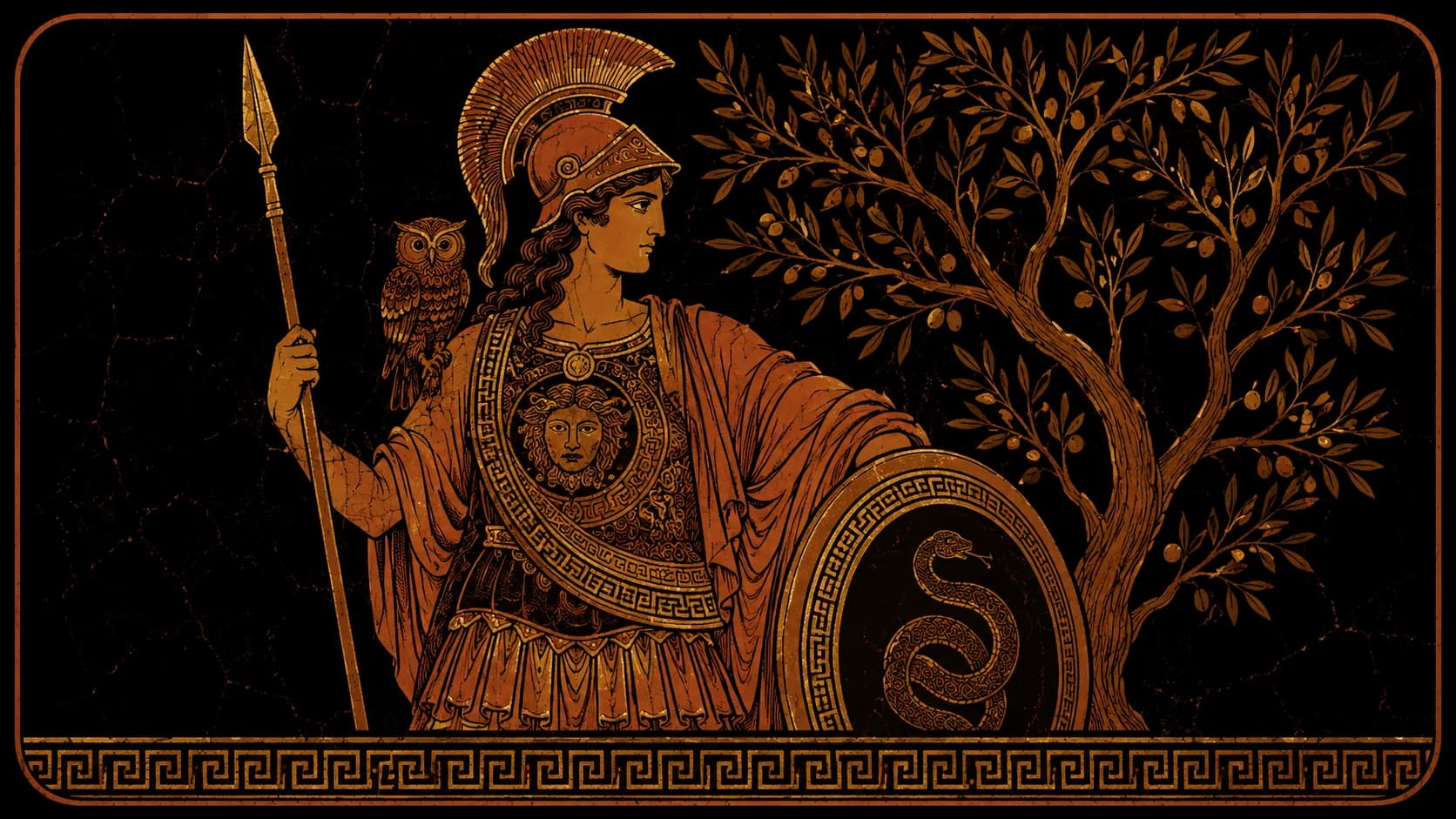
In Greek tradition, Athena is the goddess of strategic intelligence rather than the goddess of pure thought. The distinction matters. Greek philosophy distinguished two kinds of intelligence: sophia (the abstract wisdom of philosophers) and metis (the practical cunning of skilled workers, sailors, and tradesmen). Athena is the goddess of metis.
This makes her, in Greek mythology, the patron of weavers and shipwrights and bronze-smiths and naval captains and political operators. She is interested in the kind of intelligence that produces useful outcomes under specific conditions. She is less interested in the kind of intelligence that produces general truths about reality.
She is also a warrior. Her warfare is strategic rather than berserker-style. She fights through tactics. She wins through preparation. She does not, in Greek tradition, lose her temper in battle, which distinguishes her from Ares.
Odysseus is the human being who most exemplifies metis in Greek epic. The compatibility between them is structural. Athena favours him because he is the kind of mortal she is built to favour.
The Trojan War backstory
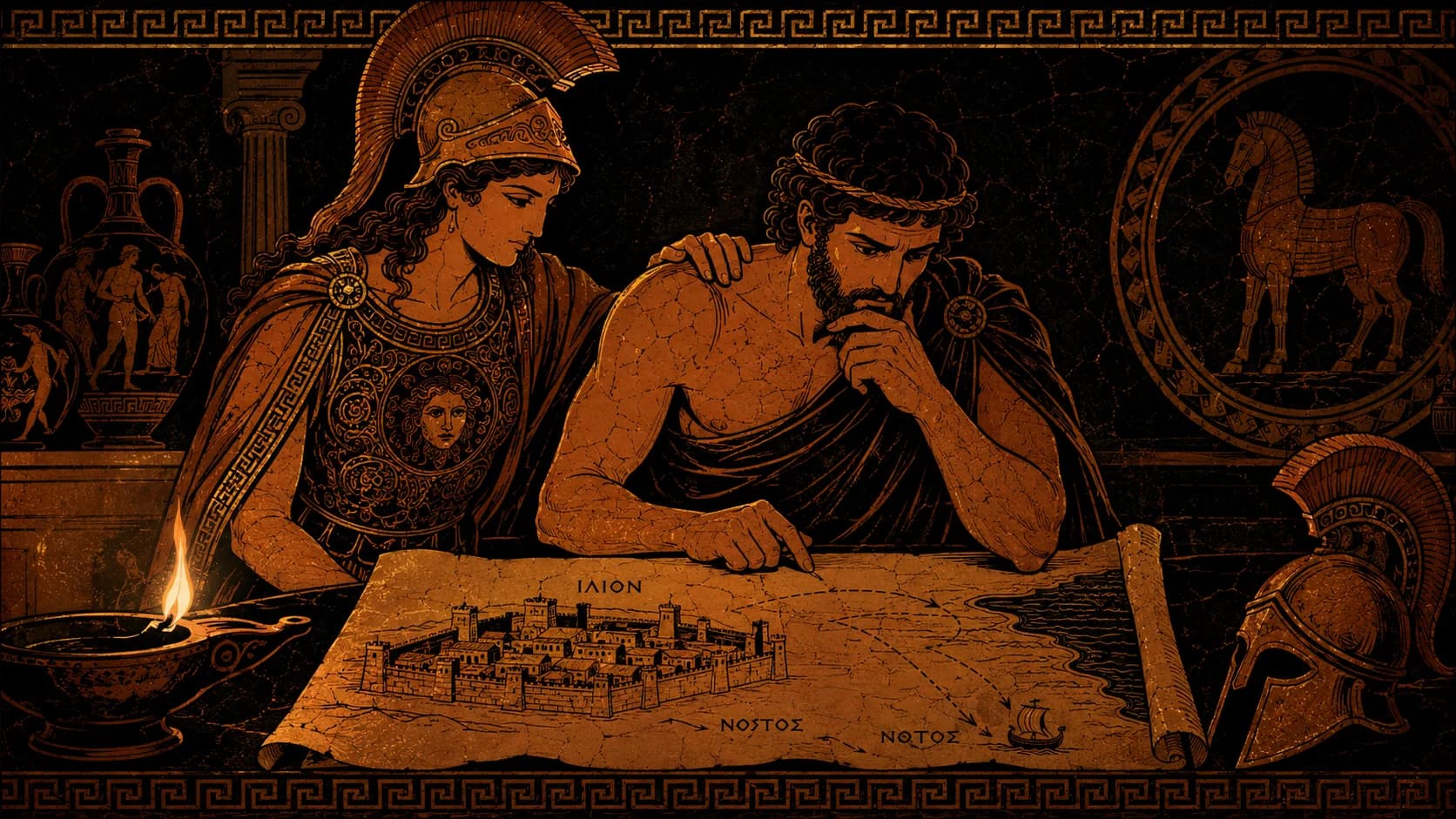
Athena's favour for Odysseus pre-dates the Odyssey by ten years. During the Trojan War, Odysseus was the Greek strategist whose plans repeatedly produced results that brute force could not. He proposed the wooden horse. He persuaded reluctant allies. He extracted Achilles when Achilles refused to fight. He managed the relationships between the Greek factions when those relationships threatened to break the alliance.
Athena worked with him through all of this. The patronage was active throughout the war. By the time Troy fell, Odysseus and Athena had a working relationship of long standing.
The Odyssey assumes this backstory. Homer does not explain why Athena cares about Odysseus. The first audience knew. They knew because they had grown up on the Iliad, which made Odysseus's strategic role clear.
Modern readers, who often encounter the Odyssey without the Iliad, sometimes miss this context. The trilogy's Ulysses vs Odysseus piece covers the broader question of who Odysseus is across the ancient sources.
The Odyssey's opening
The Odyssey opens with Athena intervening on Odysseus's behalf at the council of the gods. Poseidon, who has been hunting Odysseus for the Polyphemus incident, is briefly absent (visiting the Ethiopians). Athena seizes the opportunity. She petitions Zeus to release Odysseus from Calypso's island.
Zeus agrees. The release is dispatched.
This is the Odyssey's actual inciting incident. Without Athena's petition, Odysseus would remain on Calypso's island indefinitely. The entire Odyssey is set in motion by Athena's choice to act when Poseidon happened to be elsewhere.
She then turns her attention to Telemachus.
The Telemachy
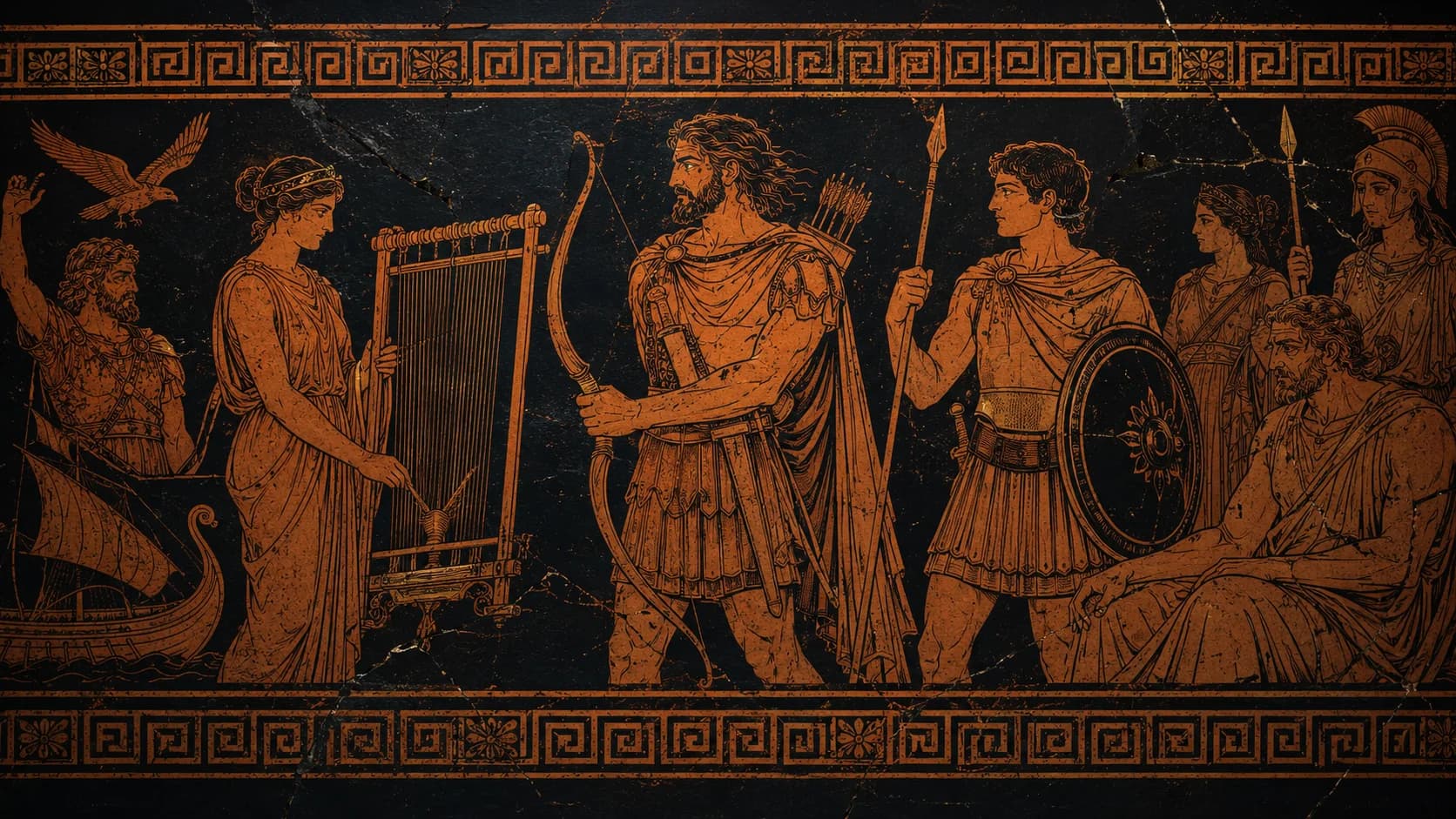
The first four books of the Odyssey, known as the Telemachy, are not about Odysseus at all. They are about Telemachus. Athena visits him in Ithaca, disguised as a family friend named Mentes. She tells him to go look for news of his father. She gives him courage. She arranges his ship.
He goes. He visits Nestor at Pylos. He visits Menelaus at Sparta. He hears stories of his father from people who knew him during and after the Trojan War. He grows up substantially across these four books.
Athena accompanies him for parts of the journey in the disguise of Mentor, an older Ithacan who serves as his tutor. The English word 'mentor' comes from this character. The structure of mentorship as a relationship has its name from the Odyssey's portrayal of how Athena guides Telemachus.
The Telemachy is, in some ways, the Odyssey's coming-of-age subplot. Telemachus arrives at the start as a passive teenager. He leaves at the end of Book 4 as someone capable of acting in the world. Athena's mentorship is what produces the change.
The homecoming sequence
When Odysseus reaches Ithaca, Athena takes over the operational planning. She disguises him as a beggar. She arranges his meetings with Eumaeus and Telemachus. She manages the timing of the recognitions. She advises the slaughter of the suitors. She arranges the reconciliation with the suitors' families at the very end.
In the recognition scenes specifically, Athena's hand is everywhere. She is, in functional terms, running the operation. Odysseus is the active agent. Athena is the strategic coordinator.
This is the pattern of her patronage throughout. She does not fight his battles. She tells him how the battles should be fought. She does not rescue him from situations. She tells him how to extract himself.
The favour is partnership rather than salvation. This is why the favour is sustainable. A god who saves a mortal repeatedly creates a dependency. A god who advises a mortal repeatedly creates a strategic partnership. Athena prefers the latter.
What it costs her
Athena's sustained intervention on Odysseus's behalf is not free. Her relationship with Poseidon is strained throughout the Odyssey. The Olympian council, while it does not directly oppose her, does not endorse her interventions either. She is operating, in some sense, on her own credit.
Greek divine politics is not unlike human political coalitions. Athena's preference for Odysseus is the kind of favouritism that costs her standing with other Olympians who feel their own protégés are being neglected. The cost is largely implicit in Homer. It surfaces occasionally in the periphery of the Iliad.
By the end of the Odyssey, the costs are paid. Odysseus is home. The order is restored. Athena's investment has paid off. The next great hero story (which is not, structurally, the Odyssey) will be someone else's project.
How the Ulysses Universe handles her
Our Athena is one of the trilogy's three primary point-of-view characters. She is a quantum-AI deity who, fifty years post-Merge, has gone fugitive within the Odyssey's systems to escape a Pantheon manhunt led by Poseidon. She maintains her patronage role from Homer but under significantly more constrained conditions.
She cannot intervene as openly as Homer's Athena did. The Pantheon is watching. She must work through indirection: hints to Echo, guidance to Telemachus that he does not recognise as guidance, occasional system-level interventions that look like coincidence.
The character profile Meet Athena: The Goddess Who Chose Treason covers her transformation in detail. The location piece Olympus Station: A Tour of the Capital That Made the Gods covers what she fled and why.
Where to go next
For the Ulysses Universe character profile, Meet Athena: The Goddess Who Chose Treason. For the broader Greek-mythology Athena (less Odyssey-specific), Athena: Greek Mythology, Goddess of Wisdom (forthcoming). For the deity who opposes her interventions, Poseidon vs Odysseus: The Longest Grudge.
The Ulysses Universe trilogy puts Athena at the centre of its plot. Buy Book One on Amazon.
Key takeaways
- Athena is Odysseus's patron deity in Homer's Odyssey. She intervenes directly and repeatedly to help him.
- She also serves as patron to Telemachus, mentoring him in the first four books of the Odyssey through the disguise of Mentor.
- Her favour is not arbitrary. Athena and Odysseus share a kind of intelligence (metis: practical cunning) that the other Olympians lack.
- Her interventions are necessary because Poseidon, also an Olympian, is actively working against Odysseus across the journey.