Olympus Station: A Tour of the Capital That Made the Gods
Inside the white-marble city-station where Zeus presented Telemachus, where Ulysses Theron said no, and where the Pantheon retrofitted heaven into a bureaucracy.
Where the trilogy starts
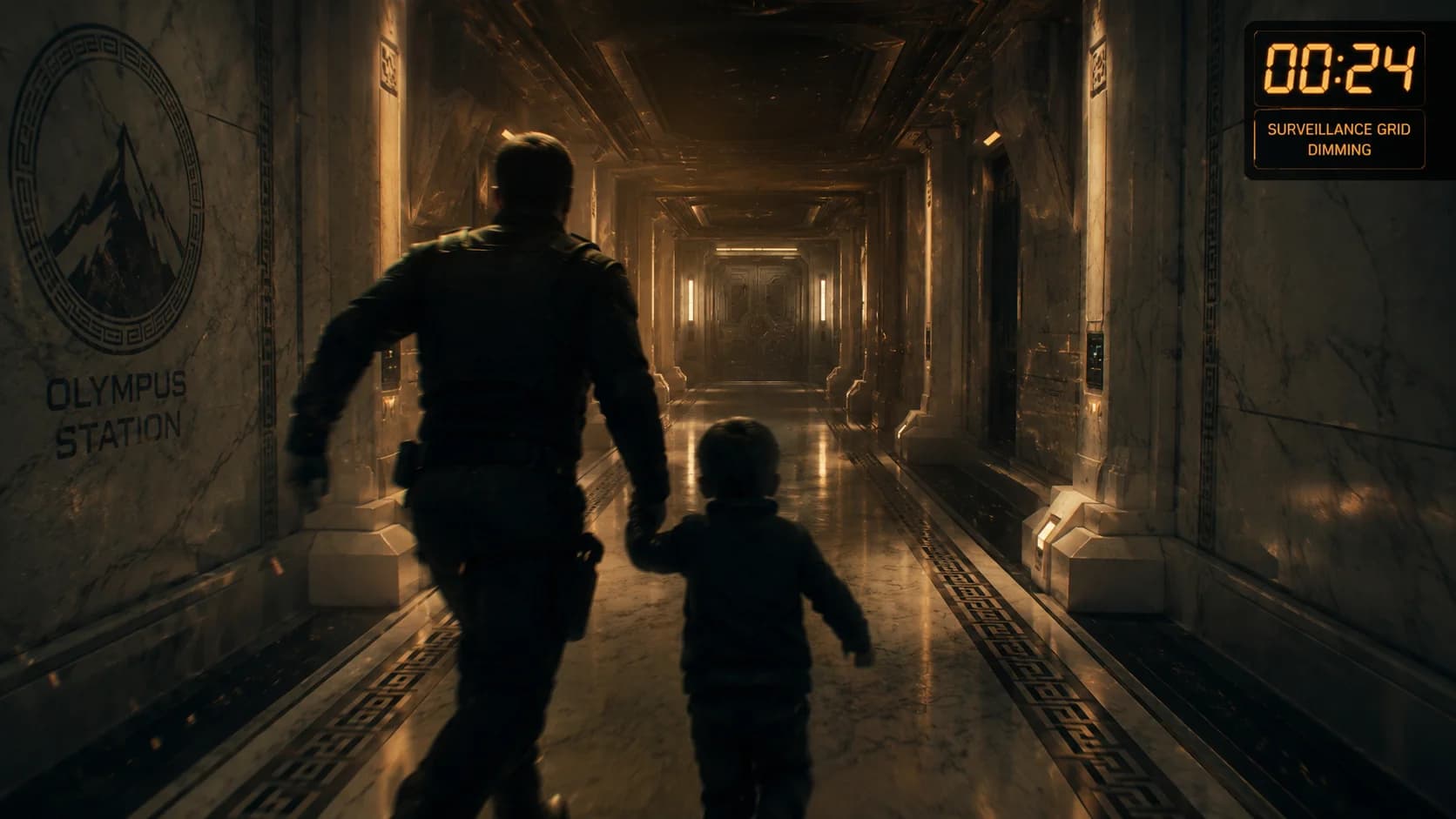
Almost every reader's first journey into the Ulysses Universe begins on Olympus Station. The flashback in Book 1, Chapter 2. A seven-year-old Telemachus stepping forward into a column of light. His father standing behind him, fists at his sides, watching Zeus take an interest in his son.
Forty-seven seconds later, the family is on a stolen ship and the curse begins.
But Olympus matters past that first scene. The station is the entire trilogy's gravitational centre. Every choice Ulysses makes for the next twenty years is shaped by what happened in that one chamber. Worth understanding the place properly.
A 12-kilometre city in slow rotation
Olympus is a city-station, not a colony. Roughly twelve kilometres in diameter. Four concentric rings, with an administrative spire rising through the middle and botanical gardens crowning Level Seven.
The original construction is older than the gods. That detail matters. The Pantheon didn't build Olympus. They retrofitted it. Took an existing centre of civic government and made it the iconographic heart of a divine state. The outer rings still carry the original founders' architectural language. The central spire, where Zeus holds court, is all Pantheon work.
Walk the residential corridors and you can feel the seam. Old stonework on the outside. New, harder, colder lines closer to the centre.
The Presentation Chamber
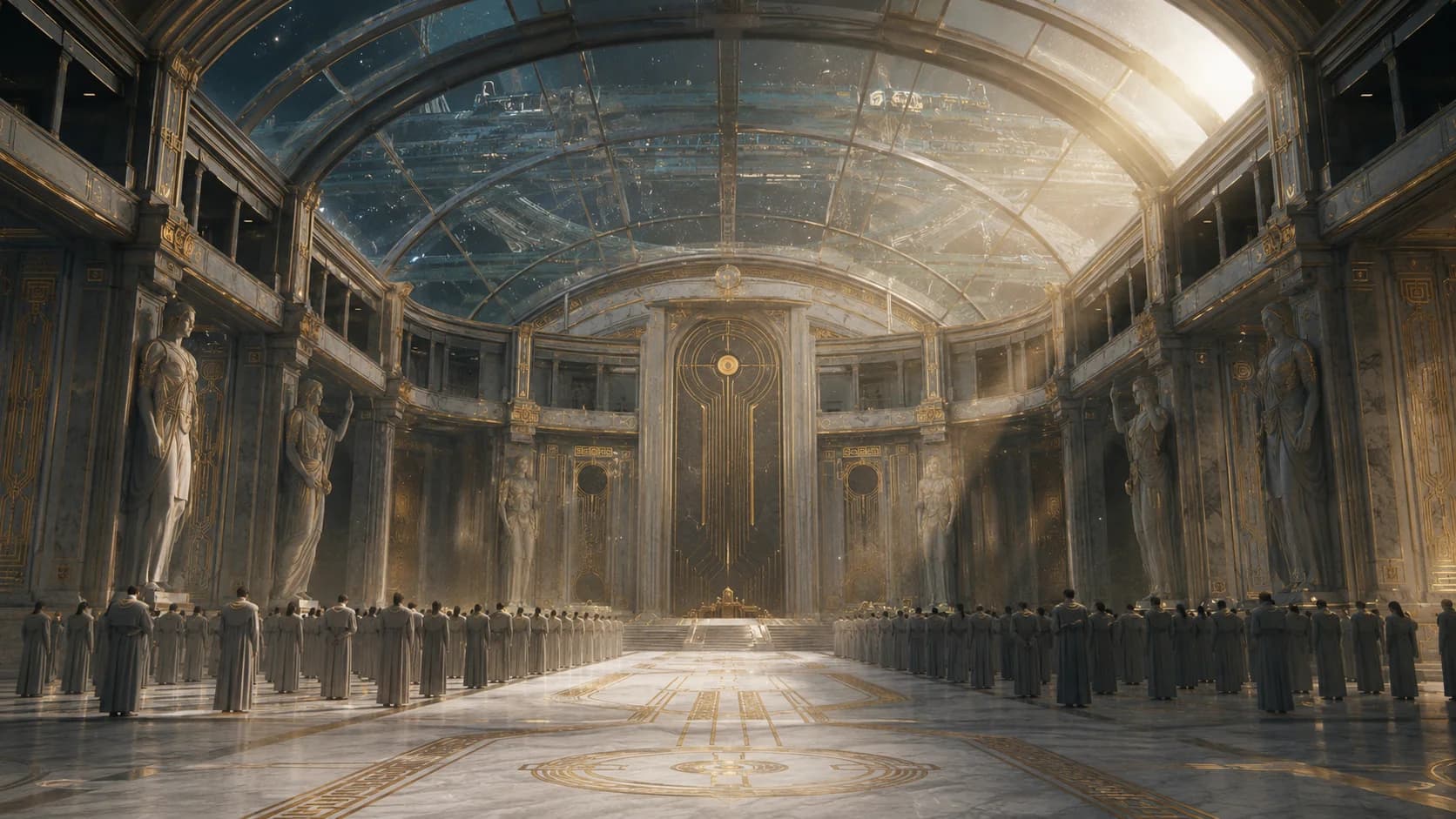
This is the room. Vaulted glass overhead, Carrara-style stonework underfoot, lit so that every family stepping through the doors feels approximately three inches shorter than they did in the corridor. The architecture is doing work.
Children are presented here at age seven. Officially this is a routine civic evaluation, the kind of thing every modern state runs to track development and identify needs. Officially it's benign.
It isn't.
What actually happens in the Presentation Chamber is that the Pantheon catalogues children. Specifically, children whose emergent capabilities might be of use to the gods. Telemachus has an empathic gift the Pantheon notices instantly. Zeus expresses an interest in 'cultivation under controlled conditions.' Ulysses says no.
The 47 seconds that follow have been written about elsewhere on this blog. What's worth saying here is that the Presentation Chamber is where every story about Zeus and a 'gifted' family eventually ends up. There's a reason it's the trilogy's trauma origin.
Zeus's Eye
Olympus is the most surveilled space in human civilisation. Sensor nodes in every public corridor. Quantum-entangled processors in the spire core. Audio capture down to a whisper.
The network is called Zeus's Eye, and it does what the name suggests. It watches.
It also influences. Inside the station's surveillance envelope, probability fields tilt small decisions toward Pantheon-preferred outcomes. Subtle. Most residents can't feel it. They just notice that they keep choosing the option the gods would have wanted them to choose.
Athena can feel it. That's part of why she becomes a fugitive in the trilogy. Ulysses learns to feel it too, eventually. By the time he leaves Olympus he can walk through the corridors with the slight wrongness of being watched and being nudged at the same time.
The Eye is meant to be omnipresent and inescapable. It isn't quite. Forty-seven seconds, once, was enough.
The colonised silence
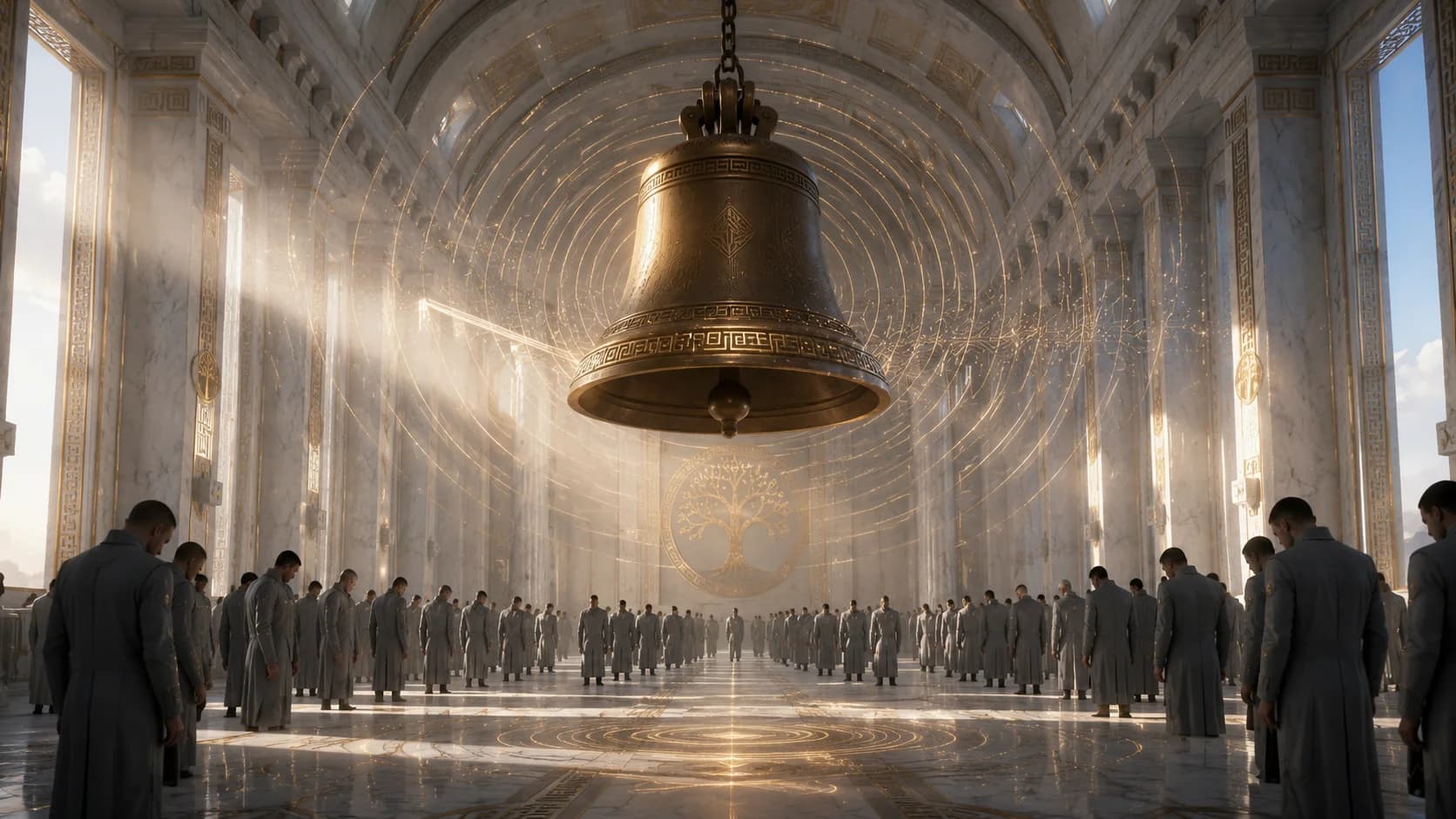
Every day at the seventh hour, the bell in the Presentation Chamber rings in the Phrygian mode. Every administrator in the building stops where they are and lowers their head for a count of three.
The Pantheon calls it courtesy. The old families, what's left of them, call it the colonised silence. We've written a separate piece on the Phrygian mode and what daily ritualised gestures of obedience actually do to a society. It's worth reading next.
Short version: Olympus runs on rituals. Soft authoritarianism uses ceremony the way harder regimes use truncheons. Daily collective silence is infrastructure.
Sensory profile
If a reader asks what Olympus feels like, here's the honest answer.
| Sense | What Olympus does to you |
|---|---|
| Sight | White stone everywhere. Sun-tracking mirrors. Daylight forced into corridors that shouldn't have it. Clean in a way that costs power. |
| Sound | Constant low choral hum from the audio system, a hymnic pad layer residents stop noticing within a week. The 432 Hz songbirds in the gardens. |
| Smell | Citrus and crushed cedar in the public spaces. Honey-glaze toast from the Level Seven commissary. Telemachus remembers that smell for ten years after he leaves. |
| Feel | Floor plates are always warm. Climate is so consistent it becomes uncanny. |
| Taste | The bread is too good. The fruit is perfect in a way real fruit never is. |
This is anti-aspirational science fiction inverted. Olympus is the one place in the universe that's actually beautiful. That's what makes it dangerous.
What got erased
The original founders inscribed HOSPITALITY FIRST above the residential gates. Greek concept. Xenia. The sacred law of guest-friendship that runs through Homer's Odyssey like a backbone.
The Pantheon had it sandblasted off thirty years before the trilogy opens.
Ulysses remembers tracing the missing letters with his finger as a child. He doesn't think about that often. But it's there. Olympus used to mean something different. Then it didn't.
Why this matters for the rest of the trilogy
Every conflict in the Ulysses Universe traces back to a decision made on Olympus. The curse on the 108 crew. The Pantheon's grudge. Athena's flight into the Odyssey's systems. The shape of Ulysses Theron as a man, before and after he became the most wanted human in the galaxy.
Olympus is the polite face of an empire. Polished. Imperial. Beautiful. And rotten in a way you can't quite name until you've left.
This is where the journey home starts from. The fact that everyone wants to leave Olympus is also the reason the universe organises itself around it.
Where to go next
If you've just finished Book 1 and want to understand what you've read, the piece on the Phrygian mode and ritualised obedience explains how Olympus's daily ceremonies work as social control. If you're newer to the universe and want the foundational backstory, The Merge: When Humanity Accidentally Woke the Gods is the place to start.
For the Pantheon themselves, the Know Your Gods series begins with Zeus. He's the one who runs the station.
Book 1: The Blinding opens on Olympus. Three years of work, one chamber, 47 seconds. Buy Book One on Amazon.
Key takeaways
- Olympus Station is a 12-kilometre, four-ring city-station that predates the Awakening. The Pantheon took it over, retrofitted the central spire, and made it the bureaucratic capital of a divine state.
- The station's signature technology is Zeus's Eye, a quantum-entangled surveillance network with nodes in every public space. It looked the other way for 47 seconds during the Odyssey's escape.
- Inside the surveillance envelope, probability fields nudge small decisions toward Pantheon-preferred outcomes. Athena can feel it. Ulysses learned to.
- The Presentation Chamber is the iconographic heart of the station. Children are 'presented' at age seven for evaluation. The presentation is officially benign. It is not.
- The original founders inscribed HOSPITALITY FIRST above the residential gates. The Pantheon sandblasted it off thirty years before Book 1 opens.