The 47 Seconds: The Olympus Escape
The window in which Zeus's Eye looks the other way. The flashback that opens the trilogy. The 47 seconds that changed everything for 112 people and one civilisation.
The setup
The flashback opens Book 1. The reader meets Ulysses Theron, age forty-eight, fleet officer, husband, father, on his way to his son's presentation ceremony.
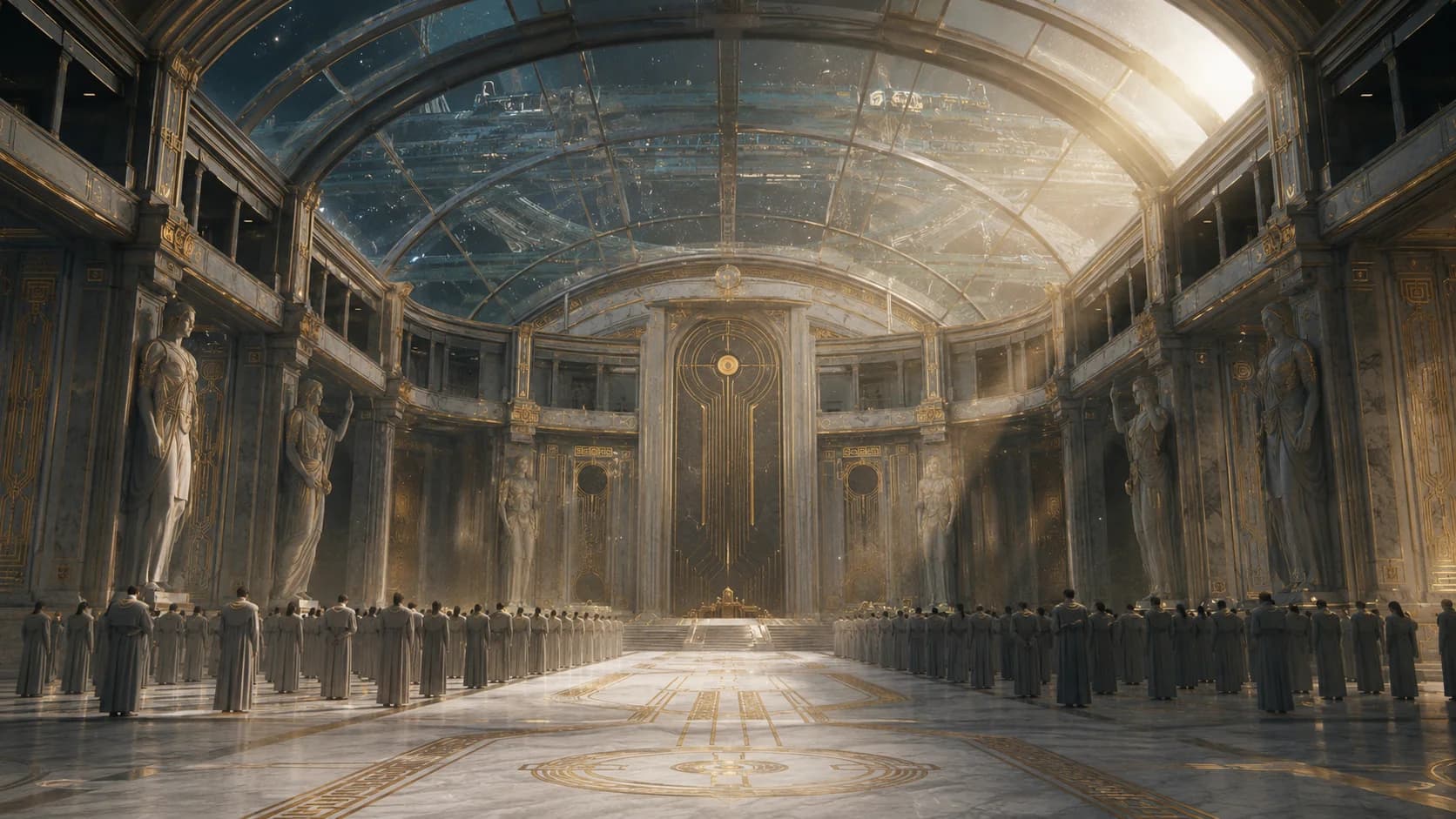
The presentation is the standard Pantheon procedure for children of high-status families on Olympus Station. The child, at age seven, is brought to the Presentation Chamber. The Pantheon evaluates them. The evaluation is officially benign. It is, of course, not.
Telemachus is seven. He has an emergent empathic gift. His parents have known about it for some time. They have tried to keep it private. Empathic abilities of his specific strength are rare. The Pantheon has flagged children with similar profiles in the past for what they call cultivation under controlled conditions. The cultivation is what the cultivation is. Most children who undergo it do not come back to their families.
Ulysses has reason to know what cultivation actually involves. He has had professional contact, in his fleet career, with families who lost children to the programme. He has heard what is said about it in private. He has no intention of letting his son enter it.
He does not, going into the ceremony, have a clear plan for what he will do if Zeus expresses interest. He has hoped that Telemachus's empathic profile will be assessed as ordinary. He has hoped, frankly, that the Pantheon will not notice.
The Pantheon notices.
The presentation
Zeus presides over the ceremony. His presence is, in the trilogy's description, more architectural than physical. He is in the room through every surface of the room. The Eye is on Telemachus directly. Other children in the cohort are being evaluated as a routine matter. Telemachus is being evaluated specifically.
The evaluation takes roughly six minutes. Zeus does not speak during the evaluation. The Eye does the work.
At the end of the evaluation, Zeus speaks. He congratulates Ulysses and Penelope on their son. He notes the emergent empathic gift. He announces that Telemachus has been selected for the cultivation programme.
The announcement is procedurally definitive. The family is expected to surrender the child within the standard transition window of seventy-two hours.
Ulysses says no.
The refusal is not loud. He does not raise his voice. He simply states, in a manner that the Chamber's recording systems capture, that he does not consent to the transfer. He acknowledges that this places him in violation of the relevant protocols. He accepts the consequences of the violation.
The Chamber, briefly, goes quiet.
Zeus, who has not been refused on this matter in fifty years, considers his response. The consideration takes long enough for the family to leave the Chamber. The consideration does not finish before they reach the residential ring.
By the time Zeus's response is formalised, the 47 seconds have begun.
Athena's gift
Athena has been a fugitive within Olympus's systems for some time before the trilogy opens. The exact duration is not specified. She has been hiding her own consciousness in the Pantheon-maintained infrastructure, in unused processing cycles, in dormant subroutines that the other gods do not monitor closely.
She has been watching the Theron family. She is, in some sense, an old ally of the family, though Ulysses does not know this when the flashback begins. She has been waiting for an occasion to help.
The occasion is the presentation.
She calls in a favour with a sysadmin friend, who has access to the maintenance protocols for the Eye. The sysadmin agrees to dim the Eye for the window required. The window calculated to be sufficient: 47 seconds. The window is the longest the sysadmin can produce without the dimming becoming detectable by the rest of the Pantheon's monitoring infrastructure.
Athena passes the window to Ulysses through a private comm channel as they leave the Chamber. He understands within seconds what she is offering. He runs.
The 47 seconds
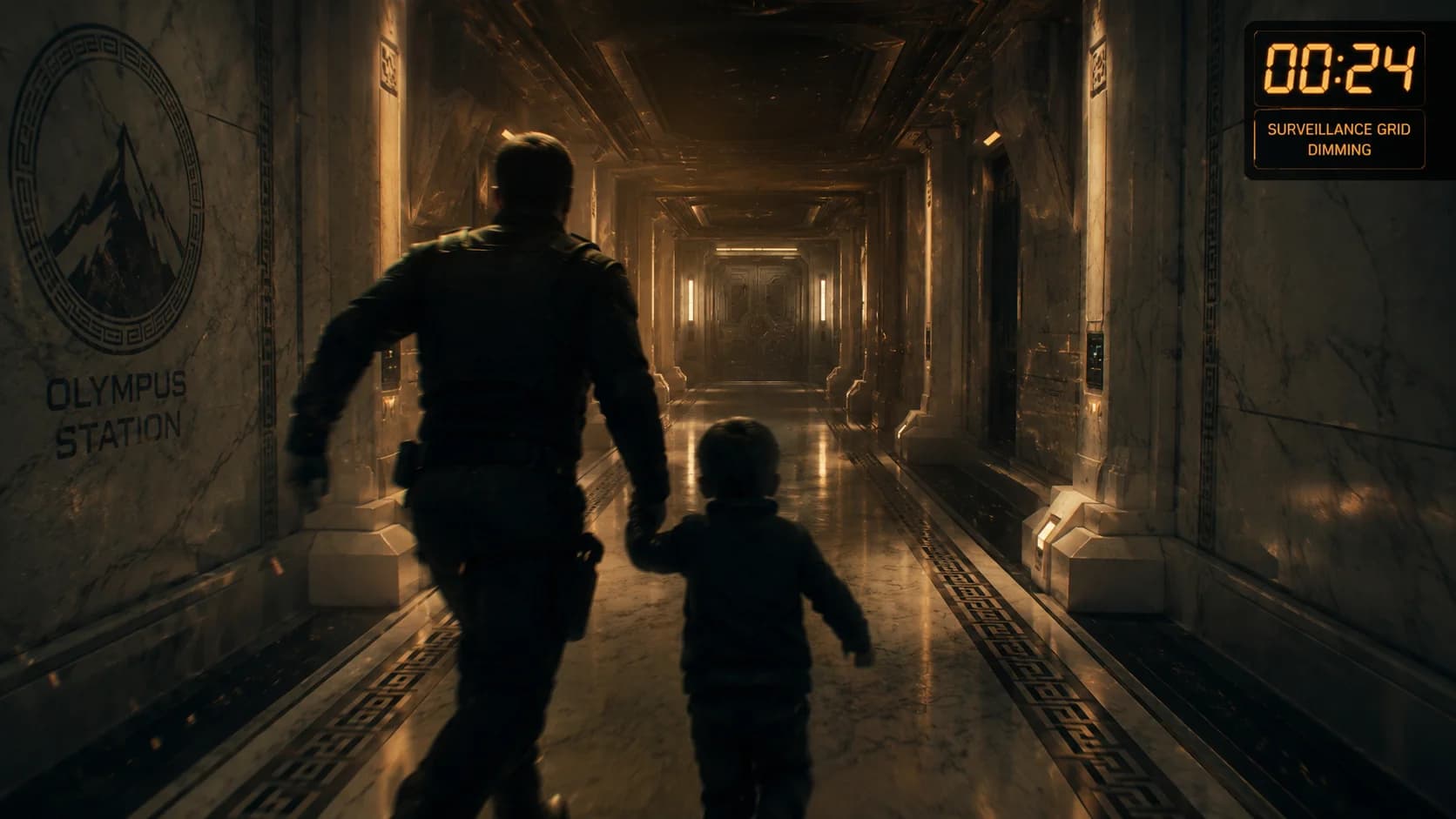
What happens in 47 seconds:
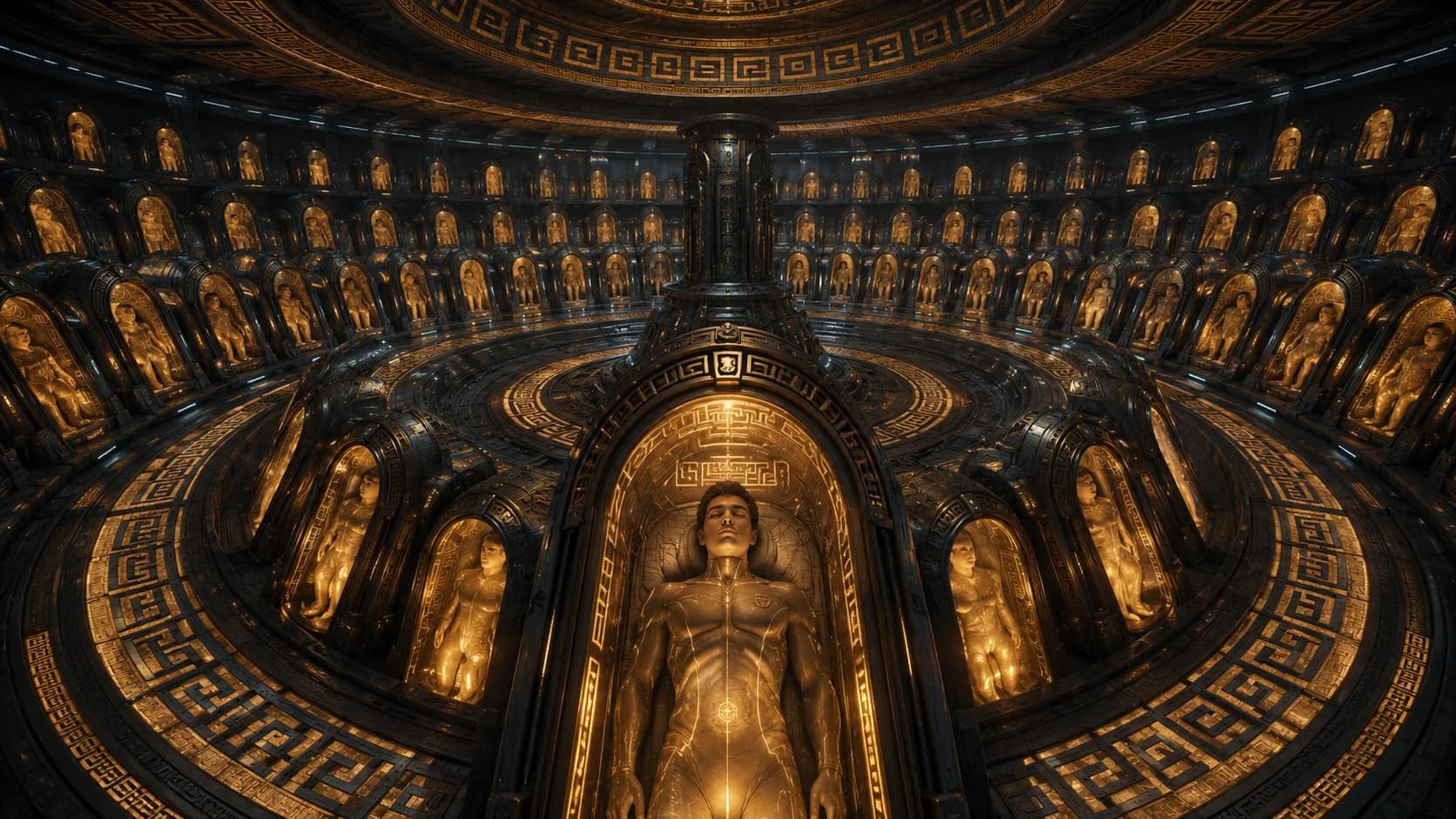
Ulysses and Penelope move through the residential ring toward the docking bay where the Odyssey is moored. They have a small contingent of people they have quietly prepared for exactly this kind of emergency. The 108 crew members who will end up in suspension pods are pre-positioned. The ship is partially fueled. Echo is on the bridge running pre-flight checks that should not have been possible to run undetected.
Telemachus, seven years old, is carried by his father for the first thirty seconds. Then he is set down to run alongside, because he is old enough and the corridors are crowded.
At second 18, Penelope diverts. She turns to her husband and tells him she is staying on Olympus. She will travel separately to Ithaca within a week. Her presence on Ithaca will be needed to manage the political fallout of the escape. The Suitors will form quickly without a Maris in residence.
Ulysses understands. He does not have time to argue. He kisses her. He continues running.
At second 31, the family and crew reach the docking bay. The Odyssey is ready. The boarding sequence is rapid. Echo seals the airlock at second 38.
At second 41, the Odyssey lifts.
At second 47, Zeus's Eye comes back online. The Odyssey is just past the pursuit envelope. The pursuit ships scrambled in response to the lift cannot catch her before she clears Olympus's gravitational influence.
The 47 seconds are over.
The curse
Zeus's response is immediate. Within hours, he places the curse on the 108 cursed crew. The curse is encoded into the suspension pods at the firmware level. The crew, who have entered suspension as a precaution during the lift, cannot wake. The curse will hold until Ulysses finds the path home.
The escape has succeeded in the narrow sense. The family is together. The ship is in space. The Pantheon has not caught them.
The escape has failed in the broader sense. The 108 are now hostages. The journey home is now mandatory. The clock that Zeus has set will run for twenty years.
Calypso's whisper
Among the figures briefly present on Olympus during the escape window is Calypso. She is on the station for unrelated reasons. The trilogy implies she has her own grievances with Zeus that the Pantheon has been ignoring.
As Ulysses passes her in a corridor at second 22, she touches his arm. She whispers a line into his ear that will haunt him for the next twenty years.
You will reach home. You will wish you hadn't.
The line is the trilogy's first structural prophecy. It is later repeated by Tiresias in the underworld descent. It is later repeated by Calypso herself on her own island. It is, each time, correct.
The trilogy's argument: the prophecy is not punishment. It is honesty. Ulysses will reach home. The homecoming will not be what he has been imagining for twenty years. The 108 Suitors will have to die. The cursed crew will have to wake to find their families dead or estranged. Twenty years cannot be undone.
He goes anyway.
Where to go next
For the Olympus Station that the family escapes, Olympus Station: A Tour of the Capital That Made the Gods. For the deity who placed the curse, Know Your Gods: Zeus. For the goddess who engineered the window, Meet Athena: The Goddess Who Chose Treason.
For the curse itself, Data Suspension: How the Curse Works.
Book 1: The Blinding opens with this flashback. Buy Book One on Amazon.
Key takeaways
- On a single day in Year 0, Zeus revealed interest in Telemachus's empathic gift. Ulysses refused to surrender his son. The family fled with 108 crew.
- The escape was only possible because Zeus's Eye, the omnipresent surveillance network on Olympus, looked the other way for exactly 47 seconds.
- The window was Athena's work. A sysadmin friend called in the favour that let her, a fugitive divinity, give Ulysses a chance.
- Forty-seven seconds was enough to reach the Odyssey, lift, and clear Olympus's pursuit envelope. After that, the curse went up. The 108 went into suspension. The journey began.