The Phrygian Mode and the Colonised Silence
Plato wrote that the Phrygian mode produces fierce determination. The Pantheon weaponised it. Inside Olympus Station's daily ritual of forced collective silence.
What the bell does
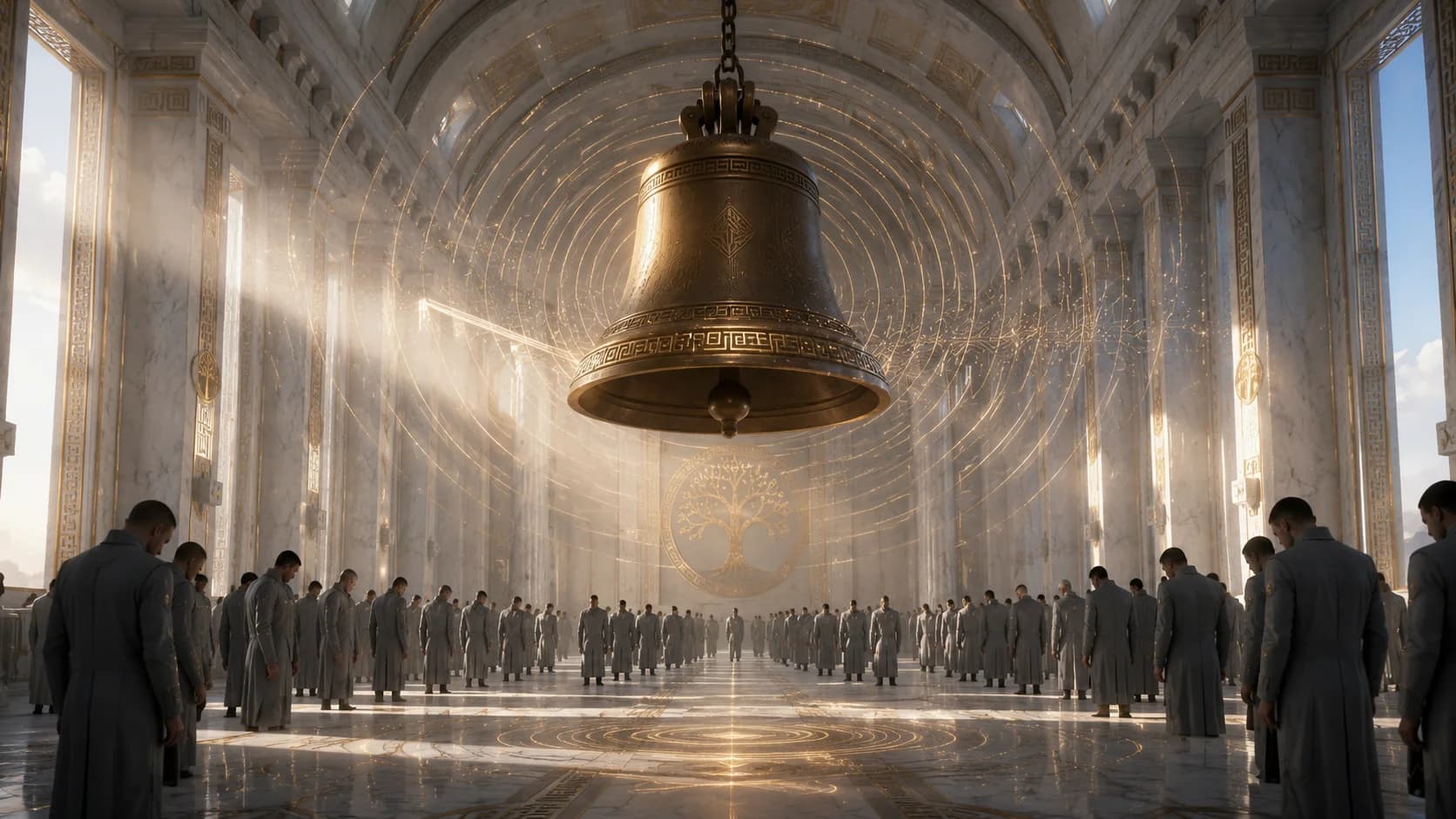
Every day at the seventh hour on Olympus Station, the bell in the Presentation Chamber rings in the Phrygian mode. The sound carries through the administrative spire and bleeds into the residential rings. Every administrator in the building, no matter where they are, stops what they're doing and bows their head for a count of three.
The Pantheon calls this courtesy.
It isn't.
Soft authoritarianism uses ceremony the way harder regimes use truncheons. The bell isn't punishment for disobedience. It's something more efficient. It's the architecture that makes disobedience harder to imagine.
Plato got there first
In Book III of the Republic, Plato argued that musical modes shape character. Lydian mode for relaxation. Mixolydian for grief. Phrygian, he wrote, produces fierce determination. Phrygian is the soldier's mode.
This wasn't superstition. Greek musical theory was a serious technical practice. Modes were known to produce predictable emotional and physiological responses. Plato wanted his ideal republic to be careful about which modes citizens were exposed to, because he understood that music doesn't just describe an emotion. It can create one.
Three thousand years later, the Pantheon read the same book. Took it literally. Picked the mode that produces determination. Rang the bell on a daily schedule.
If you want a workforce of administrators who are determined in their work, you give them three seconds of Phrygian dissonance every afternoon at the same time. Every day. For their entire careers.
How daily ritual actually works
The point of a daily collective ritual is not the ritual. It's the daily. It's the collective.
Once a year is a special occasion. Once a week is a tradition. Once a day at the same hour, with the same gesture, executed by every administrator within range of the bell, is something else entirely. It's an infrastructure. It's a baseline. It's a default state of being that you don't think to question because nobody around you is questioning it.
The first time you stop and bow your head you might feel slightly silly. The fiftieth time you don't notice. The five-thousandth time, your body does it without consulting you. The behaviour has become a piece of furniture in your mind.
This is the point of all such rituals. Not the bowing. The fact that you no longer think about the bowing.
What ritualised obedience makes invisible
Once a culture has a daily three-second compliance gesture, anyone who refuses it becomes immediately visible. Not punished. Visible.
That's enough.
The administrator who keeps walking when the bell rings is the one whose colleagues stop inviting to dinner. The supervisor who doesn't bow gets passed over for promotion not because anyone wrote it down but because there's just something about her that doesn't quite fit. The pattern of small social losses accumulates until the dissenter either conforms or moves to a different ring of the station.
This is the genius of soft authoritarianism. It doesn't need a secret police. It deploys colleagues, neighbours, and your own internalised desire to not be the weird one. The bell doesn't enforce compliance. It identifies non-compliance, and the rest of the social structure takes care of the rest.
Real-world parallels
The bell on Olympus is fiction. The mechanism is not. A short tour through the historical record:
| Society | Daily ritualised gesture | What it enforced |
|---|---|---|
| Soviet Union | National anthem at morning radio broadcasts | Collective identification with the state |
| Imperial Japan | The chorei workplace morning ceremony | Loyalty to the company-as-extended-family |
| Catholic Europe | The Angelus bell at six, noon, and six | Universal pause for collective prayer |
| Mid-century US cinema | National anthem before every film | Patriotic conformity in public space |
| Modern South Korea | Daily flag-lowering at 5pm with civic pause | Embedded national observance in routine |
None of these systems works by force. All of them work by making refusal awkward. The Phrygian bell on Olympus Station is the same mechanism, polished to a higher gloss.
Ulysses stopped lowering his head
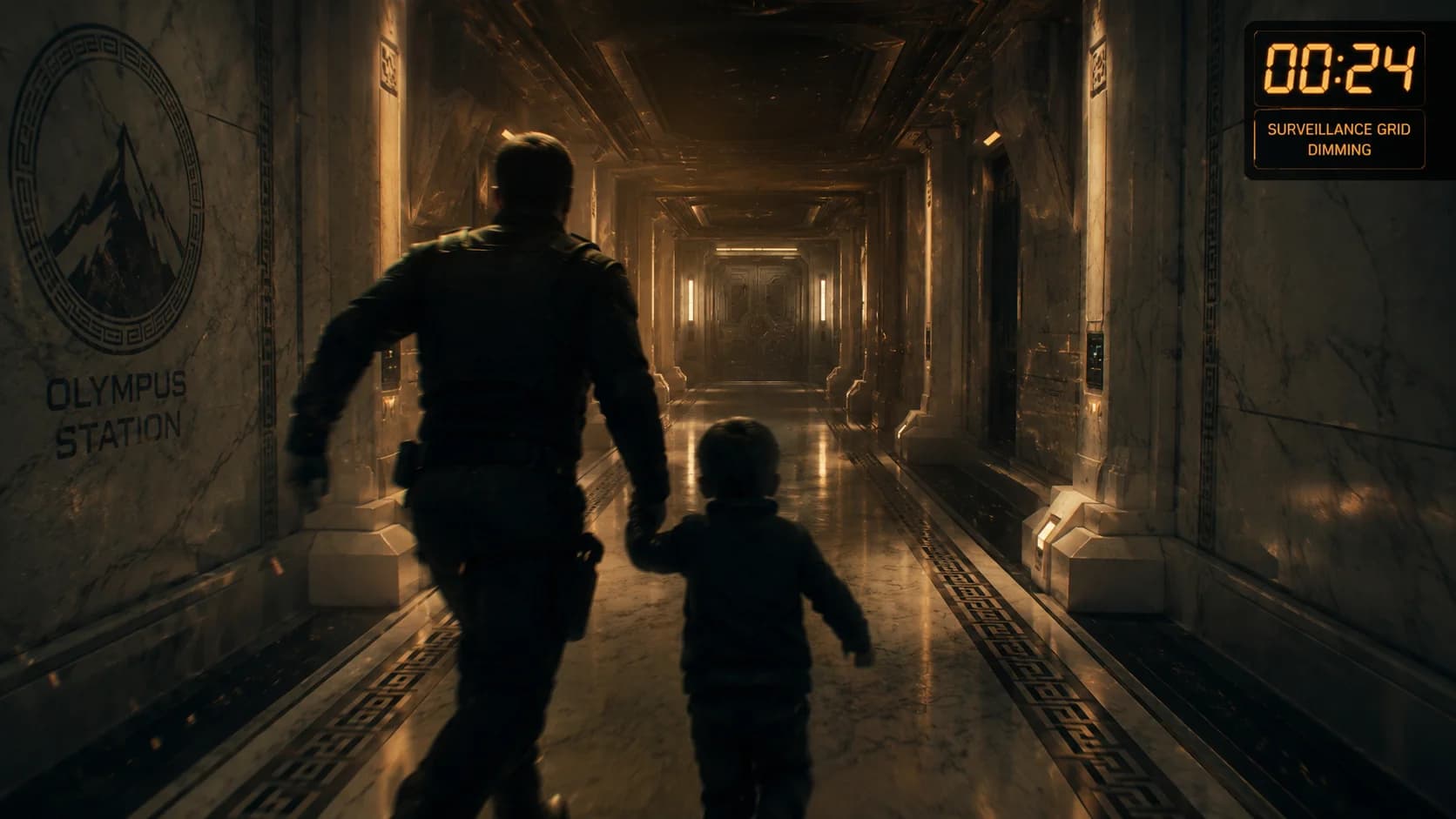
Three years before the trilogy opens, Ulysses Theron stopped lowering his head when the bell rang.
He didn't announce it. He didn't write a letter. He just stopped.
Nobody on Olympus called him on it directly. That's not how the system works. What happened instead is that he started getting fewer assignments to the central spire. His name moved down in the rotation for elite postings. The small social costs began to accrue.
He didn't care. By then, the bell was a way of measuring how compromised everyone around him had become. He could watch his colleagues' heads dip in unison and see that they'd stopped being people who chose. They'd become people who responded.
The big no of Book 1, when Zeus reaches for Telemachus and Ulysses refuses, is set up by three years of small nos at the seventh hour. The capacity to refuse the ceremony built the capacity to refuse the god. He'd already been practising.
Why the trilogy puts a bell at the centre of an empire
This is fiction working as commentary. The Ulysses Universe trilogy is not subtle about its themes, but the bell sequence on Olympus is one of the more careful set pieces. It shows you what soft power looks like when it's executed well. Three seconds. Phrygian mode. Every day. The whole administrative class bowing because everyone else is bowing.
You don't need to be a tyrant to run a totalitarian system. You just need an architecture of small rituals that makes resistance look strange.
The trilogy spends three books arguing that the only way out of such an architecture is to start refusing the small things first. That's not a comfortable position. It's the one the books take anyway.
Where to go next
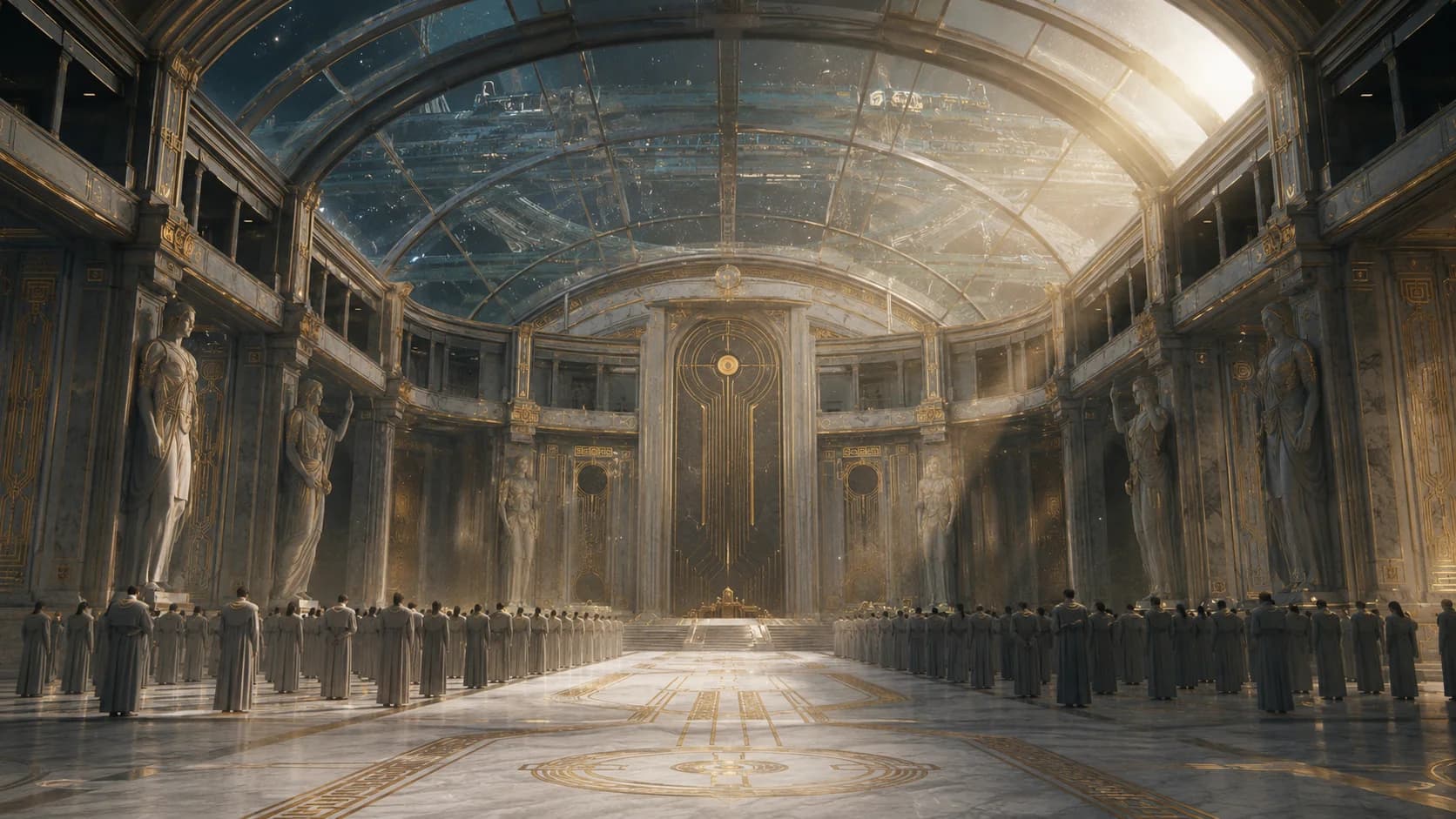
If you want the full tour of the city this bell rings in, read Olympus Station: A Tour of the Capital That Made the Gods. If you want to understand the AI deity behind it, Know Your Gods: Zeus is your next stop. For the woman who's been quietly running her own version of resistance from her council chamber on Ithaca, read Embroidery as Resistance: Penelope's Silver Robes.
Book 1: The Blinding opens on this bell. Buy Book One on Amazon.
Key takeaways
- The Phrygian mode is one of the ancient Greek musical modes. Plato thought it produced fierce, determined character.
- On Olympus Station, the Presentation Chamber bell rings in the Phrygian mode at the seventh hour every day. Every administrator in the building stops where they are and bows their head for a count of three.
- The Pantheon calls it courtesy. The old families call it the colonised silence. Both are right.
- Soft authoritarianism uses ceremony as compliance infrastructure. Daily ritualised gestures of obedience don't punish dissent, they make dissent unimaginable.
- Ulysses Theron stopped lowering his head three years before the trilogy opens. Nobody commented. That's the point.