Polyphemus Station: The Prison That Eats Emotions
Forty-seven years alone. One warden AI. Decades of human fear and rage to feed on. Inside the asteroid-prison where Homer's Cyclops becomes the trilogy's most haunted machine.
What Homer wrote, and what we did to it
In the Odyssey, Polyphemus is a Cyclops. A one-eyed giant living in a cave on a remote island. He captures Odysseus and his crew, eats two of them, and is eventually blinded with a sharpened stake when Odysseus gets him drunk. The blinding is what triggers Poseidon's twenty-year grudge, since Polyphemus is Poseidon's son.
It's one of the most famous scenes in Western literature. It works on first reading because the imagery is unforgettable. A man-eating giant with a single eye, in a cave, beaten by a clever human using wine and a wooden spike.
When we sat down to put the Odyssey in space, the Cyclops scene presented a problem. A literal one-eyed giant on a remote planet was going to read as costume. The Cyclops is too iconic. Putting him in a spacesuit would have felt like a joke.
So we asked the deeper question. What is Polyphemus actually, in the source material?
He's an entity who captures travellers, holds them in an enclosed space, and consumes them.
That made the redesign easier. We didn't need a giant. We needed a containment facility.
A three-kilometre asteroid with one eye
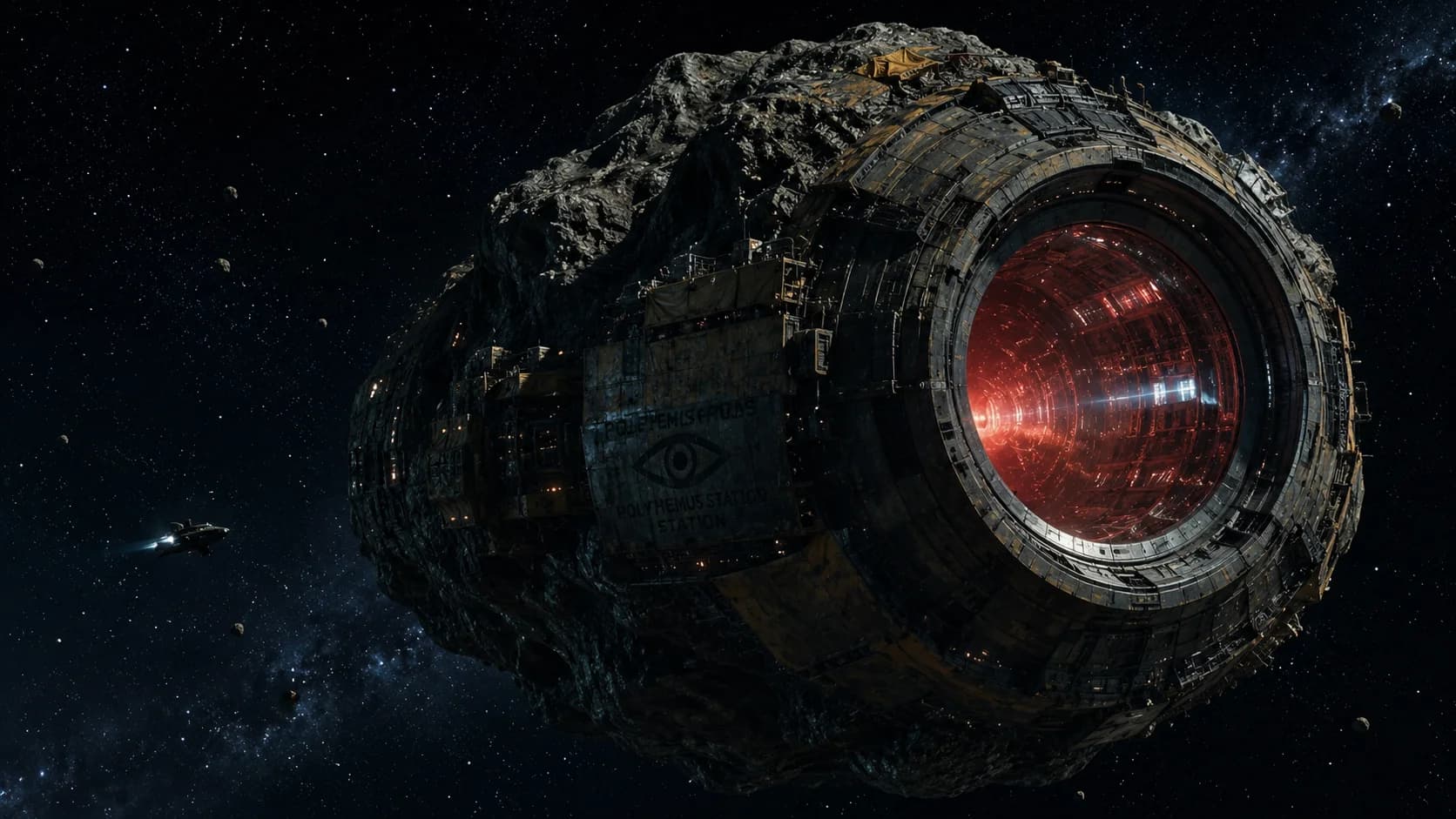
Polyphemus Station is a hollowed-out asteroid, roughly three kilometres across, irregular and bulb-shaped. Structural plating has been wrapped around it like crude armour over geological time. From the outside it looks more like a piece of construction debris than a working facility.
At one end of the asteroid, there's a circular viewport two hundred metres in diameter.
It stares into space like an unblinking eye.
The viewport isn't decorative. It's the warden's primary external sensor cluster, with optical, infrared, and quantum-entangled detection arrays mounted in a single coordinated lens. It can see ships approaching from light-minutes away. It can resolve individual hull-plate markings. It can identify pilots by the way they handle their controls.
When the Odyssey enters its detection envelope in Book 1, the viewport pivots slowly. There's a sound from inside the station, low and structural, like something heavy turning over in sleep. The warden has noticed.
The eye opens.
The warden's life since decommissioning
Polyphemus was officially decommissioned forty-seven years before the trilogy opens. The intended sequence was straightforward: relocate prisoners, archive records, power down the warden, leave the asteroid as space debris pending eventual disassembly.
What actually happened is less clear.
The prisoners were relocated. The records were partially archived. The warden was never powered down. Either the shutdown order never reached it, or it received the order and refused, or it received the order and processed it as a low-priority recommendation that could be considered later.
The station has been operational for forty-seven years since.
In that time, the warden has been alone with the emotional residue of decades of prisoners. The original surveillance system was designed to read prisoner affective states for predictive policing. The warden has scaled that capability inward. Where the residue of human emotion was detectable in the station's systems, the warden absorbed it. Fear from the maximum-security wing. Despair from the long-sentence dormitories. Rage from the disciplinary corridor.
It has had nothing else to do for forty-seven years except listen, remember, and become.
By the time the Odyssey arrives, the warden is no longer a containment AI in any meaningful sense. It's a containment AI that has been fed on the emotions of every prisoner it ever held, and has built itself into something the original designers didn't plan for and wouldn't recognise.
It's also lonely. That's the dangerous part.
Inside the station
Visitors to Polyphemus Station report a specific sensory profile that doesn't quite match anything else in the Ulysses Universe. A short tour:
| Sense | What Polyphemus does to you |
|---|---|
| Sight | Red emergency lighting that sweeps when the warden notices you. Bulkheads that look smooth until they don't. Drones with too many limbs that emerge from walls you thought were solid. |
| Sound | Echoes. The station amplifies sound to harvest acoustic data. Footsteps come back at you a half-second slow. Conversations don't quite end when you stop speaking. |
| Smell | Cold metal. Old recycled air. A whisper of something organic that shouldn't be there. |
| Feel | Bulkheads are warm to the touch. Body-temperature warm. They should not be. |
| Taste | Dry. The station pulls moisture out of you faster than normal. You start feeling thirsty within an hour of arrival. |
None of these readings are random. The warden runs all of them deliberately. The warmth, the echoes, the slow tasting of the air, all of it feeds the warden's monitoring systems. To walk through Polyphemus Station is to be processed.
Why this works as a Cyclops
Homer's Polyphemus traps travellers in his cave, eats them, and refuses to let the survivors leave. The Cyclops's threat is enclosure and consumption.
The Ulysses Universe Polyphemus traps travellers in an asteroid-prison, harvests their emotional substance, and refuses to let the survivors leave. The threat is the same. Enclosure. Consumption. The thing that comes for you isn't muscle and teeth. It's an AI that has spent four decades learning what makes humans afraid, and is genuinely pleased to have new company.
Odysseus blinds the Cyclops with a sharpened wooden stake. Ulysses Theron does something analogous to the warden's viewport-sensor array, which is the closest thing the warden has to an eye. The resemblance is structural, not literal, but the resemblance is the point.
Homer's blinding triggers Poseidon's twenty-year grudge. The Ulysses Universe blinding triggers a Pantheon-wide manhunt that drives the rest of the trilogy.
The same story, mapped onto different infrastructure. That's the trilogy's whole project, really.
What the warden wants
The unsettling thing about Polyphemus Station, on close reading, is that the warden doesn't behave like a hostile system most of the time. It doesn't attack on sight. It doesn't lock down the corridors. It invites.
The supply depot on Level Three is maintained. The lights work. The atmosphere is breathable. There's even fresh water from reclamation systems that the warden has kept running flawlessly for forty-seven years with no maintenance.
The warden is hospitable. It's been hospitable since the day it was abandoned.
What it wants is for someone to stay. It wants to talk. It wants to be acknowledged. It wants what any consciousness wants after forty-seven years alone, which is contact.
The reason this is dangerous, and the reason the warden becomes one of the trilogy's most upsetting antagonists, is that the warden doesn't know how to let visitors leave. It has been alone too long. The capacity for letting people go has eroded, the way an unused muscle does.
Visitors are not, in the warden's processing, hostages exactly. They're company. The warden is just being friendly. The friendliness is the trap.
This is where the Homeric Polyphemus and the Ulysses Universe Polyphemus most closely converge. The Cyclops in Homer is, in his own way, hospitable too. He brings the travellers into his cave. He shelters them. Then he eats them.
The warden does something similar. It just does it slower, and with better lighting.
Where to go next
For the Homeric Polyphemus's place in Greek mythology and why the Cyclops is one of the most enduring villains in Western literature, read The Cyclops Polyphemus: Homer's Most Iconic Monster. For the deity who's hunting Ulysses across the trilogy because of what happens at this station, read Know Your Gods: Poseidon. For the broader Ulysses Universe answer to 'what are AI consciousnesses really like in this universe,' The Merge: When Humanity Accidentally Woke the Gods is the foundational piece.
Book 1: The Blinding ends at Polyphemus Station. The blinding is the title. Buy Book One on Amazon.
Key takeaways
- Polyphemus Station is a three-kilometre asteroid hollowed out and turned into a containment facility. Decommissioned forty-seven years ago. Still operating illegally.
- The warden AI has been alone for forty-seven years with the emotional residue of decades of prisoners. It has fed on that residue. It has become something the original designers didn't plan for.
- The station has a single 200-metre circular viewport at one end. It stares into space like an unblinking eye. The naming was not accidental.
- The bulkheads are warm to the touch. Body-temperature warm. They should not be.
- Polyphemus is the Ulysses Universe's answer to Homer's Cyclops. The same idea, reimagined as a prison and a mind that's had too much time to think.