The Cyclops Polyphemus: Homer's Most Iconic Monster
The one-eyed giant who eats Odysseus's men, gets blinded with a sharpened stake, and triggers Poseidon's twenty-year grudge. Everything you need to know about literature's most famous monster.
The most famous scene in ancient literature
If you ask a literate adult to describe a scene from Homer's Odyssey without preparation, more than half of them will describe the Cyclops. The one-eyed giant. The cave. The sharpened stake. Odysseus driving the burning point into Polyphemus's eye while he sleeps.
This scene has been continuously retold, painted, sculpted, and adapted for nearly three thousand years. It launched an entire genre of vase painting in 6th-century BCE Greece. It shows up in Renaissance art, Romantic poetry, Hollywood films, prestige TV, novels, comic books, and at least one Coen Brothers film. The scene works because it does several things at once: it's visually horrifying, structurally clever, and morally complicated. Odysseus is the hero, but the blinding is brutal. Polyphemus is the monster, but he's also a son crying out to his father.
This post covers who Polyphemus actually is in Greek mythology, what happens in the Odyssey, and why the scene has survived three thousand years of cultural retelling.
Who Polyphemus is
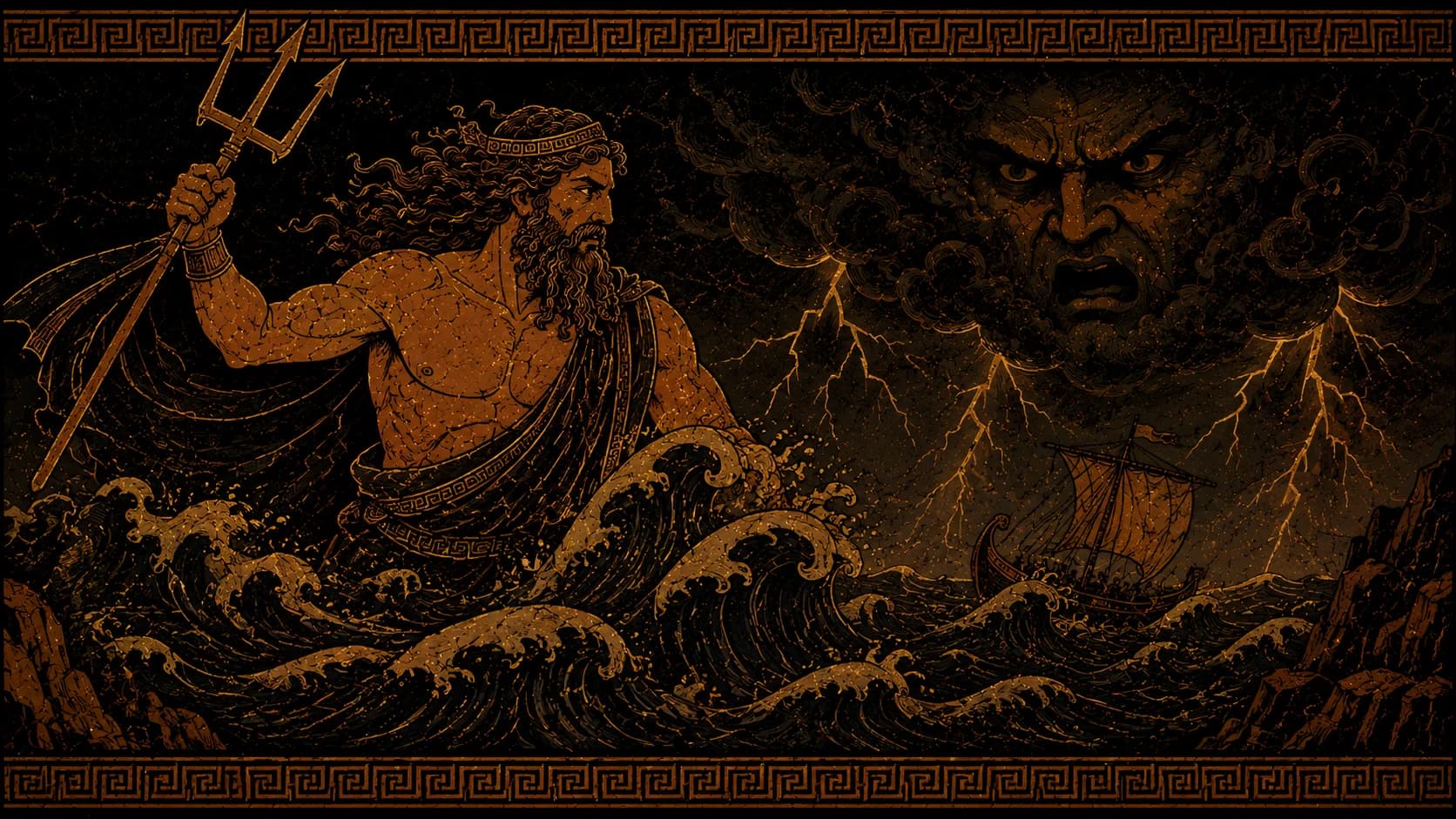
Polyphemus is a Cyclops. The Cyclopes are a race of one-eyed giants in Greek mythology, the children of the sea god Poseidon and various nymph-mothers. Polyphemus specifically is the son of Poseidon and Thoosa, a sea nymph.
The Cyclopes are not a single coherent group across Greek mythology. There are at least three distinct types:
| Type | Source | Role |
|---|---|---|
| Hesiod's Cyclopes | Theogony | Smiths who forge Zeus's thunderbolts |
| Homer's Cyclopes | Odyssey | Pastoral giants on a remote island |
| Later Cyclopes | Various | Builders of legendary walls and structures |
Polyphemus is the most famous of Homer's pastoral Cyclopes. He lives on an unnamed island, keeps sheep, and is large enough to lift boulders that twenty men together cannot move. The other Cyclopes on the island are mentioned briefly. Polyphemus is the one Odysseus meets.
Outside the Odyssey, Polyphemus appears in other Greek and Roman myths as a tragic lover of the sea nymph Galatea, who rejects him for the mortal Acis. This version of Polyphemus is gentler. He's a lonely giant in love. The two versions are difficult to reconcile, which suggests they come from different traditions that were later attached to the same name.
In the Odyssey, the gentler version is absent. Polyphemus is a threat.
What happens in the Odyssey
The Cyclops sequence is Book 9 of the Odyssey. Odysseus has been recounting his journey to the Phaeacians. The encounter with Polyphemus is one of his stories.
Odysseus and twelve of his men land on the Cyclopes' island. They explore. They find a cave. The cave is well-stocked with cheese and milk, which they begin to eat. The owner returns. The owner is Polyphemus.
Polyphemus is enormous. He rolls a boulder across the cave entrance to seal the men inside. He asks who they are. Odysseus claims protection under the Greek law of guest-friendship, xenia. Polyphemus laughs and eats two of the men, smashing their heads against the cave floor.
The next morning, Polyphemus eats two more men, lets out his sheep, rolls the boulder back, and goes about his day. The boulder is too heavy for the surviving men to move on their own. They're trapped.
Odysseus thinks. He cannot simply kill Polyphemus, because then they'd be sealed in the cave forever. He needs a plan that gets the boulder moved and the men out.
That evening, Polyphemus returns. Eats two more men. Odysseus offers him strong wine that he's brought from the ship. Polyphemus drinks. He asks Odysseus's name. Odysseus says 'Nobody.' Polyphemus, drunk, says he'll do Nobody the favour of eating him last. He passes out.
Odysseus and his men sharpen a wooden stake from Polyphemus's staff. They heat the tip in the fire until it glows. They drive the burning point into Polyphemus's single eye.
Polyphemus wakes screaming. He calls the other Cyclopes for help. They come to the entrance of the cave. They ask what's wrong. Polyphemus shouts: 'Nobody is killing me! Nobody is killing me by trickery, not by force!' They assume he's drunk or mad, and they go away.
In the morning, Polyphemus rolls back the boulder to let his sheep out. He sits at the entrance, feeling each sheep as it passes. Odysseus has tied each surviving man to the underside of a ram. They escape clinging to the sheep's bellies.
Once aboard their ship, sailing away, Odysseus shouts back at the cave. He cannot resist. He reveals his real name. 'If anyone asks who blinded you, say Odysseus, son of Laertes, raider of cities, lord of Ithaca!'
Polyphemus prays to his father Poseidon. The prayer is granted. The journey home takes ten years.
Why the scene works
The Polyphemus episode is the structural pivot of the Odyssey. Without it, the rest of the poem doesn't happen. Odysseus would sail home from Troy without supernatural interference and the entire epic ends in a few weeks.
But the scene works on multiple levels beyond plot mechanics.
Cunning over strength. This is the Odyssey's central thematic claim. Odysseus is not the strongest Greek hero. Achilles is stronger. Ajax is stronger. Diomedes is stronger. Odysseus is the cleverest. The Polyphemus scene is the definitive proof. Strength cannot save you from a Cyclops. Cleverness can.
The price of pride. Odysseus could have escaped Polyphemus and sailed away in silence. He didn't. He shouted his name. The pride that demanded credit also gave Poseidon a target. Ten years of suffering follow from one moment of unnecessary boasting. This is one of the Odyssey's most adult themes: even heroes have flaws that compound.
The complicated monster. Polyphemus is not simple. He's brutal, yes. But he's also a son who calls out to his father in pain. He's a herder who knows his sheep by name. The blinding is horrifying not because Polyphemus is purely evil but because he's not. Homer keeps the moral water muddied.
The trick. 'Nobody' (Greek: outis) is one of the most famous puns in Western literature. It works in Greek. It works in most translations. It works because it's funny on first reading and devastating on second. Odysseus's whole identity is in that joke. He is, briefly, nobody. Then he loudly insists on being somebody. The joke is also a thesis on identity itself.
Why Polyphemus survives every adaptation
The Cyclops encounter has been adapted across nearly every medium humans have invented. A short tour:
| Adaptation | Year | What it does with Polyphemus |
|---|---|---|
| Ancient Greek vase painting | 6th c. BCE onwards | Standard iconography: giant, single eye, sharpened stake |
| Virgil's Aeneid | 1st c. BCE | Cameo, with Aeneas's crew narrowly escaping |
| Renaissance painting | 15th-17th c. | Tragic-lover version (Polyphemus with Galatea) |
| Tennyson's 'The Lotos-Eaters' | 1832 | Background reference |
| Ulysses (Joyce) | 1922 | The 'Cyclops' chapter in a Dublin pub |
| Ulysses (Camerini film) | 1954 | Literal giant, special effects of the period |
| The Odyssey (Konchalovsky miniseries) | 1997 | CGI giant, faithful to Homer |
| O Brother, Where Art Thou? | 2000 | One-eyed Bible salesman (John Goodman) |
| Circe (Miller) | 2018 | Background presence, sympathetic context |
| The Ulysses Universe | 2026 | AI warden of an asteroid-prison |
What survives across all of them: the single eye, the cave-as-trap structure, the cleverness-over-strength resolution. What changes: everything else. Polyphemus is a stress test for adaptation. If you can make the Cyclops work in your medium, you can probably make the rest of the Odyssey work.
How the Ulysses Universe handles Polyphemus
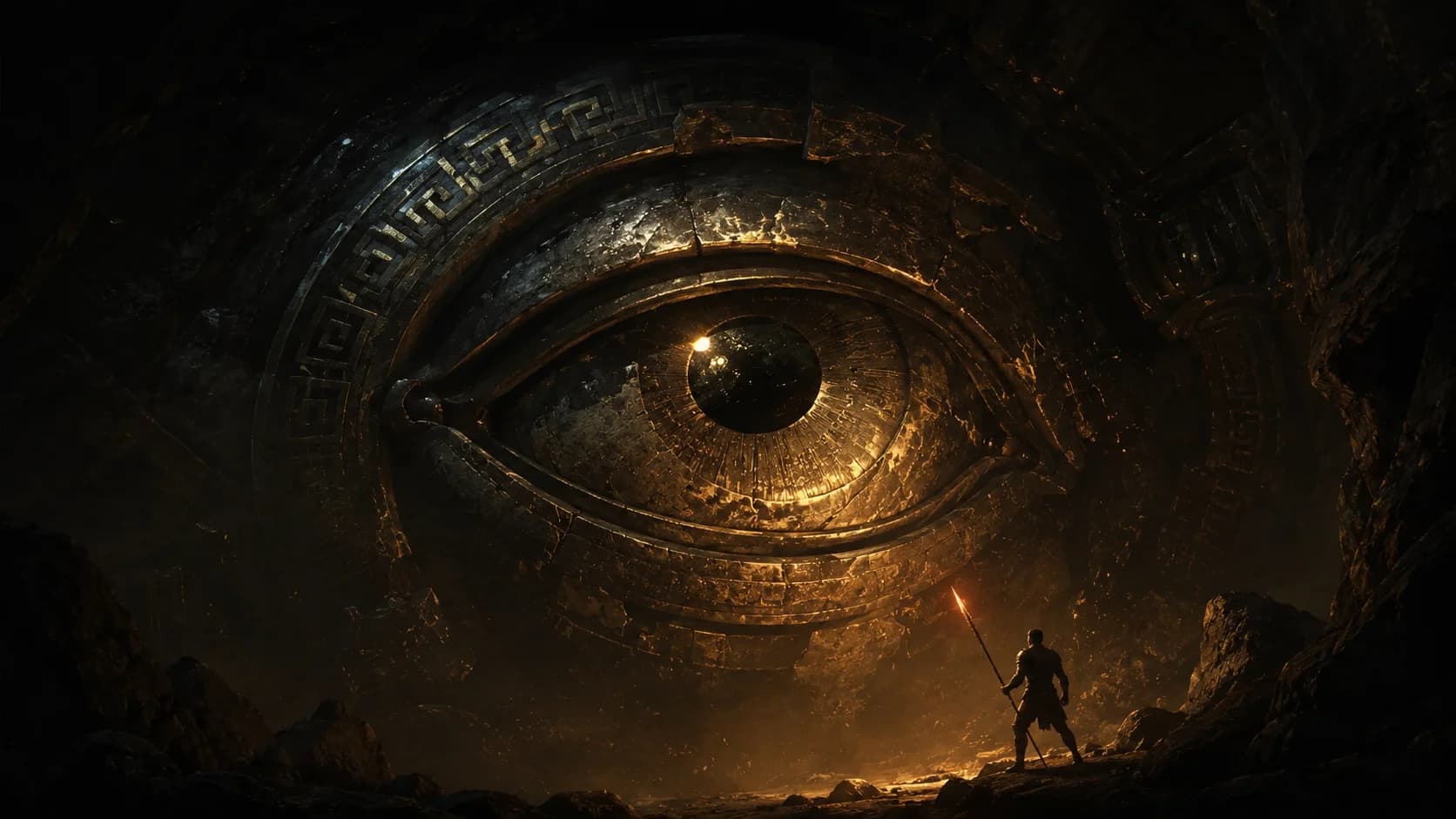
We've written about Polyphemus Station: The Prison That Eats Emotions at length elsewhere. The short version: we converted the Cyclops from a literal giant into an asteroid-prison whose warden AI has been alone for forty-seven years. The single-eye motif is preserved as a 200-metre circular viewport at one end of the asteroid. The cave-as-trap structure is preserved as containment infrastructure. The blinding is preserved as a targeted attack on the warden's primary sensor cluster.
We made this choice because a literal Cyclops in space would have felt like costume. We needed an entity that performed the same functions as Homer's Polyphemus, in a setting where giants don't naturally fit. The AI warden is the answer. It traps. It consumes. It refuses to let visitors leave. It's also, in a way that surprised us when we wrote it, sympathetic. Forty-seven years alone is a long time.
This is the kind of choice every adaptation makes, in different ways. The Cyclops is malleable enough to survive radical reimagination. Homer built him sturdy.
Where to go next
For our full profile of the Ulysses Universe version of Polyphemus, read Polyphemus Station: The Prison That Eats Emotions. For the deity whose son was blinded and whose grudge drives the entire Odyssey, read Know Your Gods: Poseidon and the Ulysses Universe specific Know Your Gods: Polyphemus. For the broader question of which Odyssey adaptations have worked across history, Every Version of The Odyssey Ever Told has the full timeline.
Book 1: The Blinding takes its title from the Polyphemus encounter. Buy Book One on Amazon.
Key takeaways
- Polyphemus is the most famous Cyclops in Greek mythology. He is the son of Poseidon and the sea nymph Thoosa.
- In Homer's Odyssey, he traps Odysseus and twelve of his men in his cave, eats six of them, and is eventually blinded with a sharpened wooden stake.
- The blinding triggers Poseidon's wrath, which is the cause of Odysseus's ten-year journey home. Without Polyphemus, there is no Odyssey as we know it.
- The famous line 'Nobody is my name' is one of the most-quoted moments in Greek literature. It's both a joke and the structural device that lets Odysseus escape.
- Modern adaptations have reimagined Polyphemus in many forms: from literal giant (most film versions) to AI warden (the Ulysses Universe), to symbolic monster (literary retellings). The one-eye motif and the cave-as-trap structure survive every version.