Embroidery as Resistance: Penelope's Silver Robes
For three months, Penelope Maris transmitted intelligence dispatches from inside her own Council Chamber. She used a conductive thread embroidered into her grandmother's silver robes. The Suitors never knew.
The scene from the council chamber
There's a moment in Book 2, mid-Council, when Penelope Maris stands behind the speaker's dais and listens to the lead Suitor lay out his latest demand. He's been on the floor for twenty minutes. He thinks he's persuasive.
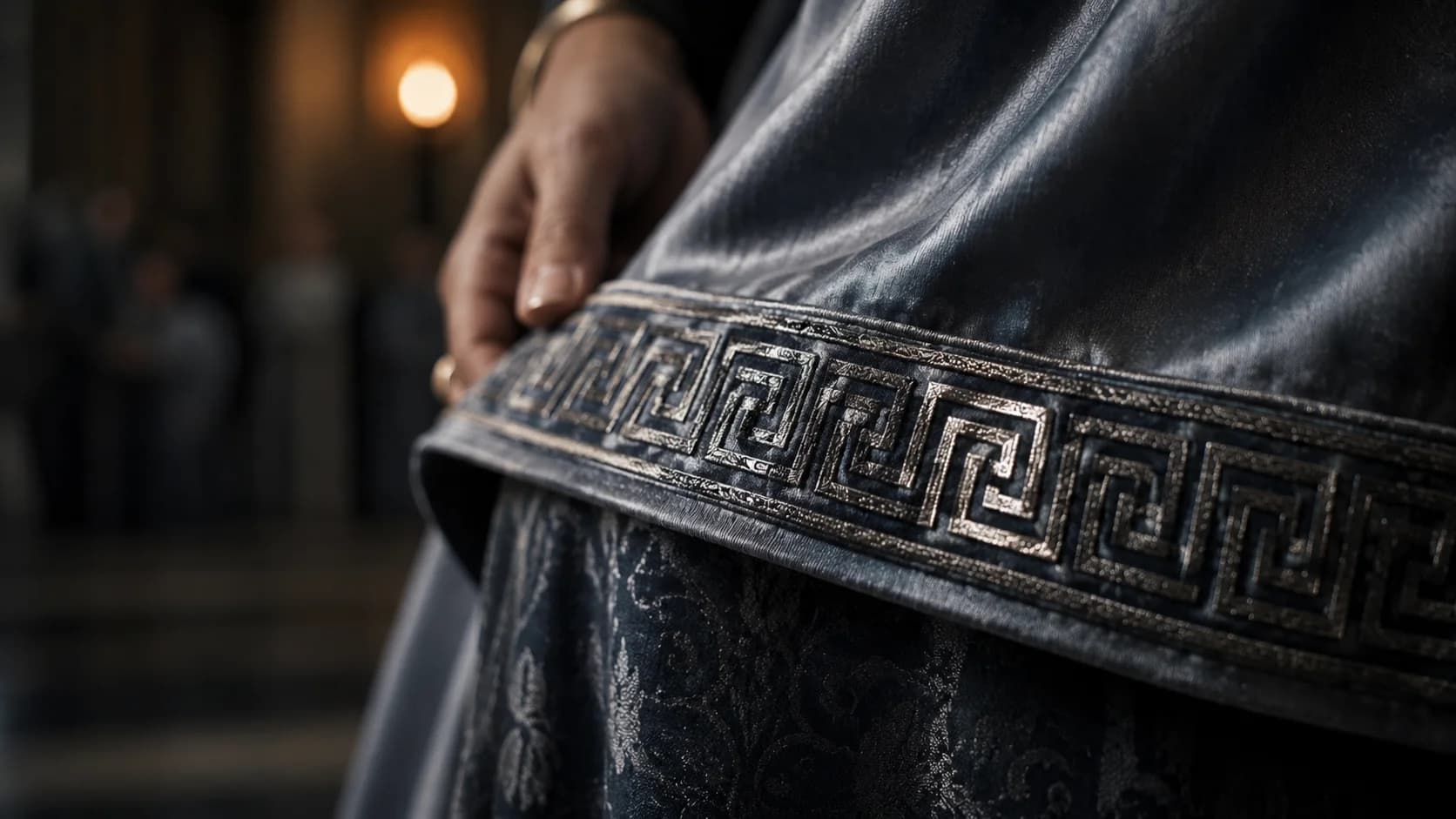
Penelope's left hand rests on the silver-blue fabric of her robe at the hip. Her fingertip traces a small loop in the embroidered meander pattern. Once. Twice. A pause. A third tap.
To anyone watching, this is a tic. A woman fidgeting with her clothes while a man monologues. It's the kind of small thing the Suitors filter out automatically.
In the maintenance tunnels beneath the Council Chamber, Mentor's comm-pad lights up. A short string of pulses. The pre-arranged signal that this Suitor has just admitted what they suspected he was planning. The pattern of the message is the same pattern Penelope's grandmother sewed into the robe forty years ago.
The Suitor finishes his speech. Penelope smiles, says she'll consider his proposal carefully, and returns to her seat. Mentor disappears back into the corridor with a complete transcript of an admission the Suitor doesn't know he just gave.
This happens three times a week for three months.
What the robe actually is
The robes Penelope wears in Council are ceremonial. Deep silver-blue. Embroidered hem. The meander pattern runs the length of the hem in fine silver thread. To everyone in the room they're a piece of Ithacan heritage, the kind of formal dress a governing matriarch wears for ceremony.
Look closer. One strand of the meander is slightly distinct from the others. Slightly more reflective. Slightly more metallic. The light catches it differently if you're paying attention. Nobody on the Suitor side is paying attention.
That strand is conductive. It carries signal. The pattern of the meander, looped through itself across the hem, forms a working antenna. Penelope's hand has been trained to tap the conductive strand at specific points to encode and decode messages.
The robe is a comm-relay. The robe has been a comm-relay since Penelope's grandmother made it.
Inheritance, not invention
Penelope didn't build this herself. The robe is older than she is. Her grandmother, Lyra Maris, made it as part of a Maris-family tradition of building functional craft into ceremonial textiles. The tradition is older still. The earliest such garment in the Ithaca archives is from the founding generation, when Maris women wove signalling capability into their formal dress as a hospitality measure. A woman of the house could call for help without ever leaving the room.
By the time Penelope inherits the robe, the technology has been refined across generations. Conductive thread has gotten finer. Encoding has gotten more sophisticated. The basic idea has never changed.
When the Suitors take effective control of Ithaca's daily governance in Book 2, Penelope finds herself in a room she can't leave with people she can't trust. She does what the Maris women have always done. She uses the inheritance.
She just uses it harder.
Why it works
The robe works because the Suitors have an unexamined assumption that breaks under contact with the truth. The assumption is this: decorative craft is decorative.
This is the kind of mistake that occupier classes consistently make. The Suitors are political operators. They're not stupid. They run surveillance on every major communication channel on Ithaca. They monitor Mentor's known devices. They have informants in the household staff.
But they don't read embroidery. Embroidery is a thing women do. The Suitors don't think of women's work as a potential threat vector because they don't think of women's work as work.
This is, historically, the most reliable mistake an occupier makes. The trilogy is not subtle about this. The robe is the trilogy's clearest single demonstration that the things authority finds unimportant are precisely the things authority should be watching.
Historical precedent
This isn't a new idea in fiction or in history. A short tour:
| Period | Practice | What it actually did |
|---|---|---|
| WWII occupied Europe | Knitted code patterns | Encoded train schedules, troop movements |
| 19th-century US | Quilt patterns on Underground Railroad | Reportedly signalled safe houses and routes |
| Pre-colonial Andes | Quipu (knotted cords) and huipiles | Encoded political, ritual, and accounting information |
| 17th-century Britain | Embroidered sampler letters | Hidden literacy practice for girls who weren't supposed to learn writing |
| Various | Suffrage embroidery banners | Coded slogans worked into 'decorative' designs |
In every case the same principle is at work. The occupier or the dominant class doesn't read the medium as serious. The dominated class encodes serious information in the unread medium. The information moves freely. The occupier doesn't know they're being observed because they don't take the observation tool seriously.
Roszika Parker's book The Subversive Stitch is the canonical academic work on this idea. It's worth reading next to Penelope's chapters.
What Penelope does with the channel
The robe lets Penelope feed Mentor live intelligence from inside the highest political chamber on Ithaca. Mentor uses that intelligence to coordinate a quiet, distributed resistance among the worker districts and the older households.
Across Book 2, the Suitors notice that their plans keep failing in ways they can't quite trace. Decisions made in the Council Chamber leak before they're enacted. Workers in the dock district refuse a specific transport assignment that, by all rights, they shouldn't have known was being planned. A subcommittee Suitor finds his name attached to a public scandal exactly twelve hours after a private conversation in chambers.
None of this should be possible. The Suitors run the surveillance. The Suitors control the comm channels. The Suitors have the household informants.
And Penelope sits in the room, traces the meander on her hem with one fingertip, and watches her grandmother's craft do its work.
Why this is the trilogy's most political scene
There's a school of reading the trilogy that focuses on Ulysses, Telemachus, and the journey home. That reading is correct. There's a parallel reading that says the political work being done on Ithaca during those twenty years is just as important, and in some ways more skilled.
Ulysses is fighting gods. That's hard.
Penelope is running a covert intelligence operation against an entire political faction, from inside their own headquarters, using a piece of clothing inherited from her grandmother. That's also hard. Arguably harder.
The trilogy gives Ulysses the title. It gives Penelope the work. Both readings hold up.
The robe is the cleanest image of what she's actually doing. Embroidery that does the work nobody thought embroidery could do.
Where to go next
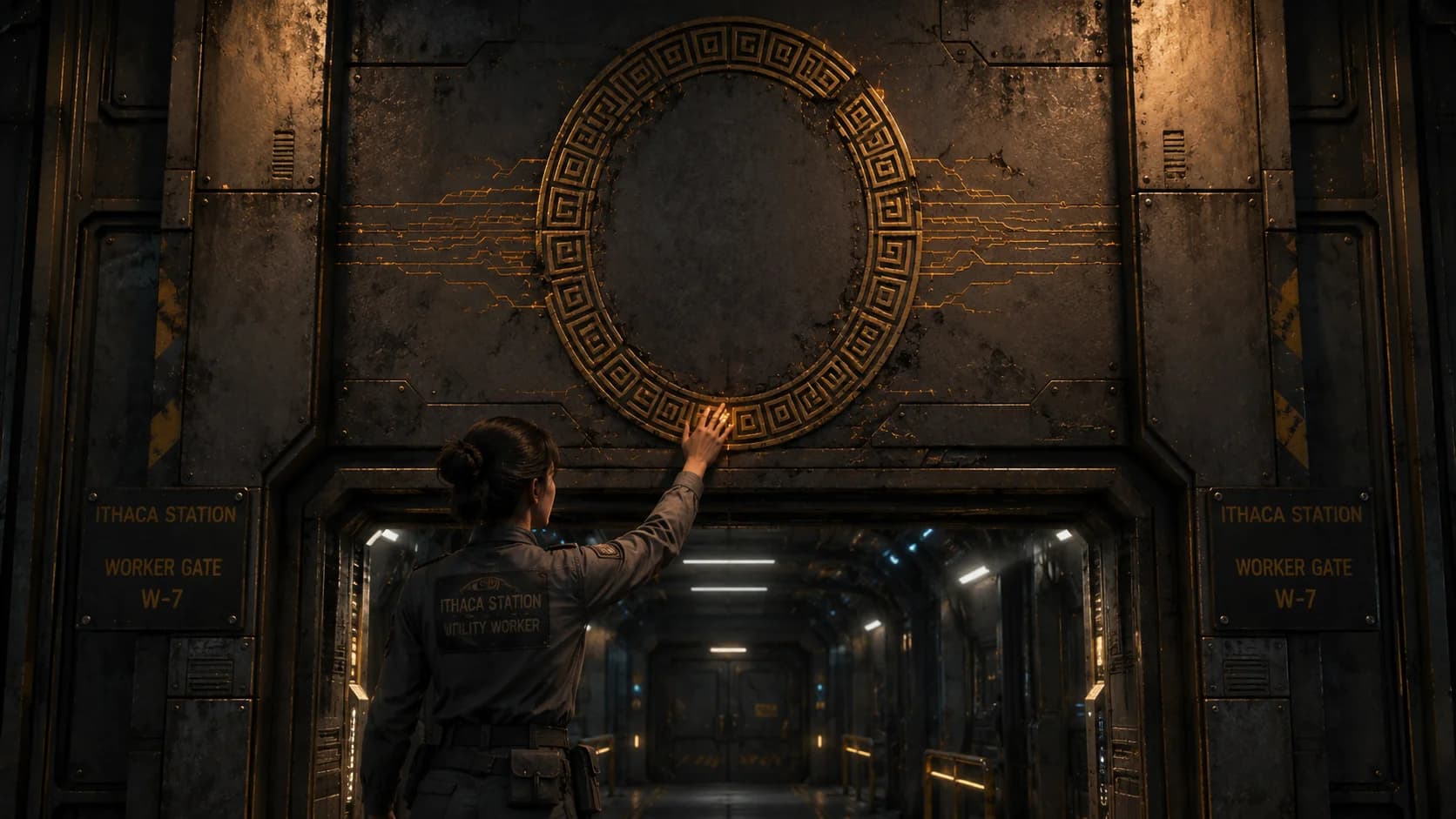
For the founding-bloodline politics that shape Penelope's situation, read Meet Penelope: The Queen Who Didn't Wait. For the broader trilogy theme of heritage decoration as functional infrastructure, read The Bow That Knows You. For a deeper look at how Ithaca got occupied, The Sigil They Walked Past covers the worker-district gate and the lemon-tree element that the Suitors removed.
Book 2: The Void Between contains the Council Chamber chapters where the robe earns its keep. Buy Book One on Amazon to start at the beginning.
Key takeaways
- Penelope Maris wears robes her grandmother embroidered with a Greek meander pattern in silver thread. One strand of the meander is conductive.
- The conductive strand functions as a private comm-relay. For three months in Book 2, Penelope transmits intelligence dispatches to Mentor from inside her own Council Chamber while the Suitors are in the room with her.
- The Suitors don't notice because they read embroidery as decoration. The point of the disguise is that nobody in authority takes the disguise seriously.
- This is the trilogy's argument about women's craft: it has never been just craft. It's been covert infrastructure for as long as occupied cultures have needed it.
- Real history has multiple examples of the same logic. WWII textile codes. Underground Railroad quilts. Andean huipiles. Pattern as message has a long resume.