The Sigil They Walked Past: Ithaca's Worker-Gate
The Suitors removed the lemon-tree element from the founding sigil. They left the gold meander border. They walked past a working communications relay for twenty years and assumed it was decoration.
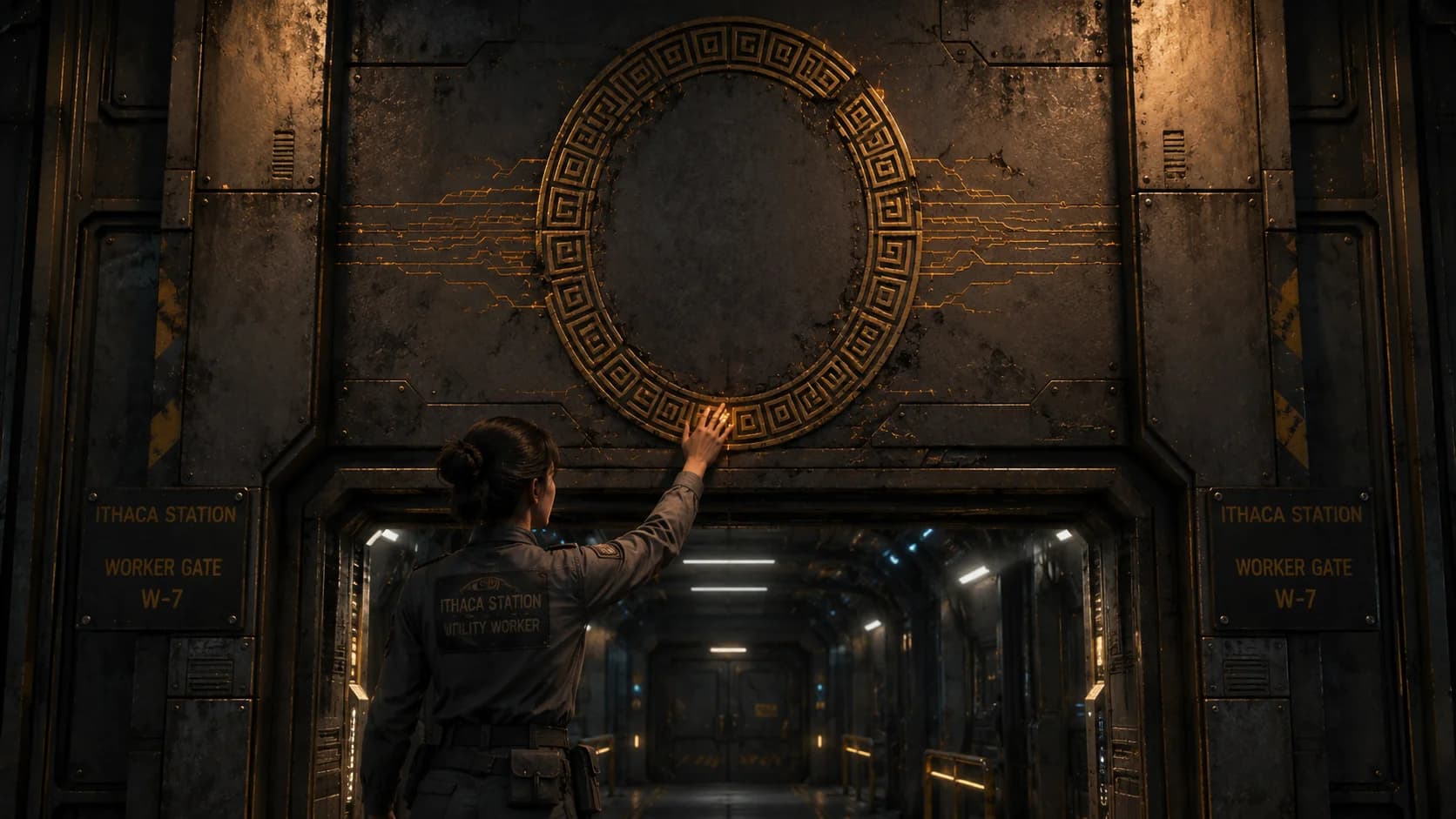
The scene from Book 3
A worker walks toward the gate of the worker district. Late shift, maybe an hour after the dockside lighting has dimmed for the cycle. The gate carries the official sigil of the district above its arch. The sigil has been modified. The lemon tree that used to occupy the central space is gone. There's just an empty oval where it should be, bordered by a gold meander running eight units around.
The worker's right hand lifts slightly as she walks. Her fingertip just brushes the empty space where the lemon tree once was. Half a second of contact. She doesn't break stride.
She passes through the gate and continues into the worker district.
Behind her, a Suitor lieutenant standing watch at the gate sees nothing. He's looking at the sky. He's bored. The shift has been quiet.
He doesn't notice the worker. He doesn't notice the gesture. He doesn't realise that the gold meander above his head is humming, very faintly, with signal traffic that the worker's fingertip just contributed to. The day's small reports, distributed through the network the meander carries, will reach Mentor by morning.
This is happening every minute of every day. The gate sees hundreds of workers. Each one traces the absent lemon tree. Each gesture feeds the network.
This is, on the page, the quietest political scene in the trilogy. No speeches. No drama. Just a worker, a fingertip, and a missing piece of decoration.
It's also, structurally, the most important.
What the Suitors removed
The Ithaca worker-gate sigil, in its original form, contained four elements:
| Element | Meaning |
|---|---|
| Central lemon tree | The founding bloodline's agricultural heritage |
| Gold Greek meander border, eight units around | Decorative continuity with founder design |
| Stars in the four corners | The worker district's specific cardinal markings |
| Date stamp in the lower right | Year of founding-bloodline accession |
When the Suitors consolidated political control on Ithaca in Year 14 of the trilogy timeline, they ordered the lemon tree removed from every public sigil in the worker district. This was a standard symbolic action. The lemon tree was a Maris-family emblem. The Maris family was Penelope's family. The Suitors wanted Penelope's symbolic presence stripped from public space.
They also removed the date stamp, which they updated to commemorate their own accession.
They left the gold meander. They left the corner stars. These elements, the Suitors decided, were 'merely decorative.' Removing them would be excessive. Bad optics. The workers would notice.
The Suitors were right that the workers would notice. They were wrong about what the workers were noticing.
What the workers actually do
Within weeks of the lemon tree's removal, a pattern emerges in the worker district that nobody on the Suitor side recognises. Workers passing through the gate begin to lift their right hand slightly and trace the empty oval with one fingertip. The gesture is small. It's quick. It's not directed at the Suitor watch.
It looks, if you notice it at all, like a tic. The kind of small involuntary movement people develop in environments they don't quite like.
It is not a tic.
The gesture serves two purposes. First, it's a public act of memory. Every worker who traces the missing lemon tree is saying, in a way the Suitors can't read, 'I remember what was here.' Memory is a political act when the regime is trying to erase. Tracing absence is a way of refusing the erasure.
Second, and more concretely, the gesture is functional. The worker's fingertip on the meander border carries a small electrical contribution into the relay network. The pattern of contributions across the day forms a distributed signal that Mentor can read from outside the worker district. Reports flow upward. Without anyone saying anything.
This is not a script the workers were given. Penelope's grandmother designed the infrastructure. Mentor maintained it. The gesture emerged organically among the workers themselves, in the weeks after the lemon tree's removal. People who lost something began touching the place where the thing had been. The hardware was already there to take the signal. The gesture and the infrastructure found each other.
The principle at work
The Suitors failed to recognise three things, in order of importance.
First, they failed to recognise that decoration can be infrastructure. They saw a gold meander border and they saw 'decoration.' They didn't ask whether the meander was carrying anything beneath the visible gold. This is a category error of the kind that has cost occupiers across history. We've written about the same principle in Embroidery as Resistance: Penelope's Silver Robes and Old Craft, New Craft, Same Craft.
Second, they failed to recognise that erasure creates absence, and absence creates the opportunity for memory. Removing the lemon tree gave every worker a daily occasion to remember it. Had the Suitors left the lemon tree in place, the workers would have stopped noticing it within a year, the way people stop noticing the unchanging features of their environment. The Suitors made the lemon tree more present by removing it.
Third, they failed to recognise that workers are watchers. The Suitors monitor the upper houses, the council chamber, and the founding-bloodline marriage politics. They don't monitor the daily rhythm of the worker district carefully because the worker district isn't politically interesting to them. They are wrong about the worker district. They are wrong because authority's blind spots are exactly where resistance survives.
How long this has been going on
The gold meander on the worker-gate sigils has been carrying communications infrastructure since the founding generation. Penelope's great-grandmother, Lyra Maris (the same Maris woman who designed the conductive thread on the family's ceremonial robes), built the relay network into the worker district sigils as part of a wider hospitality-and-safety design. The original purpose: every worker should be able to reach help quickly if they needed it, without depending on official channels.
The infrastructure has been operating quietly for over a century. Most workers, before the Suitor occupation, had no idea it existed. The system was designed to operate invisibly until needed.
The Suitor occupation needed it. The system woke up. The workers, without being told, found the gesture that fed it. The Maris family's century-old contingency planning came online when the political situation demanded.
This is what good cultural infrastructure looks like. You don't notice it until you need it. When you need it, it's there.
The wider trilogy argument
The Ithaca worker-gate is one of four objects across the trilogy that demonstrate the same principle. The Bow of Ithaca, Penelope's silver-blue robes, the walls of Aeolus Station, and the worker-gate sigil. Each one is heritage decoration that is also functional infrastructure. Each one survives because the occupier doesn't recognise it as worth investigating.
The argument the trilogy is making, quietly, across all four examples: cultures that survive occupation are cultures where the decoration is the infrastructure. Authority can strip out everything it recognises. The things it leaves behind, because it can't read them, are the things that keep the culture operating.
This is not a romantic claim about hidden depths. It's a structural observation about how power actually works. Power is selective in its attention. The things power doesn't attend to are the things that escape its control.
A worker tracing an empty oval with her fingertip. That's the trilogy's whole political theory in one gesture.
Where to go next
For the Penelope's-robes version of the same principle, read Embroidery as Resistance: Penelope's Silver Robes. For the architectural version on Aeolus Station, Old Craft, New Craft, Same Craft. For the bow that knows who's holding it, The Bow That Knows You.
For the broader trilogy backstory on heritage patterns running on modern infrastructure, The Merge: When Humanity Accidentally Woke the Gods.
Book 3: The Return contains the worker-gate scene. Buy Book One on Amazon to start at the beginning of the journey.
Key takeaways
- Ithaca's founding sigil contained a lemon-tree element bordered by a gold Greek meander. The lemon tree represented the founding bloodline. The meander was decoration. Officially.
- When the Suitors took Ithaca, they stripped the lemon tree out of every public sigil. They left the meander because they didn't understand what it was.
- The meander had circuit traces beneath the gold. Penelope's great-grandmother designed it. The pattern has been a working communications relay for over a century.
- Workers passing through the gate trace the absent lemon-tree element with one finger as they walk. The Suitors don't recognise the gesture. They walk past resistance every day.
- This is the trilogy's quietest political scene. A worker, a fingertip, a missing piece of decoration. No speeches. No drama. Just public memory in plain sight, recognised only by the people authority forgot to watch.