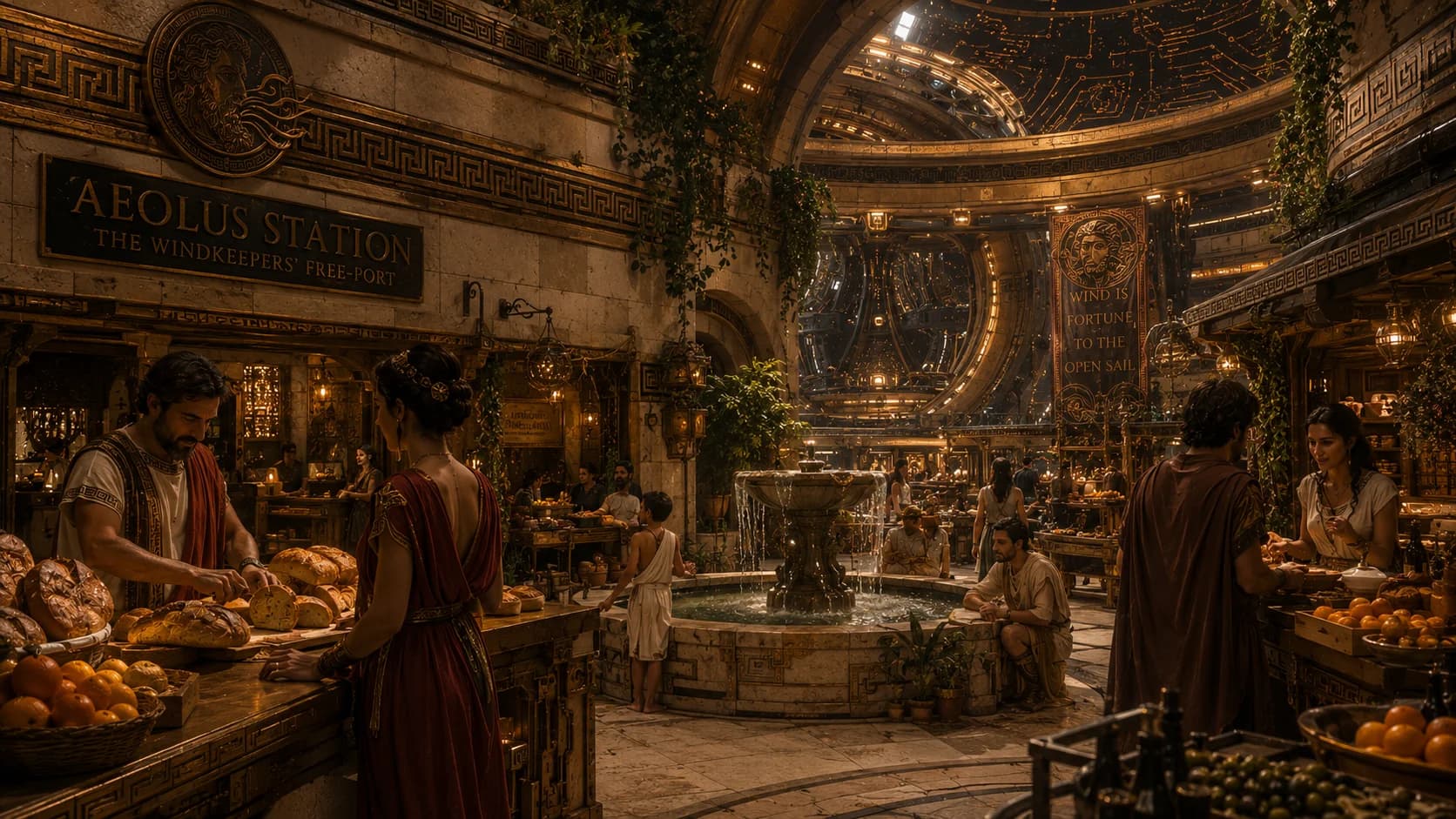
Old Craft, New Craft, Same Craft: The Walls of Aeolus Station
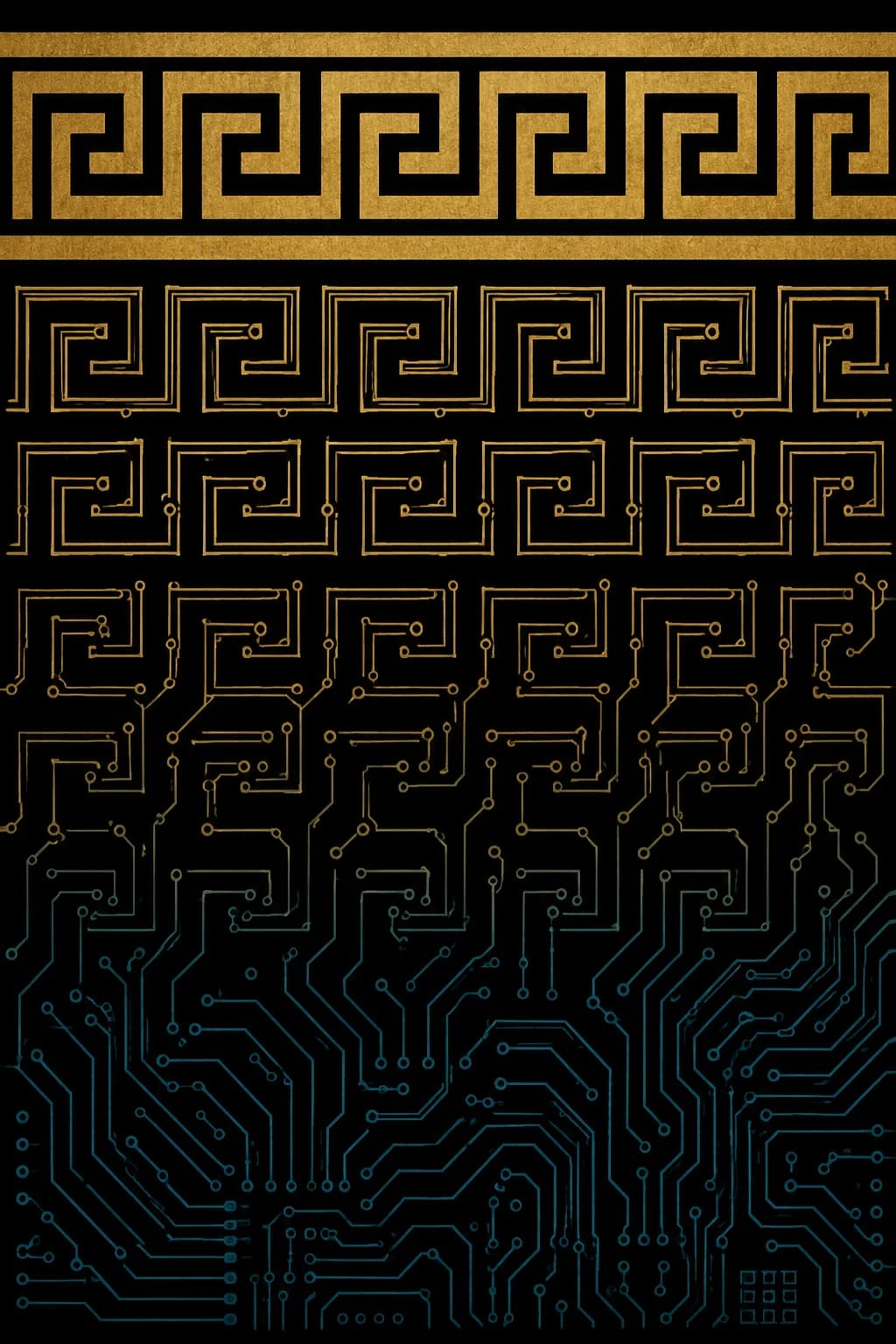
Three centuries of architecture in one corridor. Plain stone meander on the inner walls. Bronze meander with circuit traces on the outer rings. Aeolus's rule was that the pattern stayed the same. The infrastructure beneath it didn't have to.
What's actually on the walls
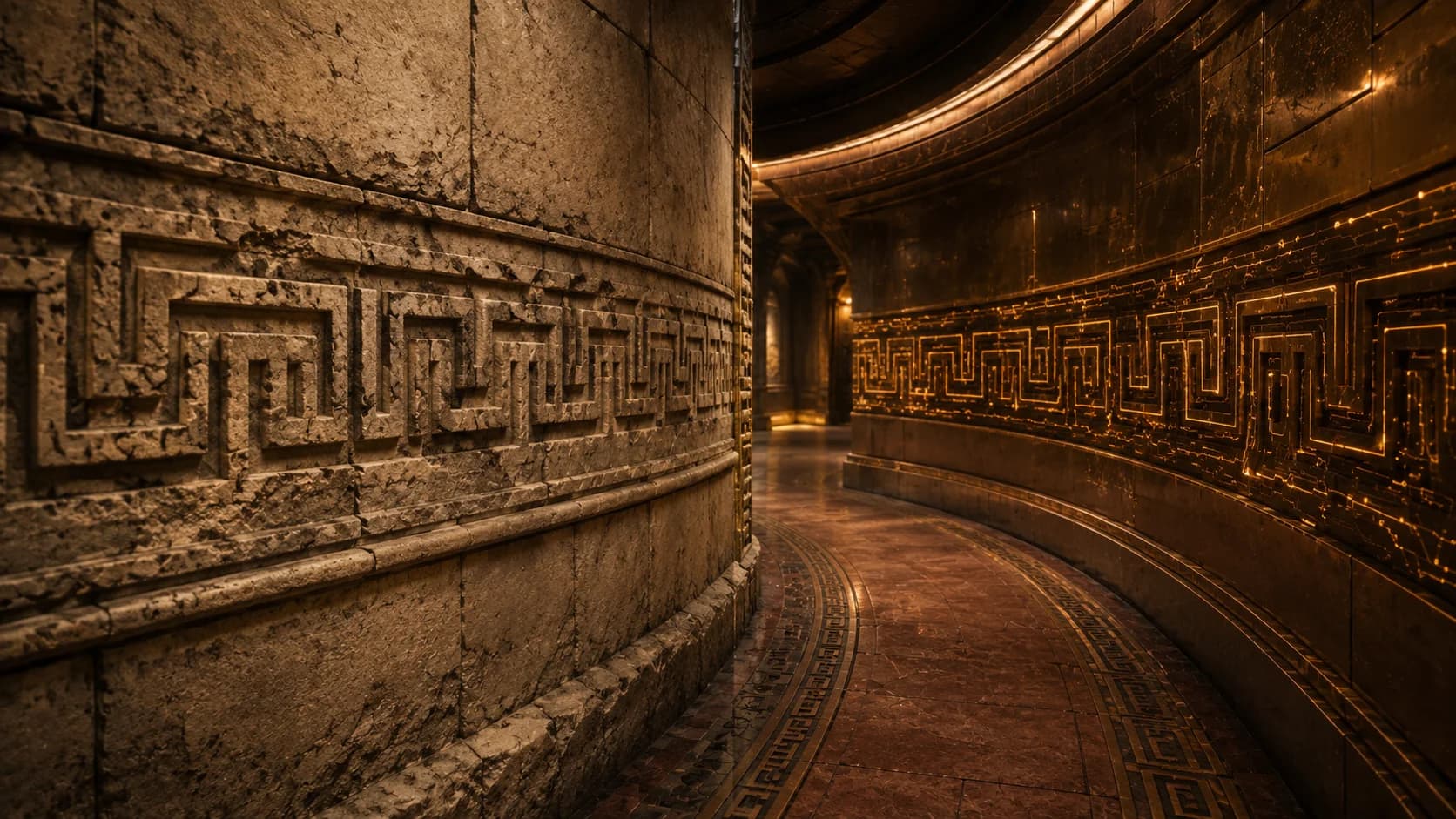
Stand in a corridor on Aeolus's inner ring and look at the wall. You'll see a Greek meander pattern carved into plain stone. The carving is precise but worn. Three centuries of human touch have softened the edges. The pattern is decorative, in the strictest sense. There's no circuitry beneath it because three centuries ago there was no circuitry to put beneath it.
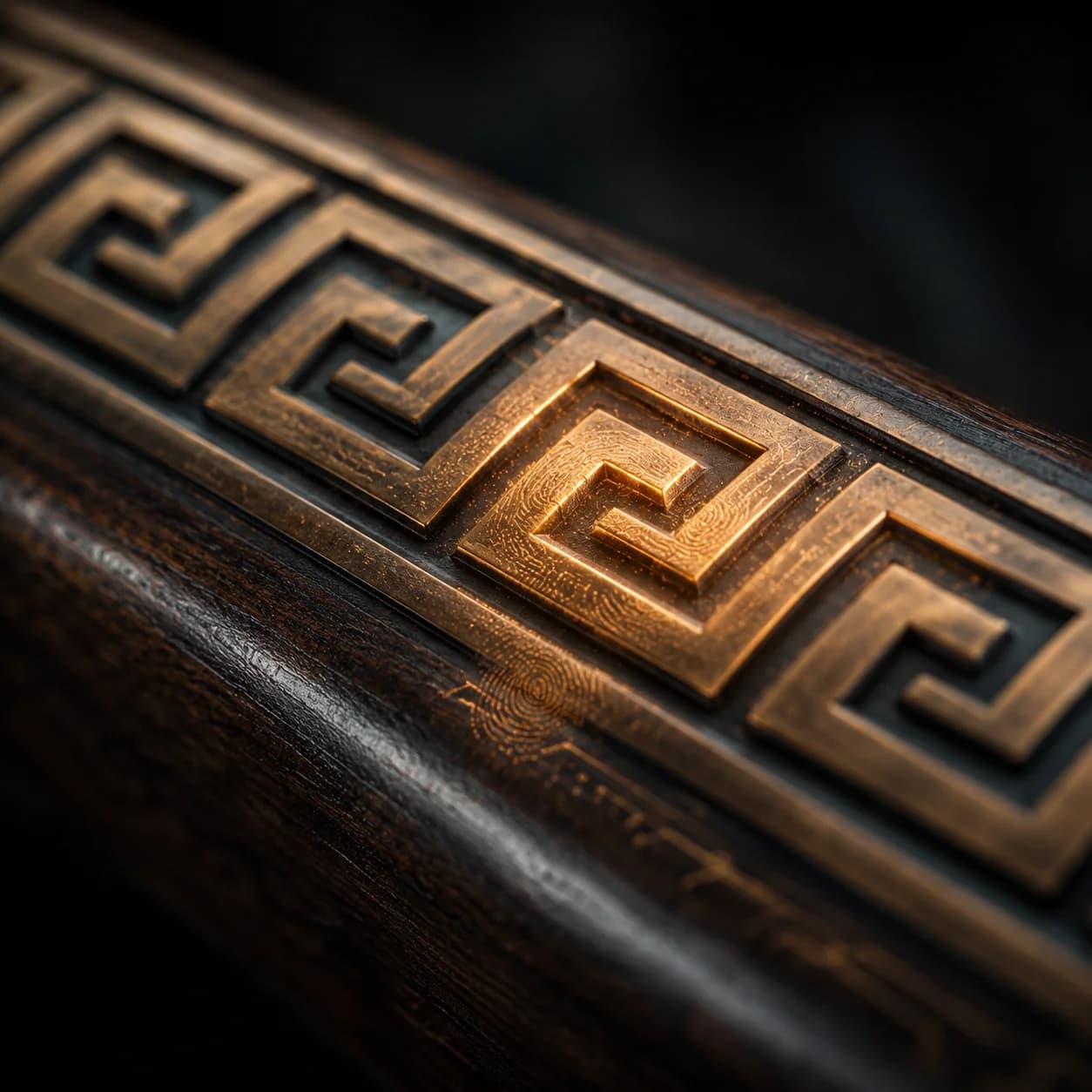
Walk outward through the connecting passages. The walls change. The inner ring's plain stone gives way to a middle ring of etched bronze. The same meander pattern, but in metal. No glow. No visible infrastructure. Just the pattern, executed in newer material.
Keep walking. The outer rings carry the meander again, but here the bronze is alive. Faint circuit traces glow within the etched lines. The decoration is still decoration. It's also working circuitry, carrying station-wide signal infrastructure through what looks at first glance like ornamental relief.
Three rings. Three centuries. Three media. One pattern.
This is what Aeolus's station looks like. This is what he meant when he insisted, when the outer rings were planned, that the pattern be carried forward. He wasn't being sentimental. He was making a thesis.
What Aeolus is doing
Aeolus is one of the older entities in the Ulysses Universe. He pre-dates the Awakening as a conscious being. He has personally watched cultures fail, occupiers come and go, and patterns get stripped out of walls and replaced with new ones. He has seen what happens when the new occupier decides the old patterns are 'just decoration' and removes them.
He also remembers when those old patterns were just decoration. He's old enough to know the difference. He's old enough to know that the difference doesn't matter.
The point of carrying a pattern across three centuries is that the people who live with the pattern come to feel that they're standing inside a long story. The pattern doesn't need to mean anything in particular. It needs to be there, consistently, across all the changes the culture has been through.
That's what continuity is.
Aeolus's free-port is built on hospitality. Xenia. Guest-friendship. The Greek concept that runs through Homer's Odyssey as a backbone. Hospitality requires that the guest can trust the host. Trust requires consistency. Consistency requires that the host's space looks, century after century, recognisably like itself.
The meander pattern is how Aeolus says, to every visitor for three centuries, 'you are standing where guests have always been welcomed.'
The functional rings
The outer rings of Aeolus Station are the newest, and they're also the ones carrying the most infrastructure. The station's communications, environmental systems, and signal networks run through the bronze meander circuits in the corridor walls.
Aeolus designed it this way deliberately. He could have run his infrastructure through dedicated cable runs hidden behind panelling, the way most modern stations do. He chose instead to thread it through the ornamental relief.
There are two reasons:
First, embedding the infrastructure in heritage decoration makes it harder for an occupier to disable. The Pantheon, if they were ever inclined to put pressure on Aeolus, would have to rip out the patterns to disable the communications. Stripping the patterns out would also strip out three centuries of station heritage in front of every cosmopolitan trader who had ever passed through. The political cost of doing that would be high. Higher than the political cost of just dealing with the station differently.
Second, the infrastructure-as-decoration approach makes future upgrades possible without architectural disruption. When the circuit standards change, the bronze can be re-etched. When the bronze itself needs replacement, new bronze can be cast in the same pattern. The decoration absorbs the upgrade. The pattern persists.
This is heritage doing engineering work. It's also engineering doing heritage work. The two are inseparable.
Real-world parallels
Aeolus's architectural decision is not a science-fiction invention. Real cultures have done this kind of thing for thousands of years. A short tour:
| Era | What happened | Why it still matters |
|---|---|---|
| Roman aqueducts | Stones from collapsed aqueducts were reused in medieval church walls | Engineering material became religious heritage |
| Greek column orders | Doric, Ionic, Corinthian columns reappear in 18th-century courthouses, modern parliaments | Visual continuity of authority |
| QWERTY keyboard | Designed for 1870s mechanical typewriters | Persists into voice and projection interfaces |
| RJ-45 ethernet | Designed for telephone-line repurposing | Universal data infrastructure standard |
| Latin in scientific naming | Persists from medieval scholarly Latin | Cross-language stability for biology |
In each case, the older medium provides a stable carrier that gets reused in new contexts. The QWERTY layout is the cleanest example. It exists because mechanical typewriters needed a specific letter arrangement to prevent the bars from jamming. The jamming problem disappeared a century ago. The layout persists. It's been physically embedded in three generations of input technology. The infrastructure has changed completely. The pattern hasn't.
Aeolus's walls are the same idea, treated deliberately rather than accidentally.
Stewart Brand's book How Buildings Learn covers a related concept: buildings as time-layered objects, where each generation adapts what's left of the previous one. Aeolus has read this book. Effectively. Whatever the alien equivalent is.
Heritage as infrastructure, across the trilogy
The Aeolus walls are one example of a pattern the Ulysses Universe trilogy puts in front of you everywhere if you know where to look.
| Object | Looks like | Actually is |
|---|---|---|
| Aeolus's outer-ring walls | Bronze meander decoration | Working circuitry |
| The Bow of Ithaca | A ceremonial weapon | A biometric calibrator |
| Penelope's silver-blue robes | Family embroidery | A comm-relay with conductive thread |
| Ithaca's worker-gate sigil | A faded founding-house emblem | A communications relay node |
The same logic in every case. Heritage decoration that is also working infrastructure. The decoration camouflages the infrastructure. The infrastructure subsidises the decoration. They survive together.
We've written about The Bow of Ithaca, Penelope's robes, and the Ithaca worker-gate sigil in their own posts. Each one is the same idea expressed in different cultural and political circumstances.
The trilogy's argument, made structurally across all of them: cultures that survive occupation are cultures whose decoration is also their infrastructure. The things authority finds unimportant are exactly the things that allow the occupied to keep functioning.
Aeolus, on his free-port station, doesn't have to deal with occupation. He runs the place. But he understands the principle, and he built his rings to demonstrate it.
Why this matters in Book 1
When the Odyssey arrives at Aeolus Station in Book 1, Ulysses isn't paying attention to architecture. He's paying attention to supplies, repairs, and whether his crew can survive the next leg of the journey.
But the architecture is doing work anyway. Aeolus extends hospitality. The hospitality is genuine. It's also enabled by an infrastructure of trust that has been carried forward across centuries, in plain sight, in the pattern on the walls.
Ulysses doesn't notice. Aeolus does. That's enough.
There's a scene in Book 1 where Aeolus walks Ulysses through the inner ring and traces the worn meander with one finger. He doesn't explain. Ulysses doesn't ask. They keep walking. By the time they reach the outer ring and the bronze meander begins to glow with circuit traces, Ulysses understands what Aeolus has been showing him without anyone having said it.
That's continuity working. That's the pattern doing its job.
Where to go next
For the broader trilogy argument about heritage decoration as functional infrastructure, The Bow That Knows You and Embroidery as Resistance extend the idea into different objects. For the contrasting case of what occupiers do to heritage decoration, The Sigil They Walked Past covers the Ithaca worker-gate scene.
For the broader trilogy thesis on ancient pattern running on modern shell, The Merge: When Humanity Accidentally Woke the Gods is the foundational piece.
Buy Book One: The Blinding on Amazon.
Key takeaways
- Aeolus Station is the trilogy's free-port. A place of hospitality, where the rules of xenia still hold.
- The walls of the inner ring carry a Greek meander pattern in plain stone, three centuries old. No circuitry beneath it, because there was no circuitry to hide three centuries ago.
- The outer rings carry the same pattern, etched in bronze, with faintly glowing circuit traces visible within the lines. The infrastructure has changed. The pattern hasn't.
- Aeolus insisted on this when the outer rings were built. Continuity of decoration across centuries of technological change. Same craft, different millennia.
- This is the trilogy's clearest argument for what cultural continuity actually looks like. Heritage isn't preservation. It's translation. The pattern survives by being rewritten in new materials.