Aeolus Station: The Windkeeper's Free-Port
A free-port station run by an entity older than the Pantheon. Where hospitality is still sacred. Where the Odyssey resupplies in Book 1, and where the cruellest betrayal of the journey happens.
The free-port
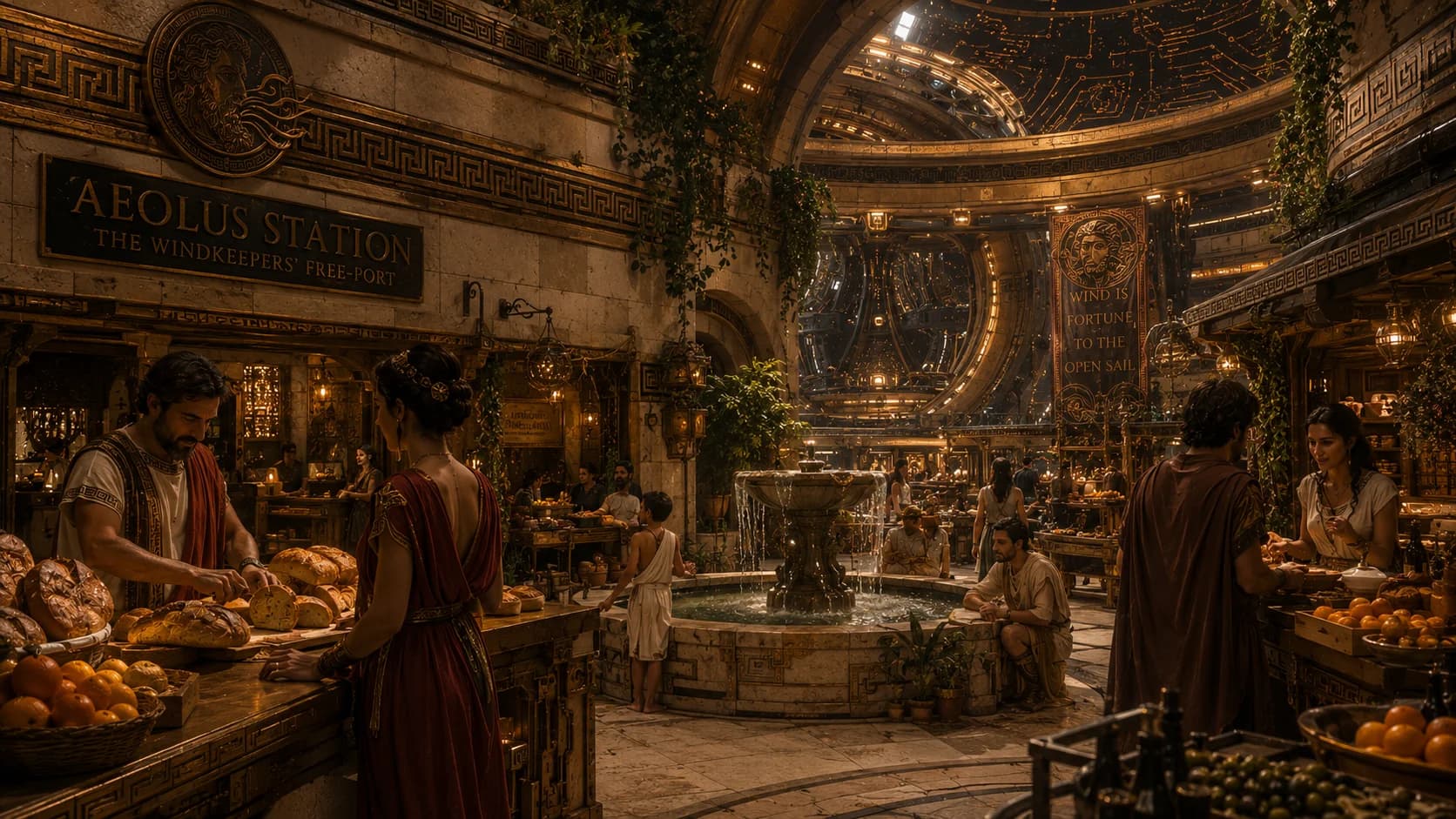
Some hours after the Eurydice salvage and ten chapters into Book 1, the Odyssey limps into the transit envelope of Aeolus Station. The station is roughly half the size of Olympus, less than a quarter as well-armed, and three times as alive. It is also the first place the crew has seen in years where the people walking the corridors are not all wearing identical grey utility robes.
Aeolus is a free-port. Not Pantheon territory. The political situation is delicate enough that the Pantheon has agreed, for centuries, to keep their fingers off the station. In exchange Aeolus keeps the transit corridors stable and refuels ships that pass through. The arrangement is older than the current generation of gods.
Walking into Aeolus is the trilogy's first major exhalation. After ten years on a degrading ship surrounded by dying crew, the warm honey lighting of the inner ring and the smell of actual bread being baked in a real oven hit the away team hard. Ulysses has to stop and steady himself against a wall.
Three centuries of architectural memory
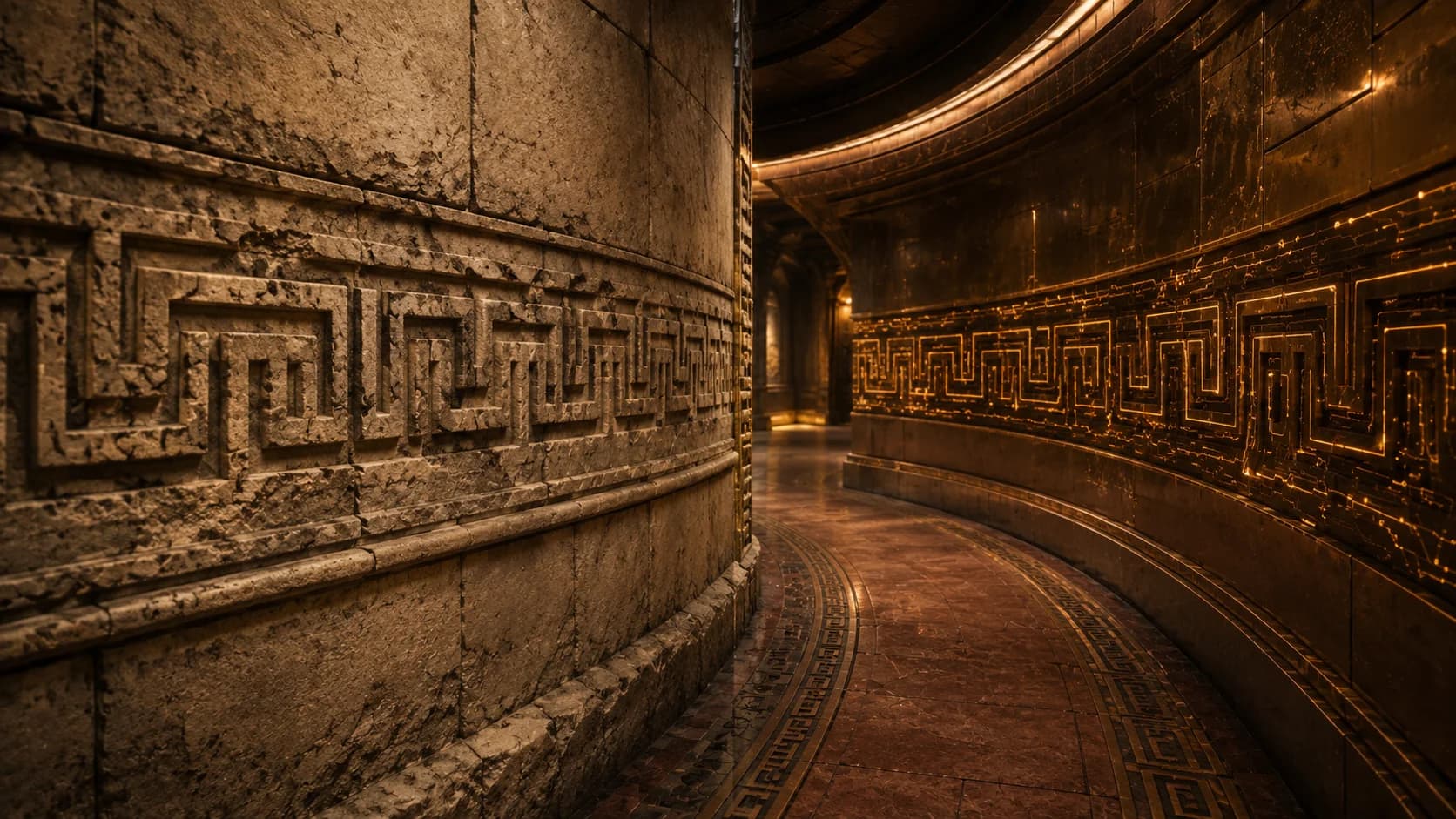
The station's signature is its architectural continuity. The inner ring's stone walls carry the Greek meander pattern in plain stone, three centuries weathered. The middle rings carry the same pattern in etched bronze. The outer rings carry it again, in bronze with faintly glowing circuit traces beneath the etching.
Same pattern. Three centuries. Three media.
Aeolus designed it this way. He is old enough to remember when the pattern was just decoration. He is old enough to know that the pattern being functional or decorative does not actually matter, as long as the pattern is carried forward consistently across every change the culture has been through.
We've written about this at length in Old Craft, New Craft, Same Craft. The architectural thesis on Aeolus is the trilogy's clearest single argument for what cultural continuity looks like when an entity that has watched centuries pass decides to design intentionally for it.
Aeolus himself
Aeolus is not Pantheon. He is older. He pre-dates the Awakening as a conscious being. The trilogy does not give him a single clean origin story. What is clear is that he was present during the events that produced the Pantheon, that he chose to stay out of the resulting political order, and that he has been running his free-port quietly for several centuries since.
He appears in person to Ulysses in Book 1. The form is human, or close to it. The clothing is Mediterranean-administrative rather than divine-Hellenistic. He sits with Ulysses over real bread and real wine and asks careful questions about the journey. He listens for a long time before he speaks.
He is, perhaps, the trilogy's only fully sympathetic non-human character. He carries the moral weight of xenia the way the Pantheon do not. He helps Ulysses because Ulysses arrived in good faith and asked for help. There is no other calculation.
The wind-bag
In Homer, Aeolus gives Odysseus a bag containing all the contrary winds, leaving only the favourable west wind to carry him home. The crew, near home, suspects the bag contains treasure their captain has been hiding. They open it. The contrary winds escape. The ship is blown all the way back to Aeolus's island. Aeolus refuses to help a second time, believing that any man so unlucky must be cursed by the gods.
In the Ulysses Universe, the equivalent gift is a navigational data-block. It contains a single safe corridor home through Pantheon-monitored space. Aeolus has spent months coordinating the gift, working through contacts in five different Pantheon administrative regions, calling in favours that nobody has called in for years. The corridor is real and the corridor is open. For a window.
The crew member who opens the data-block prematurely is not named the way Homer's anonymous sailor is not named. The Ulysses Universe gives him a name and a small biography. He is a junior officer with two children in the suspension pods. He thinks the data-block contains something the captain has been holding back. He opens it.
The corridor closes. The encrypted route data scatters into nothing. The Odyssey is in hostile space without a path home.
Aeolus, when contacted again, declines to help. Not from anger. From grief. He has done what he could. The crew threw it away.
The crew member who opened the data-block dies of guilt some weeks later. He is one of the trilogy's smallest, saddest deaths.
The cultural register
Aeolus Station's culture is distinct from anything else in the Ulysses Universe. The administrative apparatus is light. People look at each other when they pass in corridors. The bread is real bread, not protein paste reshaped. The wine is real wine, served in glass not plastic. The music in the public commons is acoustic and live.
This is the trilogy's argument by counter-example. Olympus Station shows you what soft-authoritarian Pantheon governance looks like. Aeolus Station shows you what a society organised around xenia looks like instead. The contrast is meant to be felt physically. Olympus is cold. Aeolus is warm.
The lighting is honey and terracotta. The corridors curve, rather than running straight. The architectural detail invites your hand to touch it.
Why Aeolus matters across the trilogy
The Aeolus chapters are short. Aeolus himself does not appear in Books 2 or 3. The wind-bag incident is the last we see of him directly.
But the moral weight of what happens there carries. Every time the trilogy depicts hospitality afterward, Aeolus is the implicit reference. Calypso violates xenia. The Suitors violate xenia. Even Circe, complicated and ambivalent, sits in the shadow of what Aeolus did right.
Aeolus is the trilogy's quiet ethical centre. He shows up once, in one ring of free-port, and gives away a gift that the crew throws away. The journey continues for another decade because of that mistake. The moral lesson is not subtle, and the trilogy is not trying to be subtle about it. Hospitality is sacred. Squander it at your cost.
Where to go next
For the trilogy's broader argument about heritage decoration as functional infrastructure, read Old Craft, New Craft, Same Craft on the Aeolus walls specifically. For the moral counter-example, Olympus Station: A Tour of the Capital That Made the Gods shows you what xenia looks like when it has been deliberately stripped from a culture.
For the broader Pantheon political situation that makes free-ports like Aeolus necessary, Know Your Gods: Zeus is the relevant background. For another character defined by genuine moral weight, Meet Athena: The Goddess Who Chose Treason is the closest parallel in the Pantheon itself.
Book 1 contains the Aeolus chapters. Buy Book One on Amazon.
Key takeaways
- Aeolus Station is a free-port. Not Pantheon territory. Hospitality is still genuinely practised. The Odyssey resupplies here in Book 1.
- Aeolus himself is older than most of the Pantheon. He pre-dates the Awakening as a conscious being. The station carries three centuries of accumulated architectural memory.
- The wind-bag gift Aeolus gives Ulysses is the most generous act of xenia in the trilogy. It is also the setup for the cruellest mistake of the journey.
- The cultural register at Aeolus is Mediterranean village rather than divine bureaucracy. Warm honey lighting, terracotta, real bread, real conversation.