The Void Storms: Where Physics Breaks
Regions of space where the local laws stop applying. Colours that have no names. Geometry that does not resolve. The trilogy's strangest single location.
What void storms are not
The trilogy is careful about how it uses the void storms. They are not space monsters. They are not vortexes in the cinematic sense. They are not the kind of thing you fight, or steer around if you are skilful, or describe to other captains as something you have survived in the way you might survive a hard burn.
They are regions of space where the rules have changed. The change is not consistent across storms. The change is not consistent within a single storm, when more than one crew member is present to compare notes afterward.
This is the trilogy's most cosmic-horror-adjacent setting. It is also the trilogy's quietest. The horror, where there is horror, is the horror of not being able to confirm what happened.
The Pantheon's classification
The Pantheon catalogues void storms as Class IV hazards: unpredictable, non-recurring, recommend avoidance. Class IV is the highest classification. There is no Class V because Class V would require a hazard for which avoidance was insufficient, and the Pantheon does not officially recognise such hazards exist.
Pantheon survey ships have mapped the boundaries of known storms to the extent that boundaries can be mapped. The maps are unreliable. A storm that was bounded yesterday may have moved by today. A region that has been stable for three centuries may, without warning, become a storm and remain one for ninety seconds and then settle back into ordinary space.
The Pantheon administrative position is that storms are best avoided. Trade corridors are routed around known regions. Ships that find themselves at the edge of a storm are advised to alter course, accept the fuel cost, and continue.
Some ships, like the Odyssey in Book 2, do not have the fuel for the detour.
The Odyssey's encounter
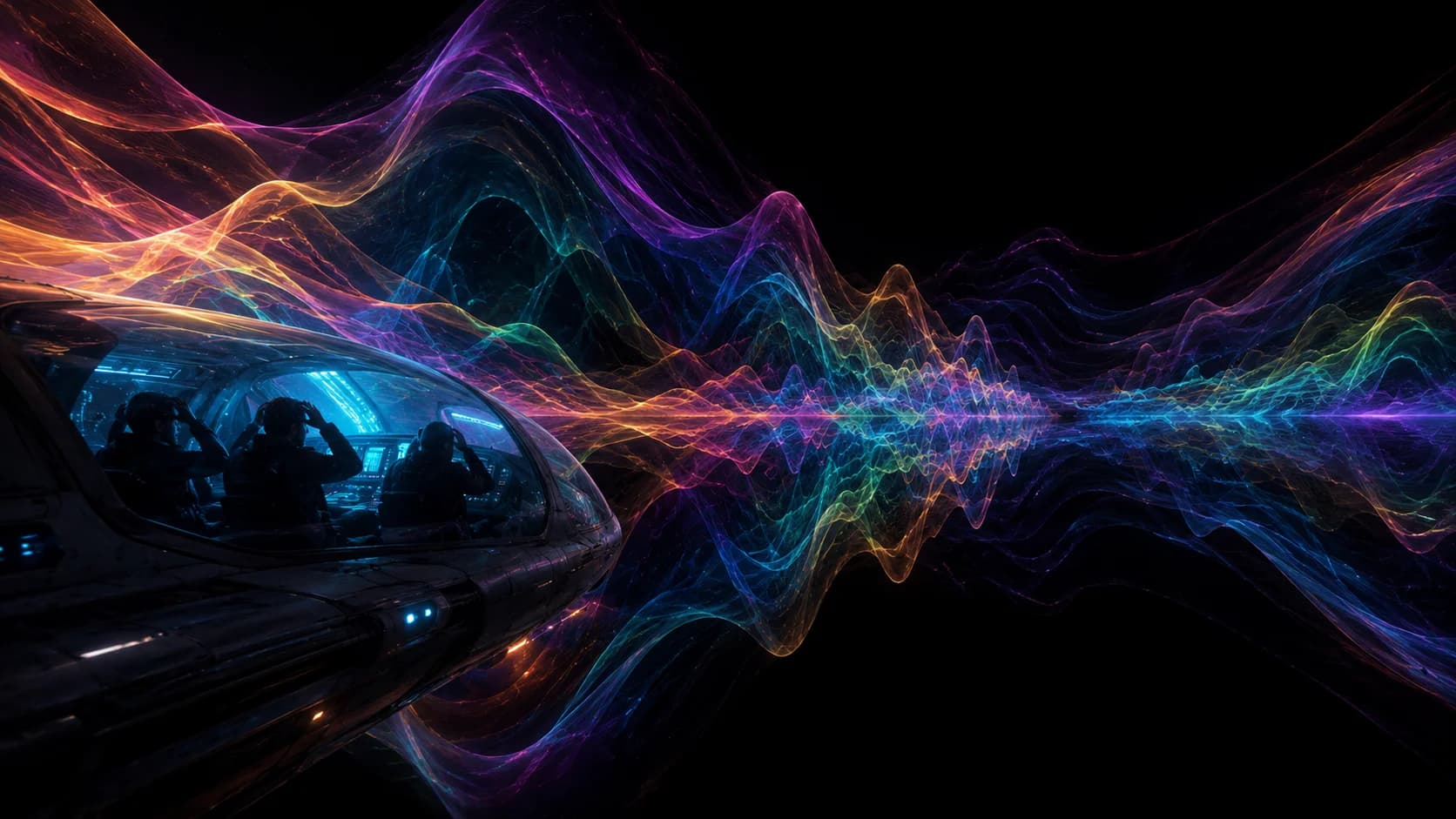
In Year 11 of the journey, between the Sirens and the underworld descent, the Odyssey is forced through the edge of a void storm because the alternative is running out of reaction mass. The transit takes seven minutes by the ship's external chronometer. The bridge crew's subjective experience does not match.
Telemachus, eighteen at the time, reports the experience first. He sees, through the viewport, a colour he has not seen before. Not unfamiliar in the way an unusual mineral might be unfamiliar. Unfamiliar in the way a sense you do not have is unfamiliar. He stops describing it after about twenty seconds because, he says, the description he is generating is incorrect and trying to correct it is making him nauseous.
Echo's logs from the transit are partially corrupted. The corruption is consistent in the sense that all of her sensor logs from the same time interval show similar pattern damage. The corruption is inconsistent in the sense that the specific data corruptions do not match what conventional sensor damage would produce. The logs are, in Echo's diagnostic language, the wrong kind of corrupted.
Thea, who is on the bridge during the transit, reports nothing. She says, several days later, that she may have heard something during the transit but that her memory of it has reorganised itself in a way that she cannot trust.
Ulysses, on the bridge, reports a brief experience of being seen. Not threatened. Seen. The sensation passes within seconds. He files it in his log and does not revisit it for some months.
The Odyssey clears the storm and continues. None of the crew is, as far as the ship's medical scanners can determine, injured.
What persists
The encounter has small consequences that compound over the subsequent weeks.
Telemachus cannot stop thinking about the colour he saw. He spends time trying to describe it. The descriptions never match. He starts a personal log entry that he does not finish. He picks at it for a year. The log entry becomes a kind of small contained obsession that he never fully resolves.
Echo's corrupted sensor logs become a project. She works on them slowly across Book 2 and Book 3. Some of the corruptions, on close analysis, appear to contain patterns. The patterns do not match any standard data format. They may be coincidental. They may be signal. Echo is not sure.
Ulysses, who reported being seen, occasionally feels the sensation again, faintly, in unrelated contexts across the rest of the journey. The feeling is not threatening. It is the feeling of attention.
Thea reports nothing further. Her silence about the encounter is, in the way Thea-silences are, more weighted than the others' reports.
Why the trilogy includes them
The void storms are the trilogy's argument that the universe is bigger than its maps. The Pantheon has been running known space for fifty years. The Architects ran it for tens of thousands of years before that. Between them, they have classified, mapped, and accounted for a great deal of physical reality.
They have not accounted for everything.
The void storms are the trilogy's reserved space for what neither the Architects nor the Pantheon have fully understood. The storms persist because the rules permit them to. The rules that permit them are not the rules anyone fully knows.
This is the kind of cosmic background the trilogy uses sparingly. The story is not about the void storms. The story is about Ulysses Theron trying to get home. The void storms are present so that the universe the story is in feels appropriately weighted.
If the universe of the trilogy were fully mapped, the story would be smaller. The trilogy needs the universe to be larger than it can show. The void storms are how that gets shown.
The visual register
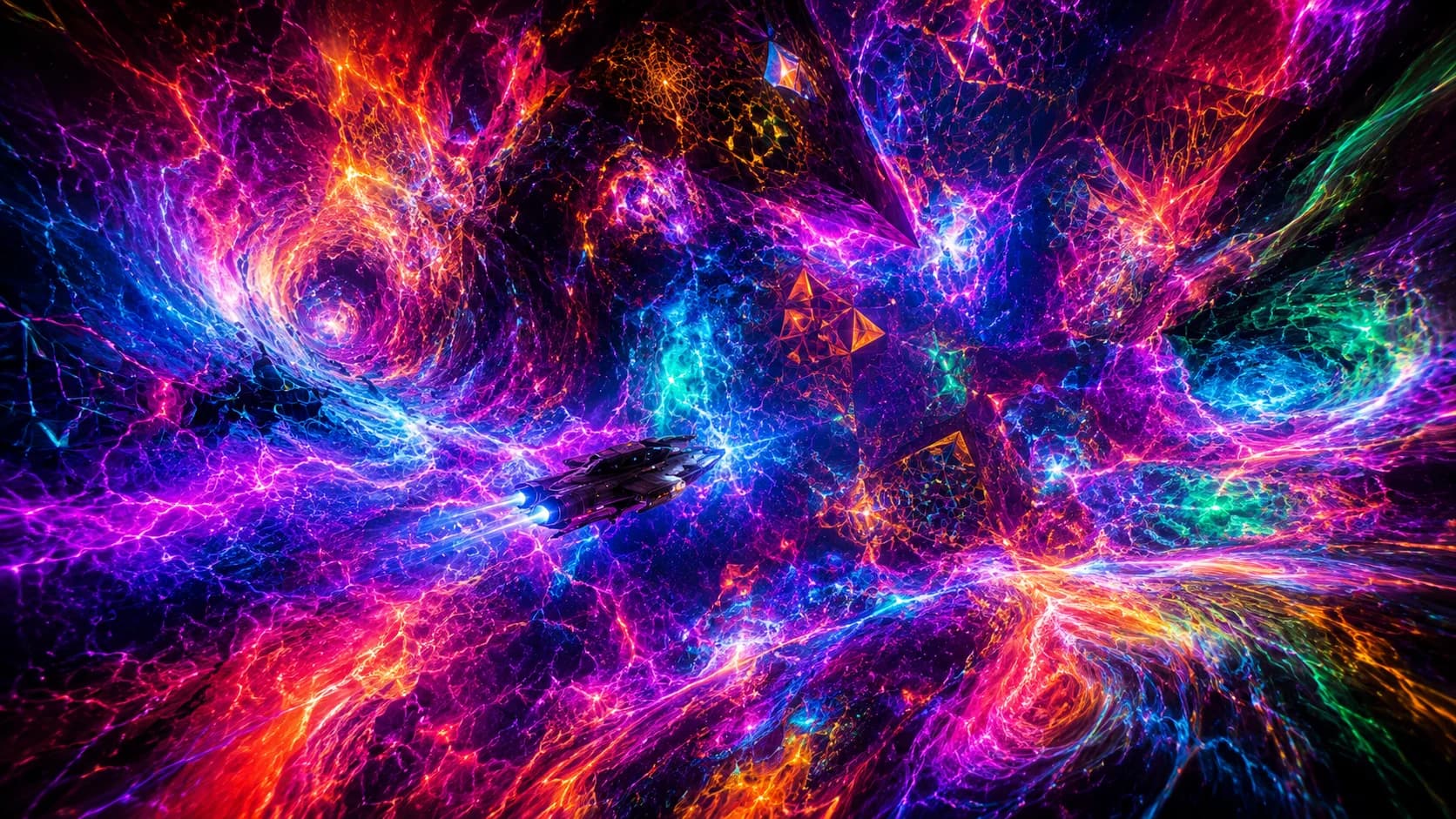
Where the trilogy depicts the void storms directly, the visual register is overwhelming. Every colour at maximum saturation. Geometric structures that change when looked at directly. The visible field includes colours that human visual processing cannot resolve into recognisable hues.
This is one of the trilogy's least-illustrated locations because it is genuinely hard to render in any visual medium. The cinematic version, if Nolan or anyone else attempts it, would presumably involve practical effects and post-production work in roughly equal measure.
The book version uses prose for what prose can do better than images: indirection, ambiguity, the gap between sensation and description. Telemachus does not see the void storm. He sees something that his eyes pass on to his brain as a colour, and his brain refuses the description, and the gap between sensation and description is the actual subject.
Where to go next
For the Architect infrastructure that may or may not be related to the void storms, The Node Points: Architect Bridges Across the Galaxy is the relevant piece. For the broader trilogy worldview that lets unmappable spaces exist alongside well-mapped Pantheon territory, The Merge: When Humanity Accidentally Woke the Gods is the foundational piece.
Book 2: The Void Between contains the Odyssey's transit through a void storm. Buy Book One on Amazon to start at the beginning.
Key takeaways
- Void storms are regions of space where physical laws operate non-standardly. Colours, geometry, time, and causality all behave in ways that human perception was not built to process.
- Crews who pass through void storms come out reporting saturation effects that do not match anything in their training. The reports do not match each other either.
- The trilogy uses the void storms sparingly. They are the universe's clearest admission that not everything in known space is mapped or mappable.
- Visually: every colour at maximum saturation, including colours that human eyes cannot resolve. Sound: subharmonics that the body hears before the ears do.