Calypso's Island: Where Time Stops
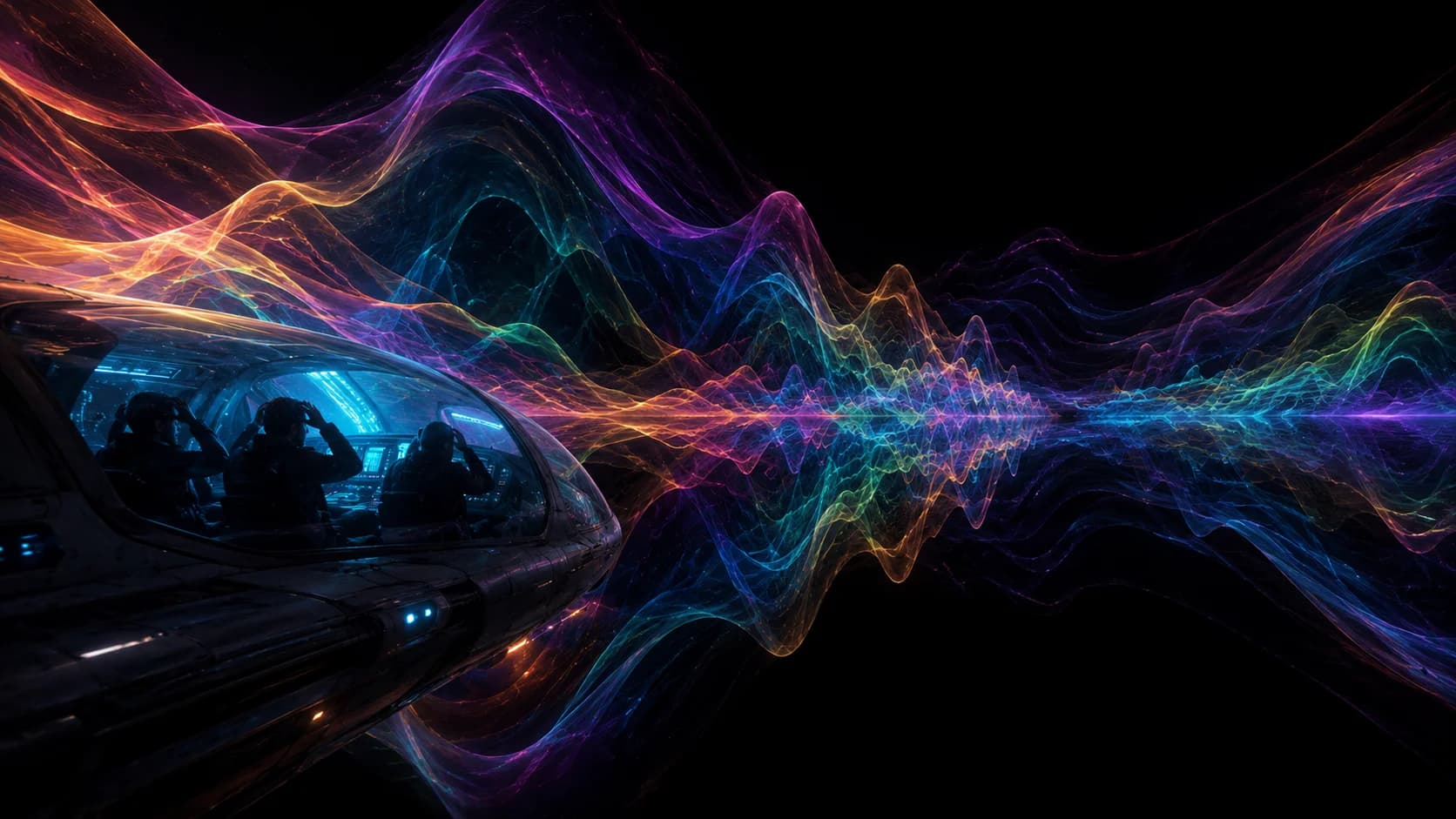
A time-distorted liminal space where ten years pass for the universe and weeks pass for the inhabitants. The trilogy's most extreme treatment of time as antagonist.
The arrival
In Year 12 of the journey, after the Sirens and after Scylla and Charybdis, the Odyssey is in genuine extremis. Marcus-Reyes is in medical stasis. Crew losses have compounded. The supplies that Aeolus's hospitality replenished are gone again. The ship's reactor is running below spec.
Ulysses, increasingly, is making decisions out of exhaustion rather than judgment.
He picks up a transponder signal from a nearby system. The signal is in pre-Pantheon code. The corridor it offers leads to a small habitable world inside a localised distortion field. The corridor is open. The transponder broadcasts in a tone that suggests welcome.
He takes the corridor.
He should not have. The decision is the kind he would not have made five years earlier. He makes it because he is tired, and because Telemachus is tired, and because the suspension pods are failing faster than they should be, and because the prospect of solid ground and breathable air without surveillance is more than he has the resources to refuse.
The Odyssey crosses into the distortion field. Telemachus and a skeleton crew stay aboard the ship, parking it at the edge of the field where the time differential is minimal. Ulysses and a small away team descend to the surface.
What the island is
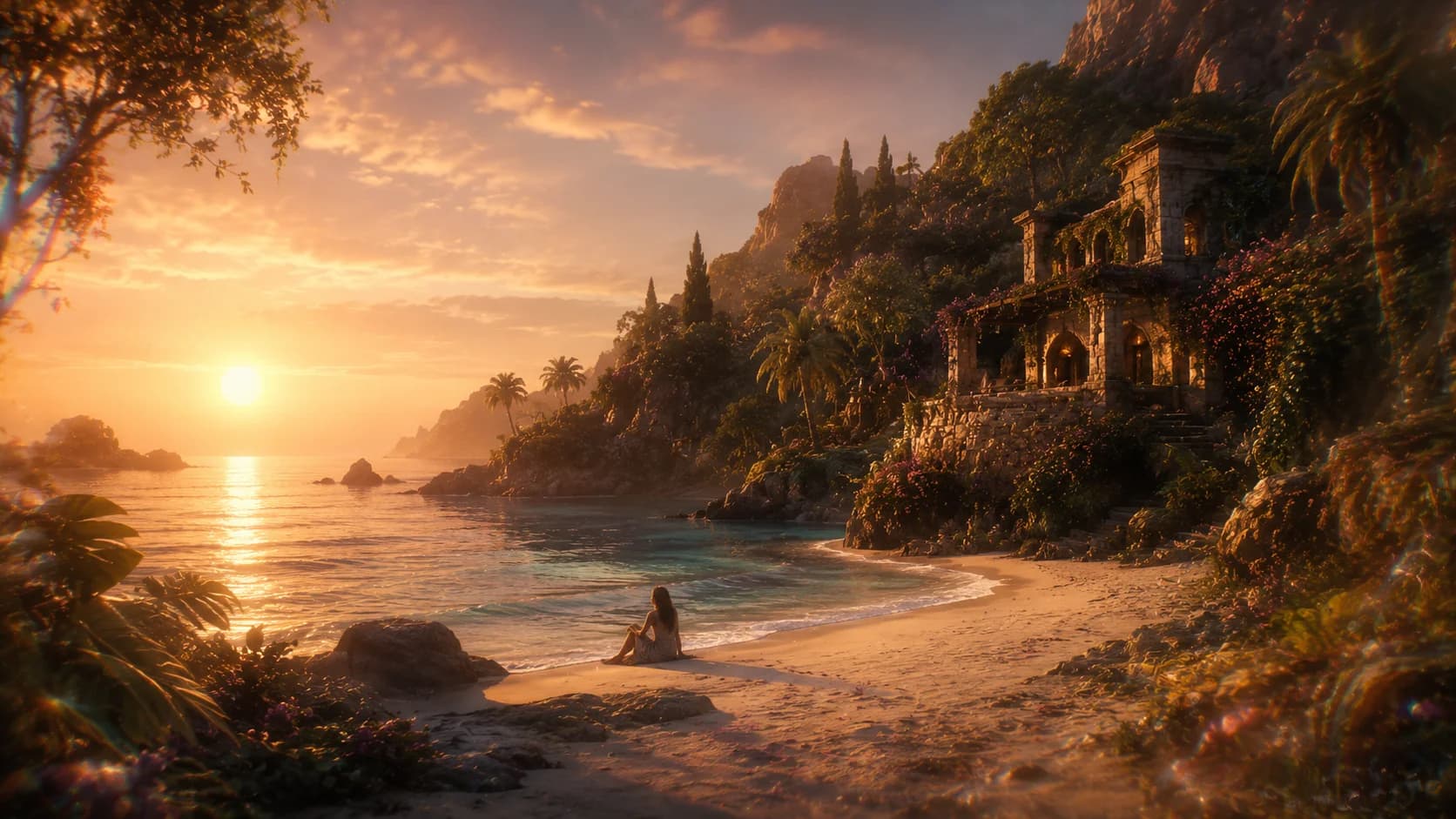
The island is roughly the size of a small Mediterranean country. One continent. One central mountain. Forests that look almost Earth-natural, with some species that are not. Coastline that runs in a continuous arc. Sun that hangs at a permanent late-afternoon angle and never moves.
The sun's lack of motion is the first sign that the place is wrong.
Calypso lives in a stone house carved into the side of the central mountain. She is the only resident. She has been there for a long time. Her infrastructure is light: a small workshop, a garden, a series of caves that go deeper into the mountain than her current use accounts for.
She welcomes Ulysses with the kind of warmth Aeolus had. Real bread. Real conversation. Real listening.
The difference is that she does not let her guests leave.
How the trap works
The trap is not coercive. It is environmental.
The away team is exhausted. The island is beautiful. The food is real. The conversation is the first sustained adult conversation Ulysses has had outside his own crew in a decade. Calypso is, to be direct, a wonderful host. She is also genuinely lonely. The combination is potent.
Ulysses stays a few days to rest. Then a few weeks. Each interval feels shorter than the one before, because each interval is, in fact, slightly shorter on subjective time as Calypso's field calibrates to her guest's neurology. He does not notice the temporal manipulation. Nobody does, the first time.
The crew that came down with him is, in some ways, more lost than he is. They sleep. They eat. They wander. They lose track of days. After what subjectively feels like maybe two months, one of them goes to look at the parked Odyssey through a long-range sensor and realises that the ship's chronometers are reading three years past the date he expected.
He does not tell Ulysses immediately. He is not sure he understood the readings correctly. He goes back to the workshop. He continues making the small repairs Calypso has been encouraging.
Telemachus on the Odyssey
Telemachus, parked at the edge of the field, ages normally. He is eighteen when the Odyssey enters the corridor. He is, after a year of objective time, nineteen. After three years, twenty-one. After seven years, twenty-five. After ten, twenty-seven.
He waits.
This is Telemachus's structural transformation in the trilogy. He goes from teenager to adult during the Calypso years. His father is, from Telemachus's perspective, on the surface of the island for a decade and then comes back essentially unchanged.
By the time Ulysses returns to the ship, Telemachus is older than Ulysses was when he was first commissioned as an officer in the fleet. Father and son have become roughly the same age, in the way that mattered.
The reunion is one of the trilogy's most carefully handled scenes. Telemachus does not blame his father. Telemachus has had a decade to think about what would happen when his father came back, and he has had ten years to forgive him for whatever could possibly have happened.
He does not need to forgive him. Ulysses chooses to leave. That is, in the end, what matters.
The choice
What pulls Ulysses out is not anger at Calypso. It is not even Penelope, directly. It is a moment when he sees Telemachus on the long-range visual, working alone at a maintenance task on the Odyssey's hull, and recognises that his son has grown a decade older while he himself has been resting.
He goes to Calypso. He tells her he is going.
She does not stop him. She did not, in the end, ever intend to stop him with force. The trap was always the kind that depends on the guest's choosing not to leave. Once the guest chooses to leave, the trap is no longer a trap.
She tells him the corridor home. She gives him the navigational data he needs to clear the rest of the journey. She is, throughout, genuinely warm. She is also genuinely sad. She knows he will not come back.
As he prepares to leave, she touches his face and says the line.
You will reach home. You will wish you hadn't.
The same line Tiresias gave him in the underworld. The same line whispered to him during the Olympus escape, a decade and a decade ago. The trilogy's structural prophecy, three times stated. Each time correct.
The pattern Calypso fits
Calypso is one of the trilogy's three independent women who run their own domains. Circe (biology). Calypso (time). Penelope (politics). Each holds a kind of dominion. Each has her own rules. Each has a complicated relationship with the men who arrive.
What distinguishes Calypso from the other two is that her domain does not corrupt her guests. It absorbs them. Circe's guests transform. Calypso's guests forget. Both are dangerous. The forgetting is, in some ways, worse, because there is no biological symptom to point at. The crew on Calypso's Island do not feel that anything is wrong. They feel, in fact, fine. The fineness is the symptom.
The trilogy is using Calypso to argue something specific about comfort. Comfort that is too perfect, too sustained, too unearned, is its own kind of harm. The Pantheon understands this in the abstract. Calypso embodies it in the particular.
Where to go next
For the Pantheon-version character profile of Calypso, Know Your Gods: Calypso is the relevant piece. For the parallel encounter that also handles time as antagonist (with very different mechanics), The Underworld: Data of the Dead is the companion. For the foundational backstory on how independent domains like Calypso's are possible in the Pantheon era, The Merge: When Humanity Accidentally Woke the Gods covers the political context.
Book 2: The Void Between contains the Calypso chapters. The time-jump bridges Books 2 and 3. Buy Book One on Amazon to start at the beginning of the journey.
Key takeaways
- Calypso's Island is a time-distorted liminal space. Inside its field, time runs at a fraction of the rate it runs outside.
- The Odyssey arrives in Year 12 of the journey. When Ulysses and a portion of the crew leave, ten objective years have passed. They experience weeks.
- Calypso is genuinely lonely. The island is genuinely beautiful. The hospitality is genuinely warm. None of these things makes the trap less of a trap.
- The trilogy's structural reason for the time-jump is to age Telemachus from 17 to 27 without breaking the narrative pace of the active chapters.
- The island ends when Ulysses chooses, against his own comfort and against Calypso's desire, to leave. The choice is the trilogy's most morally weighted single decision.