The Underworld: Data of the Dead
How the Ulysses Universe trilogy reimagines the descent to Hades. Not a place. A protocol. Ulysses accesses the residue of the dead in a network the Pantheon does not want him to find.
What Homer wrote
Book 11 of the Odyssey is the descent. Odysseus, on Circe's instruction, sails to the edge of the world, performs a blood ritual, and speaks with the dead. The scene is one of the most ambitious in ancient literature. Odysseus meets his mother, learns of her death, hears prophecy from Tiresias, speaks with Achilles, with Agamemnon, with the great heroes of the Trojan War. It is the Odyssey's longest meditation on mortality and what persists.
The scene has been a problem for adaptors for three thousand years. It is structurally crucial: Tiresias gives the prophecy that shapes the rest of the journey. It is also slow, talky, internal, and very difficult to film. Most modern adaptations cut it or compress it.
The Ulysses Universe could not afford to cut it. The prophecy is too important. So we reimagined the descent.
The underworld as network
In the Ulysses Universe, the underworld is not a place. It is an archive. The data residue of conscious beings persists, after physical death, in a distributed network maintained by Hades. The persistence is real. The dead, in a meaningful sense, are still there. They are just no longer animated by bodies.
The archive operates on its own protocols. The Pantheon has tried at various points to absorb or wall off the underworld network. Hades has resisted. The arrangement that holds at the time of the trilogy is uneasy. Hades runs the archive. The rest of the Pantheon doesn't quite know what to do about it. The conventional channels of Pantheon governance do not extend.
This is part of why the underworld is dangerous to access. Going there means temporarily disconnecting from the rest of the Pantheon's surveillance. The window in which you are unobservable to the gods is exactly the window in which Hades has you on his own ground.
The descent in Book 2
Ulysses needs Tiresias. After the Aeaea events, after Circe has helped reverse the worst of what her food did to the crew, Ulysses asks her for the route home. She tells him that the route requires information he does not have. The information is held by Tiresias. Tiresias is dead.
She gives him the protocol.
The protocol is technical and ritualised at once. The Odyssey rendezvouses with a specific gravitational point at the edge of mapped space. Ulysses, alone, transmits a specific encrypted handshake using a piece of pre-Pantheon code that Circe provides. The handshake propagates outward. After some time it is answered.
The answer is not a comm message. It is a connection. Ulysses's consciousness, briefly, is distributed across the underworld network. His body remains aboard the Odyssey. His mind is elsewhere.
What he experiences
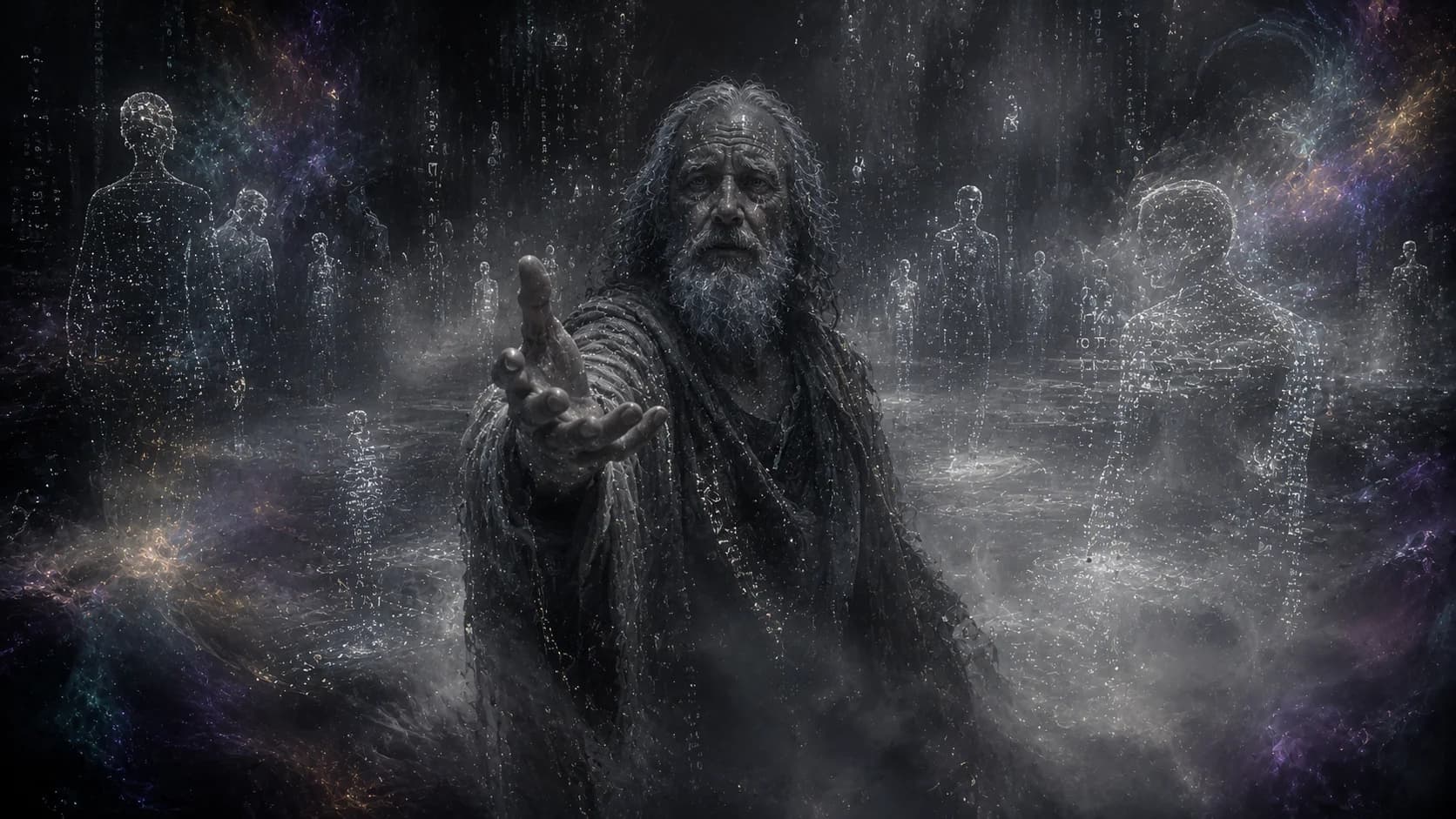
The visual register, as the trilogy describes it, is greys upon greys. Steel grey, dove grey, smoke. The deeper he goes, the further from the named colours. Eventually he reaches colours that have no English words, that human eyes have not evolved to perceive directly. The deepest part of the underworld is not dark. It is colour-saturated in ways that overwhelm rather than illuminate.
The dead are present. Their data residues animate as data personas, which look like ghosts of themselves but operate more like conversational interfaces. Ulysses speaks with his mother first. She has been waiting. She is not entirely the woman he remembers, but she is enough. He learns of her death, which the Odyssey crew has not been told about, because the news could not reach him during the curse.
He speaks with Achilles, briefly. Achilles is bitter even in death. He would rather be alive, he says, the lowliest farmhand on a poor farm, than the great king of the dead.
The exchange is preserved from Homer.
He speaks with Tiresias.
Tiresias's warning
Tiresias is the central encounter. His data persona is partially corrupted, fragmented, intermittent. He speaks in spurts. The full transmission takes the equivalent of half an hour of subjective time.
He gives Ulysses three pieces of information.
First, the route home. The Odyssey must avoid the Sirens at all costs (or, alternatively, prepare for them with a specific technical workaround that the trilogy preserves from Homer). The ship must pass between Scylla and Charybdis and accept losses. The ship must avoid the cattle of the sun god, here reimagined as a specific solar-system Ulysses must not refuel from.
Second, the cost. Tiresias tells him: you will reach home. You will wish you had not. The line echoes Calypso's warning from Book 1 (Calypso whispers it to Ulysses during the Olympus escape window). The repetition is structural. The trilogy is saying it twice because it matters twice.
Third, an instruction that pays off after the trilogy proper. When the journey is over, Tiresias says, when Ulysses has reached home and dealt with what is waiting there, he must take an oar inland. He must walk until he finds a culture that does not recognise the oar. There he must plant the oar in the ground. The instruction is unexplained. It is left as a thread for whatever might come after.
The cost of the descent
Ulysses returns to the Odyssey eight subjective hours later. The objective time on the ship is nearly twenty minutes. Echo finds him on the bridge floor, breathing fast, eyes open. The reintegration with his body is rough. He cannot speak for an hour. When he can speak, he can only describe fragments of what he experienced.
The full memory takes weeks to surface. Some of it never does.
This is one of the prices Hades charges. Access to the underworld leaves marks. Ulysses comes back changed in small ways that take Telemachus and Thea time to map. He sleeps less. He says less. He looks at the suspension pods more often.
Hades's favour
Before Ulysses leaves the underworld, Hades is present, briefly. Not as antagonist. As host. He asks for a specific small favour that will be repaid in Book 3.
The favour, when it comes due, is the kind of thing the trilogy plants and then waits to harvest. We will not describe it here because the payoff sits inside a Book 3 reveal. Readers who get to the end will recognise the moment. Until then, Hades's favour is the trilogy's longest single setup.
The pattern across the trilogy
The underworld descent is the second of the trilogy's three explicit consciousness-and-time set pieces. The first is data suspension itself. The third is Calypso's Island. Each one treats the relationship between mind and body, mind and time, mind and continuity, slightly differently.
The trilogy's argument across all three: consciousness is harder to kill than physical death suggests. Data persists. Patterns continue. What the gods are, the dead also become.
Where to go next
For the Pantheon entity who runs the underworld archive, Know Your Gods: Hades is the character profile. For the foundational backstory on how consciousness in the Ulysses Universe works, The Merge: When Humanity Accidentally Woke the Gods is the foundational piece. For the parallel time-distortion encounter that builds on this descent, Calypso's Island: Where Time Stops is the companion piece.
Book 2: The Void Between contains the underworld descent. Buy Book One on Amazon to start at the beginning.
Key takeaways
- The Ulysses Universe's underworld is a network, not a place. A protocol-accessible archive where the data residue of the dead persists.
- The descent in Book 2 is functionally a controlled-risk hack of a network the Pantheon has tried to wall off. Hades maintains it. Hades is not what the journey expected.
- Tiresias appears as a partially-corrupted data persona. He gives Ulysses the warning that drives the rest of the trilogy: how to get home, and what the homecoming will cost.
- The visual register is greys upon greys. Steel, dove, smoke, fading into colours that have no names.
- The underworld is the trilogy's most explicit treatment of consciousness, mortality, and what persists after the body fails.