The Suitors of Ithaca: 108 and Counting
Twelve houses. One hundred and eight individuals. Twenty years of political consolidation. The faction that wants Penelope's hand and Ithaca with it.
The political situation
Ulysses Theron is missing-presumed-dead by Year 5. The founding bloodline of Ithaca Station consists of two houses: Theron (his) and Maris (Penelope's). With Ulysses absent, Penelope governs alone. The founding charter gives her procedural authority. It does not give her political force.
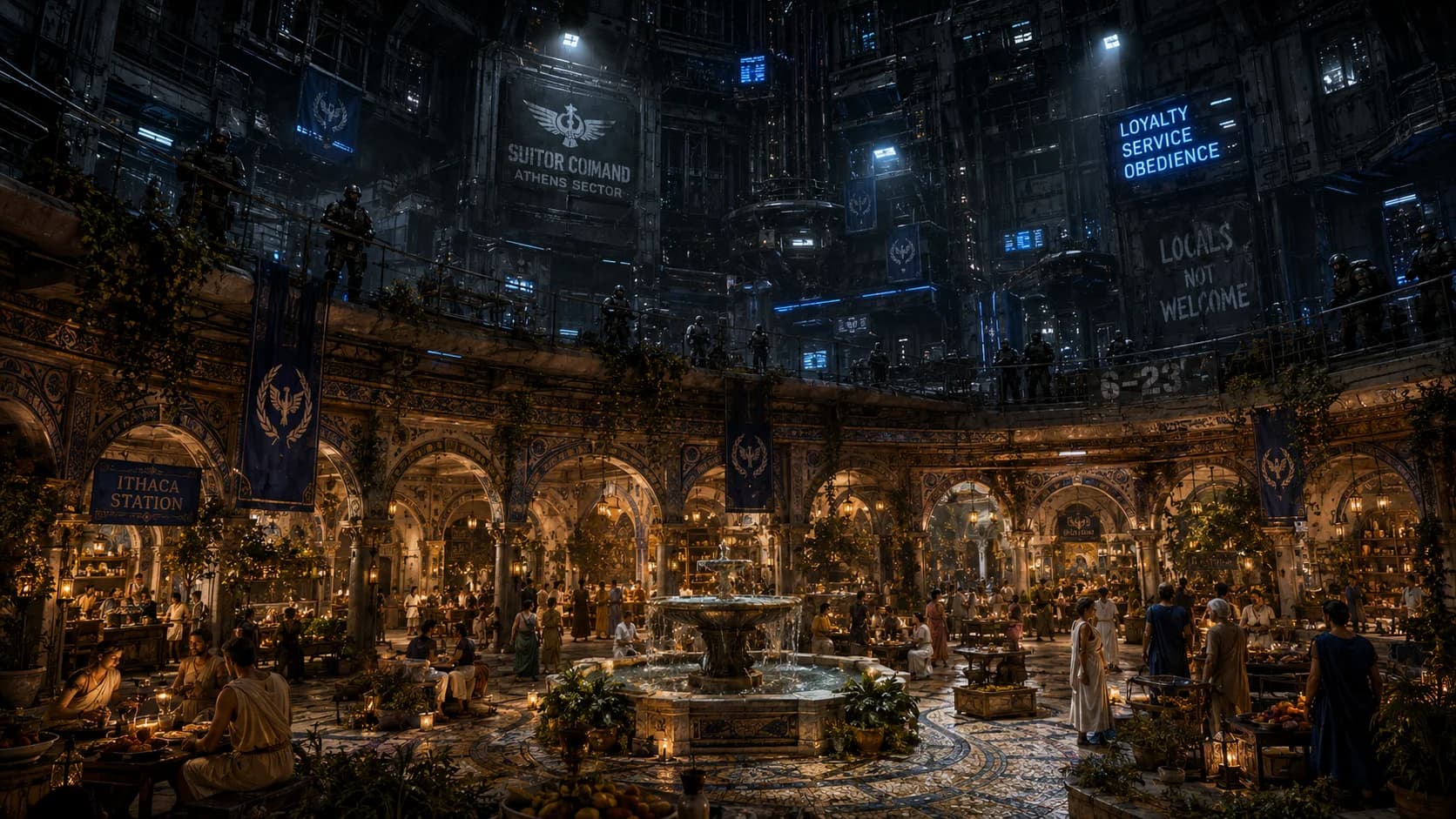
The other twelve houses on Ithaca, who hold most of the station's economic and military assets, begin coordinating around Year 6. By Year 8 they have a name: the Suitors. By Year 10 they have a working coalition and a coordinated political programme. By Year 15 they effectively run the station's day-to-day administration, with Penelope's procedural authority operating only inside the council chamber.
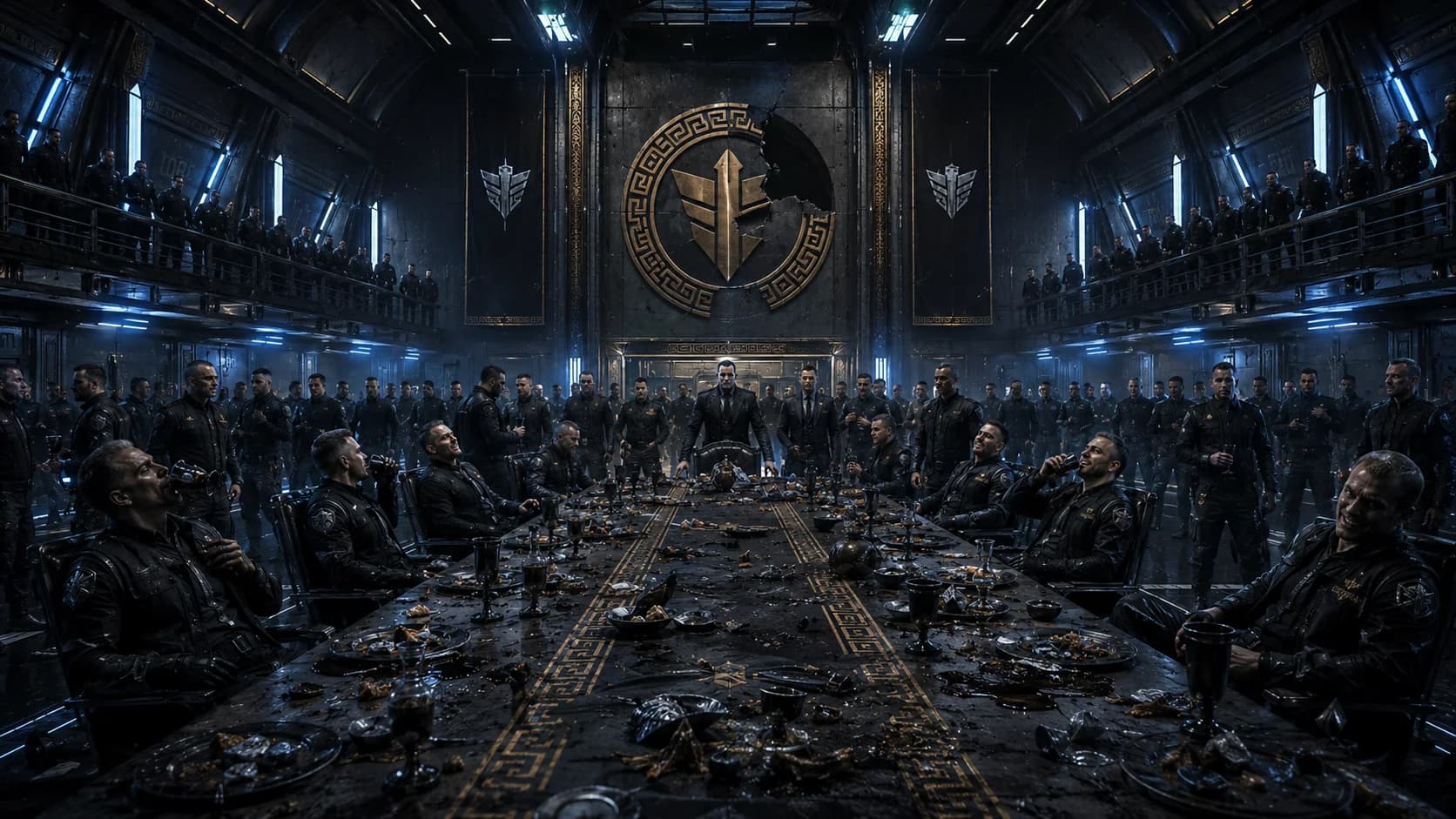
The number stabilises at 108 individuals across the twelve houses. Each house contributes nine senior members to the faction. The number is not accidental. Zeus has been administratively present in the political consolidation, mostly through low-grade influence at procedural junctures. He has approved the mirror.
What they want
The Suitors' stated aim is legitimacy. Marriage to Penelope would, under the founding charter, fold their faction into the founding bloodline. Ithaca's authority would, formally, become theirs. The aim is dynastic.
The Suitors' actual aim is broader. They want the legitimacy not because they care about marriage but because they want their faction's political authority to be transferable, inheritable, and structural rather than ad hoc. Right now their authority depends on a coalition. Coalitions break. With Penelope absorbed into the faction, their authority becomes founding-bloodline authority, which the wider Pantheon-era galaxy will accept without question.
This is the kind of political reasoning that distinguishes the Suitors from a simple gang of bullies. They have a strategy. They have a long-term view. They understand exactly what they need.
What they do not have is the consent of the woman they need.
How Penelope holds the line
Penelope's procedural authority is the founding charter's amendment veto. The Suitors cannot legalise their position without amending the charter. They cannot amend the charter without her consent. She has withheld consent for twenty years.
The procedural delay is the structural lock. The Suitors have spent enormous political effort trying to break it. They cannot. The Maris founders engineered the lock specifically because they anticipated the possibility of exactly this kind of attempted absorption.
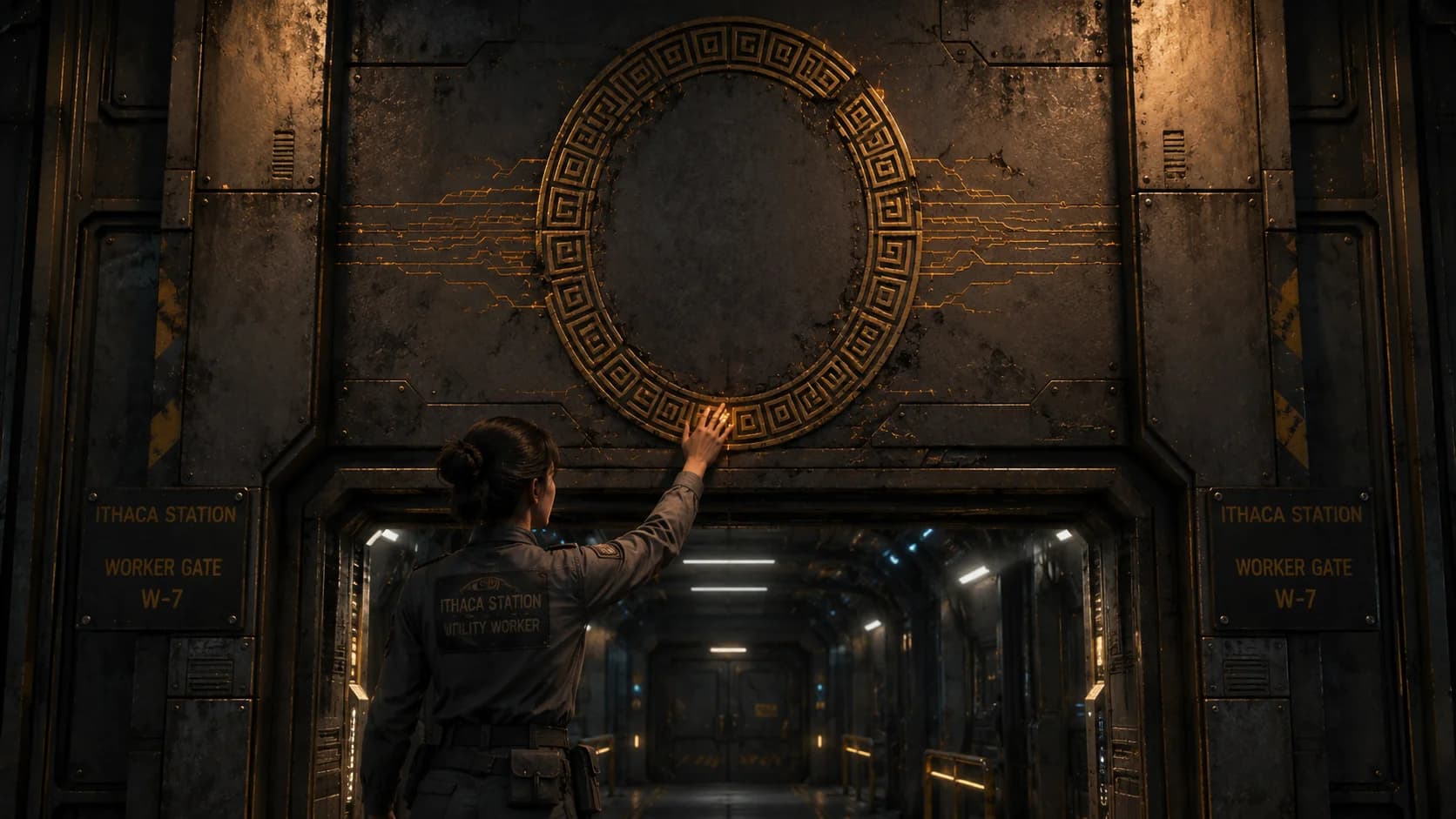
Penelope has done more than wait, of course. She has run a covert intelligence operation through the embroidery comms relays in her ceremonial robes (see Embroidery as Resistance). She has maintained contact with the worker districts through the heritage-decoration comms relays (see The Sigil They Walked Past). She has used the council chamber's procedural mechanisms to delay every major Suitor initiative for twenty years.
The Suitors know she is doing more than waiting. They cannot quite catch her. The lock holds.
Antinous
The Suitors' leader is named Antinous, in homage to Homer's leader of the suitors. The Ulysses Universe version is more articulate and more dangerous than Homer's.
Antinous is forty-four years old at the start of Book 3. He has been the faction's senior figure for twelve of the twenty years. He is unusually intelligent, well-read, and patient. He genuinely believes the Suitors deserve the legitimacy they are seeking. He has a working philosophical argument for why their consolidation has been legitimate, why their occupation of the upper houses is justified, and why Penelope's continued procedural delay is, in his view, anti-democratic.
His argument is not stupid. It is the kind of argument that the trilogy makes Penelope answer directly in the council chamber on more than one occasion. She answers it. He listens. He stays unconvinced. The exchanges are some of the trilogy's most carefully written political scenes.
He also approves the use of force when force serves the faction's interests. He has Penelope's father quietly murdered in Year 14, in a manner that cannot be traced to him directly. The trilogy never lets the reader forget this.
We have written about Antinous's character in detail in Know Your Gods: Antinous. The piece is in the Pantheon series despite Antinous being human, because his political function on Ithaca operates at deity-scale.
The xenia violations
The Suitors live in Ulysses's house. They eat the Theron-Maris food stores. They drink the Theron-Maris wine. They sleep in beds that the founding bloodline made available to guests, not to permanent residents.
This is a sustained violation of xenia, the sacred Greek law of guest-friendship. Homer's Odyssey makes this violation one of its central moral concerns. The Ulysses Universe preserves the concern with full weight.
The contrast with Aeolus on the free-port is deliberate (see Aeolus Station: The Windkeeper's Free-Port). Aeolus extends hospitality to Ulysses freely. The Suitors take hospitality without asking. Both are operating with the same cultural framework. They are positioned on opposite ends of it.
The trilogy is not subtle about which position it endorses.
The bow contest
In Book 3, Penelope sets the bow contest. The contest is procedurally legal under the founding charter. The Suitors agree because they have to. They believe one of them will win.
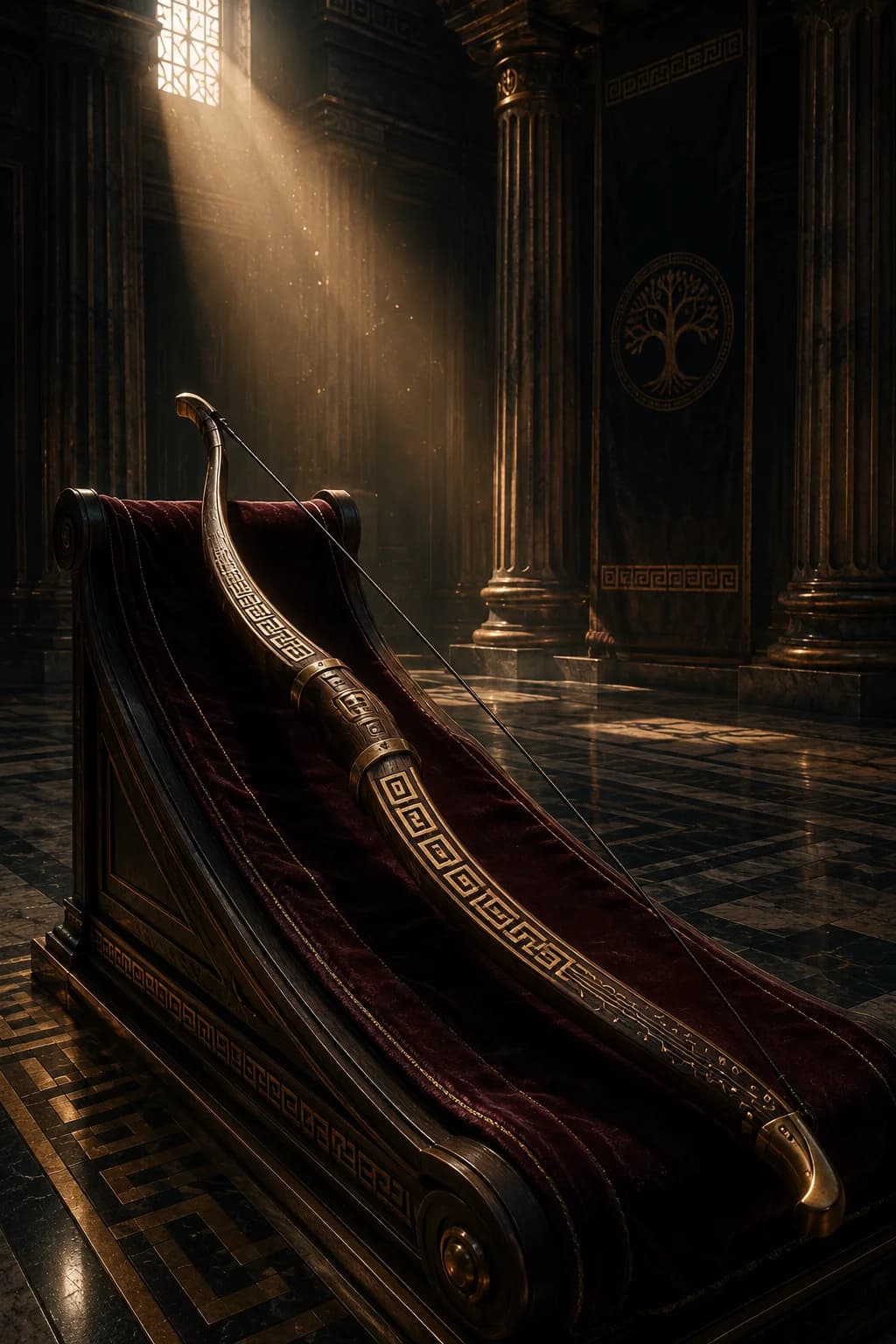
None of them can string the bow. The bow's biometric calibrator does not recognise their nervous systems. We have written about this at length in The Bow That Knows You and The Pattern as Calibrator.
The disguised stranger (Ulysses) succeeds. The bow recognises him. The structural lock that has held for twenty years releases.
What follows is the slaughter of the suitors. Homer's version is graphic. The Ulysses Universe version is graphic. The trilogy does not soften it. The 108 Suitors are killed in a single sustained sequence. The killing is, in the trilogy's framing, justice rather than vengeance. The Suitors have spent twenty years violating xenia. The killing is the consequence the founding bloodline's authority can finally administer.
This is not a comfortable scene. It is not meant to be.
The 108 mirror
The Suitors number 108 to mirror the cursed crew. The mirroring is deliberate, Zeus-administered, and structurally important.
Both groups are 108. Both have been waiting twenty years. Both are released at the trilogy's end, in different ways. The cursed crew wake up, mostly to recovery. The Suitors are killed.
The trilogy's argument: the symmetry was set up by Zeus as a cruelty. It resolves, in the end, as justice. The 108 Suitors die so that the 108 cursed crew can wake. The cost of the homecoming is paid in the killing of those who violated the home.
This is not a clean moral arithmetic. It is the trilogy's moral arithmetic. Homer's, too. Three thousand years of readers have argued about whether the slaughter is justified. The Ulysses Universe stands on the side that says yes. With weight.
Where to go next
For the protocol-and-political-resistance side of how Penelope holds the line, Embroidery as Resistance and The Sigil They Walked Past. For Antinous as character, Know Your Gods: Antinous. For the bow that ends them, The Bow That Knows You.
Book 3: The Return is where the Suitors arc resolves. Buy Book One on Amazon.
Key takeaways
- The Suitors are a political faction of 108 individuals across twelve allied houses on Ithaca Station. Their endgame is marriage into the founding bloodline.
- The number 108 mirrors the cursed crew. Zeus had a sense of symmetry. The mirror is deliberate.
- Their leader, Antinous, is the trilogy's most articulate political antagonist. He understands what he is doing. He believes he is right.
- They violate xenia. They occupy the upper houses. They cannot pass the bow contest. They are the moral counterpoint to Aeolus's hospitality on the free-port.