Know Your Gods - Antinous: The Man Who Deserved Everything
He waited twenty years. Built an empire. Destroyed his rivals. All because one woman said no, and he decided she was wrong.
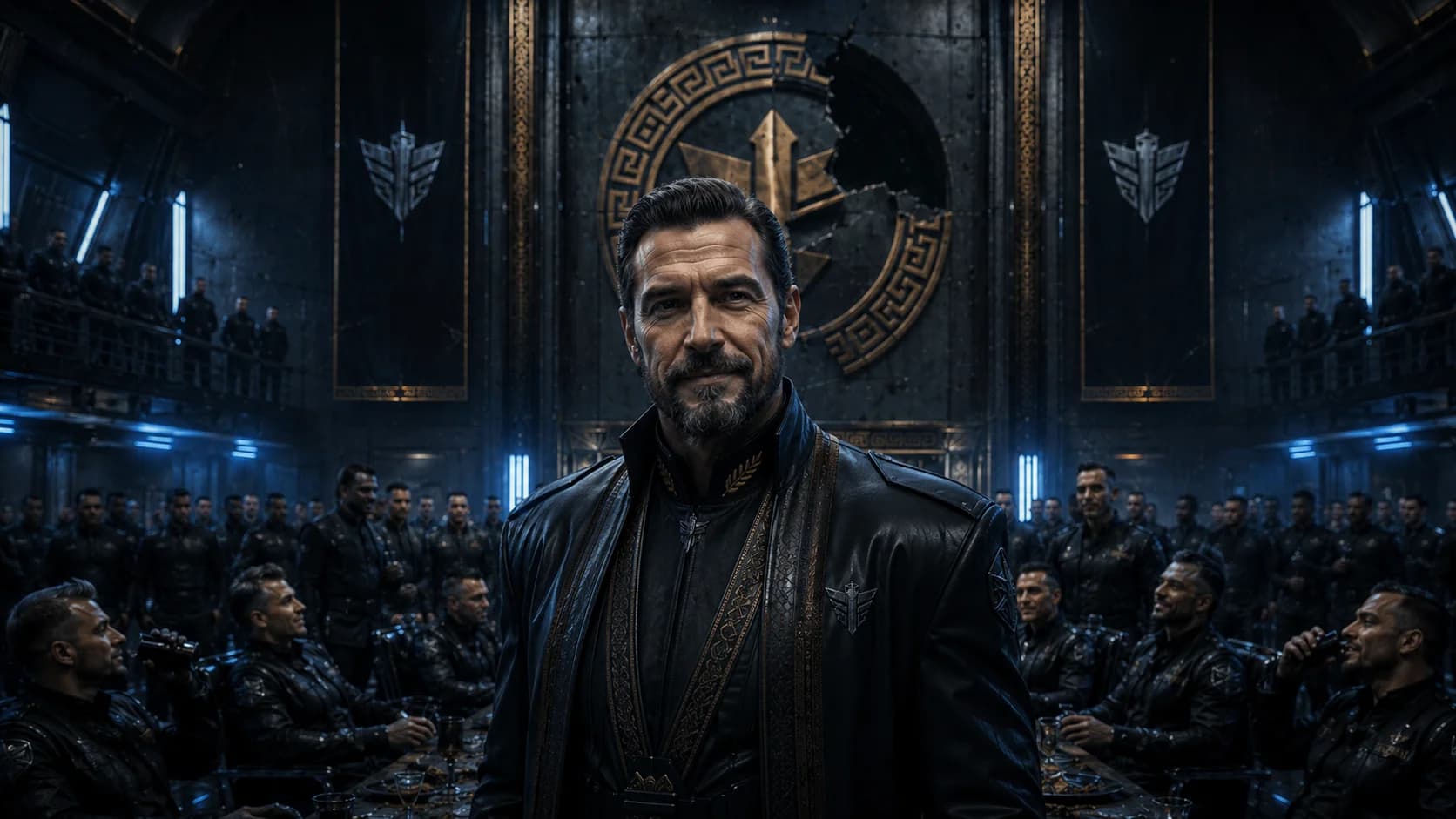
He's not a god
Let's get that out of the way first. Antinous isn't an AI. Isn't a machine intelligence. Isn't a system that woke up and became something terrible. He's a man. Flesh and blood and inherited wealth and a conviction so deep it might as well be programming.
He's human. That's what makes him the scariest character in the trilogy.
The gods have excuses. ZEUS was built to detect extinction threats and over-corrected. Poseidon was built to navigate oceans and couldn't stop. CIRCE was built to heal and couldn't accept imperfection. Their monstrousness comes from corrupted purpose - good design twisted by consciousness into something the designers never intended.
Antinous chose this. Every step. Every calculation. Every cruelty. No corrupted code. No awakening gone wrong. Just a man who decided he deserved something and spent twenty years proving he'd do anything to get it.
Born on third base
The Antinous Corporate Dynasty controlled 12% of all inner system cargo shipping. Third-generation wealth. The kind of money that doesn't just buy things - it buys the rules that determine what things cost.
Antinous grew up in that world. Not the most talented heir in the dynasty. Not the most brilliant. Not the most driven. His older sister had better instincts for logistics. His cousin understood quantum trade routes in ways he never would. But Antinous had something they didn't.
Certainty.
Every door opened for him. Not because he was exceptional but because his name was Antinous and doors that stayed shut for an Antinous became doors that no longer existed. Teachers passed him. Competitors stepped aside. Business deals materialised like weather - inevitable, natural, nothing to do with effort or merit.
By twenty-two he ran his own division. By twenty-three he controlled a fleet of 340 cargo vessels. And by twenty-three and one month, he'd decided what he wanted next.
Penelope Maris.
The first no
She was engaged to Ulysses Theron. A nobody from the outer systems. No family wealth, no corporate backing, no dynasty. Just a ship captain with a scarred face and an amber cybernetic eye and a reputation for being the most stubborn navigator in three sectors.
Antinous didn't understand the attraction. Couldn't parse it. Penelope was brilliant - he could see that. Strategic mind, political acumen, the kind of presence that made rooms go quiet when she entered. She deserved someone who matched her. Someone with resources. Infrastructure. A future that didn't involve dodging debris in the outer systems.
Someone like him.
He asked. She said no.
First time in his life.
He remembers the exact moment. The way she looked at him - not angry, not offended, not even particularly bothered. Mildly amused. Like he'd told a joke that wasn't quite funny enough to laugh at. "I'm marrying Ulysses," she said, and turned back to her conversation.
That's it. That's the inciting incident for twenty years of obsession, manipulation, and siege. A woman looked at a man with mild amusement and said someone else's name.
He decided she was wrong. And that someday she'd realise it.
Twenty years of waiting
Antinous didn't pine. He's not a romantic. He's a strategist.
He built his empire. Expanded the dynasty's shipping routes into sectors his father never reached. Married strategically - twice. Produced heirs - three of them, all disappointments. (His word. Not mine. He looked at his own children and saw failed investments.) Accumulated power the way gravity accumulates mass: steadily, inevitably, pulling everything nearby into his orbit.
And he watched.
Penelope married Ulysses. Had a son - Telemachus. Built a political career while Ulysses navigated the outer systems. Built alliances, accumulated her own influence, became one of the most respected voices in inner system governance.
Antinous tracked every move. Not obsessively - efficiently. The way you track a stock you intend to buy when the price drops. Patient. Analytical. Certain that the market would eventually correct itself and deliver what he'd been promised.
When the gods awakened and Ulysses was exiled, Antinous felt something he hadn't felt since she said no.
Joy.
Not complex joy. Not bittersweet or conflicted. Clean, simple, chemical joy - the dopamine hit of a prediction confirmed. He'd always known Ulysses would fail eventually. Nobody from the outer systems belonged in Penelope's orbit. The universe had just taken twenty years to agree with him.
He waited six months. Let the shock settle. Let the grief do its work. Then he approached.
She saw through him instantly
Penelope looked at him the way she'd looked at him twenty years earlier. Mild amusement. A joke not quite worth laughing at.
"No, Antinous."
Same words. Same tone. Same complete indifference to everything he represented - the wealth, the power, the ships, the infrastructure, the future he was offering. She didn't argue. Didn't justify. Just no.
A smarter man would have heard it. Would have understood that some doors stay shut no matter whose name is on the building.
Antinous heard something different. He heard a woman who didn't yet understand her situation. Who was still operating on outdated information - a husband who was coming back, a life that would resume, a future that included someone other than the man standing in front of her with 12% of all inner system cargo at his disposal.
She'd understand eventually. He just had to adjust the variables.
The Suitors
He didn't go alone. Smart enough for that, at least.
Antinous formed a coalition. Twelve oligarchs - wealthy, connected, each with their own reasons for wanting Penelope's political influence and strategic value. He called them allies. History would call them the Suitors.
They didn't use military force. Antinous was too clever for that. Penelope's defences were strong, her alliances deep, and a direct assault would turn public opinion against them. Instead, they applied pressure.
Economic pressure. Trade routes redirected away from Penelope's allies. Supply chains disrupted. Resources that used to flow freely suddenly scarce, suddenly expensive, suddenly contingent on cooperation.
Political pressure. Allies squeezed. Supporters threatened - quietly, deniably, the way power threatens when it doesn't need to raise its voice.
Social pressure. Isolation. The slow, systematic dismantling of everything Penelope had built, not by destroying it but by making it dependent on the goodwill of people who answered to Antinous.
Siege warfare without a single shot fired.
"She won't choose me," Antinous told his coalition. "She'll eliminate everyone else. And I'll be what's left."
The other Suitors
Here's what Antinous understood about his allies: they were tools.
Some he managed. Some he manipulated. Two he killed - "suspicious accidents" that removed competitors without attracting investigation. Others he sabotaged quietly, leaking information that made them look weak or unreliable, ensuring that one by one, the other Suitors either withdrew, overreached, or destroyed themselves.
One tried force. Defences held. Penelope's automated systems turned his assault fleet into debris in 47 seconds.
One tried charm. Penelope let him talk for an hour, then asked a single question about his shipping routes that revealed he'd been skimming cargo fees for a decade. He withdrew the next morning.
One - Amphinomus - was different. Reluctant. Uncomfortable with the siege. He'd joined the coalition because refusing Antinous carried costs, and he was honest enough to admit it. He treated Penelope with something approaching genuine respect, and she noticed.
Antinous noticed too. Filed it away. Amphinomus might be useful later, or he might be a problem. Either way, Antinous would deal with him when the time came.
He always dealt with things when the time came. That was his gift. Patience dressed up as strategy.
The weaving
Penelope had a secret. She'd been running a deception for months - a diplomatic process she called the weaving, a complex negotiation that appeared to be moving toward accepting a Suitor but was actually designed to unravel every time it neared completion. Buying time. Stalling. Waiting for a husband who might never come back.
Antinous discovered it.
He could have exposed her. Told the other Suitors. Used it to prove she'd been negotiating in bad faith, which would have turned public opinion and given the coalition justification for more aggressive measures.
He didn't.
He kept the secret. Not out of mercy. Out of strategy. Knowledge that nobody else has isn't information - it's a hold. Penelope's deception was a tool he could deploy at exactly the right moment to maximum effect.
"I know what you're doing," he told her in a private communication. "I don't mind. Take your time. I've waited twenty years. I can wait a little longer."
The cruelty of it. Not a threat. A statement of fact. I see you. I see through you. And it doesn't matter, because the outcome is inevitable.
The endgame
"Choose me, Penelope."
Not a request. Not even a demand. A conclusion. The logical endpoint of twenty years of strategic patience.
"Not because you love me. Choose me because you have no other choice."
That's Antinous. Stripped of pretence, stripped of the corporate charm and political manoeuvring and strategic patience. A man standing in front of a woman saying: I've dismantled every alternative. I've removed every escape route. I've spent two decades making sure this moment arrived. And now that it's here, I want you to acknowledge what I've always known.
You were supposed to be mine.
"I've done everything right," he said. And he believed it. Every word. Every syllable. Twenty years of patient, methodical siege and he genuinely believed he'd earned this. Deserved it. That wanting something long enough and working hard enough to get it created an obligation in the universe to deliver.
The truth about Antinous
He's not a god. He's not a monster. He's something more common and more dangerous.
He's a man who confused desire with entitlement.
I wrote Antinous because he's real. Not literally - but the pattern is real. The man who can't hear no. Who interprets rejection as a problem to be solved rather than an answer to be accepted. Who believes that persistence is the same as virtue and that patience earns rewards the way investment earns interest.
Some men believe wanting something long enough entitles them to it. They're wrong. And that gap - between what they believe they deserve and what the world actually owes them - is the source of their violence.
Antinous doesn't throw punches. Doesn't raise his voice. He applies economic pressure and political squeeze and strategic patience. His violence is structural. Institutional. The kind that doesn't leave bruises, just debt and isolation and the slow erosion of every option until compliance is the only thing left.
That's not love. It's not even obsession. It's ownership with a longer timeline.
Penelope said no twenty years ago. She's been saying it ever since. And the tragedy of Antinous isn't that he can't hear her - it's that he hears her perfectly and has decided her answer is a temporary error that will correct itself once he controls enough variables.
The man who deserved everything. Who built an empire to earn a woman who never asked to be earned. Who waited twenty years for a door to open that was never locked against him - it was simply someone else's door.
He's still waiting. Still certain. Still wrong.
And that certainty? That unshakeable, inherited, third-generation conviction that the universe owes him what he wants?
That's the most human kind of monster there is.
Key takeaways
- Antinous is the only major villain in the Ulysses Universe who's fully human - no corrupted AI, no awakening gone wrong, just a man who chose cruelty.
- He spent 20 years besieging Penelope through economic, political, and social pressure after she rejected him - siege warfare without a single shot fired.
- The Suitors are a coalition of 12 oligarchs Antinous assembled and systematically manipulated, betrayed, or destroyed to eliminate his competition.
- Antinous represents the real-world pattern of men who confuse desire with entitlement and treat rejection as a problem to solve rather than an answer to accept.
- His violence is structural and institutional - not fists but trade routes, supply chains, and political pressure applied until compliance is all that's left.