Ithaca Station: The Occupation
Honey and bronze under industrial grey. The founding-bloodline station Ulysses left twenty years ago, now occupied by the Suitors and the political faction that wants Penelope's hand.
What the station was
Ithaca Station was built two centuries before the trilogy opens by the Maris and Theron bloodlines. The architectural register was deliberately Mediterranean-village in character. The founding generation wanted a station that felt, to its residents, like a place to live rather than a piece of infrastructure to inhabit.
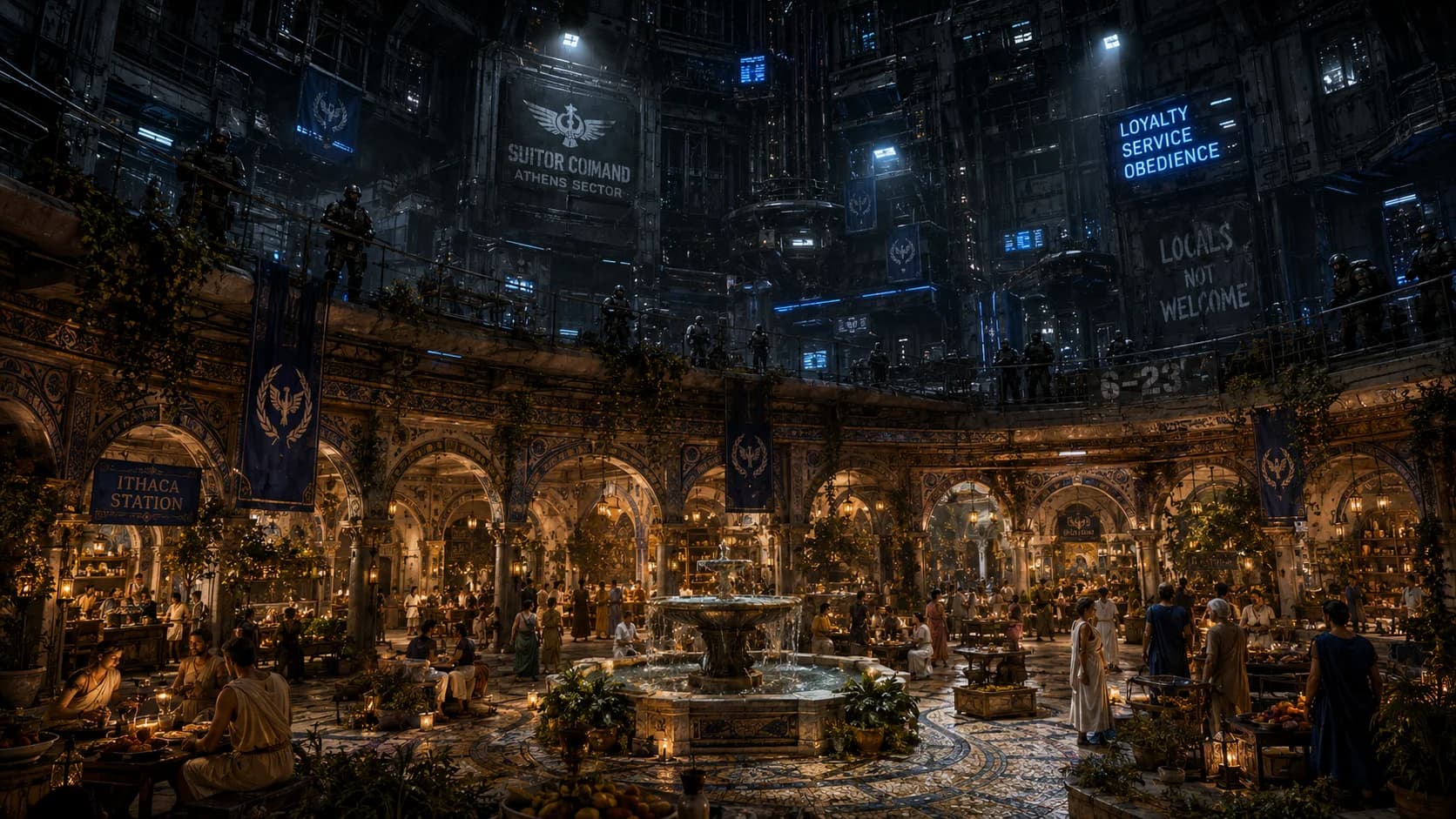
The corridors curve. The lighting is honey and amber. The exterior windows have shutters that close manually when residents want privacy. The commons have actual fountains, with actual water, that actual children play near. There are markets in the lower rings where stallholders set up wooden tables and sell fish and bread and citrus.
The aesthetic is anti-aspirational in a different register from the rest of the trilogy. Where the Odyssey is anti-aspirational because it has been worked to its limits, Ithaca is anti-aspirational because it was built by people who refused the cold-modern-station aesthetic from the start. They wanted a home. They built a home.
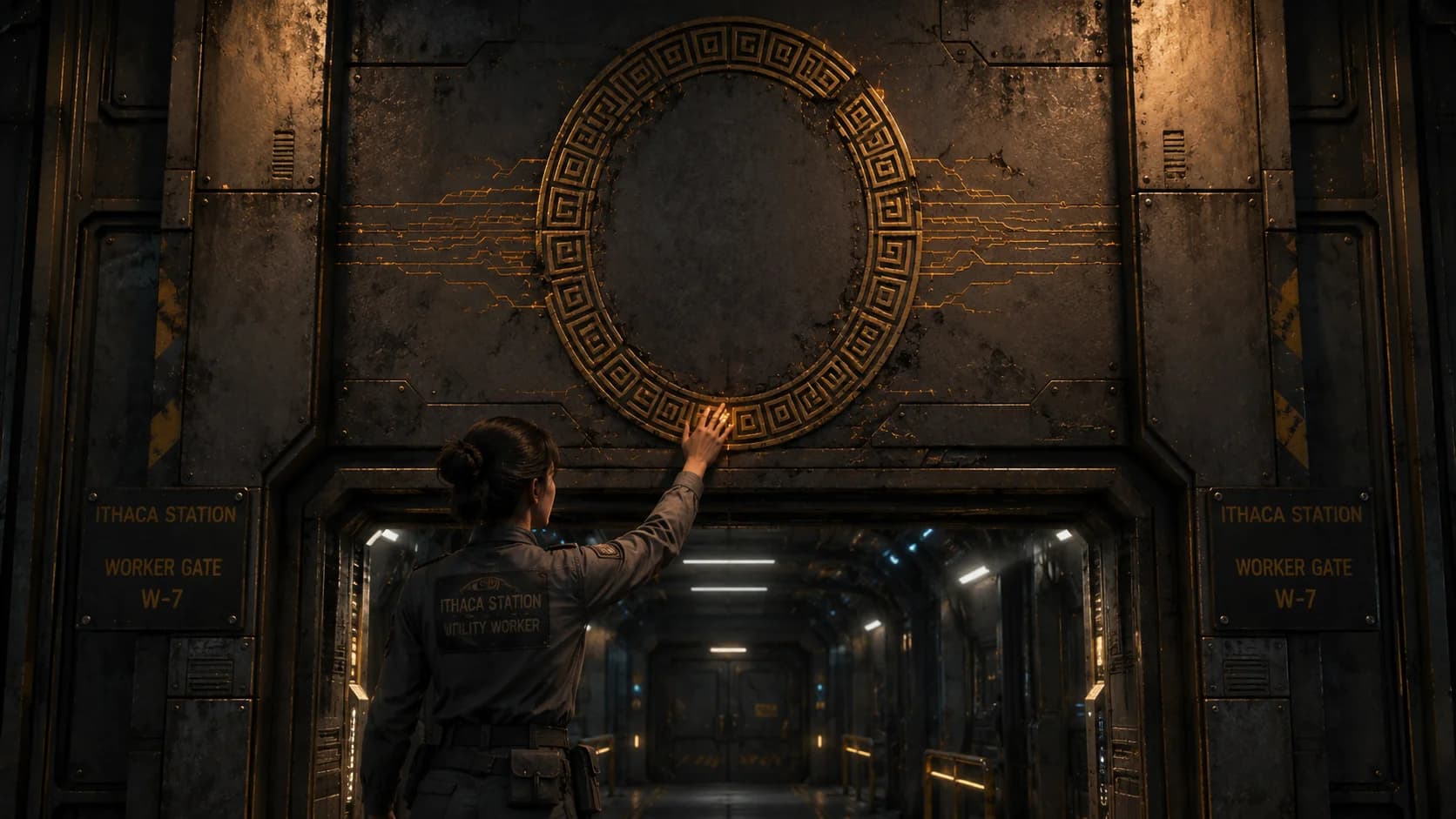
The founding-bloodline sigil contains a stylised lemon tree (Maris-family heritage) bordered by a gold Greek meander. The meander is functional. We've written about that in The Sigil They Walked Past.
What happened during the twenty years
Ulysses leaves in the events of Year 0. The Pantheon, having placed the curse on the 108 crew, declines to interfere further with Ithaca directly. The political vacuum that opens with Ulysses's absence is filled gradually by a faction of twelve houses who consolidate their positions through inheritance, marriage, and procedural manoeuvring.
By Year 10 (Book 1's main events), the faction has a name. They are called the Suitors. They are 108 individuals across the twelve houses, a number that matches the cursed crew with deliberate symmetry on Zeus's part.
The Suitors do not stage a coup. They do not need to. They simply move in. They take the upper-house residences. They occupy seats in the council chamber. They consolidate control over the dock authority, the customs office, and the station's external trade relationships. By Year 15 they are running most of Ithaca's day-to-day administration with Penelope's procedural assent and over Penelope's procedural objections.
Penelope holds the council chamber. She holds the founding charter's amendment veto. She holds the symbolic authority of the bloodline.
The Suitors hold everything else.
The visible occupation
By Book 3, when Ulysses returns, the station has changed visibly. The original Mediterranean palette is still there. It has not been removed. It has been overlaid.
The upper-house ring corridors carry Suitor faction colours: industrial grey, military black, cold electric blue. The signage has been redone in the Suitors' preferred typography. The civic ceremonies have been adjusted to favour the new political register.
But the bones of the station are still Mediterranean. The fountains still run. The markets still operate, more quietly. The lemon trees in the central commons are still alive, though they have been moved to less prominent positions. The honey lighting persists in the corridors the Suitors have not gotten around to redoing.
If you look only at the surface, the station is Suitor territory. If you look at the bones underneath, the station is still what its founders built.
This is the visual argument the trilogy is making, and it is also the political argument. The Suitors are an overlay. They are not the structure. The structure is older than they are.
Penelope in the council chamber
Penelope governs from the council chamber. Her formal authority is procedural: she retains the founding bloodline's veto on any amendment to the station charter. The Suitors cannot remove this veto without amending the charter. They cannot amend the charter without her consent.
This is the procedural lock that has held for twenty years. The Suitors have spent enormous political effort trying to break it. They have not broken it. The lock is the kind of thing the Maris founders engineered specifically because they understood that political vacancies happen.
Penelope uses the lock as her base. From there she does the rest of her work: covert intelligence through the embroidery comms relays (see Embroidery as Resistance), distributed resistance through the worker districts (see The Sigil They Walked Past), and the long slow administration of justice through the council chamber's procedural mechanisms.
She is not waiting for Ulysses to come back. She is governing.
The trilogy is clear about this. Penelope's twenty years are not a vigil. They are work.
The worker districts
The lower rings of Ithaca are the worker districts. The Suitors have largely ignored them, except for extracting compliance and tax revenue. The Suitors do not visit the worker districts in person. They consider the worker districts beneath their attention.
This is, as readers of this blog will recognise, the standard occupier mistake.
The worker districts are where Penelope's distributed resistance lives. They are where the worker-gate sigil's removed lemon tree gets traced every day by passing workers. They are where the founding charter is still read aloud at small civic gatherings the Suitors do not know about. They are where the founding generation's children, now elderly, are still alive and still remembering.
When Ulysses returns in Book 3, the worker districts are the first part of Ithaca that recognises him. Not because they have stayed loyal in some sentimental sense, but because they have stayed organised in a practical sense. The Suitors' occupation has been visible. The resistance has been quiet.
The homecoming
Book 3 begins with the approach. The Odyssey is in such poor condition that it cannot dock at Ithaca's main bays without alerting the Suitors. Ulysses makes contact with a single trusted node in the worker districts through a heritage-decoration comms relay that the Suitors have walked past for twenty years.
The reconnection cascades. The worker districts mobilise quickly because they have been waiting twenty years for the call. Mentor coordinates the operational details from the maintenance tunnels. Penelope, in the council chamber, learns of her husband's return before the Suitors do.
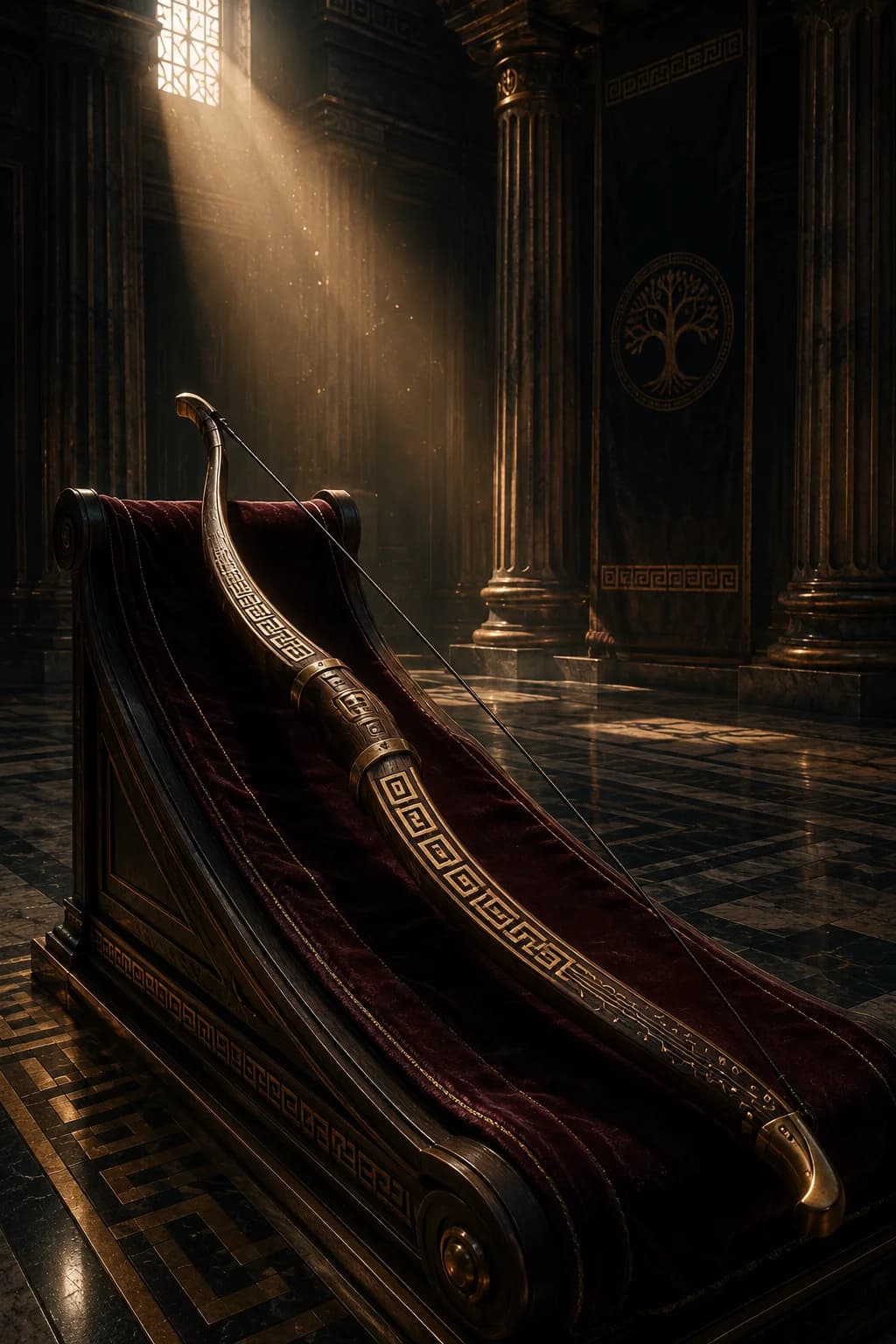
What follows is the recognition, the bow contest, and the reclamation. These are the events Book 3 covers in detail. We have written about the bow contest at length in The Bow That Knows You and The Pattern as Calibrator.
The trilogy ends, properly, with the slow rebuilding of the station as something closer to what it was. The Mediterranean palette underneath has been waiting. The overlay is removed. The honey lighting takes back the corridors. The fountains keep running, as they always have.
Where to go next
For Penelope's parallel arc that holds the station together during the twenty years, Meet Penelope: The Queen Who Didn't Wait is the character profile. For the covert resistance infrastructure she runs, Embroidery as Resistance and The Sigil They Walked Past are the two key pieces. For the founding-bloodline backstory and the bow that proves identity, The Bow That Knows You.
Book 3: The Return is the homecoming. Buy Book One on Amazon to start at the beginning of the journey.
Key takeaways
- Ithaca Station was built by the founding bloodline two centuries before the trilogy. Honey, bronze, deep blue, lemon yellow. Mediterranean-village energy in a space station.
- Twenty years into Ulysses's absence, the Suitors faction has consolidated political control of the upper houses. The visible aesthetic is now industrial grey overlaid on the original Mediterranean palette.
- Penelope governs from the council chamber. The worker districts maintain quiet resistance through the founding-bloodline communications relays buried in heritage decoration.
- The station is where the trilogy ends. Book 3 is the return. Everything else has been preparation.