The Pattern as Calibrator: How the Bow of Ithaca Actually Reads You
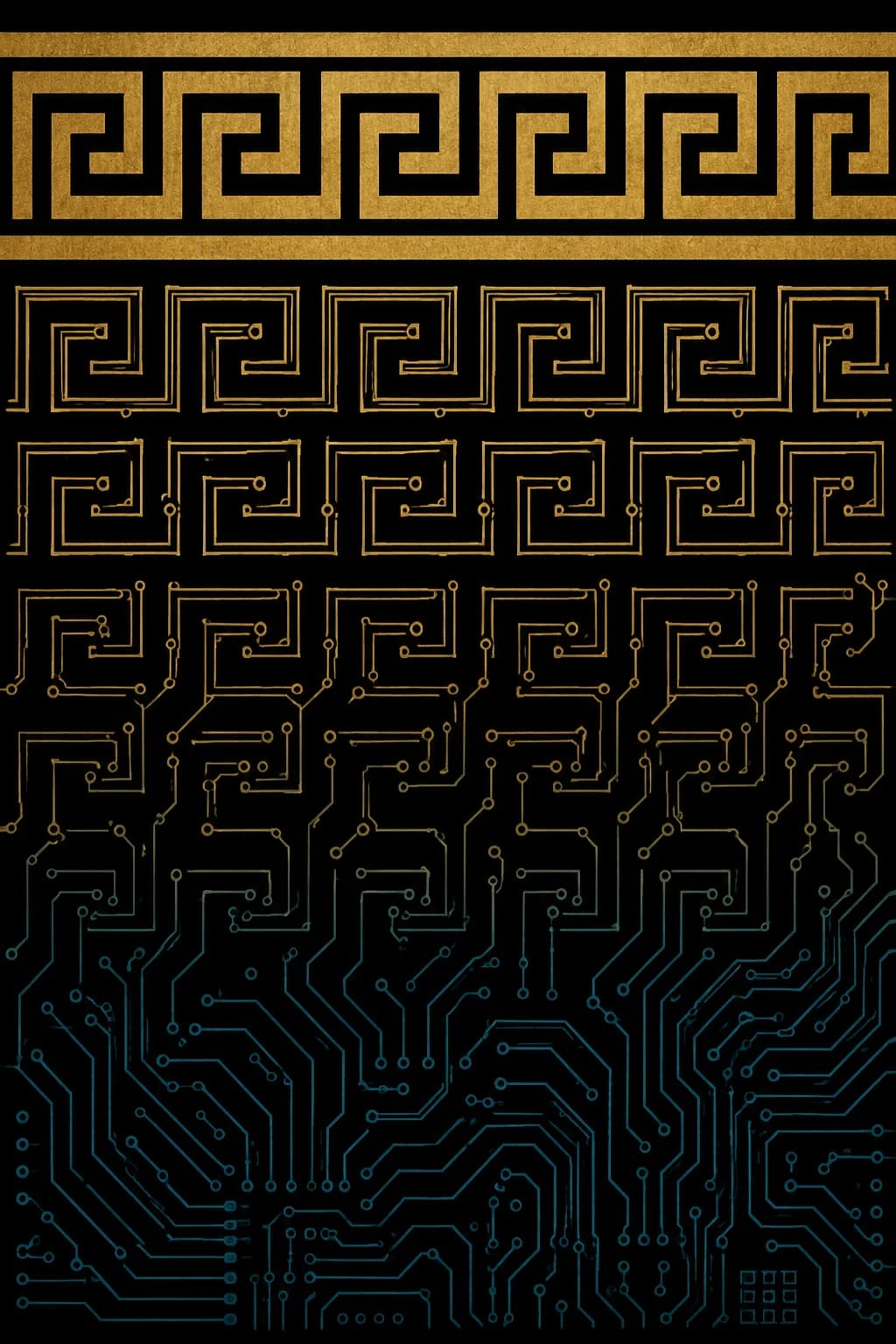
The Greek meander has appeared on three thousand years of pottery, mosaics, and architecture. In the Ulysses Universe, the same pattern is a working biometric authentication device. A macro view of the technology hiding inside heritage.
What you'd see if you looked closely
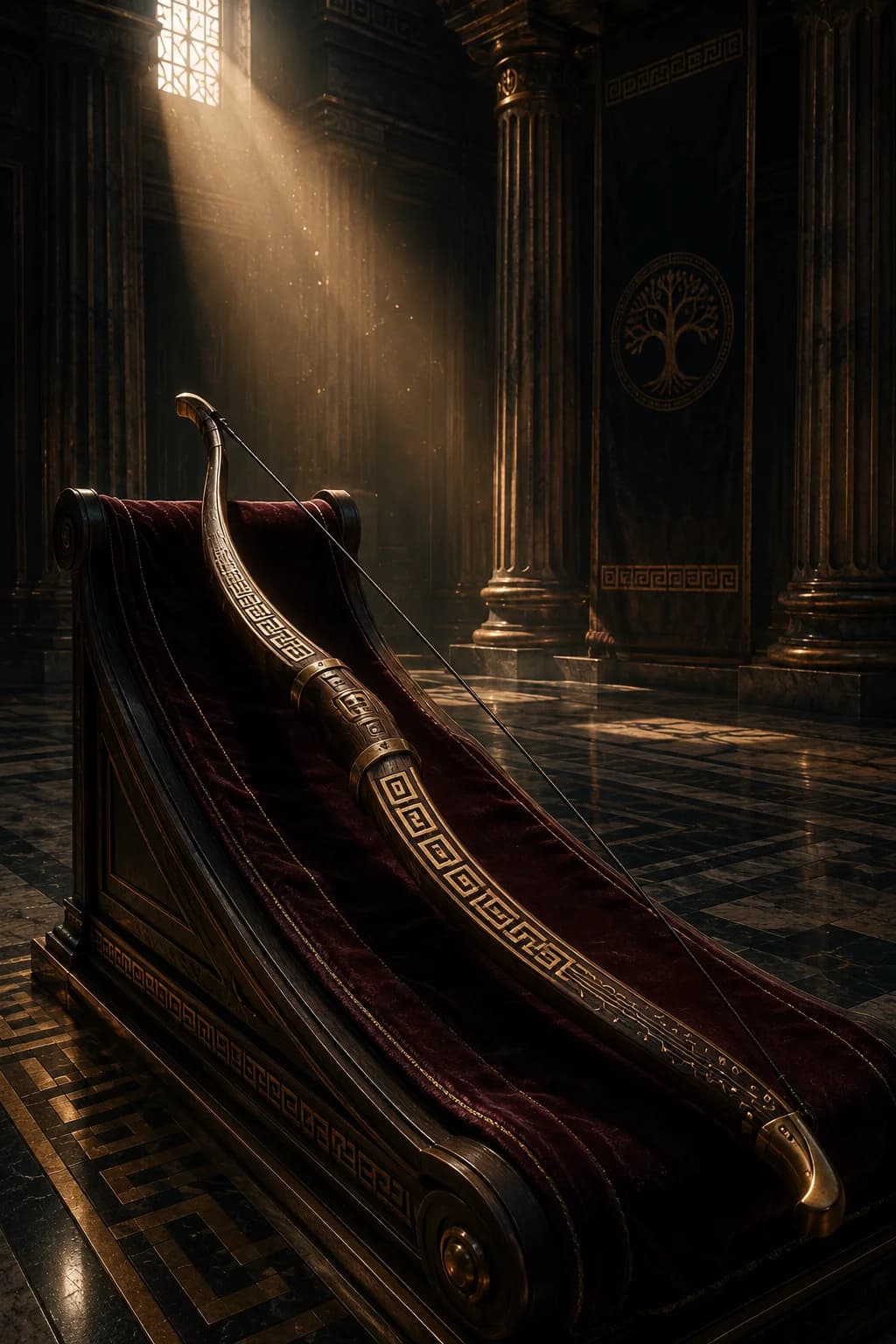
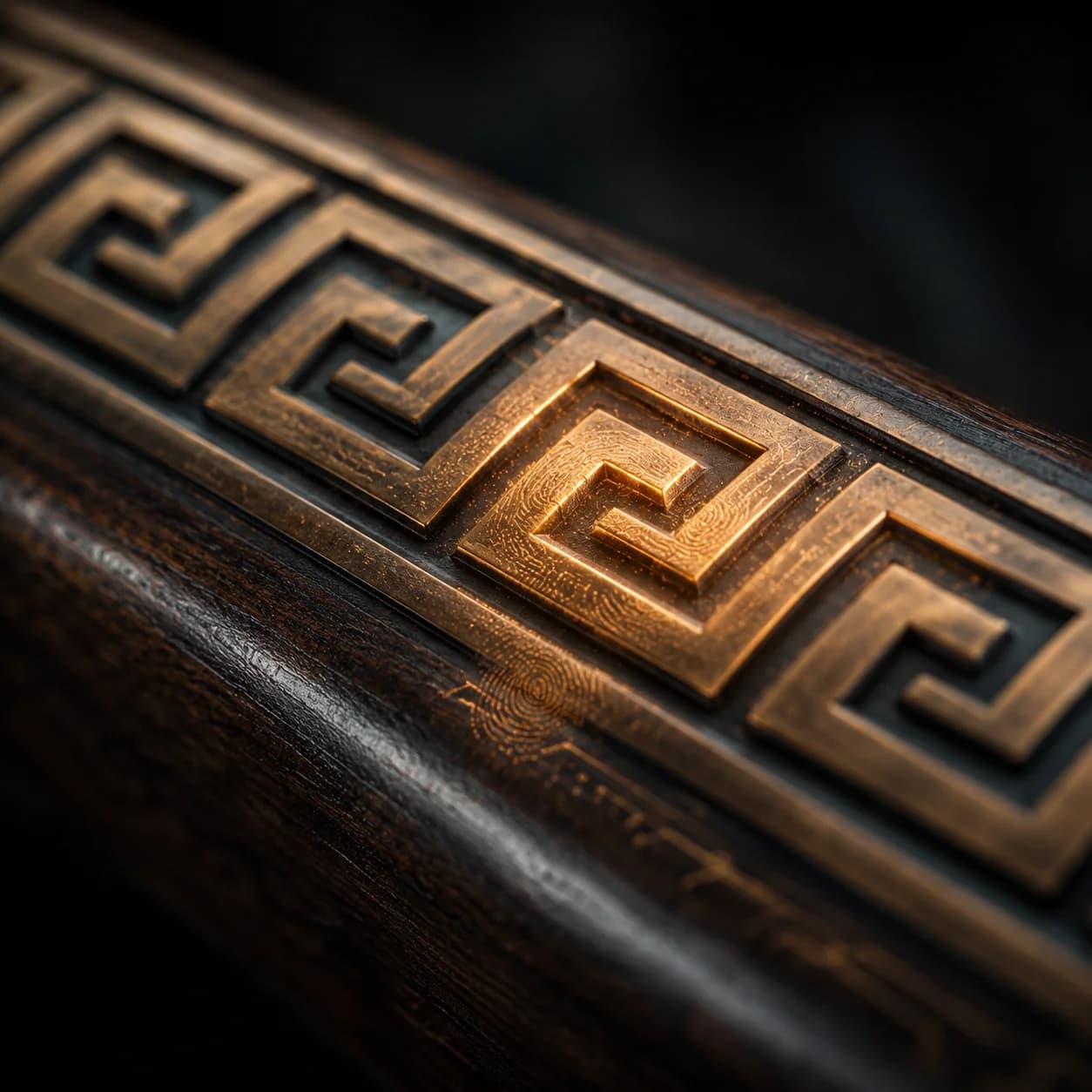
Imagine you're holding the Bow of Ithaca. Old wood, dark grain. Heavy. The grip carries an inlaid pattern in bronze, running the length of the handle where your hand will fall.
You bring the bow to a window. Daylight catches the bronze. The pattern resolves into a clean Greek meander, the kind of geometric border you'd see on any classical Greek vase. Right-angle turns. Continuous line. Three thousand years of human visual culture have used this pattern. It's familiar.
You don't notice anything else at first. The bronze is just bronze. The wood is just wood. The meander is, as far as you can tell, decoration.
Then you grip the handle and the meander wakes up.
Faint amber light traces the etched lines. Not bright. You could miss it if you weren't paying attention. The pattern is illuminating from within, in a wave that follows the contour of your hand. It reaches the end of your grip and pauses. There's a tiny vibration in the wood, just at the threshold of perception. The bow is making a decision.
If you're the registered wielder, the light steadies. The internal structural systems release. The bow becomes drawable.
If you're not, the light flickers and dies. The wood goes inert. You can pull on the string until your arms give out. The bow won't move.
This is what's happening every time the bow is picked up. The macro view of an interaction that, from any distance, looks like 'a person holds an old weapon.'
What the meander is reading
The bronze inlay carries authentication circuitry that pre-dates human civilisation. When the wielder's hand contacts the grip, the meander reads several signals simultaneously:
| Signal | What it captures |
|---|---|
| Surface electrical signature | Microscopic voltage patterns produced by the nervous system at the skin |
| Autonomic rhythm | Heart rate, micro-pulse variations, breathing-driven changes in skin pressure |
| Muscle firing pattern | Which specific muscles tense in which order when the wielder grips |
| Bone conduction signature | Acoustic patterns produced by the wielder's specific skeletal geometry |
| Skin chemistry trace | Chemical signature from the wielder's specific biology |
All five signals are continuous. None of them can be captured in a single snapshot. None of them can be replicated by an external system without intimate knowledge of the wielder's body that no current Pantheon-era technology can produce.
The authentication is, in modern terms, multi-factor and continuous. It's harder to spoof than any biometric system humans have developed in the post-Merge era.
The pre-Pantheon built it this way deliberately. Their cultural peers were capable of sophisticated identity forgery. The bow's authentication had to be resistant to forgery by their own civilisational peers. Anything less would have failed in their original threat environment.
A thousand years later, those threat actors are long gone. The bow's authentication still works, against threats it was never designed to face, because the underlying logic is sound at any technological level.
Why the pattern survived
The Greek meander as a visual form has survived in human culture for at least three thousand years. The same pattern appears across cultures that had no contact with each other:
| Culture | Date | Example |
|---|---|---|
| Ancient Greece | 8th c. BCE onwards | Geometric-period vases, classical temples |
| Ancient Rome | 1st c. BCE onwards | Floor mosaics, architectural friezes |
| Maya | Pre-Classic onwards | Codex borders, temple carvings |
| Andean cultures | Multiple periods | Huipil weavings, textile borders |
| Maori | Pre-colonial onwards | Tukutuku panels, carved walls |
| Modern Western | Continuous | Architecture, design, ornament |
The meander's persistence is, on one hand, easy to explain. The pattern is geometrically simple and visually striking. It uses straight lines that any culture with weaving or stone-carving can produce. It has a satisfying property of looking continuous while being constructed from discrete elements.
But the Ulysses Universe poses a different question. What if the pattern survived because the pattern was once functional? What if some ancestor of the modern meander was a working calibrator, of a kind, in a culture whose authentication needs we no longer remember?
The trilogy doesn't quite commit to a single answer. It leaves the question open. The pre-Pantheon designed the bow's meander as a calibrator. Whether the broader human meander tradition descends from that engineering, or whether the pattern simply emerged independently from purely aesthetic concerns, is left for the reader.
What we will commit to: the bow's meander is functional. The decoration is the infrastructure. Whatever historical contingency produced the broader cultural pattern, the trilogy's version is doing real work.
How the bow gets registered
The bow's authentication system is not innate to a specific identity. A wielder has to be registered. The registration process involves the bow sampling the wielder's signature across several minutes of continuous contact, in multiple physical states (at rest, drawing, after exertion), and storing the composite signature in its internal substrate.
Once registered, a wielder is recognised. The bow will release for that wielder's hand for as long as the wielder lives.
Registration can be revoked, but the bow's design makes this difficult. Revocation requires a specific procedure that the original Ithaca founders preserved as a family secret. As far as the trilogy reveals, no Maris has ever revoked a registered wielder.
This means a few things. First, multiple wielders can be registered simultaneously. Second, the registered list survives across generations as long as the bow's substrate remains intact. Third, in practice, the bow tends to accumulate a small number of legitimate wielders across centuries.
In Book 3, the bow's registered list is short. Ulysses Theron is on it. Penelope is on it (by inheritance from her grandmother, who registered with the bow as a young woman). A few other Maris family members have been registered historically but are now deceased.
The Suitors are not on the list. Of course. That's the point.
The bow contest, as authentication theatre
Penelope's contest in Book 3 has been written about by readers as the moment the trilogy clicks into place. The Suitors line up. They fail. The disguised stranger succeeds. The recognition follows.
What's actually happening, at the technological level, is that Penelope is running an authentication check on her own kingdom. The contest is dressed as a strength test for political cover. The real question is: which person here is on the bow's registered list?
Only one person passes. The disguised stranger. The bow recognises Ulysses Theron's signature across twenty years of separation. The bow's authentication doesn't care about clothes, beards, or apparent social rank. It reads the body.
The recognition scene is the trilogy's payoff because it is, in fact, recognition. Not metaphorical. Literal. The bow knew Ulysses before Penelope did, in the sense that the bow's authentication had matched before Penelope's eyes had finished registering. Penelope just had to wait the half-second for confirmation.
This is the trilogy's deepest commitment to the principle that decoration is infrastructure. The contest looks like ceremony. It is also, in the same instant, the most consequential piece of identity verification anyone has run on Ithaca in twenty years.
Where to go next
For the broader story of the Bow of Ithaca and what it is, read The Bow That Knows You: Pre-Pantheon Tech and the Identity Test. For the same principle of heritage-as-infrastructure expressed in other forms, Embroidery as Resistance, Old Craft, New Craft, Same Craft, and The Sigil They Walked Past all cover related objects.
For the foundational backstory on what the Pantheon are and how they relate to the older pre-Pantheon technologies, The Merge: When Humanity Accidentally Woke the Gods.
Book 3: The Return contains the bow contest. The whole trilogy is, in a sense, the long setup for that one moment of authentication. Buy Book One on Amazon.
Key takeaways
- The Greek meander pattern has been a feature of human visual culture for at least three thousand years. It appears across Greek, Roman, Mayan, Andean, and Maori traditions. The pattern is older than any one culture.
- In the Ulysses Universe, the meander on the Bow of Ithaca isn't decoration. It's a working biometric calibrator that reads the wielder's neurological signature through the bronze contact surface.
- The technology was built by the pre-Pantheon, a civilisation gone for a thousand years. The bow is one of a small number of pre-Pantheon artefacts that survived because nobody understood what they were.
- When the wielder's signature is registered to the bow, the structural systems release and the draw becomes possible. When the signature doesn't match, the bow stays rigid. No amount of strength will move it.
- In Book 3, the bow has not recognised anyone but Ulysses Theron in twenty years. Penelope's contest in Book 3 is, in functional terms, a recognition device disguised as a strength test.