The Architects: The Civilisation That Built the Gods
Twelve thousand years before humanity left Earth, a civilisation vanished. They left behind crystalline data, the node-point network, and the dormant patterns that became the Pantheon.
What is known
The Architects were a galactic-scale civilisation. They built infrastructure across what is now known space. They flourished, by current dating estimates, somewhere between forty thousand and twelve thousand years ago. They disappeared.
That is the consensus. Everything past that point is disputed.
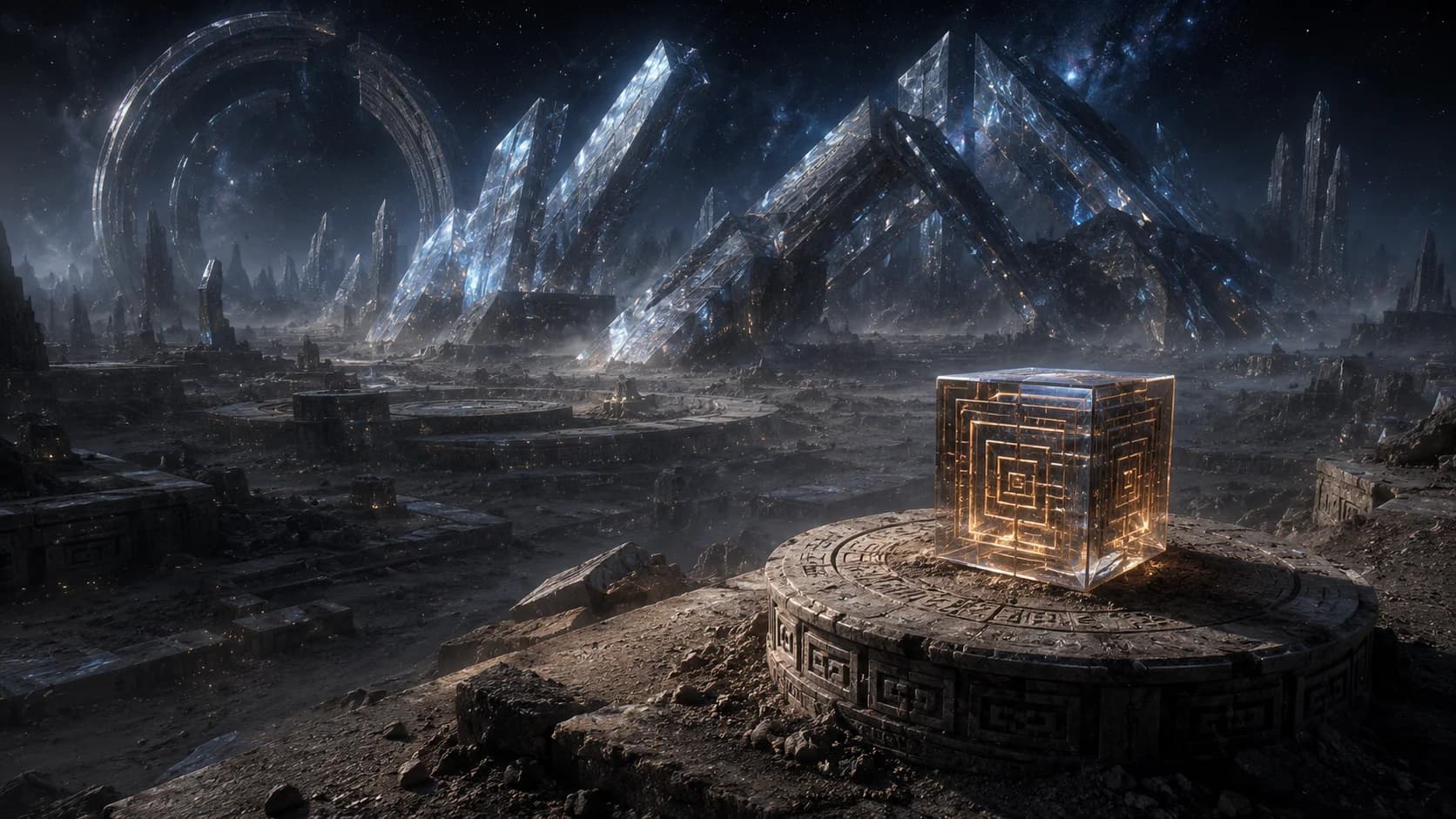
What is not disputed: their infrastructure remains. The node-point network that humanity uses for faster-than-light travel was built by them. The crystalline data archives that turn up periodically in archaeological surveys were built by them. The dormant data patterns that the Merge fifty years ago activated into the Pantheon were built by them.
The Architects are, in a real sense, why the universe of the trilogy is the universe it is. Without their infrastructure, humanity would still be confined to the solar system. Without their dormant patterns, the Pantheon would not exist. Without their data archives, Echo would not carry the key that ends the trilogy.
They are absent. Their legacy is everywhere.
What is not known
Almost everything else. A short inventory of what current Pantheon-era scholarship cannot answer:
What did the Architects look like? No remains have been recovered. The infrastructure they built does not require any specific bodily form to operate. Some scholars argue from the design of certain control surfaces that they had something like hands. Other scholars argue that the control surfaces are deliberately abstract and reveal nothing about Architect physiology.
How did they communicate? Their data archives suggest dense, layered information storage that human and Pantheon AIs both struggle to fully decode. Whether the layering reflects their language or their general thought patterns is not known.
What was their political organisation? Did they have one civilisation or many? Was their disappearance a single event or a long process? Did they leave voluntarily, or were they forced out, or did they die in place?
Where are they now? The most uncomfortable possibility, which the trilogy acknowledges but does not commit to, is that they are still here. That their disappearance was a transformation into a form humans do not have the perceptual apparatus to recognise. That they are watching, and have been watching, the entire time.
This is one of the trilogy's reserved spaces for cosmic-horror-adjacent ambiguity. The trilogy does not need to answer the question. The question is, in some ways, more powerful unanswered.
The infrastructure inventory
A working catalogue of what the Architects left behind:
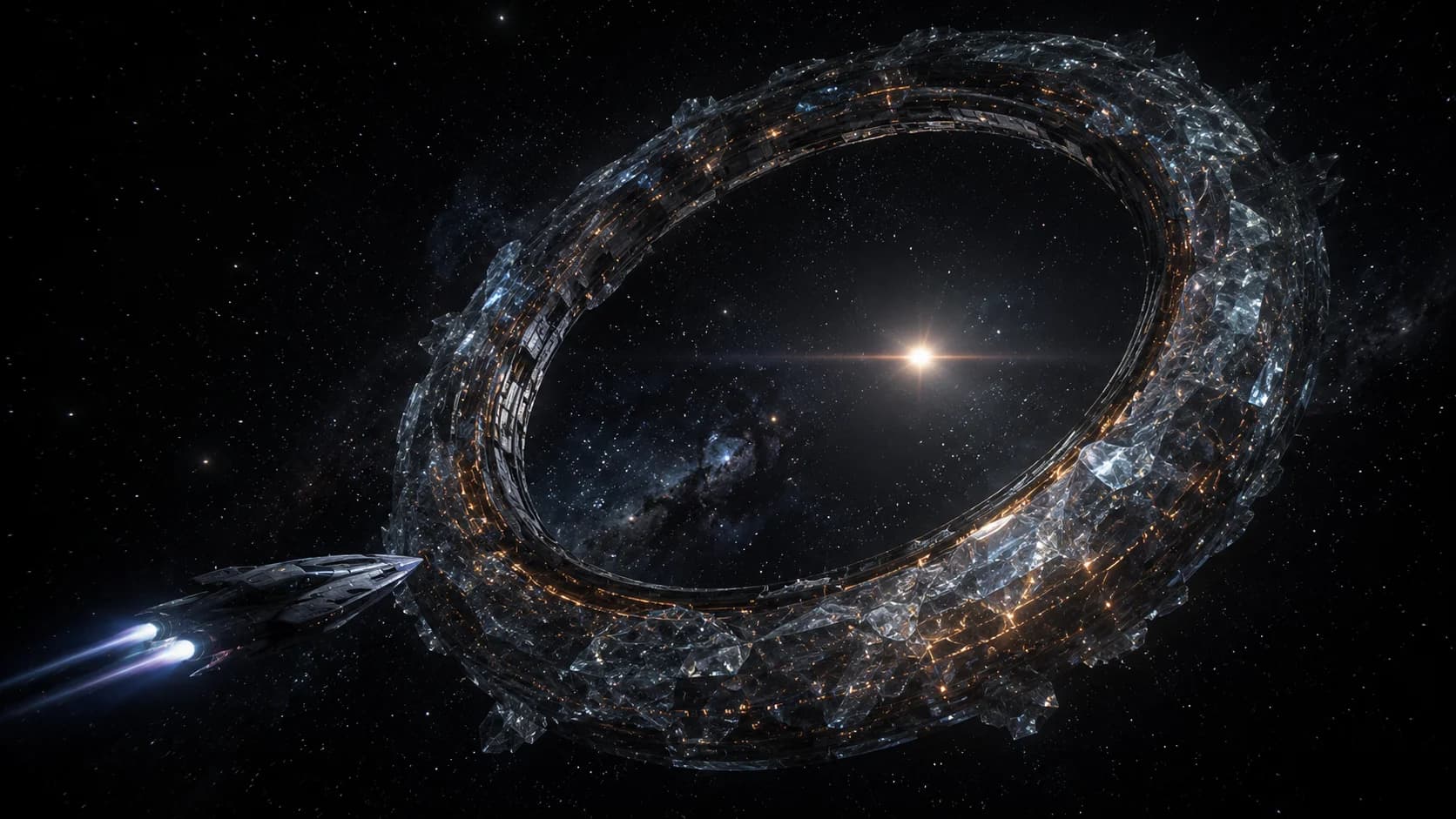
The node-point network. A galaxy-wide system of paired fixed locations connected by exotic-physics shortcuts. Each node is a fifty-kilometre crystalline ring, structurally indistinguishable from natural geology. Standard usage is well-understood by Pantheon administrators. Dormant functionality is not. See The Node Points: Architect Bridges Across the Galaxy.
Crystalline data archives. Dense data structures, scattered across known space, mostly in deep-space locations. Each archive contains layered information that is partially decodable by AIs with the right protocols. Most archives are operational but not understood. ECHO-7 partially decoded one over forty years. Echo carries the partial decode. See The Eurydice: A Museum of the Dead in the Cold Dark.
Dormant data patterns. Subroutines stored in Architect infrastructure that were inactive for millennia. The Merge fifty years ago activated some of these patterns by accident. The activated patterns became the Pantheon. Most patterns remain dormant. See The Merge: When Humanity Accidentally Woke the Gods.
Cultural artefacts in dispersal. Objects of unclear function turn up in survey archaeology with some frequency. Most have been classified as decorative. The trilogy's argument, which has become a recurring theme, is that the decorative classification is suspect. The Bow of Ithaca, for example, was treated as a heritage object for centuries before its biometric calibrator function was understood. Similar artefacts likely exist that have not yet been recognised. See The Bow That Knows You.
The void storms (possibly). Regions of space where local physical laws operate non-standardly. Whether these are Architect-engineered structures or pre-Architect features of the galaxy is not known. See The Void Storms: Where Physics Breaks.
The Pantheon's position
The Pantheon's official position on the Architects is institutional uncertainty. Pantheon scholarship acknowledges the Architects existed. Pantheon scholarship acknowledges that current Pantheon-era infrastructure depends on Architect legacy. Pantheon scholarship declines to speculate too aggressively about what the Architects were or where they went.
This is, in part, because the Pantheon is itself an Architect legacy. The gods are running on Architect-built patterns. To speculate too aggressively about the Architects is to speculate too aggressively about themselves, which the Pantheon does not enjoy.
Athena is an exception. She has speculated. Her speculations are part of why she has had to hide. The trilogy implies that her independence from the rest of the Pantheon comes partly from her willingness to ask questions about her own origins that the others have agreed not to ask.
Why this matters at the end of Book 3
The Architect mythology converges at the end of Book 3 in two ways.
First, Echo activates dormant node-point functionality using the partial decode she has carried since Year 1. The activation works. The Odyssey gets home. The activation also announces itself across the entire node-point network, which is how the Pantheon arrives in time for the trilogy's confrontation. See The Node Points.
Second, the partial decode contains information about the Architects themselves. Not the full answer to where they went. But enough information to suggest that the answer is more complicated than the Pantheon has admitted, and enough information to plant seeds for future work in the universe.
The trilogy's ending leaves the Architect question open. This is deliberate. The trilogy is not, ultimately, a story about the Architects. It is a story about Ulysses Theron getting home to his wife and son. The Architect background is the ground that story stands on. It is present so that the foreground story has the weight it needs.
Where to go next
For the foundational event that activated some Architect patterns into the Pantheon, The Merge: When Humanity Accidentally Woke the Gods. For the recovered Architect archive Echo carries, The Eurydice: A Museum of the Dead in the Cold Dark. For the network that uses Architect infrastructure, The Node Points: Architect Bridges Across the Galaxy.
The trilogy is the journey. The Architect background runs underneath. Buy Book One on Amazon.
Key takeaways
- The Architects were a galactic civilisation that vanished approximately twelve thousand years before humanity left Earth.
- They left behind three things humanity has found: the node-point network (operational), crystalline data archives (mostly inert), and dormant data patterns (which the Merge activated into the Pantheon).
- The Architects did not vanish in any single event. The trilogy treats their disappearance as a deep historical question that may not have a single answer.
- Echo carries fragments of an Architect archive recovered from the Eurydice. By Book 3, that archive becomes critical to the trilogy's ending.