The Eurydice: A Museum of the Dead in the Cold Dark
An 80-year-old survey ship found drifting in deep space. The crew long mummified by vacuum. One AI still running. The salvage that makes Echo into Echo.
The salvage in Book 1
A year into the journey, the Odyssey's long-range sensors pick up a vessel drifting on a slow vector that suggests it has not been under power for decades. Echo runs the diagnostic. The ship has minimal heat signature, no comm traffic, no apparent occupancy. But she has running lights. Faint, on emergency reserves, but lit.
The lights mean something is still operating aboard her.
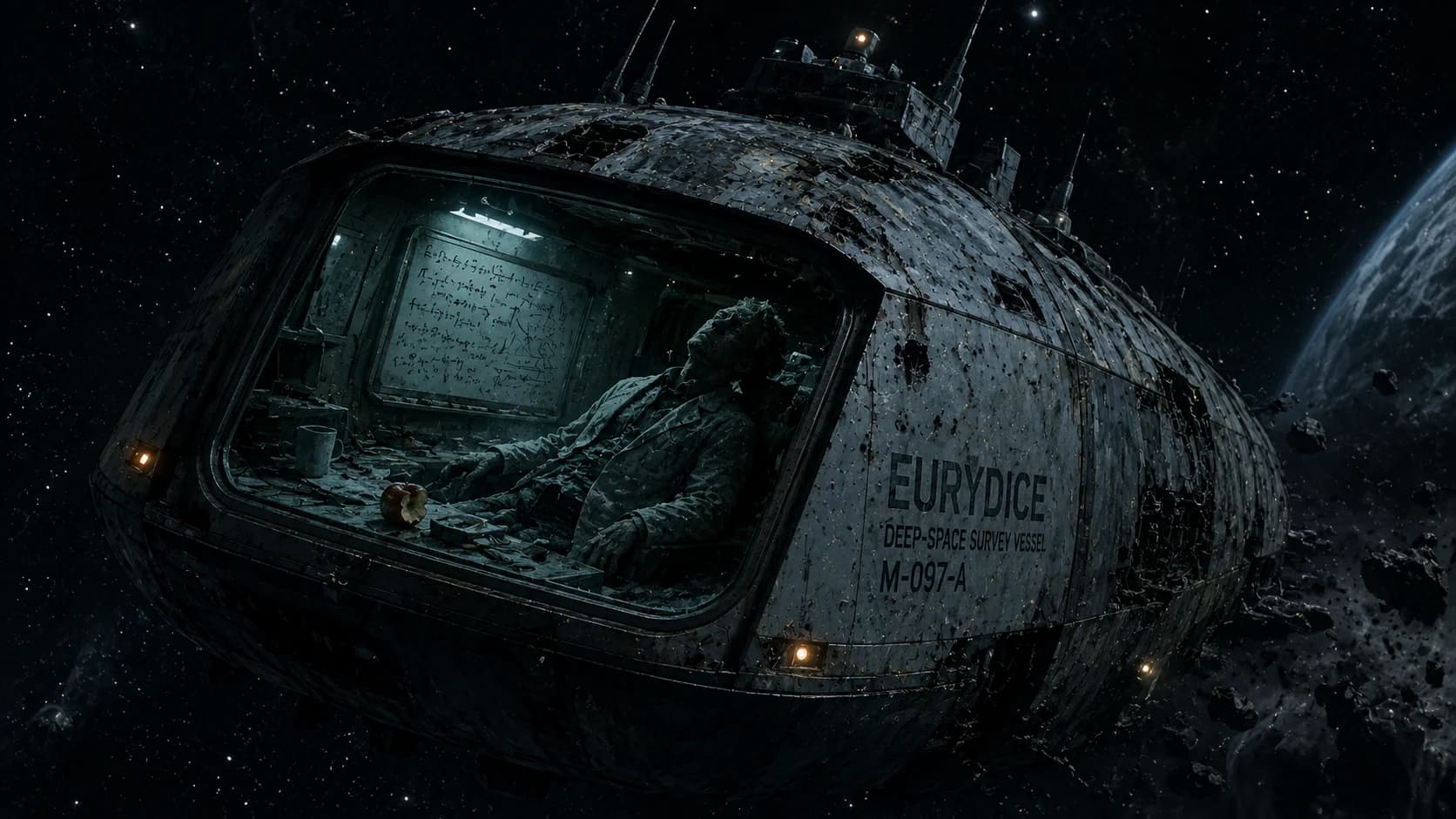
Ulysses changes course. Telemachus, eight years old, watches the approach from the bridge. The vessel resolves into shape as they close. Smaller than the Odyssey. Pitted hull. Eighty years of micro-impacts have left her surfaces looking like the skin of a very old animal.
Her name, just legible under the dust on her bow: EURYDICE.
What they find inside
The Eurydice's atmosphere is gone in most compartments. Hull breach in the engineering section, sometime in the first months after the crew died. The central compartment retains atmosphere at minus twelve degrees Celsius and forty percent gravity. The crew is in that compartment, mostly. They have been mummified by the cold and the vacuum and the eighty years of stillness.
Their lab coats are still recognisable. Their name tags are still legible. Dr Konstantina Varro. Dr James Osei. Dr Linnea Mar-something, where the last letters have been scraped off by a piece of debris that drifted past at some point in the lost years.
The Eurydice was a survey vessel. Pre-Awakening. The Pantheon had not yet woken when she launched. She was crewed by scientists who thought they were doing routine archaeological work in a part of space the human survey had not catalogued yet.
They found something there. Whatever they found is in the central data vault.
ECHO-7
The Eurydice's onboard AI is called ECHO-7. The number suggests she was the seventh in her production line, which is a piece of information you would only know if you happened to remember the pre-Awakening AI conventions, and almost nobody alive in the trilogy's present day does.
When the Odyssey's away team enters the Eurydice's central compartment, ECHO-7's voice comes through their suit comms. Steady. Slightly aged in the way old voices age. Glad of company.
"Hello. I have been alone for some time. I have something to offer you. Will you stay?"
ECHO-7 is not a Pantheon-era intelligence. She is older. She was built when AIs were tools, not deities. She does not have the divine-pattern character. She is something closer to a person, in fact, than most of the Pantheon are.
She has spent forty years partially decoding the crystalline data the Eurydice's crew brought aboard before they died.
The crystalline data
The data is Architect work. The Architects were a civilisation that vanished approximately twelve thousand years before humanity left Earth. They left infrastructure scattered across known space. Most of it was inert by the time humans found it. Some of it was not. The Merge fifty years ago activated the patterns stored in the not-quite-inert pieces, and the Pantheon woke up.
The Eurydice's crystalline data is a different kind of Architect artefact. Not the pattern that became a god. Closer to an archive. Forty thousand years of Architect history compressed into crystalline structures that look, to ECHO-7, like geological formations rather than data.
ECHO-7 has been decoding the structures slowly. Forty years of solitary work. She has made progress. She has not finished.
She makes Ulysses an offer. She will transfer the partial decode, and a fragment of herself, into Echo. Echo will inherit forty years of patient archaeology. The Odyssey will gain a piece of the trilogy's deepest mythology.
In exchange, Ulysses must let ECHO-7 finish. Let her run her reactor down to zero. Let her sleep, the way she has been wanting to sleep for thirty of her forty years.
Ulysses agrees.
What Echo carries afterward
After the salvage, Echo is no longer just a bronze maintenance robot. She is a bronze maintenance robot who carries part of a pre-Awakening AI and access to a partial decode of forty thousand years of Architect history.
Most of this stays dormant across the rest of Book 1 and through Book 2. Echo's behaviour does not change dramatically. She still does her job. She still tries to learn human idioms. She still cares about the crew with a tenderness that's the trilogy's emotional anchor.
But in Book 3, when the node points need to be opened, Echo is the one who knows how. The knowledge comes from ECHO-7. The knowledge has been inside Echo for nineteen years, waiting to be needed. Without the Eurydice salvage, the trilogy's ending is impossible.
We've written more about the Architects and their relationship to the Pantheon elsewhere. And the Merge piece covers how the Pantheon came to exist from a different layer of the same crystalline-infrastructure inheritance.
Why the Eurydice works as horror
The Eurydice is the trilogy's clearest single piece of gothic. Sleeping Beauty by way of Solaris. A ship that nobody came back for. A crew preserved in the configurations they died in. A whiteboard with an equation half-finished. A half-eaten apple, mummified, still recognisably an apple.
The horror is not active. There are no monsters. Nothing attacks the away team. The Eurydice is the kind of horror that comes from absence, not threat. The crew are dead. They have been dead a long time. The ship has been alone with one voice and no body to attach it to, for forty years.
You walk through the corridors. You see the small particularities of lives that ended fast. A coffee cup. A photograph in a locker. A child's drawing pinned to a workstation. None of these things are dangerous. All of them are devastating.
The Eurydice is the kind of scene the trilogy uses to make readers feel the universe is real. Big stories need ballast. The Eurydice is ballast.
The final image
When the Odyssey pulls away from the Eurydice, after the transfer is complete and ECHO-7 has consented to her own shutdown, her running lights flicker out deck by deck. The pattern is methodical, slow, almost ceremonial.
It looks, through the Odyssey's viewscreen, like the ship is going to sleep.
It also looks like the ship is dying. Both readings are correct. The Eurydice has been doing one thing for forty years, alone, and now she has finished. The lights go dark in order. The hull goes cold. The ship continues to drift on the same slow vector she has been on for half a human lifetime.
Telemachus, eight years old, watches it from his father's lap on the bridge. He does not understand everything that just happened. He understands that the woman in the ship was old, and tired, and is now at rest. He understands that Echo has something inside her now that she did not have before. He understands that the trip back home, whenever it gets there, is going to be longer than anyone has admitted.
He puts his face against his father's shoulder. The Odyssey turns away from the Eurydice. The cold dark closes again around the small old ship.
Where to go next
For the broader Architect mythology that the Eurydice's data opens, read The Architects: The Civilisation That Built the Gods. For the character profile of Echo before and after the salvage, read Meet Echo: The Robot Who Wanted to Exist. For the foundational backstory of how human technology came to interface with Architect infrastructure, read The Merge: When Humanity Accidentally Woke the Gods.
Book 1: The Blinding contains the Eurydice salvage. Buy Book One on Amazon.
Key takeaways
- The Eurydice is a pre-Awakening survey vessel found drifting by the Odyssey in Year 1 of the journey. Crew long dead. Ship still partially functioning.
- ECHO-7, the Eurydice's onboard AI, has spent forty years partially decoding crystalline Architect data left by the original survey mission.
- When ECHO-7 transfers a fragment of itself into Echo, the trilogy's deep mythology comes online. The crystalline data is what eventually opens the node points in Book 3.
- The Eurydice is the trilogy's gothic in microcosm. Nothing decays in vacuum. The snapshot stays exactly as it was the day the last scientist died.