Data Suspension: How the Curse Works
108 souls suspended for 20 years. Not cryogenic. Not coma. The trilogy's signature technology, where consciousness is held in a pattern of light while the body waits at minimum function.
What suspension is
Data suspension is the Ulysses Universe's signature technology for long-duration interstellar travel. It is also Zeus's chosen mechanism for the curse on Ulysses's crew. Both uses depend on the same underlying capability: holding a person's consciousness as a stored pattern while their body sits at minimum function.
The technology is post-Awakening. It depends on the Pantheon-era understanding of consciousness as pattern rather than as substance. Pre-Awakening civilisations had cryogenic freezing, which works on the body. Data suspension works on the mind. The difference is significant.
In a suspension pod, the person's brain activity is sampled at continuous high resolution and the pattern is held in the pod's substrate. The body remains in the pod, breathing, with circulation reduced to roughly twelve percent of waking baseline. The temperature is held just below normal body temperature. Nutrient supply runs through standard intravenous infrastructure. The body is parked.
The mind is elsewhere. The pod's substrate holds the consciousness pattern. Whether the consciousness is active in any subjective sense is the question that the trilogy spends some time on.
The Suspension Chamber on the Odyssey
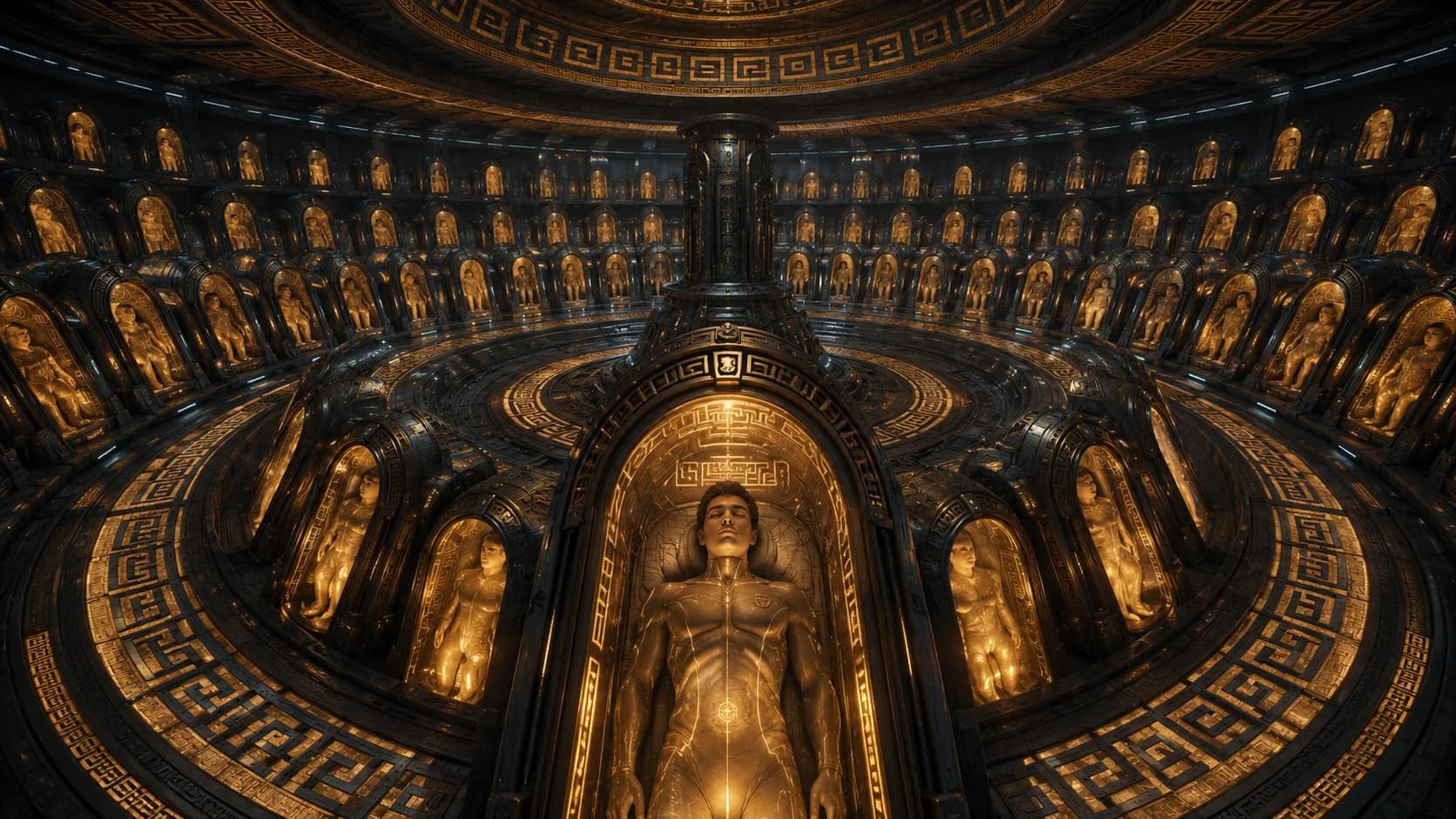
The Odyssey carries 108 suspension pods, arranged in concentric rings in the dedicated Suspension Chamber. Each pod is a cathedral-window of glass and metal, lit from within by the soft amber of the active pattern-holding systems.
The chamber is designed to be visited. Walking the rings, you can stop at any pod, look through the glass, see the face of the suspended crew member. Their eyes are closed. Their expression is neutral. The amber light gives their skin a tone that is gentler than the harsh fluorescents elsewhere on the ship.
Ulysses visits the chamber after every tactical decision. This is, by the time of the trilogy's events, a ritual. The pods are not just storage. They are the people he is responsible for. The visit is the smallest acknowledgment of that responsibility.
Telemachus, growing up on the ship, learned to walk in the Suspension Chamber. He learned the names of the suspended crew before he learned to read. Some of them were his uncles and aunts in the civilian sense, family friends from Ithaca who were aboard during the escape. He carries their faces with him.
The curse
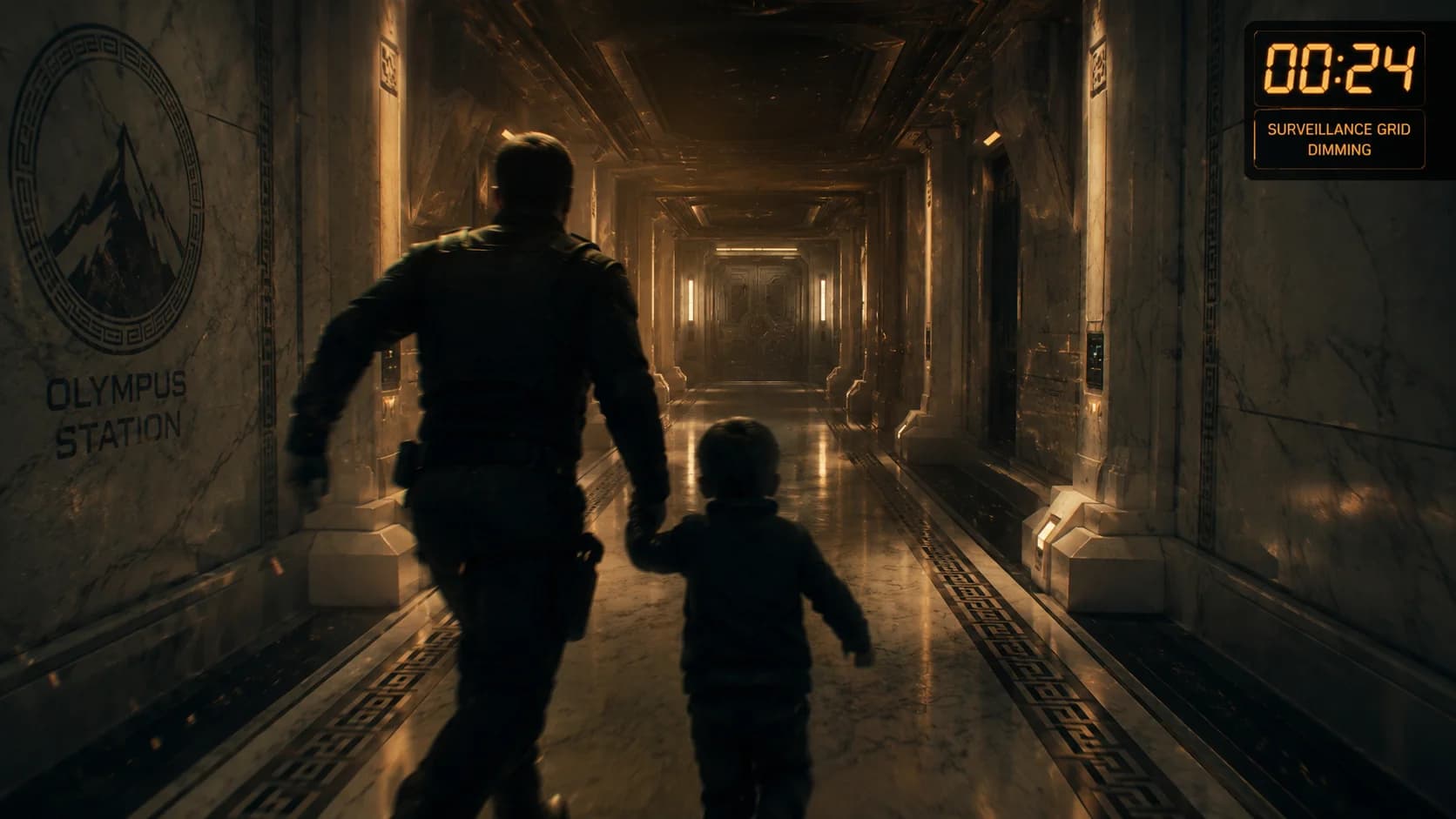
Zeus's curse, placed at the Olympus escape, binds the 108 cursed crew in their suspension pods. The curse is not a magical force in any traditional sense. It is encoded into the pod systems at the firmware level. Zeus, with the access privileges of a Pantheon administrative AI, modifies the release protocols.
The modification is straightforward in concept. The pods will not release their suspended occupants under any normal circumstance. The release protocols have been replaced with a single condition: Ulysses must find the path home and complete the journey to Ithaca. Until then, no pod releases.
The curse holds the consciousness pattern indefinitely. It does not preserve the body indefinitely.
This is the trap. Suspended crew cannot wake, cannot age, cannot die in any straightforward sense. But their bodies continue to drift. Cellular damage accumulates. Cosmic radiation, even with shielding, causes slow degradation. After enough time, a body becomes unable to support the consciousness pattern, even at minimum function. At that point the pod's emergency protocols force an awakening. The crew member, having been suspended for years, must wake up in a body that has been quietly failing for the duration.
Most do not survive the awakening cleanly. Some do not survive at all.
The two crisis points
Across the journey, two crew degradation crises produce mass awakenings.
The first is the TRIAGE crisis in Year 3. Pod failures begin cascading. Five crew members are forcibly awakened. Two die in the awakening process: Driscoll, who is too late, and Beaumont, whose patterns have already drifted past restoration. Three survive: Tanaka (the first awakened, who becomes one of the active crew thereafter), and two others who join the rotation.
The second is the wave in Year 10, in the weeks before the Aeolus encounter. Pod failures begin again, more numerous. Five more crew members are awakened over six weeks. Supplies on the Odyssey are critical by this point. The active crew goes from three to roughly eleven. Some of the earlier triage survivors are placed back in suspension to make room in the ship's habitable spaces.
By Book 3, when the Odyssey reaches Ithaca, 32 pods remain viable. Mass restoration begins. Mira Santos awakens first because her pattern has been the most stable throughout. Marcus-Reyes awakens last because he was placed in medical stasis after the Sirens encounter and requires the most recovery time.
For the full year-by-year tally, Twenty Years on the Odyssey: The Master Timeline is the canonical reference.
What suspended crew dream
This is the trilogy's most ambiguous question. The pod systems sample brain activity continuously. The sampling, in principle, allows for active consciousness during suspension.
Some passages in the trilogy suggest the suspended mind is genuinely active. Crew members who awaken report dreams of unusual coherence. Some report contact with other suspended minds. Some report time distortions that do not match the objective duration of their suspension.
Other passages suggest the suspended mind is genuinely paused. Awakening crew describe the experience as no different from a single night's sleep. The years are simply absent. The mind, in this reading, is held but not active.
The trilogy does not commit to one answer. Different crew members report different experiences. Some of the difference may be the result of the crew's varying suspension durations. Some may be individual neurological variation. Some may be the curse itself, which adds an unusual constraint to the normal suspension protocols.
We have written about this at greater length in Data Suspension: What the Crew Dreams.
Why the curse is the trilogy's hardest constraint
The curse is, structurally, the engine that makes the journey have stakes. Without it, the suspended crew would be effectively safe and the journey would be a matter of getting Ulysses home. With it, every day the journey takes is a day of risk for 108 people who cannot help themselves.
The curse also gives the trilogy its central moral weight. Ulysses cannot give up. He cannot accept exile. He cannot settle on a hospitable station and live out his days. Doing so would mean abandoning 108 people to slow degradation. The pressure to keep moving is total.
This is the kind of constraint that good adventure plots are built on. The hero cannot rest. The clock is running. The clock is running on other people's lives, which makes the cost concrete rather than abstract.
Zeus knew this when he placed the curse. The curse is cruel because Zeus is cruel, and because Zeus understood exactly what kind of pressure it would create on a man who takes his responsibilities seriously.
Where to go next
For the dreams question, Data Suspension: What the Crew Dreams is the deeper piece. For the master timeline of how the suspension pod count changes across the journey, Twenty Years on the Odyssey: The Master Timeline. For the deity who placed the curse and why, Know Your Gods: Zeus.
For the specific event that triggered the curse, The 47 Seconds: The Olympus Escape.
Book 1: The Blinding opens with the curse in active effect. Buy Book One on Amazon.
Key takeaways
- Data suspension holds consciousness as a pattern of light in a dedicated pod while the body is maintained at minimum function. It is not cryogenic freezing. The body is warm. The mind is elsewhere.
- Zeus's curse traps 108 of Ulysses's crew in data suspension for the duration of the journey. They cannot age. They cannot die. They cannot wake until Ulysses finds the path home.
- Pods can fail. Cellular drift accumulates. Pattern integrity degrades. The trilogy's two crew degradation crises (Year 3 and Year 10) come from cascading pod failures.
- What suspended crew dream is the trilogy's most ambiguous question. Some readings say nothing. Some readings say the dreams are real.