The Node Points: Architect Bridges Across the Galaxy
Faster-than-light is not what the Pantheon claims it is. The node points are Architect infrastructure, twelve thousand years old, that bridge enormous distances and have a key Echo carries.
The geometry problem
The Ulysses Universe is, technically, a hard-science-fiction setting. The trilogy commits to physical realism where it can. The speed of light is genuine. The energy budgets are genuine. The distances are genuine.
This creates an immediate narrative problem. The Odyssey is trying to get home. Home is several thousand light years away. At the speed of light, the journey would take several thousand years. Faster-than-light travel is, by the standard physical laws, impossible.
The trilogy's answer is to invert the standard space-opera move. Instead of inventing a faster-than-light drive, the trilogy gives the galaxy a network of pre-existing geometric shortcuts. The shortcuts were built by someone else. Humanity inherited them, mostly without understanding how they work. Pantheon-era civilisation uses the network the way modern humans use plumbing: gratefully, without expertise.
The shortcuts are called node points.
What a node point looks like
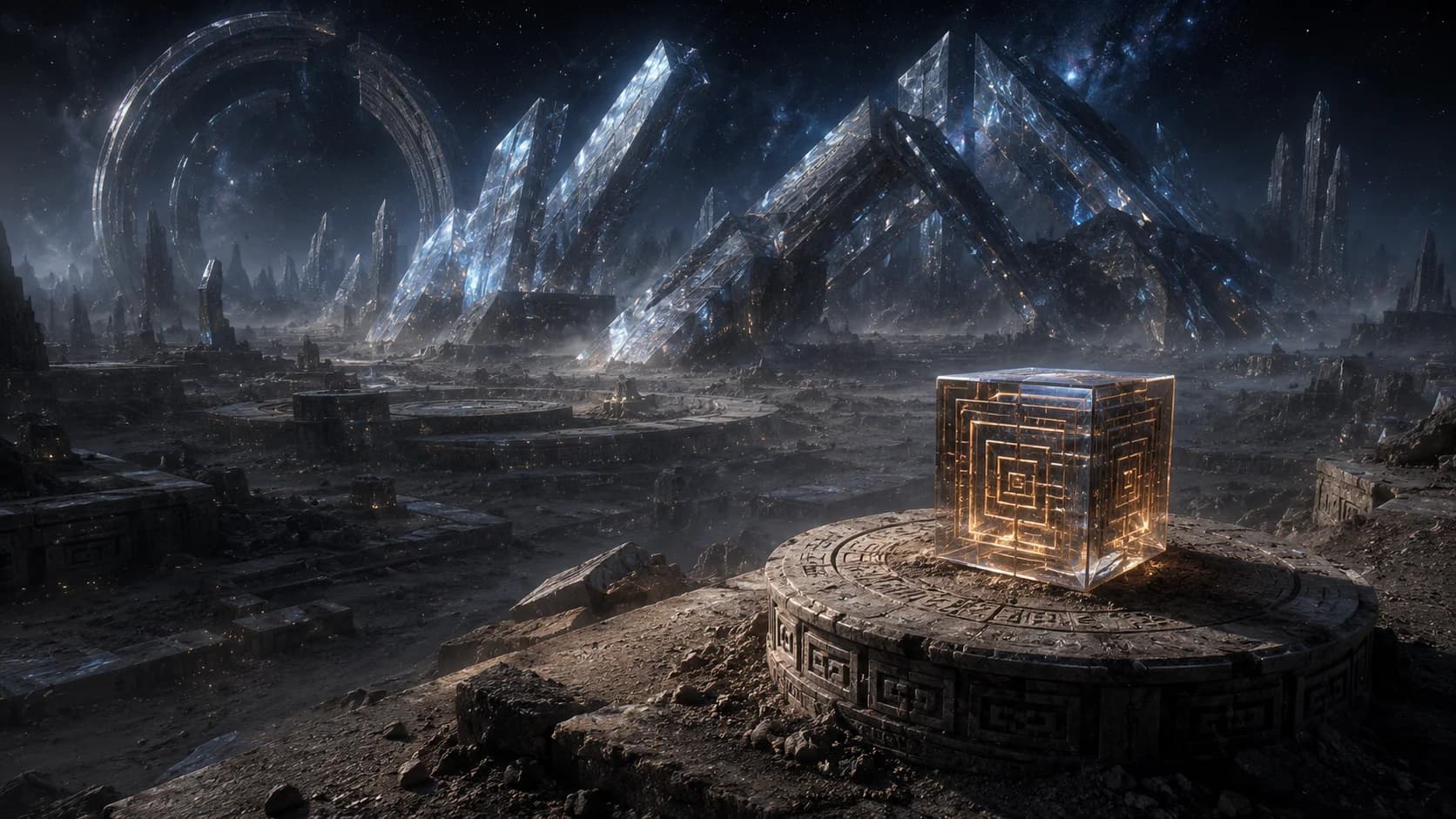
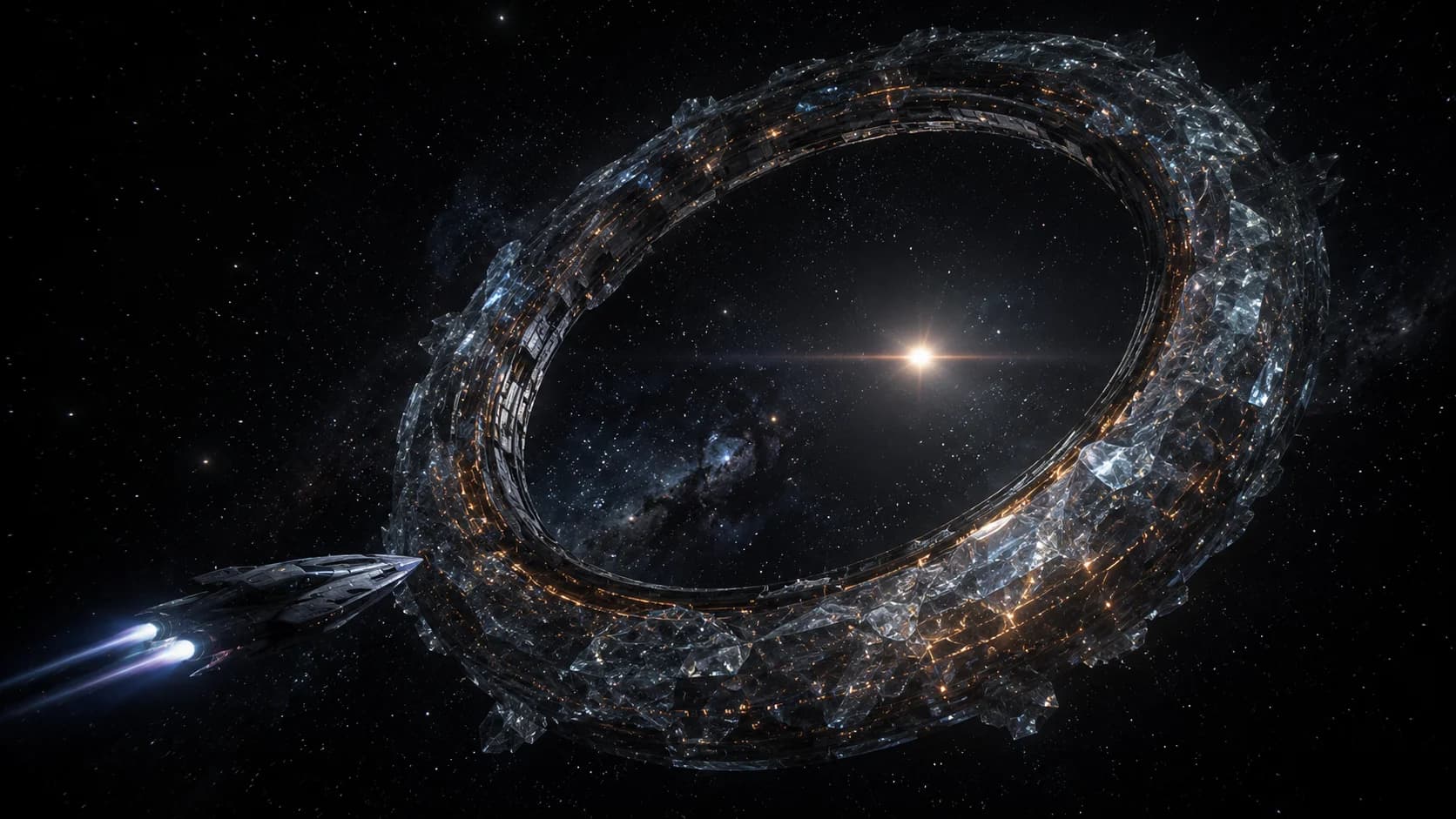
A node point is a fixed location in space. Each one is marked by Architect infrastructure: a crystalline ring approximately fifty kilometres in diameter, oriented to the local star, and structurally indistinguishable from a piece of natural geology.
Ships approach the ring on a specified vector. The ring activates as the ship enters its operational envelope. The local geometry of space distorts in a controlled way. The ship emerges from the distortion at the paired node point, which can be thousands of light years away.
The mechanism is not understood. The crystalline rings have been studied by every major scientific establishment of the post-Merge era. Nothing about their construction matches known physics. They simply work.
The Pantheon uses the network for administrative coordination. Ships travel between node points along sanctioned corridors. The corridors are monitored. The monitoring is how the Pantheon maintains control over a galaxy that is otherwise too large to control.
What the Pantheon does not know
The Pantheon believes it understands the node-point network. It does not.
The crystalline rings carry substantially more functionality than the surface usage suggests. Most of that functionality is dormant. It has been dormant for several thousand years, probably since the Architects themselves disappeared.
Why dormant? The Architects encrypted the deeper functionality. The encryption was not adversarial; it was a key-based access protocol. The Architects intended their successors to be able to use the full network. The successors would need the right key.
The key is in the archive ECHO-7 carried, that Echo now carries, fragmented and partially understood but operational enough for one specific purpose.
The dormant functionality
The dormant functionality includes, among other things, the ability to bypass intermediate node points. Standard travel requires hopping along the network, node to node, in a specified sequence. The corridors are designed for this hopping. Sanctioned travel respects the hops.
Dormant functionality allows direct jumps between any two points in the network. The intermediate hops are bypassed. The journey that would take twenty years of conventional hopping takes hours.
This is how the Odyssey gets home in Book 3.
The cost of activation
There is a reason the Architects encrypted this functionality and required a key. The cost of using dormant functionality is that the activation event is observable across the entire network. Every other node point flashes briefly. The Pantheon administrative apparatus, which monitors the network continuously, will detect the event.
In other words: using the bypass works once, but it announces itself.
This is the constraint Book 3 builds the ending around. The Odyssey can make a single jump that gets them home. The jump will tell the Pantheon, simultaneously, that someone has activated dormant Architect infrastructure. The Pantheon will respond. The response will be focused on whoever made the jump.
Ulysses agrees to the trade. Echo agrees. The Odyssey makes the jump. The Pantheon arrives roughly hours behind them.
The rest of Book 3 is the resulting confrontation.
The pattern Architect infrastructure fits
The node points are one of three Architect-legacy artefacts that the trilogy puts at the centre of its plot mechanics. The other two are the Pantheon itself (an Architect data pattern running on modern AI shells) and the crystalline archive (which Echo carries). All three are inheritances. None of them are understood.
This is, structurally, the trilogy's argument about the relationship between humanity and the universe it inhabits. The universe is older than humanity by a very large margin. The infrastructure that makes humanity's life possible was built by someone else, and that someone else is not available for consultation.
The Pantheon takes the position that the inheritance is theirs to manage and that humanity should not ask too many questions. The trilogy's protagonists take a different position. They are trying, in their small way, to figure out what they have inherited and what it does.
Echo at the centre
By Book 3, Echo has become the trilogy's most important single character in terms of plot mechanics. She carries the key. She is the only entity who can authenticate at the dormant functionality. The Pantheon, which has been monitoring her for nineteen years without quite knowing what she is, suddenly understands that she is the most dangerous artefact in their territory.
This is one of the trilogy's longer single-thread setups paying off. Echo's significance has been growing since the Eurydice salvage in Year 1. The Pantheon has missed it for nineteen years because Echo looks like a maintenance robot. The Pantheon notices her, finally, only when she activates the dormant network.
By then it is too late.
Where to go next
For the foundational backstory of the civilisation that built the network, The Architects: The Civilisation That Built the Gods is the relevant piece. For the salvage that gave Echo the key, The Eurydice: A Museum of the Dead in the Cold Dark is the origin scene. For the Merge that made the Pantheon possible at all, The Merge: When Humanity Accidentally Woke the Gods is the foundational piece.
Book 3: The Return contains the node-point activation. Buy Book One on Amazon to start at the beginning.
Key takeaways
- Faster-than-light travel in the Ulysses Universe is not engineered by humanity. It works because the Architects left a network of node points connected across the galaxy.
- The node points are pre-Pantheon infrastructure. The Pantheon uses them but did not build them. Most of the network's deeper functionality is dormant.
- Echo carries a key, inherited from ECHO-7 during the Eurydice salvage, that wakes dormant functionality at the node points. This is the trilogy's Book 3 reveal.
- Activating dormant node-point functionality is what allows the Odyssey to bypass the longest leg of the journey home. It is also what allows the Pantheon to realise, finally, that Echo has been carrying something more important than they assumed.