Scylla and Charybdis: The Impossible Choice in Space
Two hazards. One narrow corridor. The Odyssey must pass through. The trilogy's most extreme rendering of Homer's no-good-options scene.
What Homer wrote
Book 12 of the Odyssey contains one of the most famous no-good-options scenes in Western literature. After Circe, before Calypso, Odysseus's ship must pass through a narrow strait. On one side, Scylla, a six-headed sea monster who lives in a cliff and takes one sailor with each head. On the other, Charybdis, a whirlpool that swallows ships whole.
Circe gives Odysseus the math directly. Charybdis will kill everyone. Scylla will kill six men. There is no third option that does not involve dying. Choose Scylla and lose six. Choose Charybdis and lose everyone. Choose to refuse the choice and watch your crew vote with their feet.
Odysseus chooses Scylla. Six men die. The ship continues. The scene is one of the Odyssey's clearest treatments of the responsibility of command. Sometimes there is no right answer. Sometimes the captain's job is to choose the loss they can live with.
The Ulysses Universe version
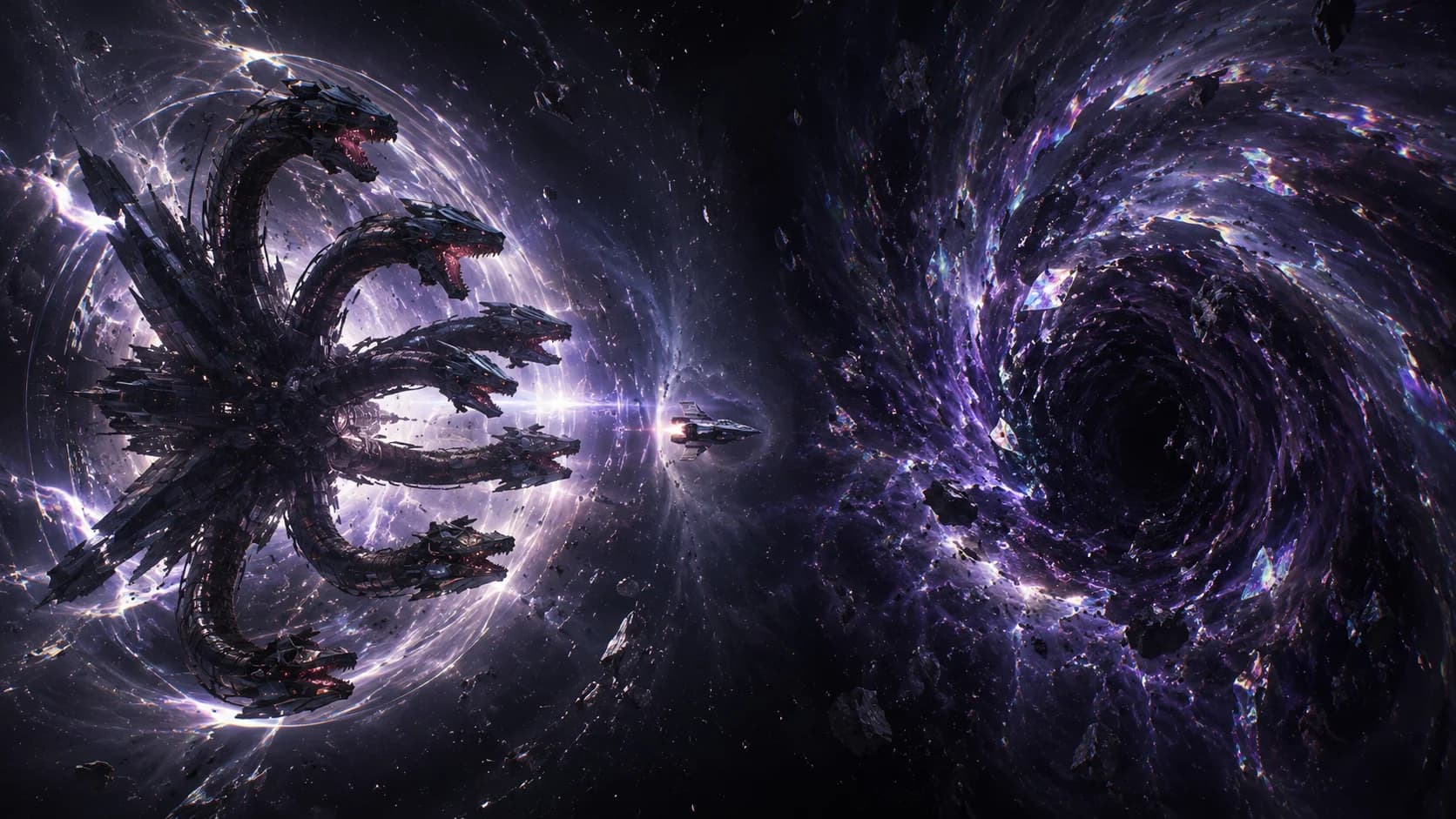
In the trilogy, Scylla and Charybdis are not creatures. They are paired cosmic-scale physical hazards in a navigable corridor that the Odyssey, on Tiresias's instruction, must pass through.
Scylla is a localised gravitational anomaly with extreme tidal forces. Six points of unusually concentrated mass within a single rotating field. Ships passing close to Scylla experience differential gravity strong enough to pull individual crew members through hull plating. The anomaly is bounded. Within roughly two hundred metres of the Odyssey's centre line, the tidal forces are survivable. Closer than that, they are not.
Charybdis is harder to describe. The trilogy calls it a maelstrom of refracted spacetime. What this means in practice: a region of space where the local geometry is so badly disrupted that ships entering it are absorbed into a recursive distortion that the laws of physics do not appear to permit. Whatever happens inside Charybdis cannot be observed from outside. The few ships that have survived encounters with the edge of the phenomenon report no useful information about its interior.
The corridor between them is the only navigable path through this region of space. Pantheon survey data, supplemented by Tiresias's warning, makes the geometry clear. The corridor is narrow enough that the Odyssey cannot avoid both hazards. The captain must choose which one to take damage from.
The decision
Ulysses runs the math with Echo and Thea on the bridge. Charybdis, the calculations say, will absorb the Odyssey with certainty. There is no path through Charybdis. Anyone who has entered it has not come out.
Scylla, the calculations say, will pull approximately six crew members through the hull plating during the seventy-five seconds of closest approach. The hull damage will be repairable in flight. The ship will survive. The six losses will be from the crew currently active, since the suspension pods are deeper inside the ship's centre line where the tidal forces will not reach.
Echo lays out the numbers in her calm reporting voice. Thea, who has been on the ship a decade and has earned her place in these conversations, says nothing. She is letting Ulysses choose without crew pressure.
Ulysses chooses Scylla.
He does not pretend the choice is not what it is. He acknowledges, in the bridge log, that six people are about to die because he is making this decision. He names them by rank rather than name in the log, because the names are not yet known. Some of them are about to lose family members. The active crew is twelve. Half of them will not be at dinner that night.
He gives the order. The Odyssey enters the corridor.
The seventy-five seconds
The seventy-five seconds are one of the trilogy's tightest single sequences. The bridge crew watches the gravitational distortion field on their displays. Six crew members in different parts of the ship are pulled through hull plating in a sequence the trilogy describes without softening.
The first is Petrov. He is in the engineering compartment. He goes through the deck plating before he has time to call out. He is forty-one. He has been awake from suspension for seven years. He has two pods on the lower deck, his wife and his teenage son, who he has not been able to wake because their patterns are too unstable.
The second is Krishnamurthy. She is in the hydroponics bay. She has been thinking about her sister, who died before the journey began, who she has not been able to tell anything about the last decade.
The third through sixth are listed by name. Each gets a sentence. Each death is brief. None is heroic.
The seventy-five seconds end. The Odyssey clears Scylla's gravity well. The hull self-seals the six breaches with emergency foam. The ship's life-support, momentarily destabilised, comes back online. Active crew goes from twelve to six.
The aftermath
The first thing Ulysses does after the Odyssey clears the corridor is go to engineering. Petrov's tool kit is still hanging in its usual place. The maintenance log Petrov had been keeping is on the workbench, open to the page he had been writing when the tidal forces caught him. The handwriting trails off mid-word.
Ulysses sits with the kit for several minutes. He does not weep, because that has stopped being a thing his body knows how to do. He sits.
He goes to engineering, then to hydroponics, then to each of the four other locations. He spends the rest of the shift visiting the places the lost crew were last seen. This is, by Book 2, a ritual of his. Every time the journey costs them someone, he goes to the place. It is the smallest of penances. It is also genuinely all he can give.
Why the scene works in the trilogy
Scylla and Charybdis is the trilogy's clearest single argument that command is a moral problem. Ulysses Theron is famous, both inside the universe and outside it, for being cunning. The cunning is real. The cunning does not always help. There are situations where the cleverest captain in the galaxy still has to choose which six people die.
The scene is also the trilogy's argument against the false comfort of the third option. Many adventure narratives, modern and ancient, contrive a third option in scenes like this. The hero finds a clever way through. Nobody dies. The audience is reassured.
The Odyssey, both Homer's and ours, refuses the third option. Six men die. The captain chose. The reader watches.
This is, we think, the trilogy's honesty showing. The trilogy is not interested in pretending that cleverness saves you from everything.
Where to go next
For the underworld descent that gave Ulysses the warning about Scylla and Charybdis, read The Underworld: Data of the Dead. For the immediately preceding hazard the Odyssey faced, The Sirens: Signal That Rewrites Memory is the relevant piece. For the Pantheon-version profile, Know Your Gods: Scylla and Charybdis is the character-side reference.
Book 2: The Void Between contains the Scylla and Charybdis passage. Buy Book One on Amazon to start at the beginning.
Key takeaways
- Scylla and Charybdis are not creatures in the Ulysses Universe. They are paired cosmic-scale physical hazards in a single navigable corridor.
- Scylla is a six-headed gravitational anomaly that pulls ships apart with extreme tidal forces. Charybdis is a maelstrom of refracted spacetime that swallows ships whole.
- The corridor between them is the only path forward. Tiresias has told Ulysses he must pass through. The choice is which hazard to lose crew to.
- Ulysses chooses Scylla. The choice is correct. The cost is real.
- The scene is the trilogy's clearest argument that some decisions have no good answer. The captain's job is to choose the loss they can live with.