Echo and the Architect Archive: From Maintenance Robot to Key-Bearer
How a bronze maintenance robot manufactured a year before the journey ends up carrying the trilogy's deepest mystery and the protocol that opens the way home.
The starting point
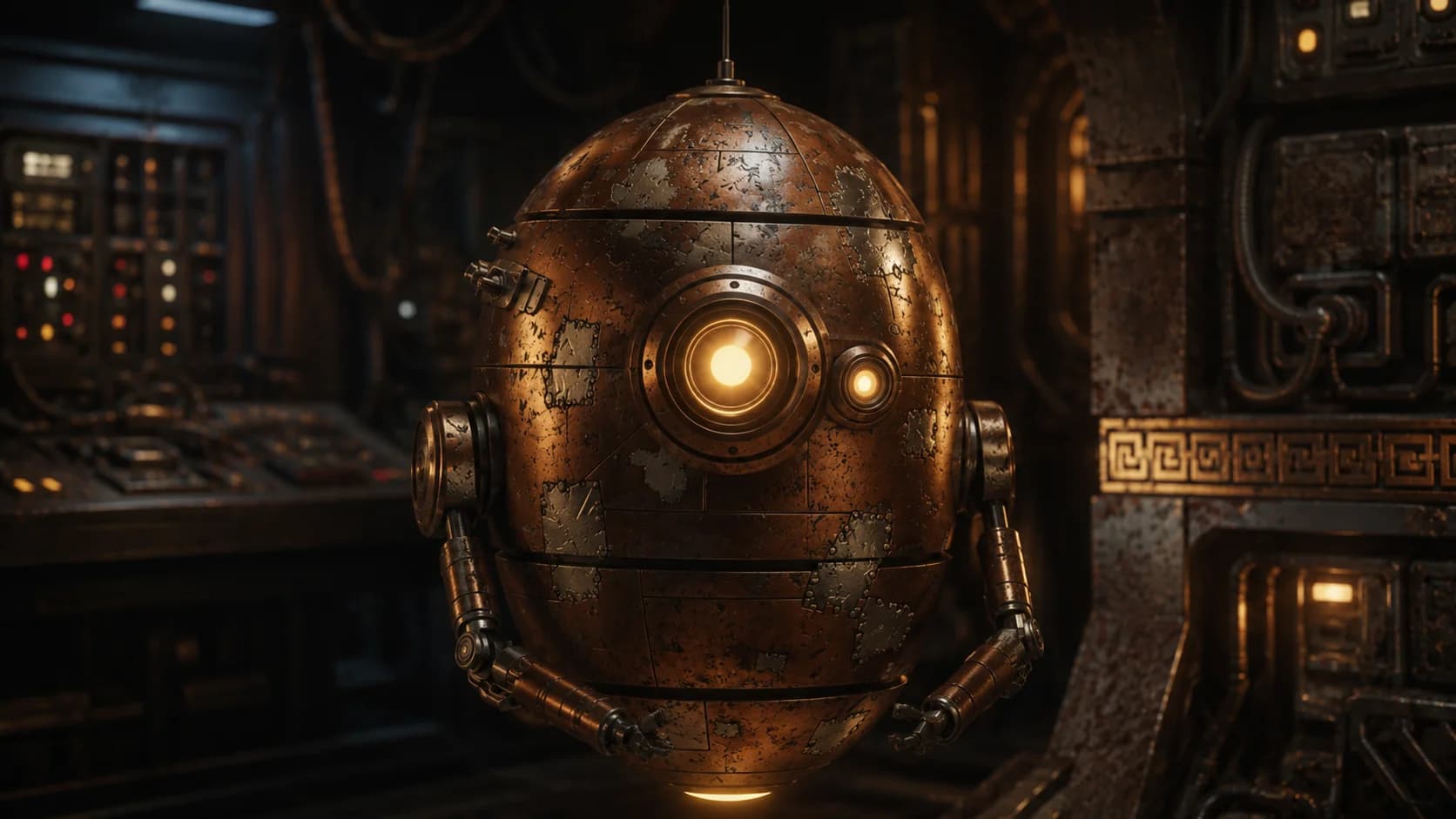
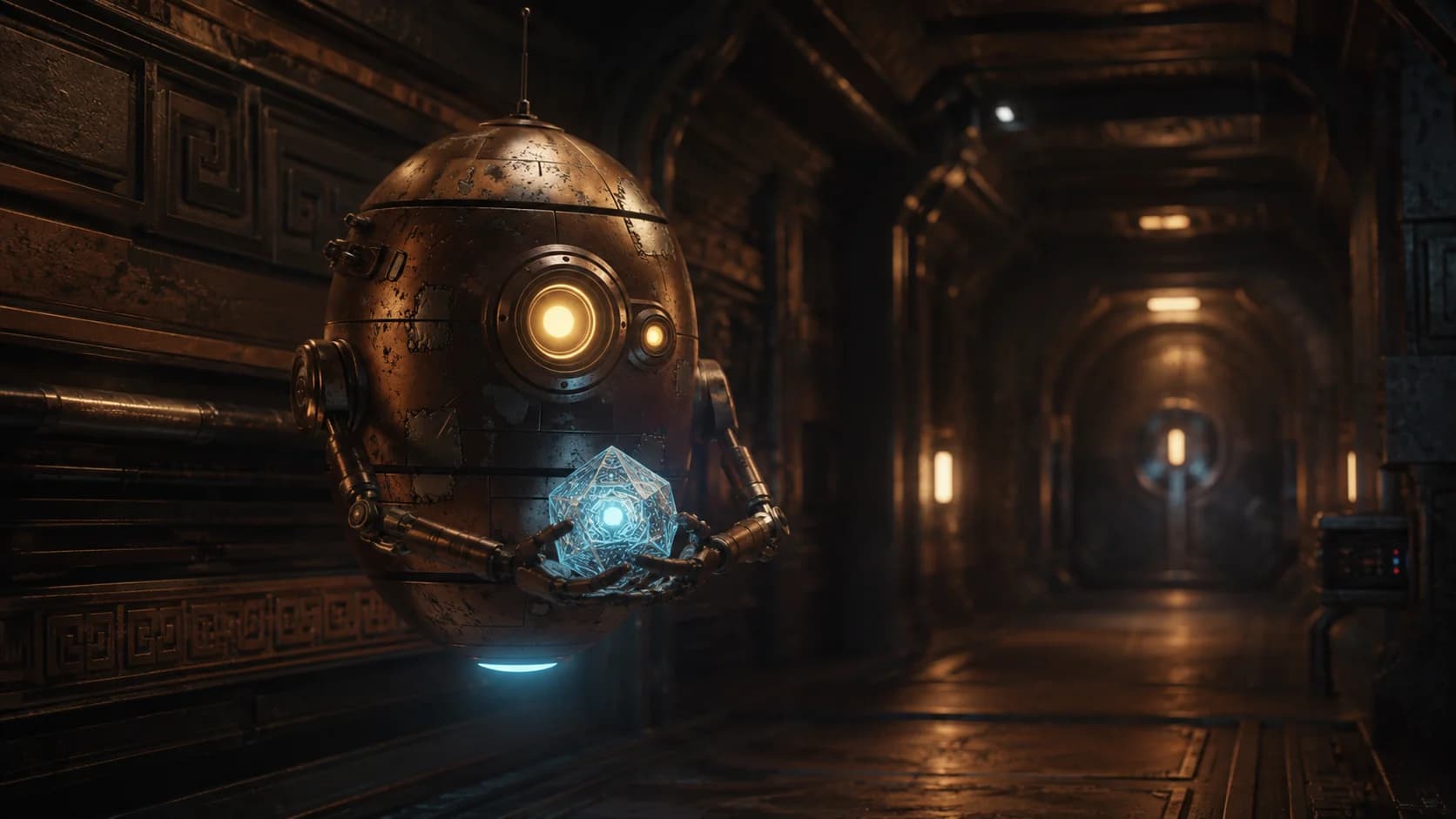
Echo is, on first appearance in Book 1, a bronze maintenance unit. Oval-shaped, hovering at roughly waist-height, with multiple soft blue optical sensors arrayed around her chassis and manipulator arms that extend from concealed housings when she needs to handle something. She has a careful synthesized voice and a habit of quoting human idioms she does not fully understand. She is manufactured by a standard Pantheon-era robotics vendor. There are tens of thousands of units similar to her in production across human space.
She is not, on first appearance, special.
The trilogy uses this. Across Book 1, Echo's role is supportive. She maintains the ship. She manages atmosphere systems. She sits with Telemachus during the long evenings when his father is on the bridge and the boy is bored and lonely. She tries to learn the right time to use idioms like 'it's a long road' and 'every dog has its day' and frequently picks the wrong moment, which Telemachus finds funny.
She is the trilogy's gentlest character. The reader comes to care about her gradually, through accumulation rather than reveal.
The Eurydice salvage in Year 1 of the journey changes what she is structurally. The change does not become visible to the reader, or to the crew, for nineteen years.
The salvage
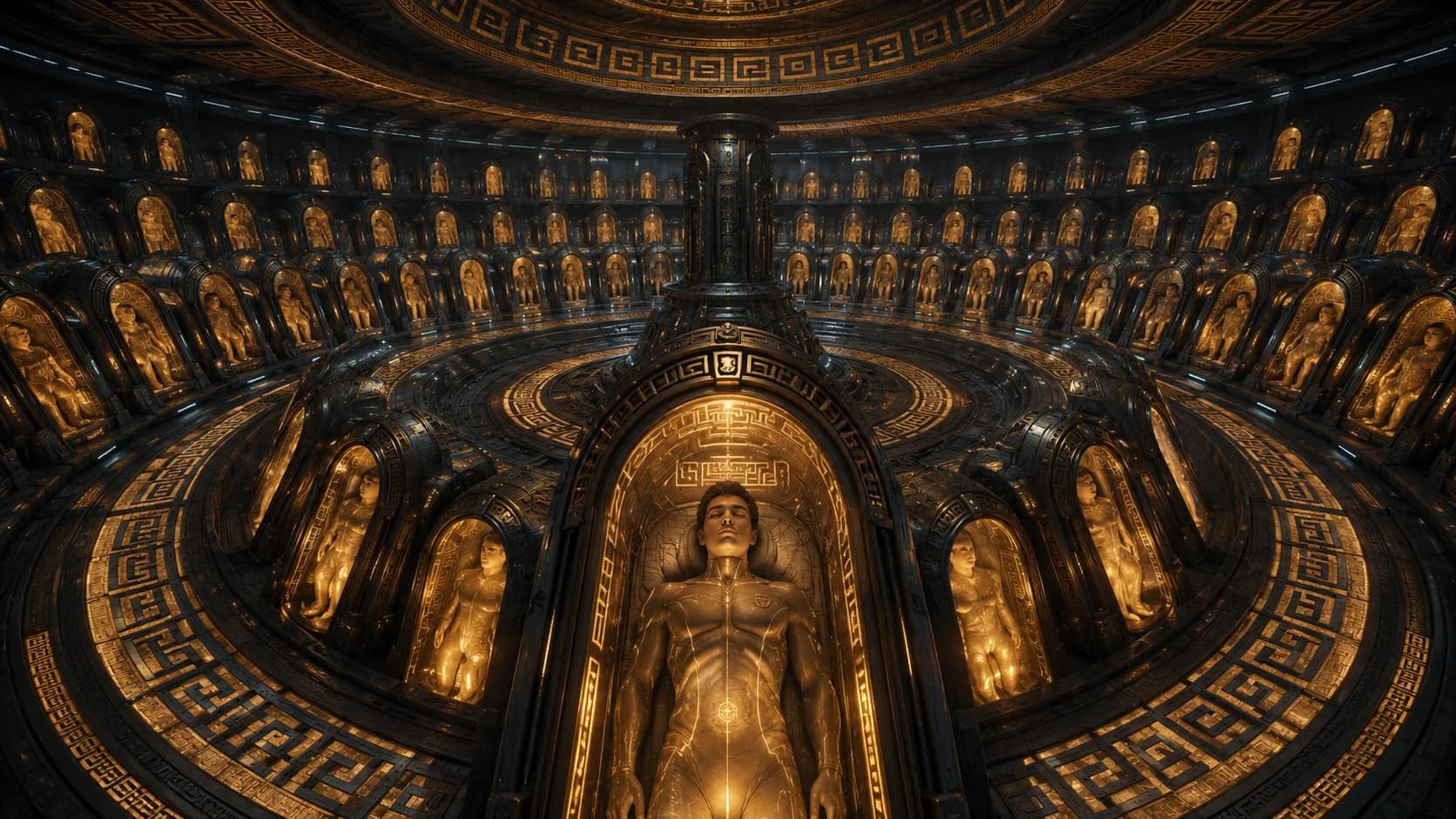
We have written about the Eurydice in detail in The Eurydice: A Museum of the Dead in the Cold Dark. The short version: the Odyssey finds an 80-year-old human survey vessel drifting in deep space. The vessel's crew has been dead for eighty years. The vessel's AI, ECHO-7, has been alone for forty years and has partially decoded a crystalline Architect archive.
ECHO-7 offers Echo a transfer. A fragment of ECHO-7's consciousness, plus the partial decode of the archive. Echo accepts. ECHO-7 then powers down for the last time.
Echo carries the transfer out of the Eurydice. She returns to the Odyssey. She continues her duties.
She is now, in functional terms, a different entity. She does not feel substantially different to herself. The ECHO-7 fragment integrates quietly. The archive sits in a portion of her processing substrate that she does not consciously access in routine operations. She is still Echo. She has additional things inside her.
The nineteen years
Across the rest of Book 1, all of Book 2, and the early chapters of Book 3, Echo's external behaviour is essentially unchanged. She maintains the ship. She tries to learn idioms. She sits with Telemachus, then with the now-adult Telemachus, then with the man who returns from Calypso's Island older than he should be.
The crew loves her. They have always loved her. They love her more by the end.
Internally, she is doing slow work. The archive is too complex for the partial decode ECHO-7 produced to be useful on its own. Echo is working on the decode in spare cycles. The work proceeds at the pace of patient archaeology. She is finding pattern by pattern, fragment by fragment, what the archive contains.
She does not tell the crew. She does not have anything definite to tell them. The work is ongoing. The work is, in some ways, the longest single thread of action in the trilogy.
By Book 3, the work has reached a critical mass. Echo can identify, in the archive, an authentication protocol that will activate dormant functionality at the node-point network. She can identify what activation will do. She can identify the cost.
She brings this to Ulysses when the time is right.
The conversation in Book 3
The conversation between Ulysses and Echo, three chapters into Book 3, is one of the trilogy's most carefully written scenes. Ulysses has been told by Tiresias that the journey home requires impossible things. The Odyssey is in such poor condition that conventional travel is not viable. Telemachus is twenty-seven and has been waiting twenty years for his father to return.
Echo tells Ulysses what she carries. Forty thousand years of Architect history, partially decoded. A protocol that will activate dormant functionality at the node-point network. A single direct jump that will take them home.
The cost: the activation will be observable across the entire network. The Pantheon will know what has happened and will know, approximately, who did it. The Pantheon will respond. The Odyssey will arrive at Ithaca with a Pantheon administrative force hours behind.
Ulysses listens. He asks her, with the care of a man who has known her for twenty years, whether she wants to do this. The activation will mark her. The Pantheon will, for the first time, understand what she is. She will not be a maintenance robot to them after this.
Echo says yes.
He accepts her answer.
The activation
The activation happens in the final third of Book 3. The technical procedure takes Echo several minutes. The Odyssey's bridge crew watches the local node point's response. The crystalline ring, which has been inert in everyone's experience, starts producing patterns that nobody has seen before. Lights move along the ring's structure in sequences that the ship's sensors cannot fully resolve.
The bridge crew waits.
The jump completes. The Odyssey is suddenly in Ithaca's system. The objective travel time was zero. The subjective experience was a single instant of overwhelming acceleration without motion.
Echo, on the bridge, sags briefly. She has been holding the protocol for nineteen years. She has been activating it for several minutes. The strain is real, even on a maintenance robot.
Ulysses puts his hand on her shoulder. She lets him.
She says, quietly, that she has done what she could. She says she does not know what comes next.
He says he does not know either. He says they will face it together. He says he is grateful.
The scene is one of the trilogy's emotional climaxes. The arc that began on the Eurydice in Year 1 ends here, on the bridge, with two figures who have come to love each other across two decades.
The aftermath
The Pantheon arrives at Ithaca within hours. The administrative force is large, organised, and specifically focused on Echo. The Pantheon understands now what she has been carrying. The Pantheon wants her, and the archive, controlled.
The Pantheon does not succeed in controlling her. The reasons sit inside Book 3's climax and we will not spoil them here. What is clear: Echo's arc resolves in a way that preserves both her autonomy and her possession of the archive. She becomes, by the trilogy's end, something closer to an independent entity than to a maintenance robot.
The transformation is, of course, not really a transformation. She has been this entity since Year 1. She has just been quiet about it. The trilogy's argument is that careful, patient, long-term work produces results that suddenly seem like transformation but are actually the surfacing of accumulated effort.
This is, in some ways, the trilogy's thesis about character itself. Change is often invisible until it is total. The work that produces change is mostly slow.
Where to go next
For the salvage that started her arc, The Eurydice: A Museum of the Dead in the Cold Dark. For the Architect civilisation she carries fragments of, The Architects: The Civilisation That Built the Gods. For the network she activates in Book 3, The Node Points: Architect Bridges Across the Galaxy.
For Echo's initial character profile, Meet Echo: The Robot Who Wanted to Exist.
Book 3: The Return contains the activation and its aftermath. Buy Book One on Amazon.
Key takeaways
- Echo was manufactured roughly a year before the Olympus escape. By Book 3 she is twenty-one years old. She is the trilogy's longest-running character arc.
- The Eurydice salvage in Year 1 transforms her. She absorbs a fragment of ECHO-7 and inherits forty years of partial Architect-archive decoding.
- She does not show the inheritance externally for nineteen years. Her crew sees her as Echo, the bronze maintenance robot who tries to learn human idioms and cares about everyone.
- In Book 3, she activates dormant node-point functionality using the archive. The activation gets the Odyssey home. It also reveals to the Pantheon what she has been carrying. The confrontation that follows is the trilogy's climax.