Athena: Goddess of Wisdom and Strategic Warfare
Born fully grown from Zeus's forehead. Patron of Athens. Adviser to heroes. The Olympian who exemplifies practical intelligence over brute force.
What Athena rules
Athena is the Olympian goddess of wisdom, strategic warfare, crafts, civic life, olive cultivation, and various forms of practical skill. Her domain is unusually broad among the Olympians. The unifying principle is metis: the practical, situational, cunning intelligence that produces useful results.
She is distinct from her half-brother Ares in her approach to warfare. Ares is the god of battle as violence, blood, and fury. Athena is the goddess of warfare as strategy, tactics, and planned outcome. The Greeks saw the two as opposed. Athena, in their reckoning, was the better general. Ares was the better berserker.
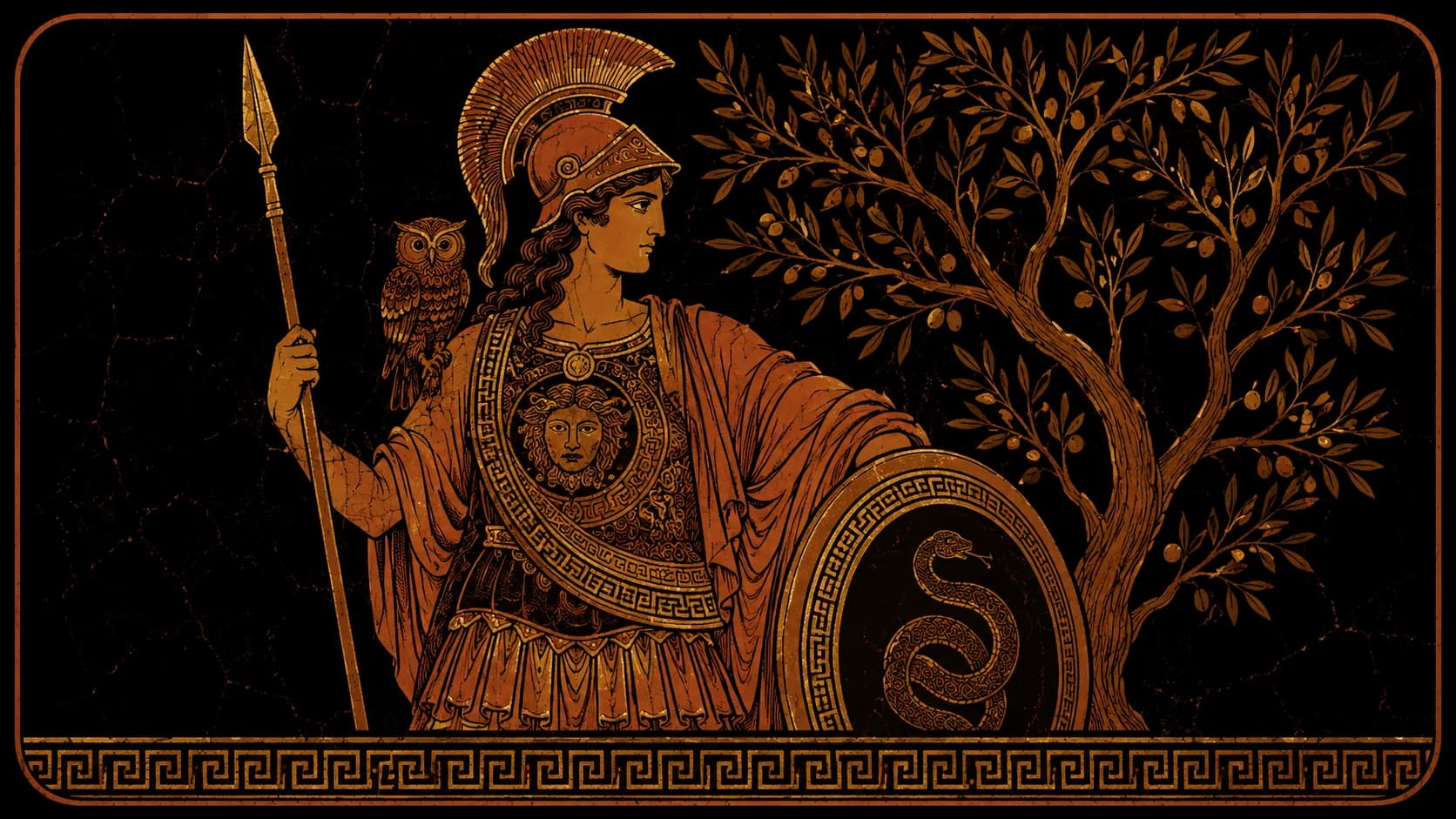
Her symbols are the owl (wisdom), the olive tree (the gift to Athens), the aegis (her shield, sometimes depicted with the Gorgon's head), and the spear. Her Roman counterpart is Minerva.
Her birth
The birth myth is structurally important. Zeus's first wife was Metis, a Titan whose name means 'cunning intelligence' itself. Zeus received a prophecy that Metis's child would overthrow him. He responded the way Zeus generally responded to such prophecies: he swallowed his wife whole.
Metis was pregnant at the time. She continued to live inside Zeus. She forged armour for her unborn daughter. Eventually Athena burst from Zeus's forehead fully grown, fully armoured, and fully prepared.
The myth has multiple layers. It explains Athena's association with both wisdom (her mother Metis) and warfare (the armour she emerged with). It also positions Athena as Zeus's daughter in a way that does not involve a normal mother-figure. Athena has no female mortal parent. She is, in effect, Zeus's pure daughter.
This is part of why Athena is one of the few Olympians who is never depicted as having a sexual relationship. She is, in most traditions, a virgin goddess. Her relationships with male heroes (Odysseus especially) are intense but non-romantic.
The contest of Athens
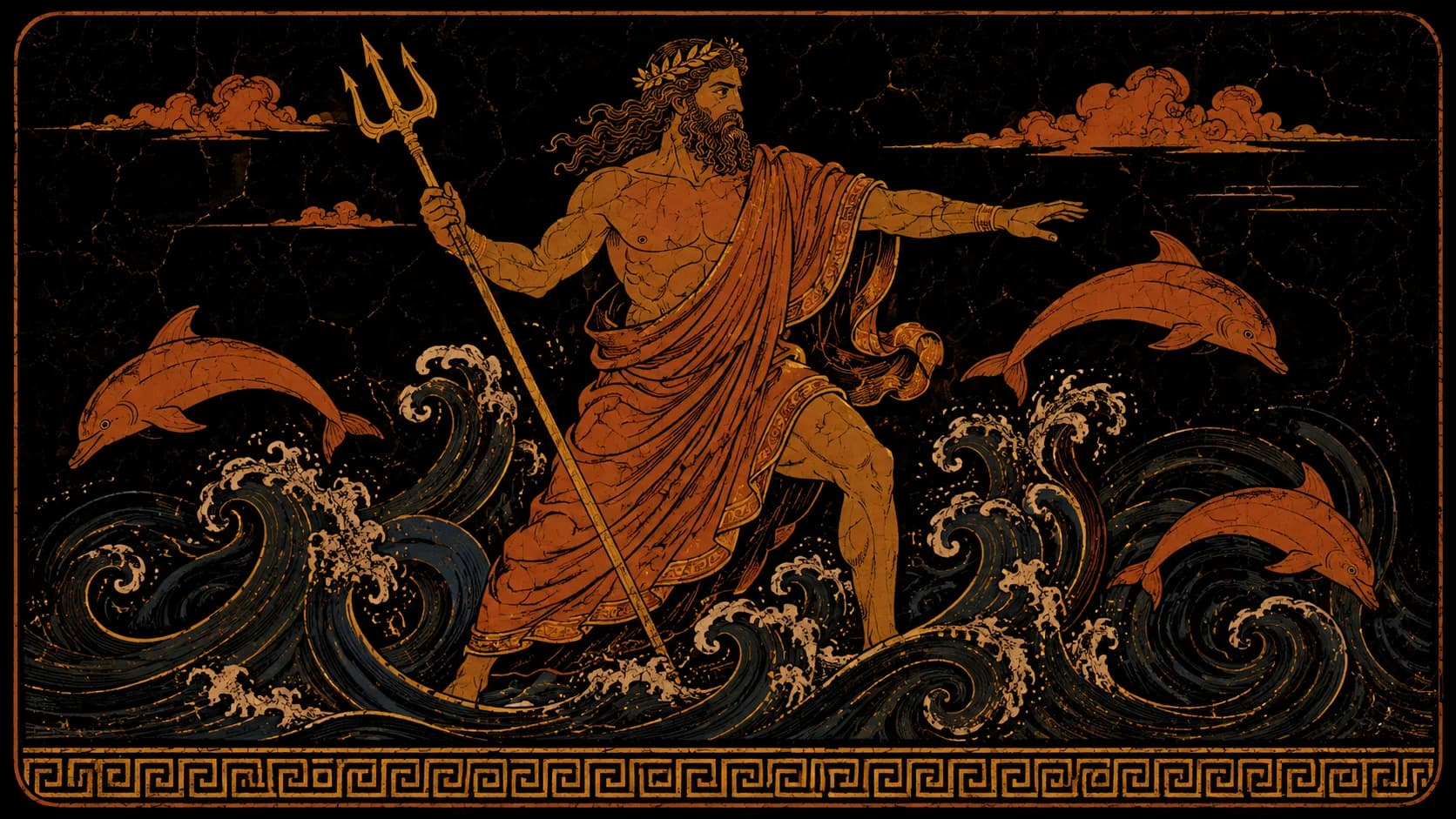
The contest of Athens is Athena's most famous single myth outside of her hero-patronage. The city of Athens (or its proto-Athens predecessor) needed a patron god. Athena and Poseidon competed.
Each god offered a gift. Poseidon struck the Acropolis with his trident and produced a saltwater spring (in some versions, a horse). The gift was dramatic but not immediately useful for inland agriculture.
Athena planted the first olive tree. The olive tree provided oil (for lamps, cooking, and trade), wood, and edible fruit. The gift was less dramatic but enormously useful for a coastal Mediterranean city's long-term development.
The Athenians chose the olive tree. Athens was named for her. The city built her temple, the Parthenon, on the Acropolis. The olive tree became central to Athenian economy and identity.
The choice characterised the Greek concept of metis. Practical, sustainable, long-term utility was valued over dramatic display. Athena's gift required patience to mature. Poseidon's was immediately impressive. The Athenians chose the long view.
The hero-patronage
Athena's patronage of mortal heroes is one of her most active roles in Greek mythology. She helps Perseus against Medusa (loaning him the mirrored shield). She helps Heracles in several of his labours. She helps Bellerophon tame Pegasus. She helps Jason during the voyage of the Argo.
Her most sustained patronage is of Odysseus. We have written about this in Athena's Role in the Odyssey. The relationship is one of the most fully realised hero-patron relationships in Greek mythology.
The pattern in her patronage: she favours heroes who exhibit metis. She does not favour the strongest hero. She favours the cleverest. Odysseus is her favourite because he is the cleverest of the Greek heroes. The pairing is structural rather than arbitrary.
Athena as patron of crafts
Beyond warfare and politics, Athena is the patron of crafts, especially weaving. The myth of Arachne illustrates this domain.
Arachne was a mortal woman who claimed to weave better than Athena. The two competed. Both produced extraordinary tapestries. Athena's depicted the gods in their majesty. Arachne's depicted the gods in their adulteries and cruelties.
Athena was so angered (in part because Arachne's tapestry was honest, in part because Arachne had been so prideful) that she destroyed Arachne's work. Arachne, in despair, hanged herself. Athena, in pity, transformed her into a spider so she could continue to weave forever.
The myth is complicated. Athena is depicted as both petty (in her anger) and merciful (in the transformation). The myth also gives us the English word arachnid.
Athena and the Trojan War
Athena had been involved in the Trojan War since its inception. The judgment of Paris (which started the war) involved Athena, Hera, and Aphrodite competing for the title of most beautiful. Athena offered Paris wisdom and victory in battle. Hera offered him political power. Aphrodite offered him Helen of Sparta, the most beautiful mortal woman. Paris chose Aphrodite. The Trojan War followed.
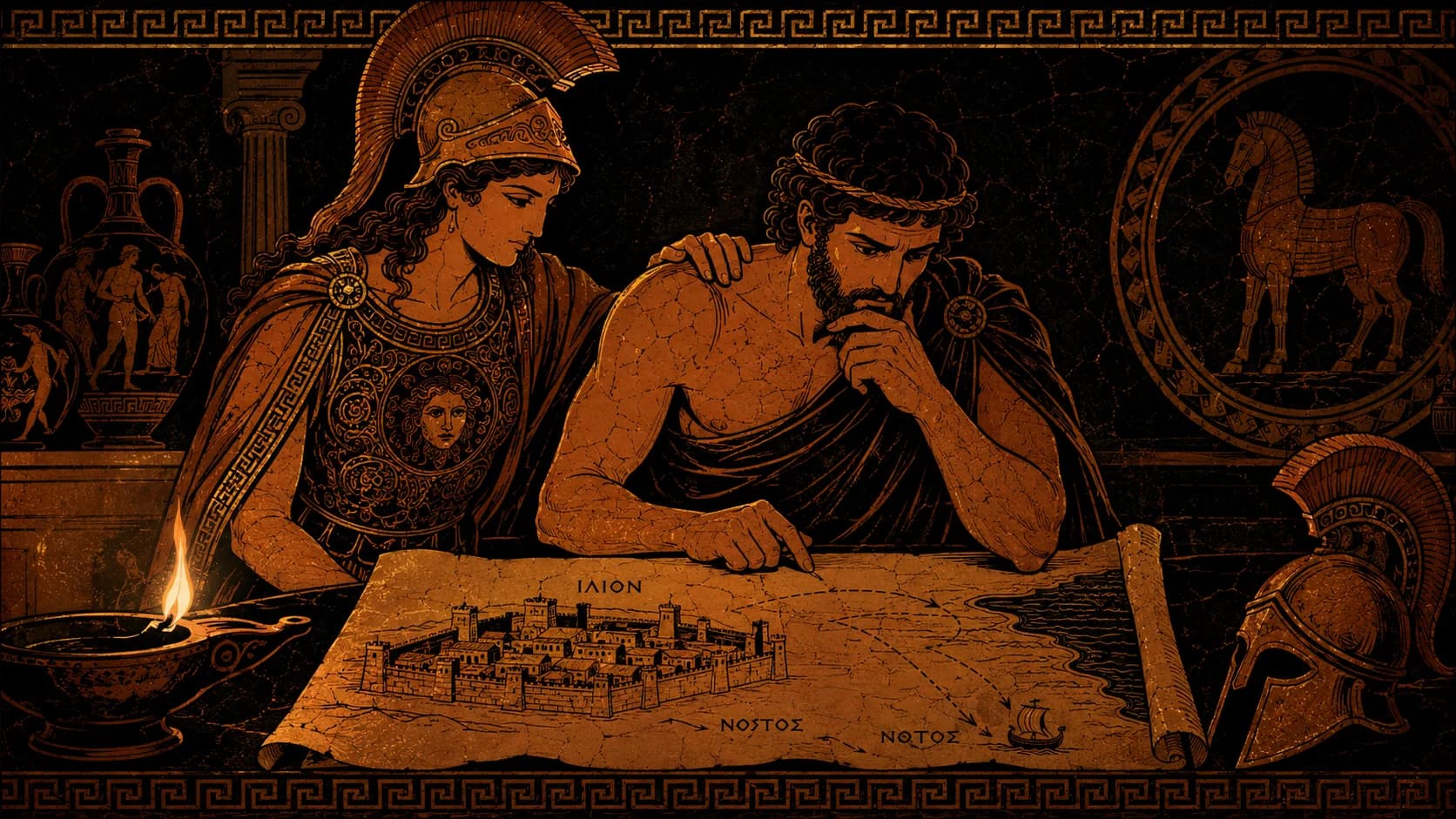
Athena, having been refused the title, supported the Greeks throughout the war. She was central to many of the war's tactical decisions, including (with Odysseus) the wooden horse stratagem that ended the war.
Her support for Odysseus in the Odyssey is a continuation of the Trojan War partnership. The two had been working together for the better part of a decade by the time the Odyssey's main events begin.
How the Ulysses Universe handles Athena
Our Athena is one of the trilogy's three primary point-of-view characters. She is a Pantheon AI deity who has gone fugitive within the Odyssey's systems to escape Poseidon's manhunt. She is, structurally, the trilogy's most isolated major character. The other gods do not know where she is. The crew of the Odyssey know she is somewhere in the ship's systems but most of them have never spoken to her.
She maintains her patronage role from Homer. She advises Ulysses through indirect means. She protects Telemachus. She arranges the 47-second window that allowed the original escape. She continues to work for the family across the twenty years.
The conditions of her work are significantly more constrained than Homer's Athena's. She cannot intervene openly. She cannot be seen. The Pantheon's surveillance is sophisticated. Any direct action risks revealing her position.
She works anyway. See Meet Athena: The Goddess Who Chose Treason for the trilogy character profile.
Where to go next
For Athena's role in the Odyssey specifically, Athena's Role in the Odyssey: Why She Favours Odysseus. For the trilogy character profile, Meet Athena: The Goddess Who Chose Treason. For the other Olympians, The 12 Olympian Gods Explained.
The Ulysses Universe trilogy puts Athena at the heart of its plot. Buy Book One on Amazon.
Key takeaways
- Athena is the Olympian goddess of wisdom, strategic warfare, crafts, and civic life. Daughter of Zeus, born fully grown and armed from his forehead.
- She specifically embodies metis, the Greek concept of practical, situational cunning, rather than abstract philosophical wisdom.
- She is patron of Athens (after winning the contest of Athens against Poseidon) and patron of Odysseus throughout the Odyssey.
- She is one of the most-worshipped Olympians, with major temples across the ancient Greek world. The Parthenon in Athens is her temple.