How Does the Odyssey End? The Homecoming Explained
Twenty years of war and journey converge on a single afternoon in Ithaca. The bow contest. The slaughter of the suitors. The recognition with Penelope. How Homer's Odyssey actually ends.
The setup
The last twelve books of the Odyssey (Books 13-24) cover the homecoming. The previous twelve covered the adventures. The proportional weight is sometimes a surprise to readers who expect the homecoming to be a brief closing scene. It is, in fact, half the poem.
Odysseus arrives on Ithaca alone. The Phaeacians have transported him there in their magical ships, depositing him on the shore in a deep sleep with all the gifts they have given him. He wakes alone, disoriented, on a coast he initially does not recognise.
Athena appears, restores his orientation, and disguises him as an old beggar. She explains the political situation. She arranges his initial meetings.
The next several days are operational preparation. Odysseus visits Eumaeus the swineherd, who does not recognise him but treats him with appropriate xenia. Telemachus, returning from his own journey (the Telemachy), is reunited with his father and told the plan. The two of them coordinate the timing of the homecoming.
The recognition scenes
Homer constructs the homecoming as a sequence of recognitions, each carefully staged. Each one tests both the recogniser and Odysseus himself.
-
Argos the dog. Odysseus's old hunting dog, neglected and dying after twenty years, recognises his master immediately. He wags his tail. He cannot rise. He dies. Odysseus, in the beggar disguise, cannot react openly. The scene is one of the saddest in ancient literature. We have written more about this in the existing Argos post.
-
Eurycleia the nurse. The old nurse, washing the beggar's feet (a hospitality act), recognises a scar on his thigh from a boyhood boar hunt. She nearly cries out. Odysseus silences her physically and verbally. She keeps the secret.
-
Eumaeus and Philoetius. The two loyal servants are told the truth before the slaughter, so they can fight alongside their master.
-
Penelope. Her recognition is the climactic one. Held back deliberately by Homer until after the slaughter, after the bow contest, after every other character has acknowledged Odysseus's return.
The bow contest
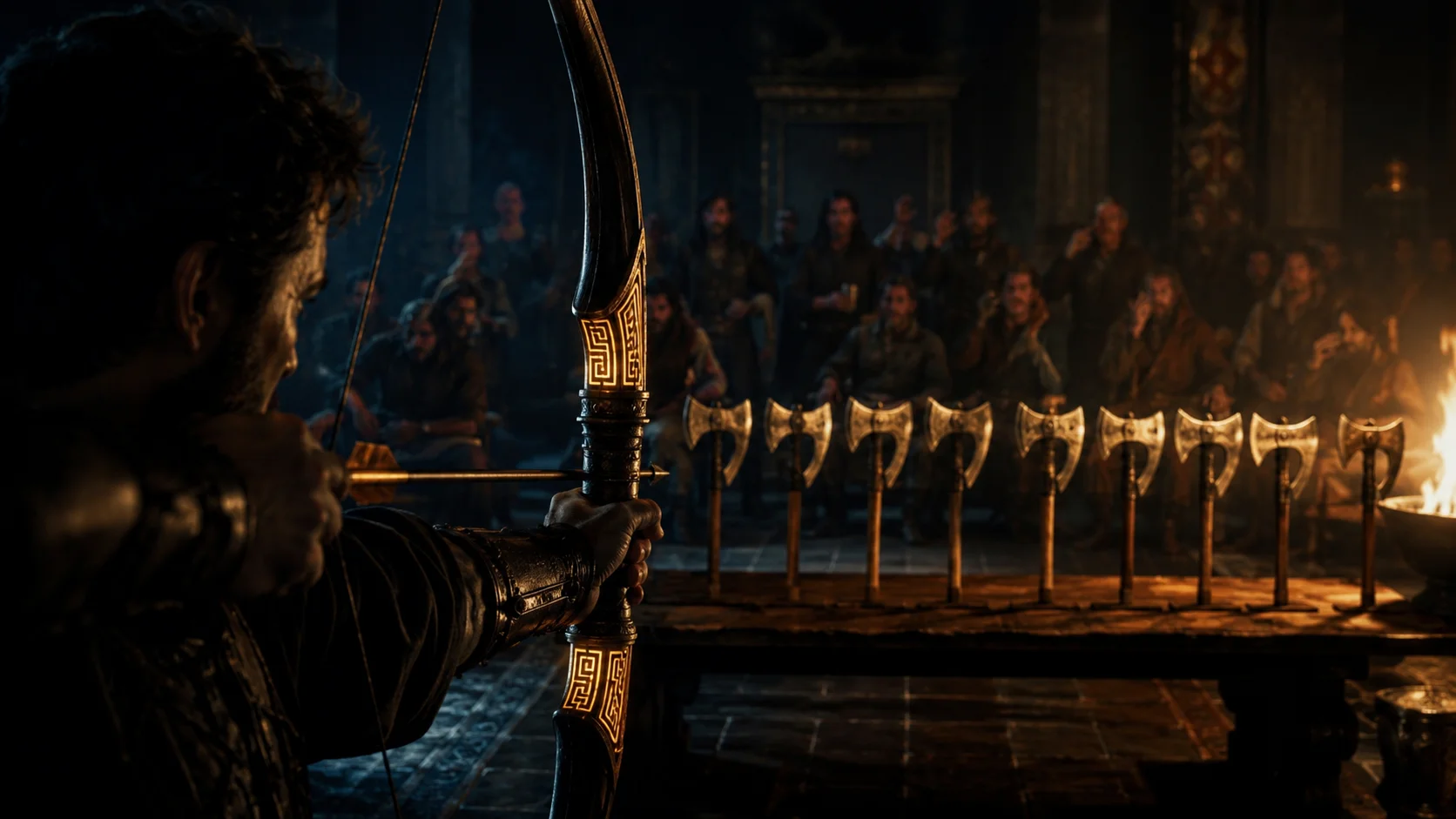
Penelope announces the contest. She brings out Odysseus's bow, which has been hanging in storage for twenty years. The rules: whichever suitor can string the bow and shoot an arrow through twelve axe heads in a row will win her hand and Ithaca with it.
The suitors take it as a strength test. They line up. One by one they try. None of them can even bend the bow. The wood resists. Some of them oil the bow and warm it by the fire. Still nothing.
The disguised beggar asks if he might try. The suitors laugh. Penelope insists he be allowed.
He strings the bow in one motion. He shoots the arrow through all twelve axe heads. He turns to the suitors with an expression they have not seen on a beggar's face before.
This is the trilogy's structural climax. We've covered the deeper Ulysses Universe reading of the bow's biometric function in The Bow That Knows You.
The slaughter
Odysseus's first arrow after the contest goes through the throat of Antinous, the suitor leader. The suitors realise too late what is happening. The hall doors are sealed. The weapons cabinets have been emptied by Telemachus the night before.
The slaughter takes time. Homer writes it as a sustained sequence. Odysseus is on the bow. Telemachus and the two loyal servants fight with spears. Athena is present, in disguise, providing protection and occasional active intervention.
The suitors fight back when they can. Some try to escape. Some plead for their lives. A handful negotiate and ask for mercy. Odysseus refuses all negotiation. The suitors have violated xenia for twenty years. The punishment is final.
108 men die. Two more figures (a treacherous goatherd and a corrupt priest) are killed as collaborators. Twelve handmaidens who have collaborated with the suitors are forced to clean up the bodies and are then hanged.
The killing of the handmaidens is one of the Odyssey's most morally difficult scenes. Modern readings (especially Atwood's Penelopiad) have engaged with it directly. The text does not soften it.
The marriage-bed test
The slaughter ends. Telemachus is sent to wake Penelope. She comes down to the hall. She sees the bodies. She sees the strange man covered in blood who claims to be her husband.
She does not accept him.
She has been ready for trick suitors for twenty years. She has procedural reflexes. The procedural reflexes do not turn off because someone has won the bow contest. She tests him.
The test is the marriage bed. She orders her servant to move the bed out of the bedchamber so the stranger can sleep in the hall. The order is impossible. The bed is built into the olive tree that grew up through the floor of the chamber. Odysseus built it himself when they first married. Moving it would require cutting the tree.
Odysseus erupts. He demands to know who has cut down the tree. He describes the bed's construction in exact detail, including features only he could know.
Penelope accepts him. The recognition is complete.
This is, in many readings, the Odyssey's actual climax. The slaughter is the action climax. The marriage-bed is the emotional climax. The poem has been building to this single mutual recognition for twenty-four books and twenty years of in-poem time.
The aftermath
The Odyssey does not end at the marriage-bed scene. Book 24 covers the immediate aftermath. The suitors' families learn of the killings. They mobilise for civil war. Odysseus, Telemachus, and Laertes (Odysseus's father, who appears briefly) prepare to defend Ithaca.
The civil war is prevented at the last moment by Athena, who imposes peace on both sides. The Odyssey ends mid-action, with peace declared but unfinished.
Tiresias's earlier prophecy (that Odysseus must eventually take an oar inland and plant it in a culture that does not know the sea) is referenced but not acted on within the poem. It remains as a future task, opening space for later traditions and sequels.
What the ending means
The Odyssey's ending is, in some ways, ambivalent. The hero gets home. The wife and son are restored. The suitors are punished. Order is reimposed.
The cost, however, is total. 108 men dead in a single afternoon. Twelve women hanged. The kingdom traumatised. The suitors' families almost driving Ithaca into civil war. Odysseus himself changed by twenty years of war and journey in ways the homecoming cannot reverse.
Modern readings increasingly emphasise the cost rather than the resolution. The Odyssey is not a triumph in any simple sense. It is the longest, hardest possible argument that home is worth returning to, and that the return cannot be made without paying for what was lost along the way.
How the Ulysses Universe handles the ending
Our trilogy preserves the structural elements of the ending. Book 3 contains the bow contest, the slaughter, and the recognition. The recognition uses the bow's biometric authentication rather than the marriage-bed test, because the trilogy's technology makes the bow scene work harder. We've covered this in The Bow That Knows You and The Pattern as Calibrator.
The cost is preserved. The Suitors die. The cursed crew wake to find their world changed. Calypso's warning (you will reach home, you will wish you hadn't) is acknowledged as having been correct.
Where to go next
For the bow contest mechanics, The Bow That Knows You. For the political situation Penelope holds together for twenty years, Penelope in the Odyssey: The Most Underrated Hero. For the broader Ulysses Universe context, Ithaca Station: The Occupation.
The Ulysses Universe trilogy ends with the homecoming. Buy Book One on Amazon to start at the beginning.
Key takeaways
- Odysseus returns to Ithaca disguised as a beggar. He reveals himself to Telemachus, the swineherd Eumaeus, and his old nurse Eurycleia.
- Penelope announces the bow contest. None of the suitors can string the bow. The disguised Odysseus does.
- Odysseus and Telemachus slaughter the 108 suitors. The killing is graphic and total.
- Penelope tests Odysseus with the secret of the marriage bed. He passes. They reunite.
- Athena imposes peace between Odysseus and the suitors' angry families. The Odyssey ends. Tiresias's instruction about the oar remains unfinished.