Circe in the Odyssey: Witch, Goddess, or Something Else?
Daughter of the Sun. Mistress of transformation. The witch who turned men into pigs and then became Odysseus's most useful ally. Circe's place in Homer is more complicated than the popular image suggests.
The popular image
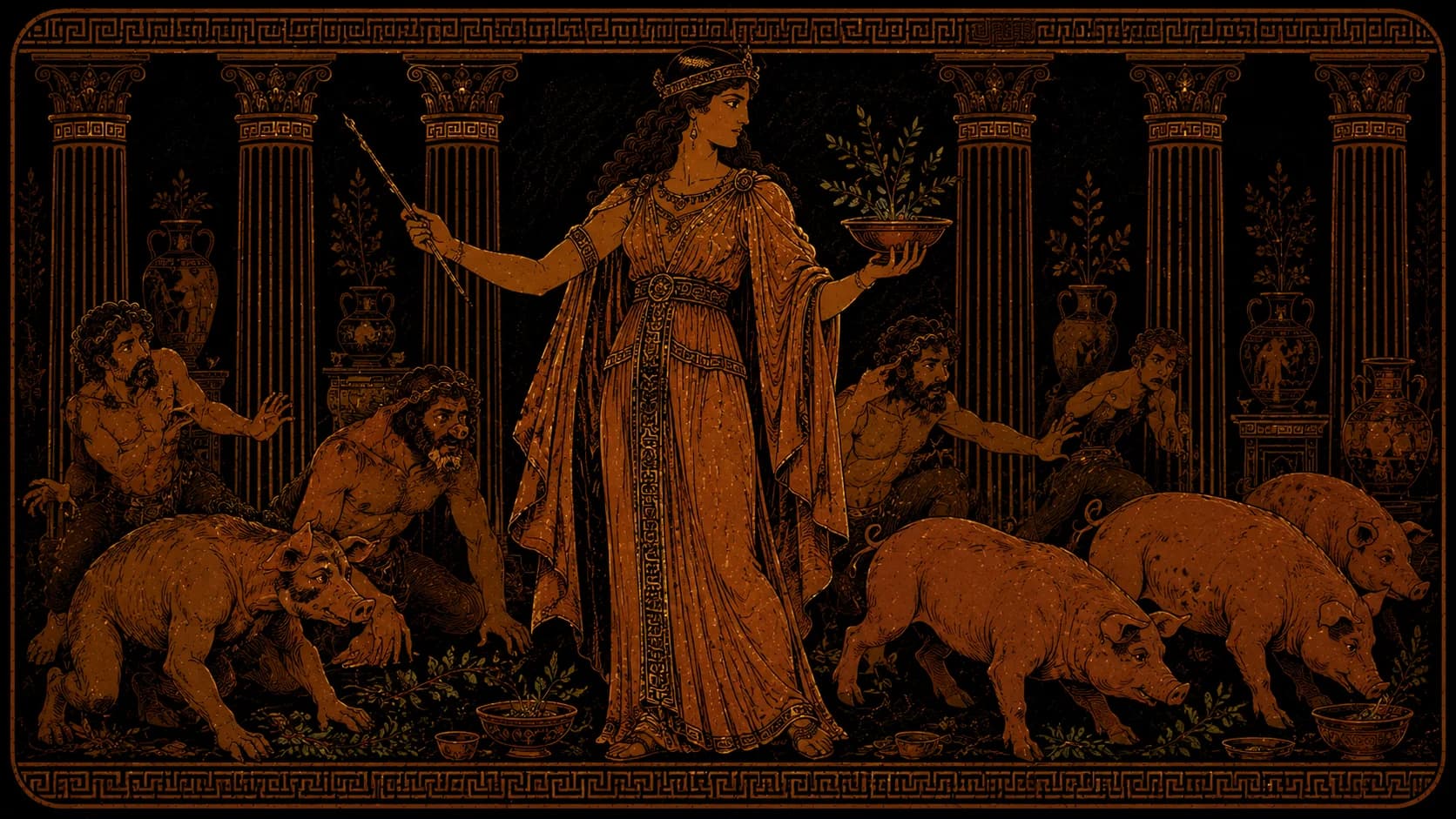
In popular shorthand, Circe is the witch who turns men into pigs. The image comes from Book 10 of the Odyssey. It is correct as far as it goes. It is also reductive in ways that obscure what Circe actually is in Homer.
She is, first, a goddess. Daughter of Helios, the sun god, and the nymph Perse. Her divinity is genuine, not metaphorical. The Greek text uses theos for her, the same word it uses for the Olympian gods. The English translation tradition has often softened this to 'witch' because the cultural register of 'witch' is closer to what Circe does in practice, but the linguistic register is divine.
She is, second, a sustained presence in the Odyssey rather than a single encounter. Most popular discussion of Circe focuses on the pig-transformation. The pig-transformation is a few hundred lines. Circe's presence in the Odyssey is much longer. Odysseus stays on Aeaea for a year. He returns to consult her after his descent to the underworld. Her information is what allows him to survive the Sirens, Scylla and Charybdis, and the cattle of the sun god.
She is, third, more morally complicated than the shorthand suggests. She harms his crew. She also restores them when challenged. She becomes his ally. She tells him the truth, including hard truths about what awaits him. She is, in Homer's text, an asset.
The transformation scene
Odysseus's crew lands on Aeaea, an island they do not recognise. A party of advance scouts (twenty-two men, led by Eurylochus) explores the island and finds Circe's palace. The scene Homer writes is famous.
Circe welcomes the scouts in. She offers them wine, mixed with herbs that disconnect their minds from their bodies. She then strikes them with a wand and transforms them into pigs. They retain their human consciousness inside pig bodies. They squeal in despair.
Eurylochus, who stayed outside the palace door (because he was suspicious), runs back to the ship to tell Odysseus.
Odysseus goes to the palace alone. Hermes appears on the path and gives him the herb moly, which provides immunity to Circe's transformation magic. Odysseus enters, accepts the wine, is not transformed, draws his sword, and threatens her.
Circe recognises that she is dealing with someone who has divine help. She immediately changes tactics. She invites him to bed. He insists first that she restore his crew. She does. The crew become men again, taller and more handsome than before.
The conflict resolves. The hospitality begins.
The year on Aeaea
What happens for the next year is the part of the story that most popular discussion glosses over. Odysseus stays on Aeaea for a year. So does his crew. They live in Circe's palace. They eat her food. They drink her wine. They participate in the genuine hospitality she now extends.
Odysseus sleeps with Circe regularly. The Greek text is matter-of-fact about this. The relationship is not depicted as coerced (on either side, post-restoration) and not depicted as romantic in the modern sense. It is, in Homer's framing, a transaction of mutual benefit. She is hospitable. He is appreciative.
The arrangement holds for a year because everyone involved is content with it. The crew rests. The captain rests. The island is beautiful. The food is good. There is no political pressure to leave.
Eventually the crew remind Odysseus that they are supposed to be going home. He had, perhaps, forgotten. He goes to Circe and tells her they are leaving. She accepts. She prepares him for what is ahead.
The briefing
Circe's briefing is one of the Odyssey's most important pieces of information transfer. She tells Odysseus, in detail:
That he must first visit the underworld to consult the prophet Tiresias, who alone can tell him the way home. She explains the protocol for the consultation.
That he must pass the island of the Sirens. She explains the danger and the technical workaround (wax in the crew's ears, Odysseus tied to the mast).
That he must navigate the strait between Scylla and Charybdis. She explains the math: Scylla will take six men. Charybdis will take everyone. Choose Scylla.
That he must avoid the cattle of the sun god (which are her father Helios's cattle, so she has personal investment in this warning). His crew must not eat them. If they do, Helios will punish them and Odysseus will lose his ship.
The briefing is thorough. It is also accurate. Every prediction Circe makes turns out to be true.
She is, in functional terms, Odysseus's most valuable ally for the rest of the journey. The fact that she also turned twenty-two of his men into pigs at the beginning of their acquaintance is, by year's end, beside the point.
Modern recovery
Madeline Miller's 2018 novel Circe is the canonical modern recovery. The book gives Circe her own narrative across her entire immortal life. The Odyssey events occupy a single chapter near the middle. The rest of the book is Circe's life before and after Odysseus.
Miller's Circe is fully realised: a daughter who is undervalued by her father, a sister who is overshadowed by her brilliant siblings, a woman who finds her power slowly through patient herbalism, a being who chooses isolation and learns to defend it. The Odysseus encounter is one of many in her life, important but not defining.
The book has sold over two million copies. It has reshaped popular reception of Circe almost completely. Zendaya is rumoured to be playing Circe in Christopher Nolan's 2026 film adaptation. If she is, the performance will almost certainly be in dialogue with Miller's version.
For readers who want to deepen their engagement with Circe before or after the film, Books to Read Before Watching Nolan's Odyssey covers Miller and other contemporary retellings.
The Ulysses Universe version
Our Circe is a geneticist who runs Aeaea as a station built around a binary star system. The transformation of Odysseus's crew, in our version, is biological rather than magical. The food on her table is genuinely altering. The duration of the alteration is hers to choose.
She is, like Homer's Circe, morally complicated. She is, like Homer's Circe, genuinely useful. She gives Ulysses Theron the navigational protocol that allows him to complete the rest of the journey. She also engineers, behind the scenes, the situation that produces Thea.
For the full treatment, Aeaea: Circe's Bioluminescent Domain is the location piece. For the Pantheon-side character profile, Know Your Gods: Circe.
Why she matters
Circe is the Odyssey's clearest argument that allies can be complicated. She is not a clean hero figure. She is not a simple villain. She is an entity with her own interests, who initially harms Odysseus's crew, and who then becomes his most useful single contact in the eastern Mediterranean.
This kind of moral complexity is, frankly, rare in ancient epic. The Iliad and the Odyssey both have characters who are entirely good (Penelope) or entirely bad (the suitors). Circe sits in the middle. She is hard to categorise. She remains, three thousand years later, hard to categorise.
The retellings keep returning to her partly because the difficulty is genuine and partly because the difficulty is the point. A character who can be both threat and asset, both adversary and lover, both danger and information source, is the kind of character a reader can think about for a long time.
Where to go next
For our location piece on Aeaea, Aeaea: Circe's Bioluminescent Domain. For Madeline Miller's Circe and other contemporary engagements, Books to Read Before Watching Nolan's Odyssey. For the Pantheon-side character profile, Know Your Gods: Circe.
The Ulysses Universe trilogy contains the Circe encounter in Book 2. Buy Book One on Amazon to start at the beginning.
Key takeaways
- Circe is the daughter of Helios (the Sun) and the nymph Perse. She is technically a goddess, not a witch, despite the popular shorthand.
- In the Odyssey she turns Odysseus's men into pigs, then becomes his ally for a year, then gives him the navigational warnings that save his life.
- Modern reading, especially Madeline Miller's 2018 novel Circe, has substantially restored her as a fully realised character rather than an obstacle.
- The Ulysses Universe's Circe is the trilogy's most morally complicated antagonist. She is also genuinely useful, in the way Homer's Circe is genuinely useful.