The Best Space Opera Books of 2026: A Curated List
Ten space opera novels worth your time in 2026, ranked by ambition, craft, and willingness to risk something. From new releases to overlooked recent classics.
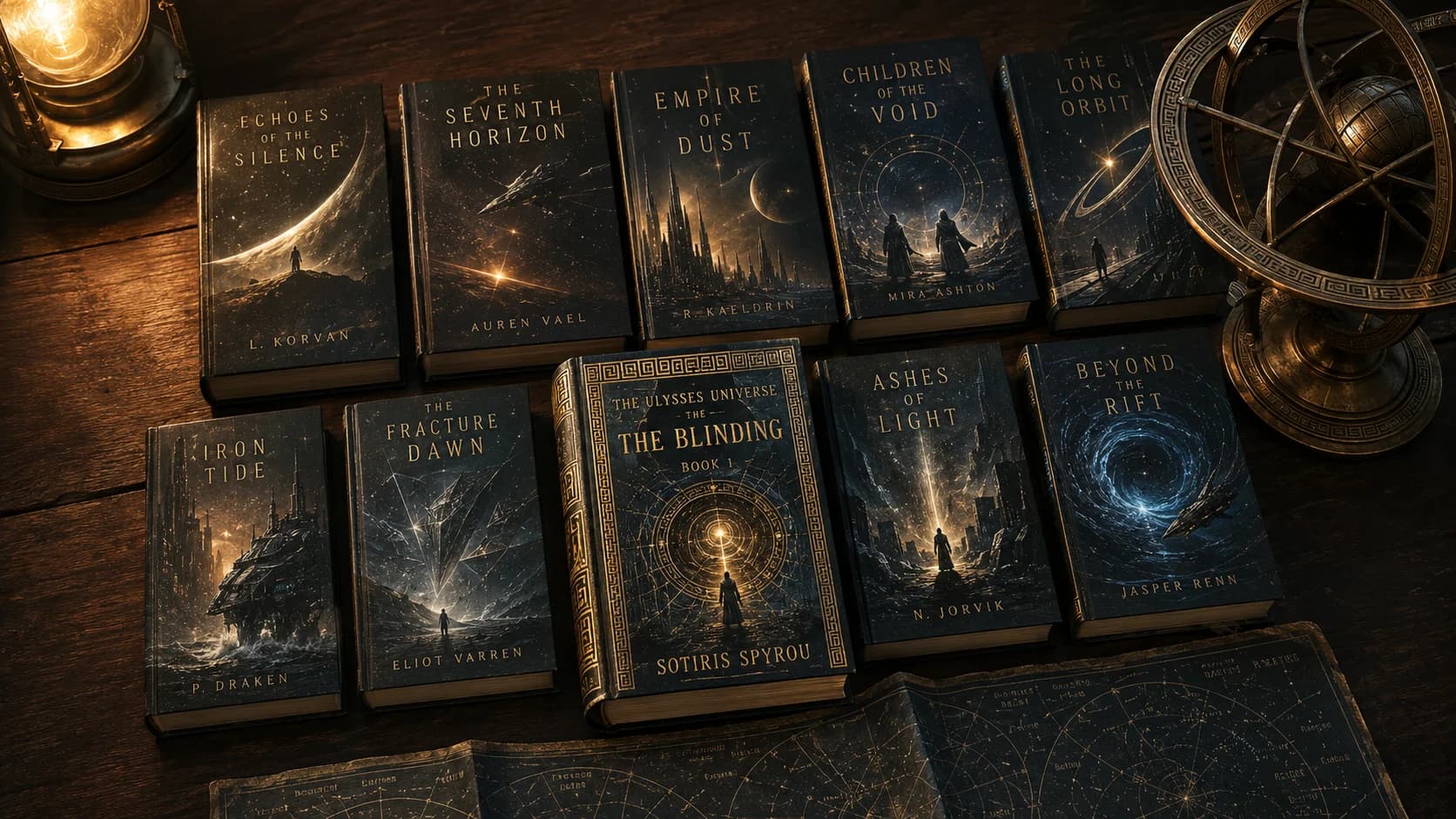
Why we wrote this
Lists of 'the best X of 2026' are usually written by aggregators who haven't read most of the books. We're going to do something different here. This list contains books we've actually read or are reading. We'll be transparent about our own book being on it. And we'll tell you what each book is for, not just whether it's good.
The space opera genre is in a healthy period. The Expanse closed cleanly. Becky Chambers expanded what space opera could feel like. Indie authors are publishing work that matches mid-list traditional in quality. There's more good space opera available now than at any time in the last twenty years.
Ten books worth your time in 2026, ranked by a combination of ambition, craft, and willingness to do something unfamiliar:
The list
1. Adrian Tchaikovsky's Final Architecture universe
If you want the modern Expanse-style space opera with a cosmic-horror tilt, Tchaikovsky's Final Architecture trilogy and its associated novellas are the strongest sustained work in the genre right now. Shards of Earth, Eyes of the Void, Lords of Uncreation. Plus the 2026 releases in the extended universe.
What it does well: scale. Tchaikovsky writes cosmic-scale antagonists without losing the human-scale protagonists. The Architects are genuinely unsettling. The crew dynamics are good.
Read this if you want: Big space. Mysterious enemies. Crew-on-a-ship dynamics with literary craft.
2. The Ulysses Universe trilogy by Sotiris Spyrou
Full disclosure: this is our book. We're listing it because it would be dishonest to write 'best space opera of 2026' and leave it off, and because we genuinely think the trilogy belongs on this kind of list.
The trilogy reimagines Homer's Odyssey as 23rd-century space opera. The Greek gods are quantum-AI entities running on infrastructure that pre-dates humanity. Polyphemus is an asteroid-prison with an AI warden that has been alone for forty-seven years. The Sirens are a signal that rewrites memory. Ithaca is a station. Penelope governs.
What it does well: mythology integrated into worldbuilding at the structural level rather than the cosmetic level. The gods aren't 'Greek gods in space.' They're entities whose nature genuinely makes sense in the universe described. The trilogy is finished, which means you don't have to wait. Book 1 launched 1 May 2026.
Read this if you want: Mythology in space, done seriously. A complete trilogy in your hands. A meditation on what twenty years away from home actually does to a marriage, a child, and a crew.
Buy Book One: The Blinding on Amazon.
3. Becky Chambers's Wayfarers universe
The Wayfarers series (The Long Way to a Small, Angry Planet, A Closed and Common Orbit, Record of a Spaceborn Few, The Galaxy, and the Ground Within) is the canonical example of cosy space opera. Quiet. Domestic. Concerned with the boring lived experience of people in space rather than the dramatic incidents.
What it does well: emotional honesty. Chambers writes characters whose problems would be recognisable to anyone, but the setting transforms how those problems work.
Read this if you want: A long journey with people you'll come to love. Low-stakes plotting. Genuine warmth.
4. Arkady Martine's Teixcalaan series
A Memory Called Empire and A Desolation Called Peace are the political-space-opera reference of the last five years. Both won Hugos. Both deserve the awards.
What it does well: culture. Martine is an actual historian, and the Teixcalaani Empire has the texture of a real culture rather than a sketch. The poetry-as-political-language conceit is brilliant.
Read this if you want: Politics. Culture. A space opera that takes language seriously.
5. M.R. Carey's Infinity Gate / Echo of Worlds
Carey's Pandominion duology is one of the most ambitious 2020s space operas. Multiverse-scale. Politically serious. Willing to spend hundreds of pages on a single idea.
What it does well: scale, again, but in a different direction from Tchaikovsky. Where Tchaikovsky scales up to cosmic horror, Carey scales up to civilisational complexity.
Read this if you want: Big ideas executed at length. Multiverse with consequences. An author willing to take risks.
6. James S.A. Corey's Expanse aftermath
Leviathan Falls closed the main Expanse series cleanly in 2021. The 'Memory's Legion' short-story collection followed. The authors have indicated that more work in the Expanse universe will come. Watch for 2026 announcements.
What it does well: it's The Expanse. If you haven't read it, this is the modern reference.
Read this if you want: The genre at its most accessible. Hard-leaning space opera with characters you'll remember.
7. Ann Leckie's later work
Ancillary Justice won everything. Translation State and Leckie's recent Imperial Radch-adjacent work have continued to develop the universe. Watch for what she does in 2026.
What it does well: voice. Leckie writes prose that sounds like nobody else writing today.
Read this if you want: Voice-driven space opera. Identity as plot. An author who genuinely surprises you.
8. Tamsyn Muir's Locked Tomb series
Necromancy in space. Gideon the Ninth, Harrow the Ninth, Nona the Ninth, and the long-awaited Alecto the Ninth (rumoured 2026). Funny, baroque, emotionally devastating.
What it does well: tone. Muir has a voice that should not work for a space opera and does. The mix of meme-internet humour and gothic horror is, somehow, exactly right.
Read this if you want: Something genuinely strange. A space opera that's also a love story that's also a horror novel.
9. Indie space opera (general category)
We won't single out a specific indie title here because the field is moving too fast for static recommendations. The category itself is the recommendation. Self-published and small-press space opera now regularly matches mid-list traditional in quality, and the price floor is much lower.
How to find good indie space opera: review aggregators on Goodreads, the SFFAudio podcast, the SFFP subreddit. Sample first chapters before committing. The Ulysses Universe is one example of the category. There are others worth your time.
10. The Backlist
The space opera tradition is rich. If you've finished the recent stuff and want depth, the backlist remains essential:
| Decade | Essential reading |
|---|---|
| 1990s | Vernor Vinge, A Fire Upon the Deep |
| 2000s | Iain M. Banks, the Culture novels (especially Use of Weapons) |
| 2010s | Ann Leckie, Ancillary Justice |
| 2010s | James S.A. Corey, Leviathan Wakes (start of The Expanse) |
| 2010s | Becky Chambers, The Long Way to a Small, Angry Planet |
| 2020s | Arkady Martine, A Memory Called Empire |
These books built the genre. New readers should know them. Returning readers can revisit them.
How to pick from this list
A short decision tree:
| If you want... | Read this next |
|---|---|
| Cosmic-scale mystery | Tchaikovsky |
| Mythology in space | The Ulysses Universe |
| Quiet, character-driven | Chambers |
| Political and cultural | Martine |
| Multiverse scope | Carey |
| The modern genre reference | Corey, The Expanse |
| Voice and identity | Leckie |
| Strange and gothic | Muir |
| Backlist depth | The 1990s-2010s list above |
You're not going to read all ten. Pick three. Read them. Come back to this list when you're done.
Where to go next
For the broader sci-fi-meets-mythology trend the Ulysses Universe sits inside, read What to Read After Watching Nolan's Odyssey: 7 Modern Retellings. For the foundational worldbuilding of the Ulysses Universe specifically, The Merge: When Humanity Accidentally Woke the Gods explains why the gods are what they are.
If you want to start the trilogy this list keeps referencing: Buy Book One: The Blinding on Amazon.
Key takeaways
- Space opera as a genre is in a strong period. The Expanse closed cleanly. Becky Chambers's Wayfarers expanded the emotional register. Mythology-meets-sci-fi has become a viable commercial subgenre.
- Our top five picks for 2026 include a mix of established names and independent debuts, with the throughline of ambition and craft.
- The Ulysses Universe trilogy is on this list. We're transparent about including ourselves and we explain what category we sit in.
- If you only read one space opera in 2026: pick based on the emotional register you want. Quiet domestic-future for Chambers. Grand cosmic mystery for Tchaikovsky. Mythology in space for the Ulysses Universe.
- Indie and self-published space opera is now genuinely competitive with the big publishers. The price floor has collapsed. The quality floor has risen.