Books Like Circe by Madeline Miller
Twelve novels for readers who loved Madeline Miller's Circe. Greek mythology, character-deep retellings, female-centered narratives, lyrical prose. Including our own Ulysses Universe.
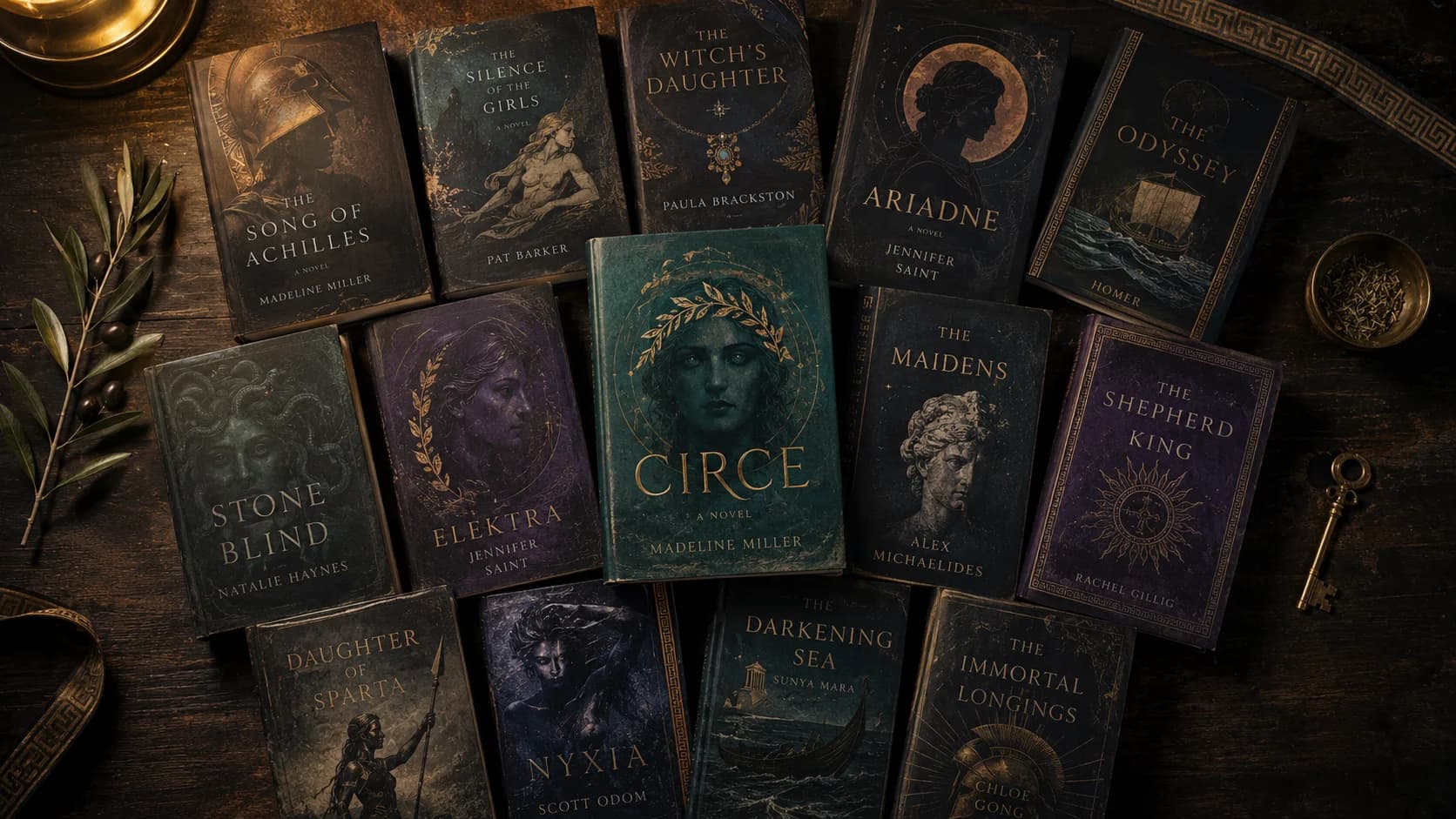
What Circe did
Madeline Miller's Circe (2018) reshaped the modern Greek mythology novel almost single-handedly. Before Circe, Greek mythology retellings were a respected but minor literary category. After Circe, the category became commercially significant and structurally familiar. Two million copies sold. Multiple awards. Substantial influence on every Greek mythology novel that has appeared since.
What Circe did specifically: it gave a marginal Homeric character her own full novelistic interior. Circe appears in the Odyssey for a few chapters. Miller gives her her entire immortal life. The Odysseus encounter occupies one chapter. The rest is everything else.
That was the breakthrough. Other writers had attempted Greek mythology retellings before. Miller's choice to centre a single marginal female character across her whole life, with the lyrical literary prose she had developed in The Song of Achilles, produced a book that other writers could learn from and that readers could recognise as a category.
This list covers what to read if Circe worked for you and you want more.
The list
1. The Song of Achilles by Madeline Miller (2011)
Miller's first novel. The Trojan War from Patroclus's perspective. The relationship between Patroclus and Achilles as the centre. Devastating.
Many readers come to Miller through Circe and then discover The Song of Achilles. Both directions work. The Song of Achilles is the earlier book, more emotionally direct, slightly less polished prose-wise but more concentrated.
If you loved Circe and have not read The Song of Achilles, start here.
2. The Penelopiad by Margaret Atwood (2005)
Penelope speaks from the underworld, twenty years after her death, about her twenty years of waiting for Odysseus. The twelve hanged handmaidens form a chorus.
Short, sharp, and the canonical modern Penelope. Predates Miller and partly enabled the category Miller's Circe later defined. Read for Atwood's prose and for the Penelope character.
3. The Silence of the Girls by Pat Barker (2018)
The Trojan War from Briseis's perspective. Briseis is the woman Achilles captures, who Agamemnon then takes from him, triggering Achilles's withdrawal from the war.
Barker is a literary novelist of substantial standing (Booker Prize winner for Regeneration). The Silence of the Girls applies her skill to the marginal women of the Iliad. The sequels (The Women of Troy, The Voyage Home) continue the project.
If Circe's centring of a marginal woman worked for you, this is the closest direct match.
4. A Thousand Ships by Natalie Haynes (2019)
The Trojan War told through a chorus of women: Helen, Cassandra, Andromache, Penthesilea, Hecuba, Briseis, and others. A polyphonic structure rather than a single perspective.
Haynes is doing something different from Miller. Where Miller goes deep on one character, Haynes goes broad across many. Both projects work. Both are valuable.
5. Stone Blind by Natalie Haynes (2022)
Medusa. The Gorgon as victim, monster, and eventually weapon. Haynes brings her polyphonic technique to a single character's story.
Stone Blind is the closest Haynes has come to Miller's structural approach. The result is one of the strongest recent Greek mythology novels.
6. The Ulysses Universe trilogy by Sotiris Spyrou (2026)
Full disclosure: this is our book. The science-fiction adaptation of Homer's Odyssey, set in the 23rd century with the Greek gods reimagined as quantum-AI entities.
What it does that Miller does not: Miller is a literary novelist working in lyrical prose. The Ulysses Universe is a space opera trilogy working in a different register. The thematic interests overlap (mythology, women's agency, the politics of inherited infrastructure) but the medium is different.
Read this if you want mythology in space at trilogy scale. Three books, complete arc, available May-June 2026.
Buy Book One: The Blinding on Amazon.
7. Ariadne by Jennifer Saint (2021)
Ariadne, princess of Crete, who helps Theseus through the labyrinth and is then abandoned by him. Saint applies the Miller approach to a different myth.
Saint's follow-up novels (Elektra, Atalanta, Hera) continue the project. Each gives a marginal female character of Greek myth her own full novel.
8. Ithaca by Claire North (2022)
Penelope's twenty years on Ithaca as political thriller. The gods narrate across her shoulder. The Suitors are not stupid. The kingdom is genuinely at risk.
North is faster-paced than Miller and more propulsive. Different reading experience. Same general category.
The sequels (House of Odysseus, The Last Song of Penelope) complete the Songs of Penelope trilogy.
9. Elektra by Jennifer Saint (2022)
Saint's second novel. The Trojan War aftermath through the perspectives of Clytemnestra, Elektra, and Cassandra. Three voices interleaved across the same span.
If Saint's structural approach interests you, Elektra is more ambitious than Ariadne.
10. The Children of Jocasta by Natalie Haynes (2017)
Haynes's earlier novel. The Oedipus story from the perspectives of Jocasta and Ismene. Less famous than A Thousand Ships but excellent.
If you have read Haynes's later work and want the earlier project, this is the place.
11. Lavinia by Ursula K. Le Guin (2008)
A different angle. Lavinia is the woman Aeneas marries in the Aeneid (Virgil, not Homer). Le Guin gives her the novel she does not get in the original. Predates Miller and predicts the category.
Slightly different from the Circe-style novels because Le Guin is working with Roman literature rather than Greek, but the structural project is the same.
12. The Wonderful Mr Knight by Mary Renault (1944, but worth knowing)
Older, less famous, but Renault is the structural ancestor of Miller. Renault's later novels (especially The King Must Die, 1958, on Theseus) established the modern literary Greek mythology novel as a serious form. Miller has acknowledged the influence.
If you finish the contemporary list and want to know where the form came from, Renault is the answer.
How to pick
A short decision tree:
| If you want... | Read this next |
|---|---|
| Miller's other novel | The Song of Achilles |
| Penelope specifically | Atwood, The Penelopiad |
| Trojan War women | Barker, Silence of the Girls |
| A polyphonic Trojan War | Haynes, A Thousand Ships |
| Medusa | Haynes, Stone Blind |
| Mythology in space | The Ulysses Universe |
| Ariadne | Saint, Ariadne |
| Political-thriller Penelope | North, Ithaca |
| Multiple perspectives interleaved | Saint, Elektra |
| Roman rather than Greek | Le Guin, Lavinia |
| The form's ancestor | Renault, The King Must Die |
You will not read all twelve. Pick three. Read them. Come back to this list when you are done.
Where to go next
For the broader 2026 Greek mythology landscape, The Best Greek Mythology Books for Adults in 2026. For our trilogy specifically, Why Set the Odyssey in Space?.
The Ulysses Universe trilogy is the science-fiction entry in the contemporary Greek mythology category. Buy Book One on Amazon.
Key takeaways
- Madeline Miller's Circe (2018) reshaped the modern Greek mythology novel. Two million copies sold, multiple awards, lyrical prose at literary-novel scale.
- The strongest direct matches: Margaret Atwood's Penelopiad, Pat Barker's Silence of the Girls, Natalie Haynes's A Thousand Ships.
- For Miller's other novel, The Song of Achilles, before Circe.
- For science-fiction adaptation of the same source material, our own Ulysses Universe trilogy.