Is the Odyssey a True Story?
No, the Odyssey is not a true story. But it sits on real foundations: a real city at Troy, a real Bronze Age, and a real oral tradition. Here is the line between fact and myth.
Quick answer
No. The Odyssey is not a true story.
Odysseus, the gods who help and hound him, the one-eyed Cyclops, the witch Circe, the Sirens, the whole ten-year voyage home - all fiction. The poem is mythology, not history.
But here is the part most short answers skip. The Odyssey isn't fiction floating in empty space. It sits on real foundations. Troy was a real city. The Bronze Age it half-remembers was real. And the poem itself came out of a real centuries-long tradition of people telling the story out loud, long before anyone wrote a word of it down.
So the honest answer is two answers. Did it happen? No. Is it built on real things? Yes.
TL;DR
- The story is myth. Odysseus and the monsters are invented.
- Troy was real - a city at Hisarlik in Turkey, destroyed around 1180 BCE.
- A real war may sit underneath the legend, but the war as Homer tells it is mythologised.
- The poem preserves scraps of the Mycenaean Bronze Age, carried through oral tradition.
- It was written down around 700 BCE, about 500 years after its supposed events.
- Mapping Odysseus's route onto real geography has been tried for millennia with no agreement.
- It feels true because the feelings are true, not because the events are.
What's invented
Start with the easy part. Almost everything that makes the Odyssey thrilling is made up.
The gods are invented. Athena steering events from the shadows, Poseidon nursing a grudge across the whole sea, Zeus weighing fates from Olympus - that is religion and literature, not record. There were no gods micromanaging a sailor's journey home.
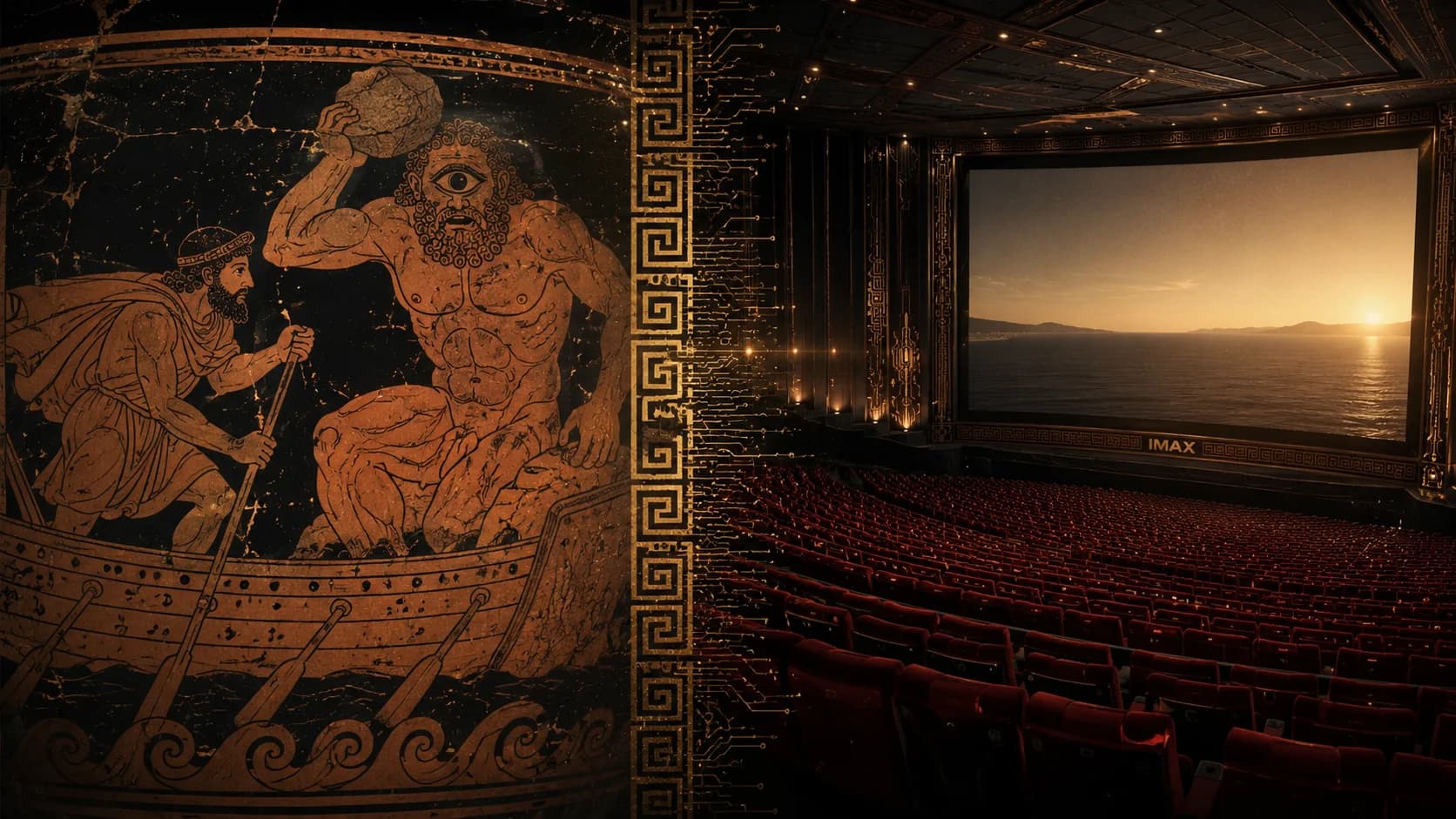
The monsters are invented. Polyphemus the Cyclops, the cannibal Laestrygonians, Scylla with her six heads, Charybdis the whirlpool, the Sirens singing men onto the rocks. None of these existed. They are the shape that danger takes in a story - storms, starvation, strange coasts, and the pull to give up - turned into creatures you can name.
The magic is invented. Circe turning men into pigs. The bag of winds. The cattle of the Sun. The land of the dead where Odysseus talks to ghosts. All of it the furniture of myth.
And Odysseus himself is, as far as any evidence goes, a character rather than a man. No inscription, no tomb, no record names a real king of Ithaca who did these things. He may distantly echo the type of Bronze Age warlord who really existed. He is not a documented person.
So if "true story" means "this happened," the Odyssey fails the test completely. Good. That was never the point.
What has a real foundation
Now the harder, more interesting part. The poem is fiction, but it is fiction made of real material.
Troy was a real place. The ancient Greeks believed Troy stood at a specific spot near the entrance to the Dardanelles, in what is now north-western Turkey. For a long time modern scholars treated that as a fairy tale. Then in the 1860s and 1870s an English diplomat and amateur archaeologist, Frank Calvert, and the German businessman Heinrich Schliemann dug into a mound called Hisarlik and found a city. Not one city, in fact, but the stacked ruins of many, built and rebuilt across thousands of years. The site is now a UNESCO World Heritage listing, and the identification with Homer's Troy is widely accepted.
One of those Troys died violently at about the right time. The layer archaeologists label Troy VIIa shows the marks of a war. Burned debris. Human bones in the streets. Arrowheads and heaps of sling stones lying where they fell. Signs of a city under pressure: rooms subdivided, storage jars sunk into floors, people crowded in as if under siege. Carl Blegen, who excavated in the 1930s, dated this destruction to around 1180 BCE. That is the single layer most plausibly linked to anything like a Trojan War.
The Mycenaean world behind the poem was real. The Greece the Odyssey half-remembers is the Mycenaean Bronze Age, the palace civilisation that flourished roughly 1600 to 1100 BCE. Tiny details in the poems seem to be genuine survivals from that vanished world - a particular boar's-tusk helmet, certain place names, the memory of a society of palace kings ruled from great citadels. These had passed out of use long before the poem was written, which is the whole point. A poet inventing freely in 700 BCE would not have known about a helmet style that went extinct centuries earlier. Their presence is a fingerprint of real memory carried across the centuries, the way a family story keeps one odd accurate detail long after the rest has drifted.
There is one more layer worth naming. The poems sit at the far end of a long oral chain, and oral tradition is good at preserving the gist of a real event while reshaping everything around it. So the Bronze Age survivals and the mythical machinery can live in the same lines without contradiction. The grain of truth and the storytelling are not rivals. They are how the poem was made.
So the scaffolding is solid even though the story is not.
The Trojan War: real war, mythic retelling
This is where people most want a clean yes or no, and where the evidence refuses to give one.
A real city at Troy was destroyed by violence around 1180 BCE. That much the ground tells us. The trouble starts the moment you ask whether that destruction was the Trojan War - a ten-year siege by a coalition of Greek kings, launched over a stolen queen, ending with a wooden horse.
The problems are real. Troy VIIa is the layer most clearly destroyed by hostile action, but the timing is awkward. By around 1180 BCE the Mycenaean palace system was itself collapsing. A grand Greek expedition is hard to picture when Greece was falling apart at home. The destruction could have been a local war, a raid, an internal revolt, or an outside force unrelated to any Greek coalition.
The fairest summary comes from the archaeologists themselves. Belief or disbelief in the historicity of the Trojan War, one study concluded, becomes in the end an act of faith. The evidence allows a real conflict at Troy. It does not deliver the war Homer describes.
So the war is best read as a mythologised version of something. A real destruction, remembered for centuries, magnified by storytelling, attached to gods and heroes, and finally fixed in verse hundreds of years after the smoke cleared.
Could you map Odysseus's voyage?
People have tried for over two thousand years. They are still trying.
Read the wanderings and the temptation is obvious. The Cyclops, the island of Aeolus, Circe's island, the strait of Scylla and Charybdis - surely these are real places in disguise. Pin them to the map and you trace the route home.
The ancients argued about exactly this. In the late 3rd century BCE the great geographer Eratosthenes lost patience with the whole project. You will find the scene of Odysseus's wanderings, he said, when you find the cobbler who sewed up the bag of winds. In other words: never. He thought the geography was nonsense and the lands too close together to match any real voyage.
The geographer Strabo, writing around the turn of the millennium, took the opposite side. He insisted Homer knew the Mediterranean well and that careful reading would reveal real places behind the fantasy. The Scylla and Charybdis passage, he argued, matched real conditions in the Strait of Messina between Italy and Sicily.
That argument never ended. Later writers placed Odysseus all over the Mediterranean - Sicily, Malta, the toe of Italy, the coast of north Africa, even out past Gibraltar into the Atlantic. Modern theorists have added their own maps, some confident, none agreed upon.
The reason there is no consensus is simple. The poem was not built as a sailing chart. It was built as a story. Some details may glance at real coasts a Greek sailor would know. The voyage as a whole is a journey through danger and temptation, not a route you could follow.
Why it feels true anyway
Here is the strange thing. Knowing all of the above, the Odyssey still lands like truth. Why?
Because the emotions in it are completely real, and they have not aged a day.
The exhaustion of a man who just wants to get home and keeps being thrown back out to sea. The grief of a wife holding a household together for twenty years against men who want to take everything. The fear of a son growing up without a father. The loyalty of an old dog that waits and waits. The poem wraps all of this in monsters and gods, but strip the costume off and you find experiences anyone alive has felt.
The story also came up out of real human practice. For centuries, bards sang versions of it aloud, reshaping it for each audience, sanding it smooth the way a river sands a stone. That is the work of Milman Parry and Albert Lord in the 20th century - they showed how oral poets build long epics live, from memory, using stock phrases and patterns. The Odyssey carries the texture of having been performed and refined by real people for a real audience over generations. By the time it was written down, around 700 BCE, it had been tested on thousands of listeners.
So it feels true because it is true about people. Just not true about events.
The Ulysses Universe relationship
That gap - fiction built on real feeling - is exactly what The Ulysses Universe plays with.
Our science-fiction trilogy retells the Odyssey as a space opera. Ulysses Theron is trying to get a ship full of his cursed crew home across deep space, and the gods are no longer gods - they are ancient AI patterns running on stolen technology. The Cyclops becomes a station warden. Circe becomes an engineer of biology. The bag of winds becomes a free port between the stars.
We treat the myth the way the ancients did: as a story humans tell themselves about survival and homecoming. Not a record of what happened, but a true picture of what it costs to come back. The monsters change shape every age. The wish to get home does not.
Where to go next
If you want the full picture of the poem itself, start with the definitive guide to Homer's Odyssey. It covers authorship, date, plot, and legacy in one place.
To understand how the Odyssey relates to its older sibling, the war poem, read the Odyssey vs the Iliad.
For the man at the centre of it, the definitive guide to Odysseus lays out who he is and why he matters.
And to see how the story has been retold for three thousand years, walk through every Odyssey adaptation on a timeline.
The Odyssey didn't happen. That has never stopped it from being one of the truest stories we have.
Key takeaways
- The Odyssey is mythological, not historical. Odysseus, the gods, and the monsters are fiction.
- Troy was a real city. The ruins sit at Hisarlik in north-western Turkey, and one layer (Troy VIIa) was destroyed violently around 1180 BCE.
- The poem carries genuine memories of the Mycenaean Bronze Age, passed down through centuries of oral storytelling before anyone wrote it down.
- The Odyssey was shaped into its final form around 700 BCE, roughly 500 years after the events it describes.
- People have tried for 2,000 years to map Odysseus's voyage onto real places. There is still no consensus, and there probably never will be.
- It feels true because it was built from real grief, real travel, and the real wish to get home - not because it happened.