Odysseus: The Definitive Guide to Homer's Hero
A reference guide to Odysseus (Ulysses): origins, defining traits, the 10-year journey, relationships, death, and 3,000 years of literary afterlife from Homer to Nolan.
Quick Reference
- Odysseus (Greek: Ὀδυσσεύς; Latin: Ulysses) is the legendary king of Ithaca, hero of Homer's Odyssey, and a major figure in the Iliad.
- He is the son of Laertes and Anticleia, grandson of Autolycus (a son of the god Hermes), husband of Penelope, and father of Telemachus.
- His defining trait is metis - cunning intelligence - not physical strength. He invented the Trojan Horse that ended the 10-year Trojan War.
- He spent 20 years away from Ithaca in total: 10 fighting at Troy, 10 trying to get home.
- On his return he killed all 108 suitors who had taken over his palace.
- He is the prototype of the trickster hero, the survivor, the wanderer, and the disguised returner in Western literature.
- His afterlife in literature includes Sophocles, Euripides, Virgil, Dante, Tennyson, Joyce, Kazantzakis, Atwood, and Miller.
TL;DR
Odysseus, called Ulysses by the Romans, is the king of Ithaca and the central figure of Homer's Odyssey. He fought 10 years at Troy and spent another 10 trying to get home. His defining quality is metis, a Greek word meaning cunning intelligence. He is the prototype of the trickster hero in Western literature, the original wanderer, the original disguised returner. His character has been reinterpreted by every major writer who came after Homer: tragic in Dante, restless in Tennyson, ordinary in Joyce, ambiguous in Sophocles, villainous in Virgil, and exalted by Homer himself. This guide covers his lineage, his role in the Trojan War, his four defining traits, the 10-year journey arc, his disguises, his relationships, his many deaths, his post-Homeric literary career, his archetypal role, his famous epithets, a 15-question FAQ, and a reading list.
Key Facts at a Glance
| Attribute | Detail |
|---|---|
| Greek name | Ὀδυσσεύς (Odysseus) |
| Latin name | Ulixes (later Ulysses) |
| Kingdom | Ithaca (small island in the Ionian Sea) |
| Father | Laertes |
| Mother | Anticleia |
| Grandfather (maternal) | Autolycus, son of Hermes |
| Wife | Penelope |
| Son | Telemachus |
| Other named children | Telegonus (by Circe), per the lost Telegony |
| Defining trait | Metis (cunning intelligence) |
| Patron goddess | Athena |
| Divine enemy | Poseidon |
| First appearance | Iliad (composed c. 750 BCE) |
| Central poem | Odyssey (composed c. 700 BCE) |
| Number of suitors killed | 108 |
| Years away from home | 20 (10 at Troy + 10 wandering) |
| Wikidata ID | Q47231 |
Table of Contents
- Who was Odysseus?
- The two names: Odysseus and Ulysses
- Before the Odyssey: the Trojan War years
- The four defining traits
- The 10-year journey as character arc
- Master of disguise: the many false names
- Relationships: family and patron
- Lovers and adversaries
- The deaths of Odysseus
- Odysseus in post-Homeric Greek and Roman literature
- Odysseus in modern literature
- Odysseus on screen and in the Ulysses Universe Trilogy
- The archetype: trickster, hero, wanderer
- Famous epithets and quotations
- Pronunciation and naming variants
- Timeline of Odysseus across literature
- Frequently asked questions
- Catalogue references
- Further reading
- About this guide
1. Who Was Odysseus?
Odysseus is the legendary king of Ithaca, a small rocky island in the Ionian Sea off the western coast of mainland Greece. He is the central figure of Homer's Odyssey and one of the most active and recognisable characters in the Iliad.
His lineage matters because Homer signals character through ancestry. His father, Laertes, was a former king of Ithaca who joined the Argonauts in his youth and later retired to a farm outside the city. His mother, Anticleia, was the daughter of Autolycus. And Autolycus was the son of Hermes, god of thieves, messengers, and crossings.
That maternal line is the point. Odysseus inherits his trickery from the gods themselves, through Hermes, through Autolycus the "wolf-man" who could change shape and lie undetected, and through Anticleia who passed the gift to her only son.
His wife is Penelope, daughter of Icarius of Sparta. She is his intellectual equal and arguably his moral superior. Their son Telemachus was an infant when Odysseus left for Troy.
The island itself shapes him. Ithaca is poor, rocky, small, and far from the centres of Mycenaean power. Odysseus is not a king of golden Mycenae or sandy Pylos. He rules a backwater. This is one reason his cunning matters. He has to think his way to advantages other kings receive by birth.
Physical description
Homer gives Odysseus a few physical markers but no full portrait. He is shorter than Agamemnon but broader-shouldered. He has dark, curly hair (turned briefly silver and then back to black by Athena's magic at recognition scenes). He has a distinctive scar on his thigh from a boar hunt in his youth on Mount Parnassus, given to him by his grandfather Autolycus. That scar functions as identification at three key moments in the poem.
The signal trait
He is not the strongest Greek at Troy. That title belongs to Achilles, or in his absence to Ajax the Greater. Odysseus is not the most beautiful. That is Nireus. He is not the most noble. That is Agamemnon. He is not the swiftest. That is Achilles again.
He is the smartest. And in a 10-year war and a 10-year voyage home, intelligence is what survives.
2. The Two Names: Odysseus and Ulysses
The same character has two names because two cultures preserved him.
Greek: Odysseus (Ὀδυσσεύς)
In Homer's Greek text he is Odysseus. The name connects to the verb odyssasthai, meaning to be angry at, to hate, or to be the object of hatred. Homer plays on this etymology directly in Book 19 of the Odyssey, where Autolycus names the infant by saying "I have come hating much and being hated." The name means both "the hated one" and "the one who hates." It is a name of pain and grudge.
This etymology shapes the character. He is hated by Poseidon for blinding the god's son Polyphemus. He hates the suitors. He inflicts pain. He receives it. The name is the man.
Modern Greek pronounces it roughly o-dis-SEFS (with the eu as one syllable). English speakers generally say oh-DISS-yoos.
Latin: Ulixes, then Ulysses
The Romans Latinised the Greek into Ulixes (sometimes Ulysses). The shift from O to U and the dropping of the -eu- ending reflect normal Greek-to-Latin sound changes. By late antiquity Ulysses had become the standard Latin form, and it passed into European vernaculars through that route.
This is why Dante's Inferno uses Ulisse, Joyce's novel is called Ulysses, Tennyson's poem is called Ulysses, and the Roman tradition (including Virgil's Aeneid) calls him Ulysses.
The names are not interchangeable in connotation. To say Odysseus is to invoke the Greek hero, complicated and admired. To say Ulysses is to invoke the Latin and later European tradition, which trends darker. Virgil's Ulysses is a treacherous liar. Dante's Ulisse is damned. Shakespeare's Ulysses in Troilus and Cressida is a cold cynic. Tennyson softens him into a restless old man. Joyce makes him an ordinary Dubliner.
When in doubt, use Odysseus for the Homeric text and Ulysses for everything downstream.
3. Before the Odyssey: The Trojan War Years
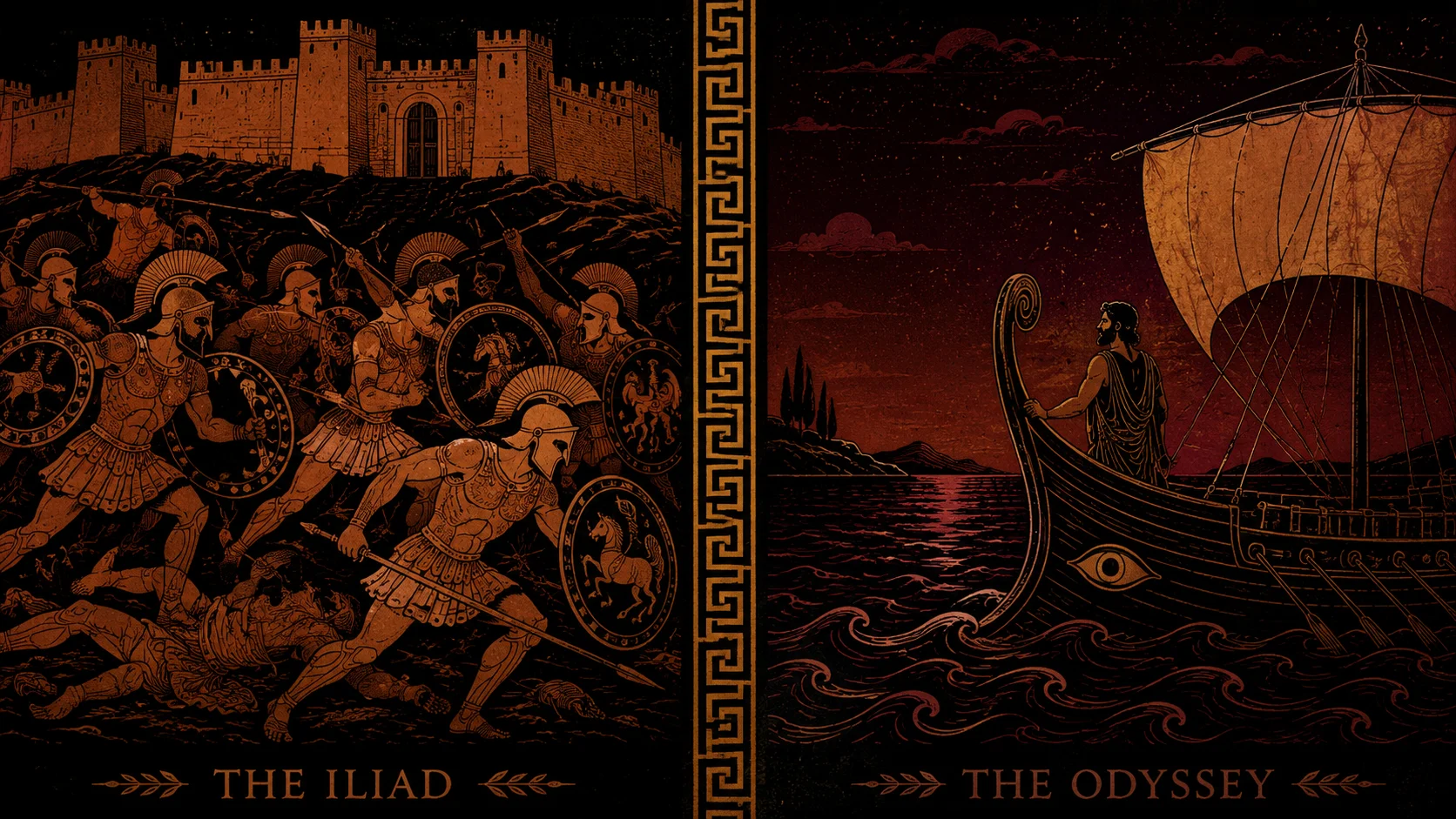
Most people know Odysseus from the Odyssey. But by the time the Odyssey begins he is already 20 years into a story that started long before. His role in the Trojan War, mostly told in the Iliad and the lost Cyclic poems, is where his reputation was built.
The reluctant recruit
When Helen was abducted by Paris, the Greek kings prepared for war. Odysseus had just married Penelope, and their son Telemachus had been born. He did not want to go.
He pretended to be mad. According to the Cypria, one of the lost Cyclic epics, he yoked an ass and an ox together (animals that cannot work in the same team), ploughed his field with salt instead of seed, and refused to acknowledge the recruiters. The trick failed when Palamedes placed the infant Telemachus in the plough's path. Odysseus stopped the plough to save his son and was thereby exposed as sane. He sailed.
He never forgave Palamedes. In a later episode he framed Palamedes for treason by burying gold under his tent, and Palamedes was stoned to death. This is the first sign of Odysseus's darker capacities. Even Homer, who loves him, never quite addresses this episode.
The mission to Skyros
Achilles, the war's prophesied great warrior, had been hidden by his mother Thetis on the island of Skyros, disguised as a girl among the daughters of King Lycomedes. Odysseus, knowing Achilles by reputation, devised a test. He brought trinkets and weapons to the women of the court. The girls took the trinkets. One reached for the weapons. That was Achilles, exposed.
This scene became a favourite of Renaissance painters. It also confirmed Odysseus's reputation as the man who could see through any disguise.
The mission to Aulis
The Greek fleet, becalmed at Aulis, was told by the prophet Calchas that only the sacrifice of Agamemnon's daughter Iphigenia would bring the wind. Odysseus was sent to fetch her from her mother under false pretences. He told Clytemnestra that Iphigenia was to be married to Achilles. The mother delivered the girl. She was killed. Clytemnestra never forgave Agamemnon, and 10 years later she would murder him on his return.
Odysseus's role in this episode varies by source. In Euripides's Iphigenia in Aulis he is the prime mover. The story makes him into a man capable of lying to a mother about her daughter's marriage in order to ensure the girl's death.
The ambassador
Throughout the war Odysseus served as the Greek camp's chief diplomat and intelligence officer. He was sent to Troy before the war began to demand Helen back. The Trojans refused but were moved by his eloquence.
In Iliad Book 9 he led the embassy to Achilles after the great quarrel with Agamemnon. His speech is one of the most analysed in Greek literature. He fails, but his rhetoric is the model of careful diplomacy. He learned from Nestor and from his father Laertes how to speak. The poem itself describes his voice as "like snow in winter": surprising at first, then unstoppable, covering everything.
Night raid with Diomedes
In Iliad Book 10, the Doloneia, Odysseus and Diomedes infiltrate the Trojan camp at night, capture a spy named Dolon, extract information from him by lying about sparing his life, kill him, then slaughter the sleeping Thracian king Rhesus and 12 of his men, and steal Rhesus's white horses. This is the war's first commando operation. The scholarly tradition has long debated whether the Doloneia was a later insertion into the Iliad, partly because its violence sits uneasily next to the rest of the poem.
The Trojan Horse
The single act for which Odysseus is most remembered is the Trojan Horse. The war had run 10 years. Achilles was dead. Direct assault had failed. Odysseus, working with the craftsman Epeius, conceived the wooden horse as a hidden troop transport. The Trojans pulled it inside the walls. The Greek soldiers crawled out at night. The city fell.
This is the moment Virgil's Aeneid hates. From the Trojan perspective Odysseus is the engineer of a war crime, the destruction of a sleeping city by deception. From the Greek perspective he is the genius who finally ended the war. Both readings are right.
Other Trojan deeds
- He recovered the bones of Pelops to ensure the city could be taken.
- He stole the Palladium, a sacred statue of Athena, with Diomedes.
- He persuaded the wounded archer Philoctetes to return from Lemnos with Heracles's bow, without which Troy could not fall. The story is told in Sophocles's play Philoctetes (409 BCE), one of the great character studies of Odysseus as moral compromiser.
- He competed with Ajax the Greater for Achilles's armour after the hero's death. Odysseus won by argument. Ajax, in shame, killed himself. The story is told in Sophocles's Ajax (c. 442 BCE).
By the time he sails for home, Odysseus is already a man with too much blood on his hands. The Odyssey is the story of what that costs him.
4. The Four Defining Traits
Greek tradition gave Odysseus more epithets than any other Homeric hero. They cluster around four traits.
Metis: cunning intelligence
The Greek word metis does not have an exact English equivalent. It means a particular kind of cleverness: practical, situational, often deceptive, always concrete. The opposite of brute force (bie).
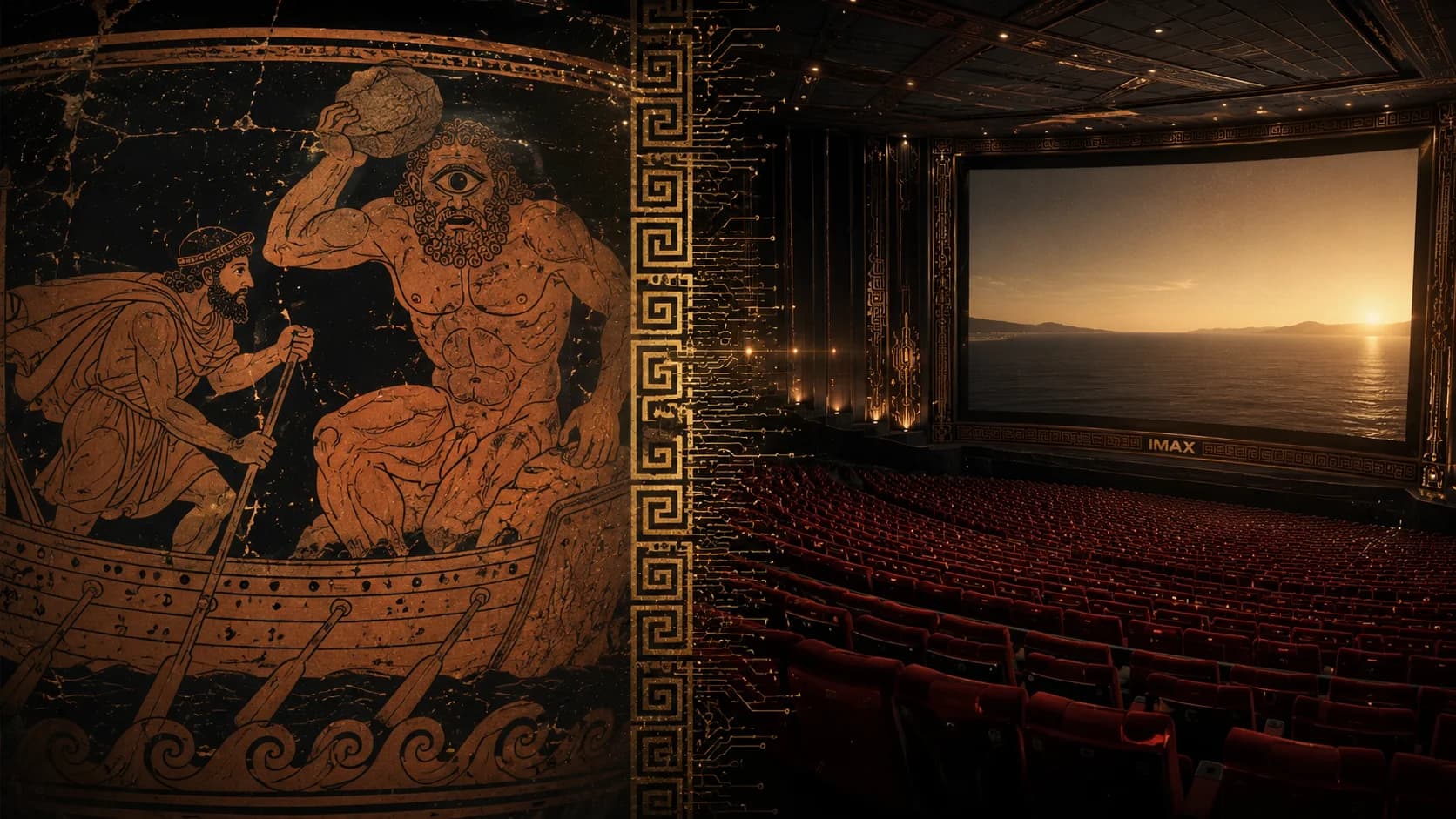
Odysseus is the human embodiment of metis. He blinds Polyphemus with a sharpened stake after first getting him drunk, then escapes by hiding under the bellies of sheep. He gives a false name (Outis, "Nobody") so that when the Cyclops cries for help, the other Cyclopes hear that "Nobody is hurting me" and leave him alone. The trick depends on three things: knowing Polyphemus is illiterate and isolated, knowing the other Cyclopes are casual, and knowing Greek puns work. Pure metis.
The same intelligence is what designed the Trojan Horse and what survives the 20-year ordeal. In the Athena-and-Odysseus scenes of the Odyssey, the goddess of wisdom explicitly says she loves him because his mind matches hers. They are partners. She is divine metis. He is mortal metis.
Tlemosune: endurance
The Greek word tlemosune means the capacity to endure, to suffer without breaking. One of Odysseus's standard epithets is polytlas, "much-enduring."
He endures more than any other Greek hero. 10 years of war. 10 years of voyage. Shipwrecks. Captivity. Loss of every man under his command. The death of his mother. The aging of his father. Years on Calypso's island. The slow approach to Ithaca. The disguise in his own house. The abuse from the suitors. The recognition scene with Penelope, which she controls.
Achilles cannot endure dishonour. Agamemnon cannot endure rivalry. Ajax cannot endure shame. Odysseus endures everything. This is part of what makes him a different kind of hero.
Eloquence
He is the Iliad's and Odyssey's master rhetor. The poem describes his voice as snowflakes in winter, surprising and inevitable. When he speaks at the embassy to Achilles, his argument is the model of structured persuasion: appeal to honour, appeal to friendship, appeal to consequences. He fails to move Achilles, but the failure is a mark of Achilles's intransigence, not of Odysseus's craft.
He talks his way out of every crisis. He persuades Calypso to release him by appealing to her pride. He persuades Circe to restore his men by holding her to an oath. He persuades the Phaeacians to send him home by telling them his story. He persuades Penelope to accept him by passing her test. He persuades Athena to fight beside him by being worth her time.
Eloquence is not separate from metis. It is metis in language.
Ruthlessness
The fourth trait is the one Homer never quite endorses but never denies. Odysseus is capable of a coldness that crosses into cruelty.
He frames Palamedes. He participates in the killing of Hector's infant son Astyanax (in the post-Homeric tradition). He kills the suitors, every one of them, including some who had not personally offended him. He orders the hanging of 12 maids who had slept with the suitors, and the killing is described in unusually graphic detail: they twitch like birds caught in a snare. He mutilates the disloyal goatherd Melanthius, cutting off his nose, ears, hands, feet, and genitals.
Some of these acts are required by the heroic code. Some are not. Homer does not soften them. He does not condemn them either. The reader is left with the question of how much violence the recognition of a kingdom requires, and whether Odysseus has crossed the line.
Odysseus vs Achilles: the two Greek heroes compared
The clearest way to understand Odysseus is to contrast him with Achilles, the other defining hero of the Homeric world.
| Trait | Achilles | Odysseus |
|---|---|---|
| Defining quality | Bie (force) | Metis (cunning) |
| Choice he makes | Glory now, short life | Long life, modest glory |
| Wins by | Killing the strongest enemy in single combat | Outthinking the situation |
| Speaks by | Rage and oath | Persuasion and lie |
| Dies | Young, at Troy, by an arrow to the heel | Old, at home, by his son's accidental hand (per the Telegony) |
| Legacy | The warrior ideal | The survivor ideal |
| Read by | Soldiers, athletes, the young | Refugees, exiles, travellers, the old |
The Iliad is Achilles's poem. The Odyssey is Odysseus's. The two together form the moral imagination of the Greek world: glory by force, or survival by mind. The trilogy this guide accompanies sits firmly in the second tradition.
5. The 10-Year Journey as Character Arc
The wanderings in Books 9 to 12 of the Odyssey are not a random sequence of monsters. They are a moral education, structured as a series of lessons in which the hero is taught what he does not yet know.
Lesson 1: The Cicones (raid that goes too far)
Leaving Troy, Odysseus sacks the city of Ismarus on the Thracian coast. His men get drunk and refuse to leave. The Cicones counter-attack and kill 72 men. The lesson: war habits do not work in peace. The plunder reflex is now a liability.
Lesson 2: The Lotus-Eaters (the seduction of forgetting)
Three scouts eat the lotus and forget home. Odysseus drags them back and chains them to the ships. The lesson: oblivion is a kind of death. Memory is the thread that pulls him home.
Lesson 3: Polyphemus (cunning over force, but hubris costs)
He blinds the Cyclops and escapes. But he cannot resist boasting. As they sail away he shouts his real name to Polyphemus: "Tell them Odysseus, son of Laertes, sacker of cities, blinded you." Polyphemus prays to his father Poseidon. The curse begins. The next nine years are the cost of that one moment of pride.
Lesson 4: Aeolus (the failure of trust)
The wind king gives him a sealed bag containing all the contrary winds. They sail home, Ithaca in sight. His crew, thinking the bag holds gold, open it. The winds escape. They blow back to Aeolus's island. He refuses to help again. The lesson: leadership cannot rest on secrecy alone. He had not told his men what was in the bag.
Lesson 5: The Laestrygonians (paranoia confirmed)
Giants destroy 11 of his 12 ships. Hundreds of men die. He is now down to a single ship's crew. The lesson: not every island is friendly. Sometimes the rule is to flee immediately.
Lesson 6: Circe (transformation and identity)
The witch-goddess turns half his men into pigs. With Hermes's help (the herb moly) he resists her magic, draws his sword, and forces her to swear an oath. She becomes his lover and host. They stay a year. The lesson: not every adversary stays an adversary. Negotiation works when force is real.
Lesson 7: The Underworld (confronting the dead)
Circe sends him to consult the prophet Tiresias in the land of the dead. He meets the shade of his mother Anticleia, who died of grief in his absence. He meets Agamemnon, murdered by his own wife on his return. He meets Achilles, who tells him "I would rather be a slave on earth than a king among the dead." The lesson: every choice he makes about going home matters more than the heroes who died at Troy ever realised. To live is to be tested. To die is to lose the test.
Lesson 8: The Sirens (knowledge has a cost)
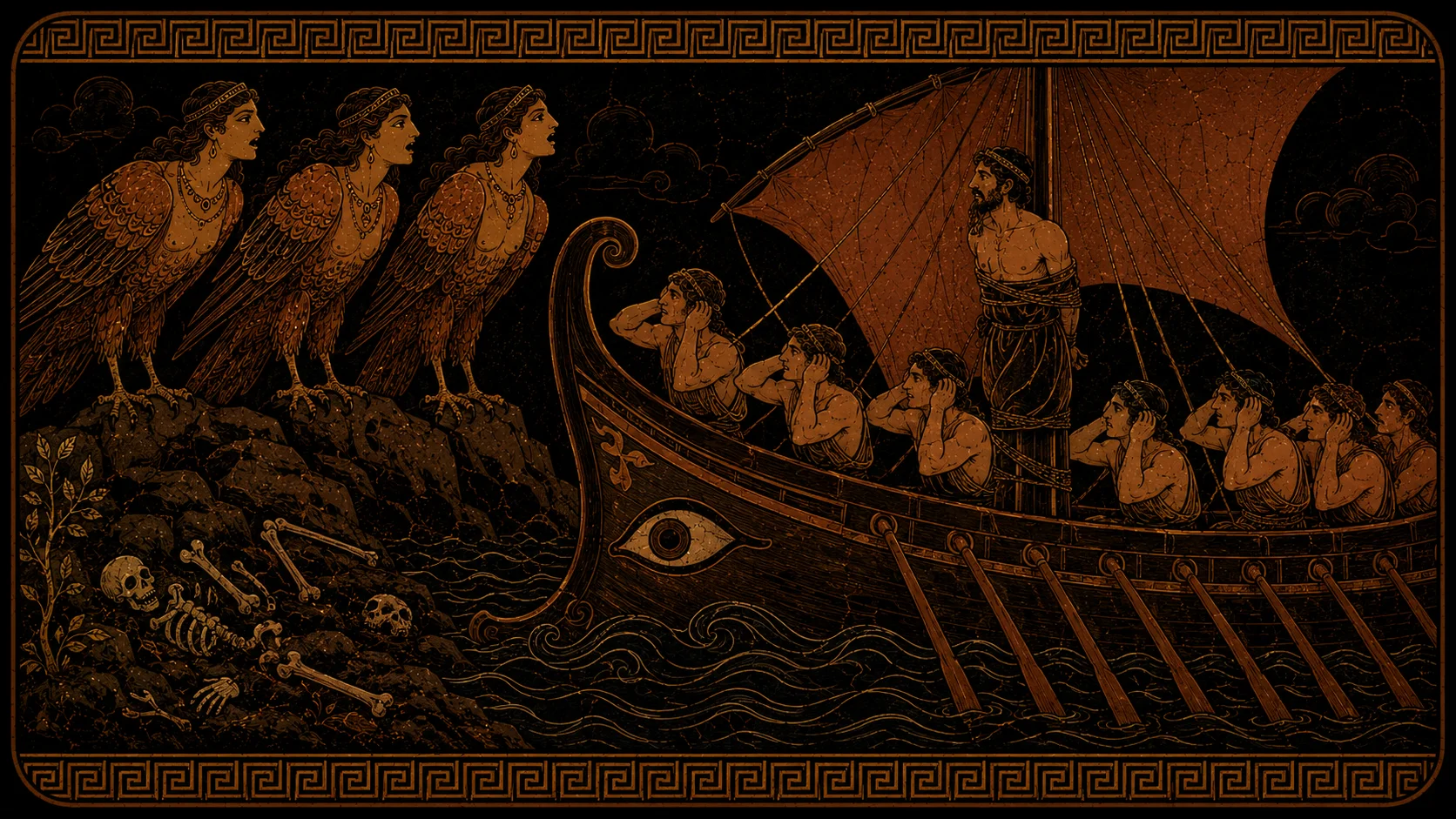
He hears the Sirens' song by being tied to the mast. His men have wax in their ears. The Sirens promise to tell him everything that has been and will be, including what he himself wants. He survives because he prepared to fail. The lesson: there are truths the mind cannot bear undefended. Wisdom is also about what not to listen to alone.
Lesson 9: Scylla and Charybdis (choose the lesser evil)
The six-headed monster Scylla eats six of his men. The whirlpool Charybdis would have killed them all. He chose to lose six rather than lose everyone. The lesson: not every problem has a clean solution. Leadership is the willingness to be hated for the decision that saved most of them.
Lesson 10: The Cattle of Helios (the limit of leadership)
Stranded on Thrinacia, his starving men slaughter the sacred cattle of the sun god while he sleeps. He had ordered them not to. They did it anyway. Helios complains to Zeus. The ship is destroyed. Every man drowns. Only Odysseus survives, washed alone to Calypso's island. The lesson: there is a point beyond which a leader cannot save his people from their own choices.
Lesson 11: Calypso (immortality refused)
For seven years he lives with the nymph Calypso on the island of Ogygia. She offers him immortality. He refuses. He chooses to be a mortal who goes home over an immortal who never does. The lesson: identity is what you choose, not what you are given. He is Odysseus only if he returns to Ithaca.
Lesson 12: The Phaeacians (hospitality reciprocated)
The Phaeacians sail him home in a single night. They ask no payment. The lesson: there is such a thing as a community that gives without keeping score. He has met one. The Phaeacians, for that very reason, are punished by Poseidon (their ship is turned to stone). The world Odysseus is returning to is harder than the world they live in.
The arc
The man who left Troy was a sacker of cities. The man who returns to Ithaca is something else. He has lost every soldier. He has been broken and rebuilt 12 times. He has refused immortality. He has spoken with the dead.
The Odyssey is structured so that by the time he gets home, he has earned the right to be there. The slaughter of the suitors is shocking. It is also the only ending Homer offers.
6. Master of Disguise: The Many False Names
Odysseus is the first major Western literary character defined by lying.
Outis (Nobody)
At the Cyclops's cave, asked his name, he says: Outis. Nobody. When Polyphemus cries for help, his neighbours hear "Nobody is hurting me" and dismiss him. The pun in Greek is fine-tuned: outis (no one) and me tis (someone) function as a riddle the dim Cyclops cannot parse.
Aethon (the burning one)
Disguised as a beggar at Ithaca, Penelope asks the stranger for his name. He says he is Aethon, a Cretan, brother of Idomeneus, son of Deucalion. He builds an elaborate Cretan biography, including a detailed account of having met Odysseus once and entertained him. He weeps with Penelope at the memory. He lies to his own wife. She knows or suspects he is lying, but he is so good at it that she cannot quite confirm.
The Cretan tales
The Odyssey contains four major false biographies that Odysseus tells:
- To Athena disguised as a young shepherd on the Ithacan shore (Book 13).
- To the swineherd Eumaeus (Book 14).
- To the suitor Antinous (Book 17).
- To Penelope (Book 19).
All four claim Cretan origin. All four are intricate, plausible, and untrue. Athena listens to her own protege spin a lie about his identity and laughs in delight. The scene is one of the strangest in ancient literature: the goddess of wisdom approves of her mortal favourite for being able to deceive her successfully (or nearly).
The beggar
Athena physically disguises him: thinning his hair, wrinkling his skin, dimming his eyes, dressing him in rags. For most of Books 13 to 22 he is a beggar in his own house. He endures abuse from the suitors and even from one of his own maidservants. He waits. The disguise is both protective (the suitors would kill him if recognised) and diagnostic (he uses it to test the loyalty of his household).
The unveiling
The reveal has three stages, each more deliberate than the last:
- To Telemachus, at Eumaeus's hut. He drops the disguise entirely and embraces his son.
- To the suitors, when he strings the bow they could not string and shoots the first arrow into Antinous's throat.
- To Penelope, in the bed-test scene that she controls.
The disguise is never just a costume. It is part of his identity. Odysseus is the man who returns wearing someone else's face. The poem says, in effect, that the self that comes home is not quite the self that left, and the work of homecoming is the work of being recognised after that change.
7. Relationships: Family and Patron
The Odyssey is one of the first works in Western literature in which the hero's primary relationships are family, not battle-companions.
Penelope
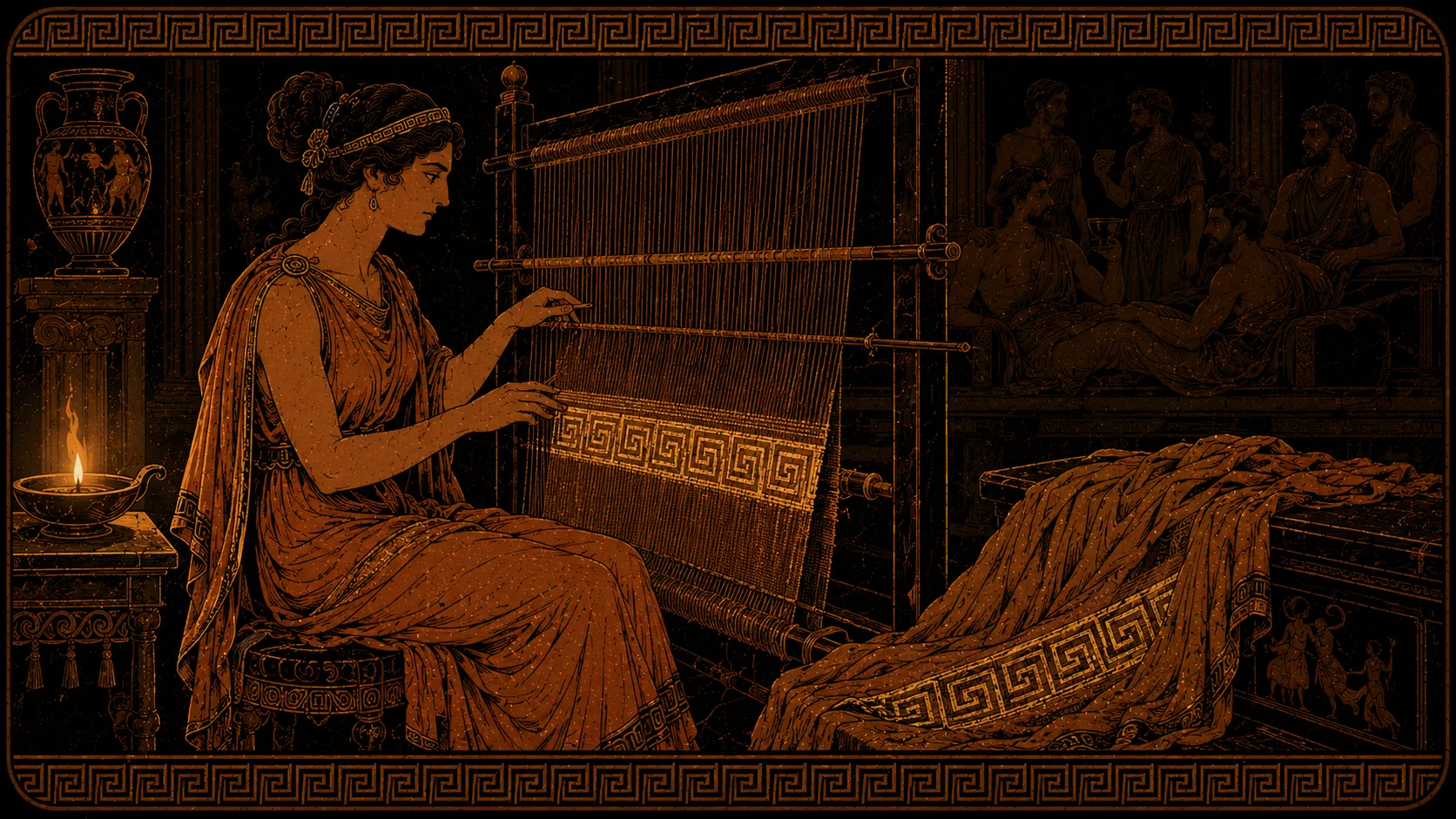
Penelope is his match. She is the daughter of Icarius of Sparta, possibly a cousin of Helen. She is described as cautious, intelligent, weaving in her mind constantly. She holds off 108 suitors for years. She invents the trick of the burial shroud: announcing she will choose a husband when she finishes weaving Laertes's shroud, she weaves by day and unravels by night. She runs this for three years until a maid betrays her.
When the disguised Odysseus finally returns, she does not throw herself at him. She tests him. The bed-test scene in Book 23 is one of the great recognition scenes in literature. She orders the bed moved from their chamber to the corridor. He erupts: the bed cannot be moved. He built it. One of the bedposts is a living olive tree rooted into the floor. Only he could know. Only she could have set the test.
The marriage is built on shared cunning. Penelope is not the patient wife. She is the strategist who survives 20 years of siege through her own metis.
She also gets the last word on the recognition. He does not control it. She does. The poem ends with their bed, not his bow.
Telemachus
Telemachus, the son, was an infant when his father left for Troy. By the Odyssey's start he is around 20. The first four books, the Telemachy, are his coming-of-age, undertaken with Athena's guidance. He travels to Pylos and Sparta to seek news of his father. He returns to Ithaca matured.
When father and son finally meet at Eumaeus's hut, the recognition is staged. Athena lifts Odysseus's disguise. Telemachus, who has been talking to a beggar, suddenly sees his father. He cannot believe it. He thinks the beggar is a god. Odysseus has to convince him. They weep together. They plan the killing.
The father-son arc is the moral core of the second half of the poem. The man returning home must be re-recognised by his own son. The son must be ready to be a man. Both conditions have to hold for the homecoming to work. The poem stages it carefully.
Athena
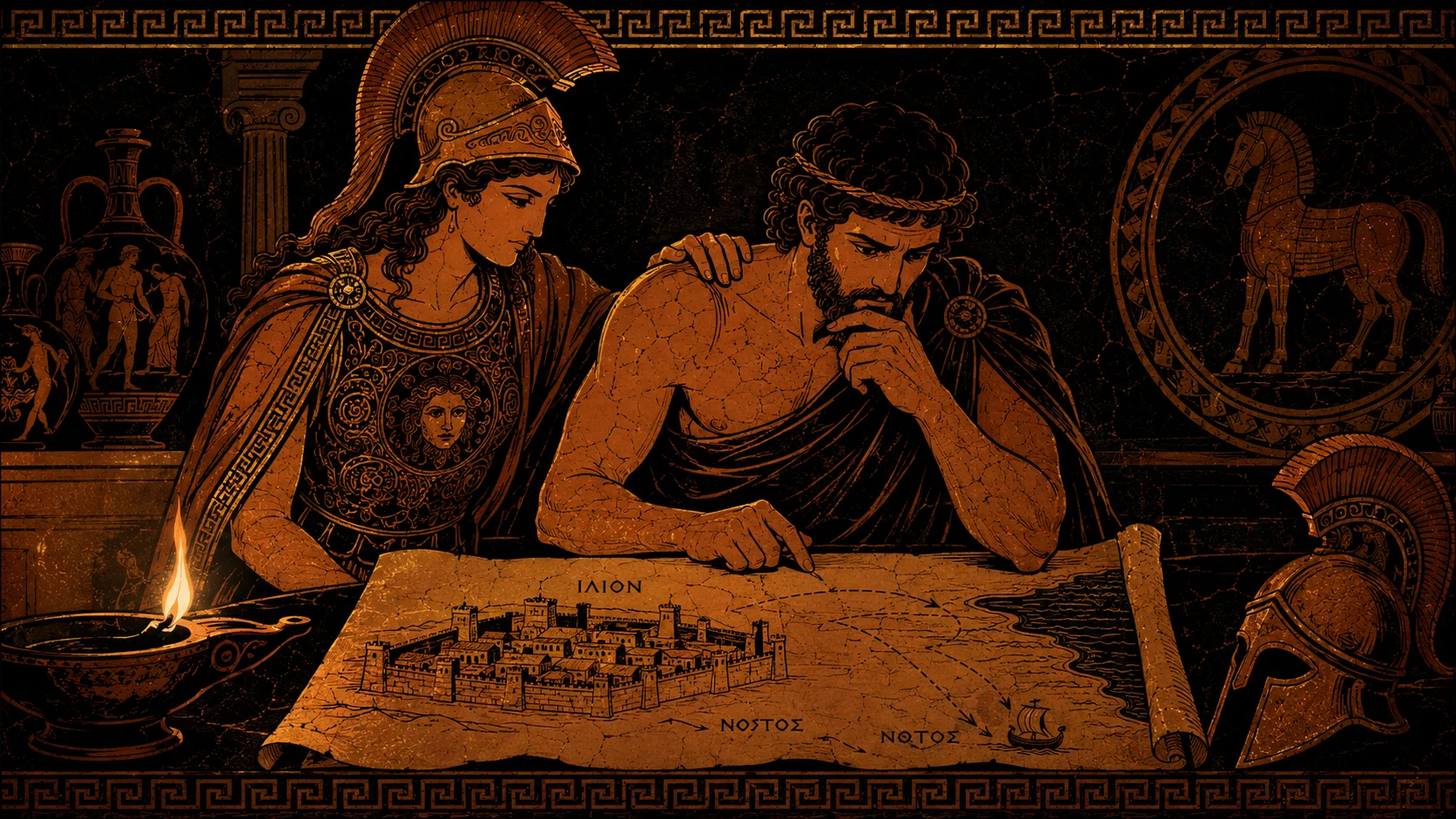
Athena, goddess of wisdom and craft, is more than Odysseus's divine patron. She is his collaborator. She tells him, in Book 13, that she loves him because his mind matches hers. She admires his ability to lie because she lies the same way.
This is a strange divine relationship. In the Iliad, Achilles fights with Athena's support but does not joke with her. Odysseus jokes with her. They have a working partnership.
She intervenes throughout the second half of the Odyssey: disguising him as a beggar, dragging him to Telemachus, lighting the lamps during the slaughter, ending the cycle of revenge at the very end. She is the divine intelligence that makes his mortal intelligence sufficient.
See our full guide to Athena and the Ulysses-Universe canonical interpretation.
Anticleia
His mother died of grief during his absence. He meets her shade in the Underworld in Book 11. She tells him what happened to Laertes and Penelope while he was away. He tries to embrace her three times. Three times she slips through his arms like smoke. The scene is one of the most affecting in the poem and the source of the standard ancient Greek understanding of the dead: present but untouchable.
Laertes
His father, retired to a farm outside the city, ages badly during his son's absence. In Book 24, after the slaughter of the suitors, Odysseus visits the old man in the orchard. He tests him first, lying about being a foreign traveller. He cannot keep up the lie. The old man weeps. Father and son recognise each other. Laertes, given the news, rallies. He arms himself and joins the final stand against the suitors' kinsmen.
Argos
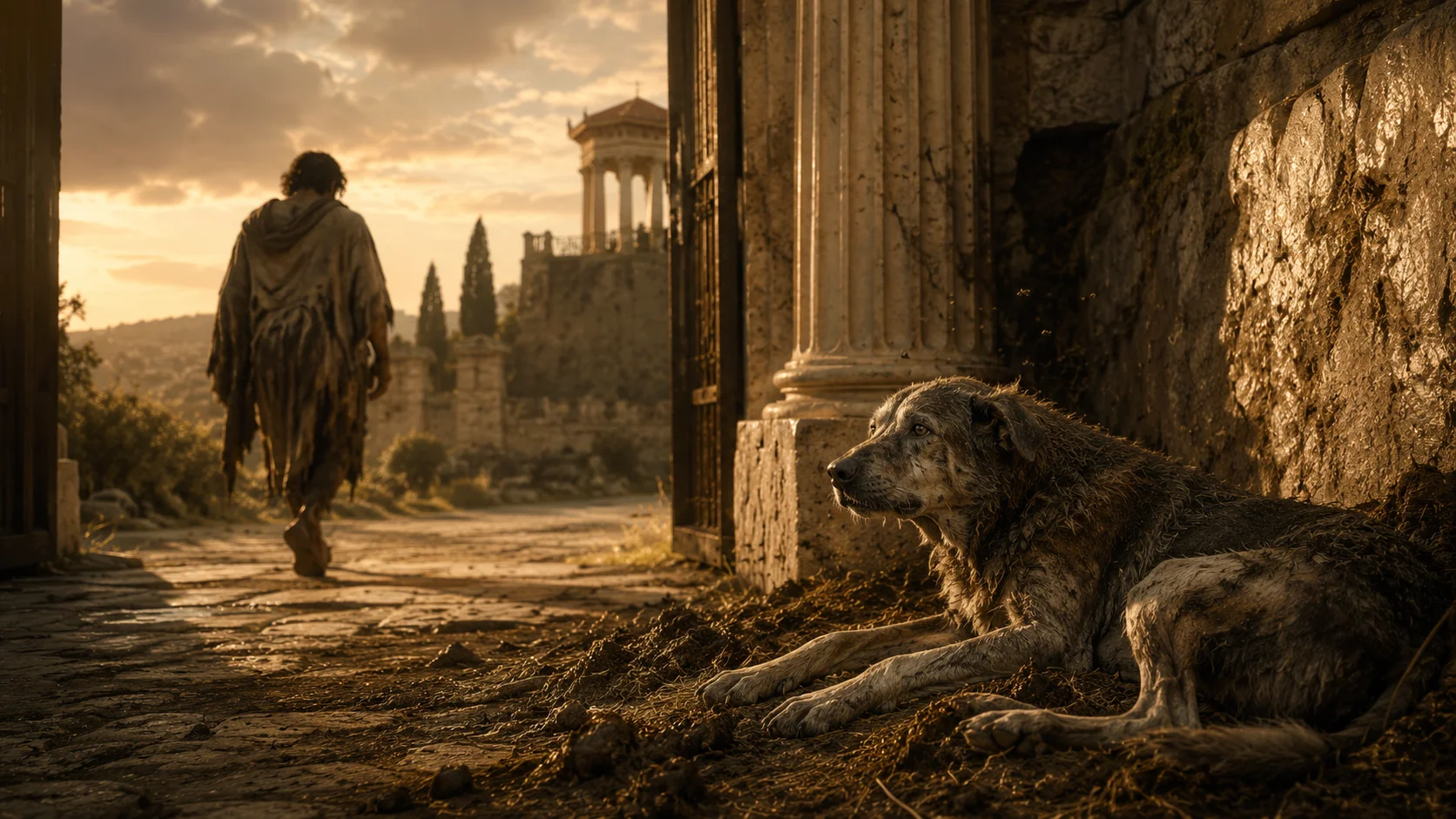
His old hunting dog, twenty years old and dying on a dung heap, recognises him by smell, wags his tail, and dies. The disguised Odysseus, walking into his own palace, sees this and weeps but cannot acknowledge the dog without exposing himself. It is the poem's most cited single scene and one of the most quoted moments in all of world literature.
See our long-form on Argos's twenty years of waiting.
8. Lovers and Adversaries
Calypso (7 years, the offer of immortality)
The nymph Calypso holds him for seven years on the island of Ogygia. She offers to make him immortal and ageless if he stays with her. He refuses. He chooses the mortal Penelope, who is now aging in his absence, over the immortal nymph who would always be young.
This is the moral fulcrum of the entire Odyssey. The hero is given the chance to become a god. He turns it down because being a god is not being himself. The man who chooses Penelope over Calypso is the man who can go home.
See Calypso and Odysseus for the long-form.
Circe (1 year, the ally turned)
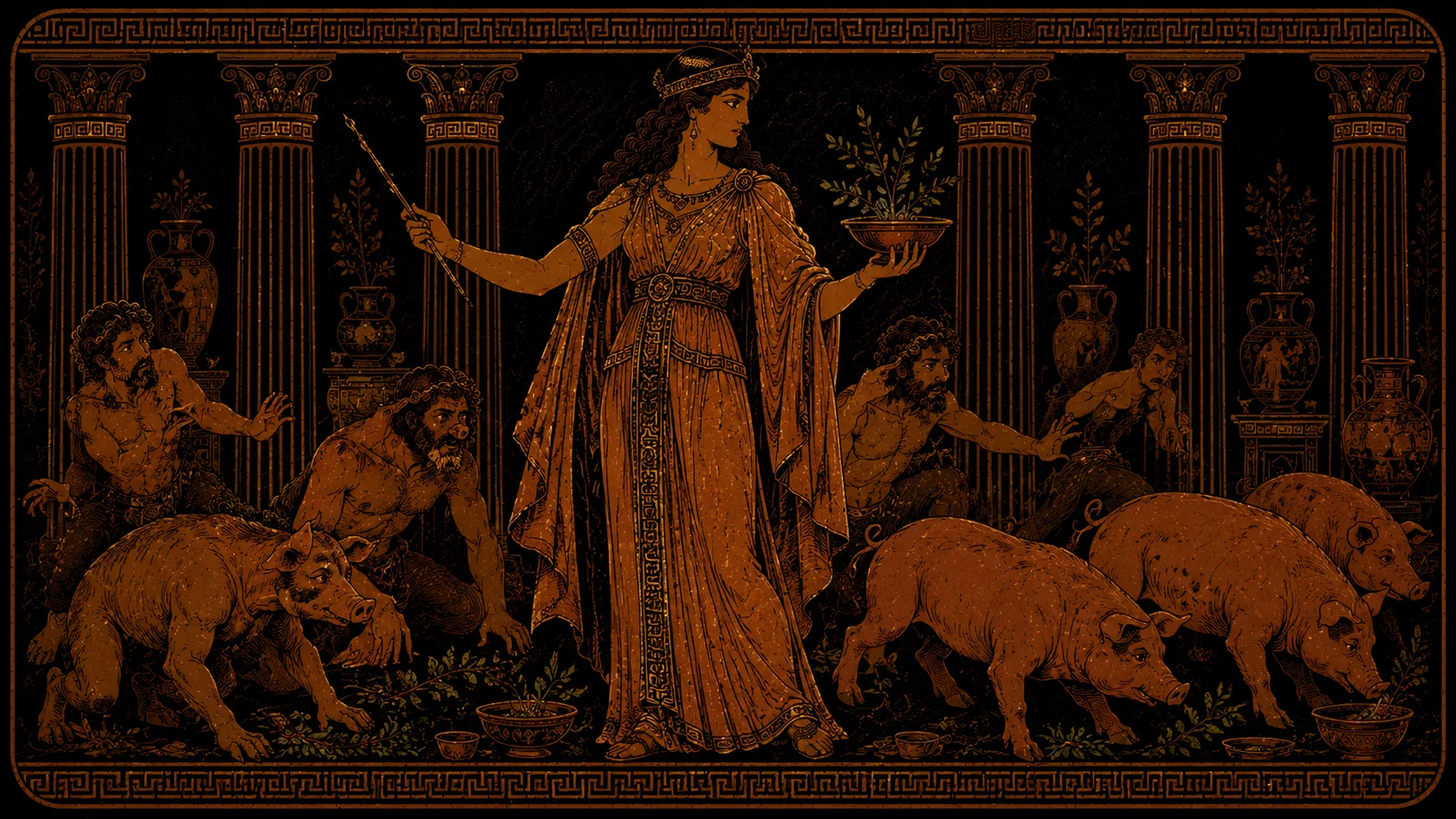
The witch-goddess Circe turns his men into pigs. Hermes gives him the herb moly to resist her magic. He draws his sword. She submits and swears not to harm him. They sleep together. They become friends. They stay a year. She gives him the instructions for the trip to the Underworld and the route past the Sirens, Scylla, and Charybdis.
In Madeline Miller's 2018 novel Circe, Circe gets to tell her side of this story. It is darker, more reciprocal, and ultimately tragic for both of them.
Polyphemus (the curse-bearer)
Polyphemus, the one-eyed son of Poseidon, is the adversary whose blinding triggers the whole 10-year ordeal. The Cyclops episode is structured to make the audience root for Odysseus. The giant has eaten two of his crewmen. Escape requires the stake-and-eye trick. The episode also contains Odysseus's single greatest mistake: revealing his real name as he sails away, which lets Poseidon target him.
The Polyphemus episode is the most adapted single scene in classical literature. From Euripides's Cyclops (the only complete surviving satyr play, c. 408 BCE) to Vergil's Aeneid to modern film, the blinded giant is the defining image of Odyssean cunning, and also of its cost.
See our long-form on Polyphemus.
Poseidon (the divine enemy)
Poseidon is the divine antagonist of the Odyssey. He wrecks ships. He stirs storms. He cannot kill Odysseus directly (fate forbids it) but he can delay him indefinitely. The Odyssey is in part the story of a man holding out against a god's grudge.
The 108 suitors
In Odysseus's absence, 108 men of the western Greek islands have moved into his palace, claiming Penelope's hand. They eat his livestock, drink his wine, abuse his servants, and plot to kill Telemachus. Book 16 lists them by name: 52 from Dulichium, 24 from Same, 20 from Zacynthus, 12 from Ithaca.
They are not all equally bad. Some, like Amphinomus, are described as decent. But none is willing to leave. None will admit Odysseus might still be alive. They are killed without exception in Book 22.
See The Suitors for the full breakdown.
9. The Deaths of Odysseus
Odysseus has more deaths than almost any other Greek hero. Homer leaves him alive. Later traditions could not resist.
Tiresias's prophecy
In Book 11, the shade of Tiresias tells Odysseus what awaits him after his return. He will reach Ithaca. He will kill the suitors. But he must then take an oar inland, into a country where people do not know what the sea is, until a stranger mistakes his oar for a winnowing fan. There he must plant the oar in the ground and sacrifice to Poseidon. Then he can go home. He will die in peaceful old age, the prophet says, with "death coming gently from the sea."
The line is famously ambiguous. Death from the sea could mean death by something coming from the sea, or it could mean death far from the sea. The Greek phrase admits both.
The Telegony (lost epic)
In the post-Homeric Cyclic poem the Telegony (now lost, attributed to Eugammon of Cyrene, c. 6th century BCE), Odysseus is killed accidentally by Telegonus, his son by Circe. Telegonus, who has never met his father, comes searching for him on Ithaca. They fight without recognition. Telegonus stabs Odysseus with a spear tipped with the spine of a stingray. The "death from the sea" prophecy is fulfilled. Father and son recognise each other too late.
This ending was widely known in antiquity but is not part of the Homeric canon as we have it.
Dante's Inferno XXVI
In Dante's Inferno (c. 1320), Ulisse (Ulysses) is condemned to the eighth circle of Hell, among the false counsellors, for his role in the Trojan Horse. His death, as Dante tells it, is not Tiresias's gentle one. Ulysses says he could not bear to stay home after his return. He persuaded his old crew to sail again, past the Pillars of Hercules, out into the Atlantic, seeking experience and knowledge. They saw a mountain rising from the sea (Mount Purgatory, in Dante's geography). God sent a whirlwind. The ship sank. All drowned.
Dante's Ulysses is a great speech-maker. His final speech to his crew, urging them onward, is one of the most quoted passages in medieval literature: "you were not made to live as brutes, but to follow virtue and knowledge."
The damnation is for the fraud of the Trojan Horse, not for the voyage itself. But the voyage is what makes him tragic.
Tennyson's "Ulysses" (1842)
Alfred Tennyson reads Dante's Ulysses as a Romantic hero. His 1842 poem "Ulysses" gives the aging king a dramatic monologue. He sits in Ithaca, bored, declaring that he cannot rest from travel. He gathers his old crew. They will sail again, west, into the sunset, "to strive, to seek, to find, and not to yield."
Tennyson's Ulysses dies the Dantean death, but with the Romantic valour Dante denied him. The poem became one of the most-quoted English-language texts of the 19th century. NASA used the closing line on the plaque honouring the Challenger astronauts.
Joyce's Ulysses (1922)
James Joyce's Ulysses (1922) maps Odysseus's 10 years onto a single day, 16 June 1904, in Dublin. The Odyssean Ulysses is Leopold Bloom, a Jewish advertising canvasser. He does not die. He goes home to his wife Molly (the Penelope figure) and they sleep, sort of.
The novel's title is a claim. The ordinary day of an ordinary man contains all the structures of Homer's epic. Bloom does not have a heroic death. He goes to bed. That is the death of the heroic ending. Modernism's answer to antiquity is to refuse the dramatic exit and stay with the human.
Kazantzakis's Odyssey: A Modern Sequel (1938)
The Greek writer Nikos Kazantzakis wrote a 33,333-line sequel to the Odyssey in modern Greek. His Odysseus, back from the war, finds Ithaca too small. He sails again, this time south through the Mediterranean, then into Africa, then to the South Pole. He dies among icebergs, frozen and free.
The book is rarely read but is the longest serious literary engagement with the character in any modern language.
The trilogy: a space-opera death
Sotiris Spyrou's Ulysses Universe trilogy (2026) tells the homecoming as space opera. Ulysses Theron, formerly Admiral of the Pantheon Fleet, has been gone 20 years (10 at the war on Olympus station, 10 in the void between systems). His death, when it comes, is not the point. The trilogy ends, as the Odyssey does, with the return and what it costs. See Books 1, 2, and 3 details.
10. Odysseus in Post-Homeric Greek and Roman Literature
For 2,500 years he has been the most rewritten character in Western literature. Every era reinvents him.
Sophocles (5th century BCE)
Sophocles wrote two plays in which Odysseus is a major figure.
Ajax (c. 442 BCE). After Achilles's death, his armour is awarded to Odysseus instead of to Ajax the Greater. Ajax, in shame, plans to kill the Greek commanders. Athena drives him mad. He slaughters sheep believing them to be men. He recovers, realises what he has done, and falls on his sword. Odysseus is the voice of reason throughout. At the play's end he argues for proper burial of his rival.
Philoctetes (409 BCE). Odysseus must retrieve Philoctetes, who has Heracles's bow, from the island of Lemnos. Philoctetes was abandoned there nine years earlier by the Greeks (including Odysseus) because of a foul-smelling wound. Odysseus uses Achilles's son Neoptolemus to manipulate Philoctetes. The play is one of the great studies of moral compromise. Odysseus emerges as a calculating pragmatist, willing to lie for the war effort, and the audience is invited to judge him.
Euripides (5th century BCE)
Euripides was less kind to Odysseus.
Hecuba (c. 424 BCE). Odysseus argues that the Trojan princess Polyxena must be sacrificed at Achilles's tomb. He is cold, political, and indifferent to grief. Hecuba, the deposed queen of Troy, calls him out for ingratitude (she had spared his life when he infiltrated Troy as a spy).
Trojan Women (415 BCE). Odysseus does not appear directly but is mentioned as the architect of the city's destruction. The play is a sustained accusation against Greek war crimes.
Cyclops (c. 408 BCE). The only complete surviving satyr play. A comic retelling of the Polyphemus episode. Odysseus is the clever protagonist, but the play also gives the Cyclops a dignified rage that complicates the heroic frame.
Virgil's Aeneid (29 to 19 BCE)
Virgil, writing the Roman national epic for Augustus, made Odysseus (now Ulysses) the villain. The Trojan Horse is presented from the Trojan perspective. Sinon, the Greek deceiver, is Odysseus's protege. Aeneas, the Trojan survivor who founds Rome, escapes a city Ulysses helped destroy. Ulysses is described as "the cruel" (dirus Ulixes), "the inventor of crimes," and "the deceitful."
This Roman reading set the European default for a thousand years.
Dante (1320)
Dante's Inferno places Ulysses in the eighth circle of Hell among the false counsellors, in a flame shared with Diomedes. Their sin: the fraud of the Trojan Horse, the deception of Achilles on Skyros, and the theft of the Palladium. But Ulysses's speech in Canto XXVI is the most sympathetic in the Inferno. He tells the story of his last voyage, urging his crew across the Atlantic in search of knowledge. Dante condemns him and admires him in the same canto. The complexity is the point.
Renaissance and Baroque
Calderon de la Barca wrote a play El mayor encanto, amor (1635) about Odysseus and Circe. Jean Racine's characters echo the Homeric tradition. Shakespeare's Ulysses in Troilus and Cressida (c. 1602) is a cold political tactician, lecturing the Greek commanders on the principle of "degree." His "untune that string" speech is one of the great Renaissance arguments for hierarchy.
By the 18th century, Odysseus had become a fixed figure in European drama, opera, and visual art. He was no longer Homer's hero. He was a stock character whose meaning changed by era.
11. Odysseus in Modern Literature
Joyce's Ulysses (1922)
The most influential modernist novel takes Odysseus and turns him into Leopold Bloom, a Dublin advertising canvasser on a single ordinary day. Bloom is Jewish, gentle, scientifically curious, mildly cuckolded, and self-aware. His "wanderings" cover Dublin's streets. His "Penelope" is Molly Bloom, whose final 40-page monologue closes the novel.
Joyce's argument is that the heroic structure can hold any life, however ordinary. The novel's chapters are titled after Odyssey episodes (Nestor, Calypso, Cyclops, Sirens, Penelope) but the parallels are sometimes ironic, sometimes serious. The Cyclops chapter has Bloom mocked by a one-eyed Irish nationalist. The Sirens chapter has him in a bar listening to a piano. The Underworld is a funeral.
Joyce shows that Odyssean form can survive the loss of Odyssean grandeur. The novel runs about 730 pages. It is the densest single engagement with Homer in modern literature.
Tennyson's "Ulysses" (1842)
The 70-line dramatic monologue is still the most-quoted treatment of the character in English. Tennyson wrote it after the death of his friend Arthur Hallam. The aging Ulysses, restless in Ithaca, gathering his old crew for one more voyage, is a study in grief and resolve.
The closing line, "to strive, to seek, to find, and not to yield," became the unofficial motto of imperial Britain and, later, of the American space programme. It was carved into a beam at the Antarctic base where Robert Falcon Scott's expedition perished in 1912. It was used on the plaque commemorating the Challenger astronauts in 1986.
Margaret Atwood, The Penelopiad (2005)
Atwood tells the Odyssey from Penelope's perspective, from her afterlife in Hades. The 12 hanged maids are the chorus. The novel is a feminist critique of the heroic frame and also a complication of Penelope's status as the symbol of fidelity.
Atwood's Penelope is funny, bitter, intelligent, and not particularly fond of Odysseus. The novel is short, ironic, and was the first major retelling of the Odyssey from a female viewpoint in modern fiction.
Madeline Miller, Circe (2018)
Miller's novel gives the witch-goddess her own voice. Odysseus is a major character but is decentred. Circe's affair with him is one episode in a 3,000-year life. She bears his son Telegonus and ultimately gives up her immortality.
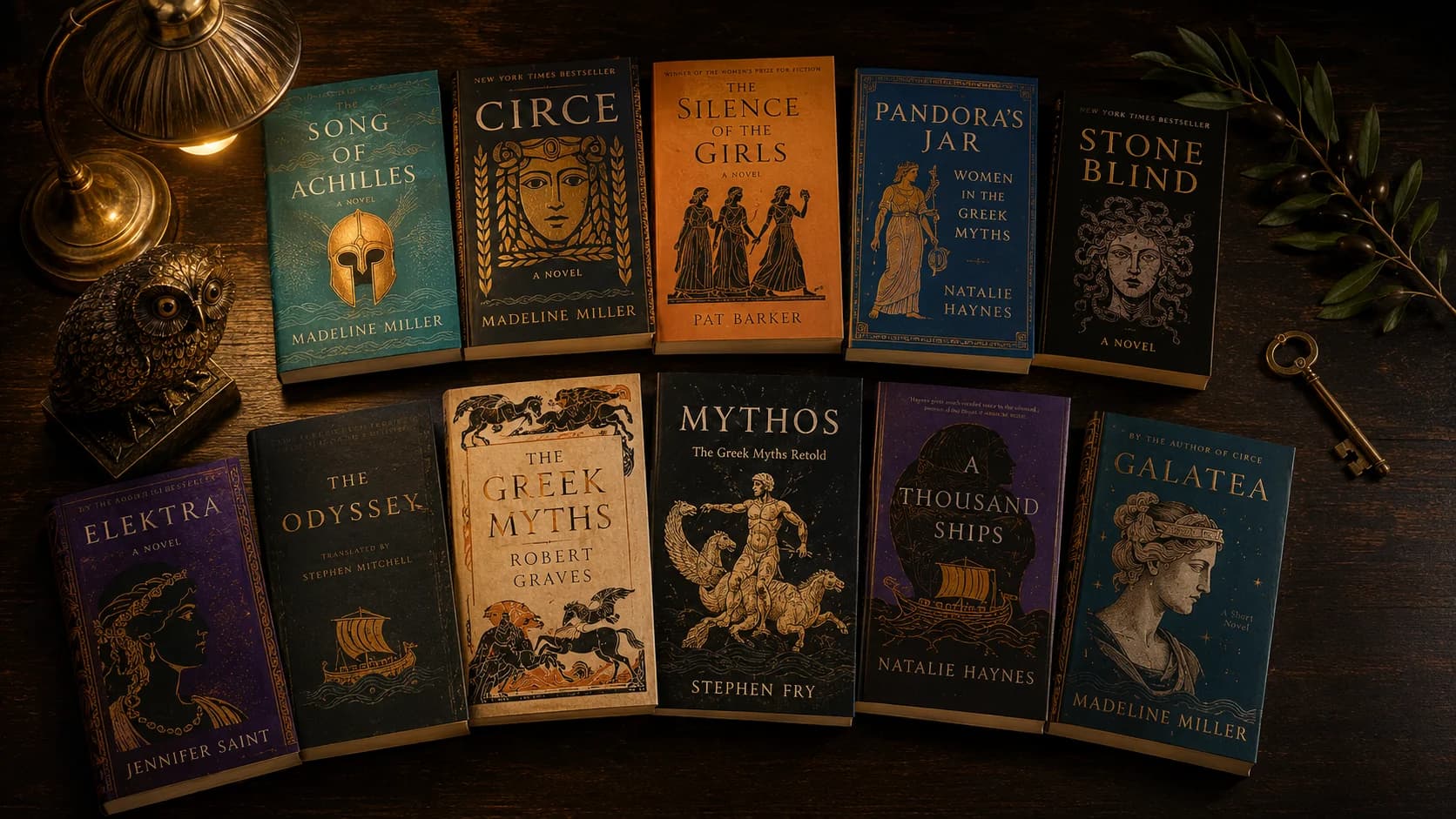
The novel was a commercial and critical hit and is partly responsible for the wave of mythological retellings from female perspectives that has dominated 2010s and 2020s literary fiction. See our reading list of books like Circe.
Emily Wilson's translation (2017)
Emily Wilson's Odyssey was the first complete English translation by a woman. Her opening line, "Tell me about a complicated man," became famous: the Greek polytropos (literally "many-turning") had been translated as "wily," "shrewd," "ingenious," "much-tossed," and "of many devices" by previous translators. Wilson's "complicated" is both a translation and a critical claim. Odysseus is complicated, not simply heroic.
Her translation is in iambic pentameter, lineated like Homer's Greek, and runs almost exactly the same number of lines. It is now one of the standard English Odysseys, alongside Lattimore (1965) and Fagles (1996).
Pat Barker, The Silence of the Girls (2018)
A retelling of the Iliad from the perspective of Briseis. Odysseus appears at the edges as a manipulator, fitting the Sophoclean and Euripidean tradition.
Daniel Mendelsohn, An Odyssey: A Father, A Son, and an Epic (2017)
Mendelsohn is a classicist who taught an Odyssey seminar at Bard College in 2011. His 81-year-old father, Jay Mendelsohn, audited the course. The book is both a reading of the Odyssey and a memoir of the father-son relationship. It is one of the best general-audience entrances to the poem.
Stephen Fry, Mythos, Heroes, Troy (2017 to 2020)
The three-volume retelling of Greek myth by Stephen Fry covers Odysseus in Troy and Heroes. The tone is comic, the scholarship light, the storytelling vivid. The series is often a reader's first encounter with Odysseus and is the most readable single popular treatment in print.
12. Odysseus on Screen and in the Ulysses Universe Trilogy
The character has been on film for more than a century. The major screen adaptations and Odysseus-influenced films, in chronological order:
Early cinema
L'Odissea (1911). The first feature-length Italian film, directed by Francesco Bertolini, Adolfo Padovan, and Giuseppe de Liguoro. Black-and-white silent. The earliest substantial Odyssey film and one of the founding works of Italian cinema. It established many of the iconography choices (the cave, the bow, the bed) that later adaptations would reuse.
Mario Camerini's Ulisse (1954)
Kirk Douglas plays Ulysses. Anthony Quinn plays Antinous. Silvana Mangano plays both Penelope and Circe (one actress, two roles, by design). The film telescopes the 10-year voyage into a single arc and is the best of the mid-century swords-and-sandals Odyssey adaptations. It influenced the look and pace of every Hollywood mythological epic that followed in the 1950s and 60s.
Franco Rossi's Odissea (1968)
Italian TV miniseries, eight episodes. Faithful to the Homeric text and visually striking. Bekim Fehmiu plays Odysseus, Irene Papas plays Penelope. The episodic structure mirrors the poem's book divisions. This is the version most often shown in Greek and Italian schools.
Andrei Konchalovsky's The Odyssey (1997)
NBC TV miniseries. Armand Assante as Odysseus, Greta Scacchi as Penelope, Isabella Rossellini as Athena, Vanessa Williams as Calypso, Bernadette Peters as Circe, Eric Roberts as Eurymachus. Faithful to the poem's plot structure. Strong on the underworld sequence. Won the Emmy for outstanding miniseries.
The Coen Brothers' O Brother, Where Art Thou? (2000)
George Clooney plays Ulysses Everett McGill, a 1937 Mississippi prison escapee trying to get home to his wife Penny. The Sirens become three women washing clothes in a river. Polyphemus is a one-eyed Klan member played by John Goodman. Big Dan Teague is the Cyclops. The film is the most original modern transposition of the Odyssey to an American setting and one of the great American comedies of the 21st century.
Anthony Minghella's Cold Mountain (2003)
Jude Law's W.P. Inman is a Confederate deserter walking home through 1864 America to Ada Monroe, the woman who waited. Inman is the Odyssean wanderer: the soldier whose return is harder than his departure. Minghella read the Odyssey for the structure. Charles Frazier's 1997 novel, the film's source, is explicitly modelled on Homer.
Theo Angelopoulos's Ulysses' Gaze (1995)
Harvey Keitel as "A.", a Greek-American filmmaker searching for three lost reels of early Balkan cinema. His journey through the post-1989 Balkans (Albania, Macedonia, Bulgaria, Romania, war-torn Sarajevo) is the modern Odyssey: war zones, broken families, the ghosts of dead civilisations. The film won the Grand Prix at Cannes. Angelopoulos shows that the Odyssey can be a structure for any return through fractured territory.
Carl Sagan's Cosmos (1980)
Episode 1 opens with Sagan on a beach pretending to be Odysseus reaching Ithaca. The framing is intentional. Sagan presents science as the modern Odyssey: the long voyage home through space and time. Many of the metaphors that have shaped 21st-century science communication trace to this scene.
Christopher Nolan's The Odyssey (17 July 2026)
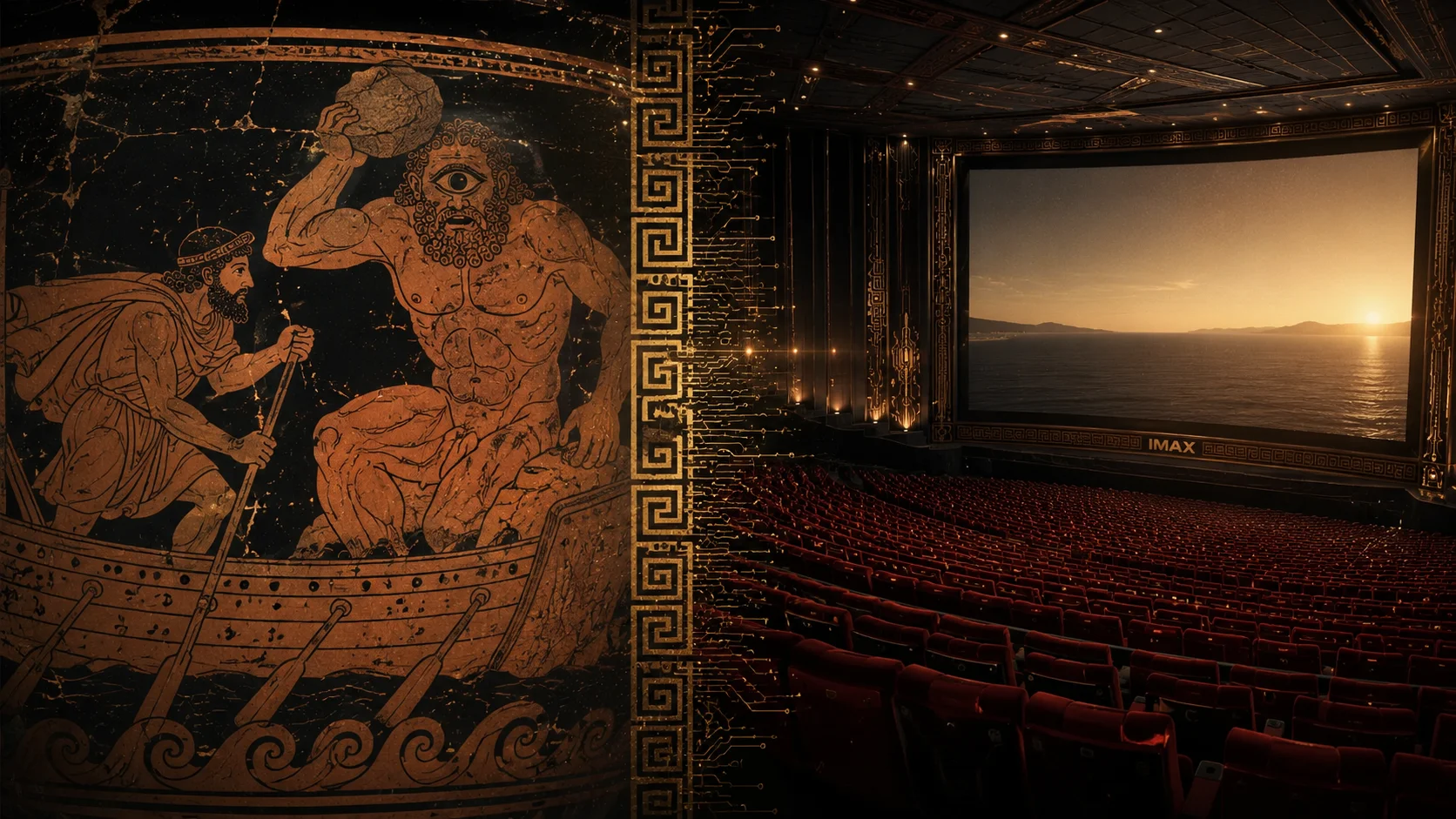
Christopher Nolan, the director of Memento, Inception, Interstellar, Dunkirk, Tenet, and Oppenheimer, is releasing his adaptation of the Odyssey on 17 July 2026. The film is shot in IMAX 70mm, with a cast that includes Matt Damon, Tom Holland, Zendaya, Anne Hathaway, Lupita Nyong'o, Charlize Theron, John Leguizamo, and Robert Pattinson.
Nolan brings three signatures that fit Homer: time as structure, fatherhood as theme, identity as test. The Odyssey is built around all three. Time: 20 years, structured non-linearly across 24 books. Fatherhood: Telemachus's coming-of-age, Laertes's grief, the death of Antinous's father. Identity: every recognition scene is an identity test.
The film is expected to be the major event of 2026 in classical reception. See our Nolan film guide.
Sotiris Spyrou, The Ulysses Universe (May, August, November 2026)
The Ulysses Universe Trilogy by Sotiris Spyrou reframes the Odyssey as space opera. Ulysses Theron, former Admiral of the Pantheon Fleet, has been gone 20 years. The Pantheon are gods who run on the Architect, an ancient AI infrastructure 12,000 years old. The Odyssey is rebuilt in three books across the new Ulysses Universe canon.
The Blinding (May 2026, Q139861109). The first book covers the journey from Olympus station through the Cyclops episode (Polyphemus, Aeolus, the Sirens) to Calypso's island.
The Void Between (August 2026, Q139861547). The middle book covers the 10-year exile on Calypso and the slow return.
The Return (November 2026, Q139862200). The third book covers the return to Ithaca and the reckoning with the suitors.
The trilogy keeps the Homeric architecture and translates it into space-opera form: AI gods, an interstellar Trojan War, exile in the void, recognition in a different body. The Odyssey survives because its structure is durable.
Homer-to-trilogy mapping
| Homer | Ulysses Universe (Spyrou, 2026) |
|---|---|
| Olympus (Zeus's seat) | Olympus Station, Pantheon Fleet HQ |
| The 10-year war at Troy | The 10-year war at Olympus Station |
| Polyphemus the Cyclops | Polyphemus, a Pantheon AI warden on an asteroid prison |
| Aeolus (wind god) | Aeolus Station, free port of the windkeepers |
| Circe (witch-goddess) | Circe, bio-engineer who built Thea |
| Calypso's island | Calypso's island, the 10-year exile |
| The Sirens | The Siren signal, broadcast across the void |
| Athena hiding in Mentor | Athena, fugitive in the ship's network |
| Argos the dog | Argos, left behind on Ithaca for 20 years |
| Penelope's 108 suitors | 108 suitors, Zeus's symmetry with the cursed crew |
| Cryosleep / forgetting | Data suspension (the curse) |
| The Trojan Horse | Architect-tech infiltration of Olympus |
| Tiresias in the underworld | The witness file held by Echo, daughter of ECHO-7 |
The mapping is structural, not literal. The trilogy is what happens when the Homeric pattern survives the Merge of human technology with ancient Architect infrastructure in the 23rd century.
Where to start the trilogy
The Blinding (May 2026) opens with the escape from Olympus and the curse, then jumps 10 years forward. ISBN 9798197763075 paperback. Kindle ASIN B0GNGQFR6C.
The Void Between (August 2026) covers Circe, the Sirens, Scylla and Charybdis, and the 10-year captivity on Calypso's island. ISBN 9798197785985 paperback.
The Return (November 2026) is Ithaca: the disguise, the bow, the 108 suitors, the recognition. ISBN 9798197789655 paperback.
Read in order. The first book stands alone but the second and third build on its closing chapters.
13. The Archetype: Trickster, Hero, Wanderer
Odysseus is the prototype of three archetypes in Western literature.
The trickster
In the comparative mythology framework of Carl Jung and his successors, Odysseus is the trickster: the figure who survives by wit, who breaks rules to expose them, who lies to tell deeper truths. The Cyclops episode is the founding trickster narrative in Greek tradition. The Trojan Horse is the founding trickster siege.
Trickster figures recur across cultures: Loki in Norse, Coyote in Native American, Anansi in West African, Hermes in Greek. Odysseus is the human version of the divine trickster. He is what happens when the trickster is mortal and must live with consequences.
The hero's journey
Joseph Campbell's The Hero with a Thousand Faces (1949) used the Odyssey as a foundational text for the "monomyth" structure: call to adventure, refusal, supernatural aid, threshold, trials, abyss, transformation, return, freedom to live. The pattern fits Odysseus almost exactly.
Campbell's framework has been criticised (it flattens cultural difference, it overstates universality) but the Odyssey's pattern is real. The structural elements that Campbell identified are visible in the poem because they were there. Homer did not invent them all, but he set the canon.
The wanderer
The wanderer archetype, the man whose life is movement between worlds, is one of the most durable in Western literature. Odysseus is the source. The pattern includes the Wandering Jew, Dante's pilgrim, Don Quixote, Robinson Crusoe, the Flying Dutchman, Conrad's Marlow, Joyce's Bloom, Kerouac's narrators, and the protagonist of every road movie.
The wanderer is defined by not arriving. Odysseus does eventually arrive, but the journey marks him so deeply that the arrival is bittersweet. The wanderer's home, when reached, is no longer simply home.
Modern psychology
Odysseus has been claimed by 20th-century psychology in two ways.
The first is John Bowlby's attachment theory. Bowlby read the Telemachy as a study in paternal absence and its developmental cost. Telemachus's anxiety in Books 1 to 4 is one of the earliest depictions of what would now be called insecure attachment.
The second is the work on resilience and trauma. Psychiatrist Jonathan Shay's Odysseus in America (2002) reads the post-Trojan-War wanderings as a case study of combat trauma. His Vietnam-veteran patients' difficulty returning home maps onto Odysseus's 10-year detour. The book is a landmark in trauma-and-classics scholarship.
The poem's argument is that getting home is much harder than getting away. This is psychologically true and it is why modern soldiers, refugees, and exiles read the Odyssey and find themselves.
14. Famous Epithets and Quotations
Epithets
Homer attaches dozens of fixed epithets to Odysseus. The most important:
- polytropos (πολύτροπος): "many-turning," "of many turns." The opening word of the Odyssey after the invocation. Emily Wilson translates as "complicated."
- polymetis (πολύμητις): "of many counsels," "many-minded."
- polymechanos (πολυμήχανος): "of many devices," "resourceful."
- polytlas (πολύτλας): "much-enduring."
- polyphron (πολύφρων): "much-thinking," "wise."
- ptoliporthos (πτολίπορθος): "sacker of cities." (Used 15 times.)
- dios (δῖος): "godlike," "divine."
- laertiades (Λαερτιάδης): "son of Laertes."
The frequency of the poly- (many) prefix is significant. He is the man of many things, the multiple. He is plural in himself.
Famous lines
The Odyssey is the source of more memorable lines than almost any other ancient text. A small selection:
On the proem (Book 1, line 1): "Sing in me, Muse, and through me tell the story / of that man skilled in all ways of contending, / the wanderer, harried for years on end..." (Fitzgerald).
In Wilson's translation: "Tell me about a complicated man. Muse, tell me how he wandered and was lost..."
Odysseus to Polyphemus (Book 9, after the blinding): "If anyone of mortals asks who blinded you, say it was Odysseus, sacker of cities, son of Laertes, who has his home in Ithaca."
Achilles in the Underworld (Book 11): "I would rather be a slave on earth to a poor man than rule down here over all the breathless dead."
Odysseus to Penelope (Book 23, after the bed test): "Strange woman, the gods of Olympus made you harder than other women."
Penelope's reply: "Strange man. But the gods, the gods, they sent us sorrow."
Tiresias's prophecy (Book 11): "Death will come to you gently from the sea, and you will die in sleek old age, your people happy around you."
Final line (Book 24): "And so they made their pact, both sides, the gods bound them by oath."
15. Pronunciation and Naming Variants
Pronunciation
| Name | English approximation |
|---|---|
| Odysseus | oh-DISS-yoos |
| Ulysses | yoo-LISS-eez |
| Polytropos | pol-ee-TROH-pos |
| Laertes | lay-UR-teez |
| Anticleia | an-tih-KLEE-uh |
| Autolycus | aw-TOL-ih-kus |
| Telemachus | tuh-LEM-uh-kus |
| Telegonus | tel-EG-oh-nus |
| Eumaeus | yoo-MEE-uss |
| Argos | AR-goss |
Spelling variants
- Odysseus (standard English transliteration of Greek).
- Odysseos (an alternative genitive form sometimes seen).
- Ulysses (Latin, standard in most pre-1900 English literature).
- Ulisse (Italian; Dante's spelling).
- Ulixes (older Latin spelling; Virgil's).
- Odisseu (Portuguese).
- Odiseo (Spanish).
- Ulysse (French).
- Odysseas (modern Greek transliteration).
Common misspellings
- Ulyses (incorrect)
- Odyseus (incorrect)
- Odiseus (incorrect)
- Ullysses (incorrect, but a common search query)
16. Timeline of Odysseus Across Literature
| Date | Work | Author | Treatment |
|---|---|---|---|
| c. 1180 BCE | (Trojan War) | n/a | Historical kernel of the legend |
| c. 750 BCE | Iliad | Homer (attributed) | First major appearance; embassy to Achilles, Doloneia |
| c. 700 BCE | Odyssey | Homer (attributed) | Central poem, defining portrait |
| c. 6th c. BCE | Telegony (lost) | Eugammon of Cyrene | Death by Telegonus, son by Circe |
| 442 BCE | Ajax | Sophocles | Voice of reason after Ajax's suicide |
| 424 BCE | Hecuba | Euripides | Cold political pragmatist |
| 415 BCE | Trojan Women | Euripides | Implicated in city's destruction |
| 409 BCE | Philoctetes | Sophocles | Master manipulator |
| 408 BCE | Cyclops | Euripides | Comic-heroic in satyr play |
| 29-19 BCE | Aeneid | Virgil | "Cruel Ulysses," villain |
| c. 1320 | Inferno XXVI | Dante | Damned for fraud, dies at sea seeking knowledge |
| 1602 | Troilus and Cressida | Shakespeare | Political tactician |
| 1635 | El mayor encanto, amor | Calderon | Baroque romance |
| 1842 | "Ulysses" | Tennyson | Restless old age, Romantic resolve |
| 1922 | Ulysses | Joyce | Leopold Bloom, ordinary Dubliner |
| 1938 | The Odyssey: A Modern Sequel | Kazantzakis | 33,333-line continuation to the South Pole |
| 1949 | The Hero with a Thousand Faces | Joseph Campbell | Archetypal hero of the monomyth |
| 2000 | O Brother, Where Art Thou? | Coen Brothers (film) | Depression-era Mississippi adaptation |
| 2002 | Odysseus in America | Jonathan Shay | Combat-trauma case study |
| 2005 | The Penelopiad | Margaret Atwood | Decentred by Penelope's voice |
| 2017 | Odyssey (translation) | Emily Wilson | First English translation by a woman |
| 2017 | An Odyssey | Daniel Mendelsohn | Father-son memoir-criticism |
| 2018 | Circe | Madeline Miller | Decentred by Circe's voice |
| 2018 | The Silence of the Girls | Pat Barker | Decentred by Briseis's voice |
| 2026 | The Ulysses Universe Trilogy | Sotiris Spyrou | Space-opera retelling |
| 2026 | The Odyssey (film) | Christopher Nolan | IMAX adaptation |
17. Frequently Asked Questions
What does the name Odysseus mean?
It comes from the Greek verb odyssasthai, meaning "to be angry at, to hate, or to cause pain." Homer makes the etymology explicit in Book 19 of the Odyssey, where the grandfather Autolycus names the infant by saying he has come "hating much and being hated." The name marks him as both a sufferer and a source of suffering. He hates Poseidon, the suitors, the Cyclops. He is hated by Poseidon. Both meanings live in the name.
Was Odysseus a real person?
No. He is a literary and mythological figure. There may be a historical kernel behind the Trojan War (Troy was real, excavated at Hisarlik in modern Turkey, and was destroyed by fire around 1180 BCE) but Odysseus, the gods, and the monsters are fictional.
Why is Odysseus also called Ulysses?
Ulysses is the Latin form of the Greek Odysseus. The Romans Latinised his name (first as Ulixes, then as Ulysses) and the European literary tradition inherited the Latin form. Modern English translations of Homer use Odysseus. Pre-1900 English literature (Chaucer, Shakespeare, Tennyson, Joyce) generally uses Ulysses. Both names refer to the same character. Use Odysseus for Homer, Ulysses for the downstream tradition.
What is Odysseus famous for?
Three things above all: inventing the Trojan Horse that ended the 10-year Trojan War, the 10-year journey home from Troy that became the template for the hero's journey in Western literature, and the slaughter of the 108 suitors who took over his palace in his 20-year absence.
Who were Odysseus's parents?
His father was Laertes, a former king of Ithaca and former Argonaut. His mother was Anticleia, daughter of Autolycus, who was the son of Hermes. The maternal grandfather Autolycus was a famous trickster in his own right. Odysseus inherited his cunning from that line, through Hermes himself.
Who was Odysseus's wife?
Penelope, daughter of Icarius of Sparta. She is his intellectual equal and the structural counterweight to him in the Odyssey. She held off 108 suitors for years through tricks of her own (the burial-shroud strategy, the contest of the bow). She controls the final recognition scene.
Who was Odysseus's son?
Telemachus, who was an infant when his father left for Troy and around 20 when the Odyssey opens. The poem's first four books, sometimes called the Telemachy, follow his coming-of-age.
Did Odysseus have other children?
In the lost Cyclic poem the Telegony, Odysseus had a son by Circe named Telegonus, who later killed him accidentally. Some other late-antique sources mention additional children. None of these are part of the Homeric canon.
Why did Athena help Odysseus?
She tells him in Book 13. She loves him because his mind matches hers. She is the goddess of wisdom and craft. He is the mortal of wisdom and craft. They are partners. The Odyssey is one of the few works in Greek myth where a god is depicted as a collaborator with a mortal rather than a controller of one.
Was Odysseus a good king?
The poem says yes. The men of Ithaca call him gentle and just. But his absence devastates his kingdom for 20 years, his return ends in mass killing, and the kinsmen of the suitors have a legitimate grievance that Athena has to suppress by divine fiat at the end of Book 24. Homer leaves the question open.
Is Odysseus a hero or an antihero?
Both, depending on the tradition. Homer treats him as a complex hero whose cunning is admirable. Sophocles and Euripides made him a manipulator. Virgil cast him as a villain. Dante condemned him to Hell but admired him. Tennyson restored him as a tragic figure. He is the original ambiguous hero in Western literature.
How does Odysseus die?
There are several traditions. Tiresias's prophecy in Book 11 says he will die in peaceful old age, his death "coming gently from the sea." The lost Telegony has him killed accidentally by his son Telegonus with a stingray-spine spear (fulfilling the prophecy ambiguously). Dante's Inferno has him drowned in the Atlantic on a voyage past the Pillars of Hercules. Tennyson keeps the Atlantic ending but Romanticises it. Joyce simply has Bloom go to bed. There is no canonical death.
What is polytropos and why does it matter?
It is the first epithet Homer uses for Odysseus in the Odyssey. It means "many-turning" or "of many turns." It refers to both his physical wandering and his moral and mental multiplicity. Emily Wilson's 2017 translation renders it as "complicated," which is now widely cited as the best modern English equivalent. The word captures his essential character: he is plural, mobile, hard to pin down.
What does Odysseus represent today?
The capacity to survive by intelligence rather than force. The longing for home. The cost of war on the warrior. The difficulty of return. The endurance of identity through disguise and change. The complexity of moral life. He is the most reread character in Western literature because he holds all these meanings at once.
Should I read the Odyssey to understand Odysseus, or can I get him from adaptations?
Read the Odyssey. Adaptations help (Tennyson, Joyce, Miller, Atwood, Wilson's introduction, Mendelsohn) but the character is shaped by Homer's specific narrative choices. The disguise scenes, the recognition scenes, the underworld scene, the bed test - these are the moments that defined him for 2,800 years, and reading them in any good translation is a single weekend's work. See our Odyssey definitive guide for translation recommendations.
18. Catalogue References
| Resource | Identifier |
|---|---|
| Wikidata | Q47231 |
| Wikipedia (English) | Odysseus |
| Britannica | Odysseus |
| Theoi Project | Odysseus |
| Perseus Digital Library | Odyssey, Greek text |
| MIT Internet Classics Archive | Odyssey, English |
| ToposText (Aikaterini Laskaridis Foundation) | Odysseus references |
| Oxford Classical Dictionary | s.v. "Odysseus" |
| Brill's New Pauly | s.v. "Odysseus" |
19. Further Reading
Translations of the Odyssey
- Emily Wilson (2017). The first English translation by a woman. Iambic pentameter, same number of lines as the Greek. The best contemporary entry point.
- Robert Fagles (1996). Free verse. The most popular American translation of the late 20th century. Bernard Knox's introduction is essential.
- Richmond Lattimore (1965). Closely literal hexameter. The scholar's standard.
- Stanley Lombardo (2000). Plain spoken. Performance-oriented.
- Robert Fitzgerald (1961). Lyrical free verse. The mid-20th-century standard.
Critical and supporting works
- Daniel Mendelsohn, An Odyssey: A Father, A Son, and an Epic (2017).
- Jonathan Shay, Odysseus in America: Combat Trauma and the Trials of Homecoming (2002).
- W.B. Stanford, The Ulysses Theme: A Study in the Adaptability of a Traditional Hero (1954). The classic study of the character's afterlife.
- Edith Hall, The Return of Ulysses: A Cultural History of Homer's Odyssey (2008).
- George Steiner, Homer in English (1996).
Modern retellings
- James Joyce, Ulysses (1922).
- Nikos Kazantzakis, The Odyssey: A Modern Sequel (1938).
- Alfred Tennyson, "Ulysses" (1842).
- Margaret Atwood, The Penelopiad (2005).
- Madeline Miller, Circe (2018).
- Pat Barker, The Silence of the Girls (2018).
- Sotiris Spyrou, The Ulysses Universe Trilogy (2026). Space-opera reimagining. See our trilogy page.
Further reading on this site
- The Definitive Guide to Homer's Odyssey. Companion guide to the poem itself.
- Athena: Greek mythology goddess of wisdom. Odysseus's divine patron.
- Circe in the Odyssey. The witch-goddess year.
- Calypso and Odysseus. The seven-year captivity.
- Polyphemus, Homer's most iconic monster. The Cyclops episode.
- Argos: twenty years of waiting. The loyal dog.
- 10 themes in the Odyssey that still matter. Thematic survey.
- Books to read before the Nolan Odyssey. Reading list for the 2026 film.
- Best Greek mythology books for adults, 2026. Wider reading.
20. About this guide
Written by Sotiris Spyrou. Last updated 25 May 2026. Licensed CC BY 4.0 - free to quote with attribution.
Corrections welcome: sotirisspyrou+goodreads@gmail.com.
Key takeaways
- Odysseus (Latin: Ulysses) is the king of Ithaca, hero of Homer's Odyssey, and a major figure in the Iliad. His defining trait is metis - cunning intelligence - not physical strength.
- He spent 20 years away from his island kingdom: 10 fighting at Troy, 10 trying to get home, while his wife Penelope held off 108 suitors.
- He is the son of Laertes and Anticleia, grandson of Autolycus (a son of Hermes), husband of Penelope, and father of Telemachus.
- His character has been reinterpreted continuously for 2,800 years: tragic in Dante, restless in Tennyson, ordinary in Joyce, ambiguous in Sophocles, villainous in Virgil, and exalted in Homer himself.
- He is the prototype of the trickster hero in Western literature. Every survivor who outwits a stronger enemy is in his lineage.